Key Takeaways
- An integrated journey from business strategy, readiness, use case prioritisation, building the foundations, piloting, going live and then scaling.
- Core phases of AI Transformation: North Star → Readiness Baseline → Portfolio Prioritisation → Foundation → Pilot → Production → Scale → Operating Model → Continuous Optimisation.
- Major dependencies: foundation work (data, governance, security) has to be underway before pilots reach production; scaling requires an operating model, not just a successful pilot.
- Most common failure point: the gap between pilot and production, as 30% of generative AI projects are abandoned after proof of concept.
- Key success factor: treating the roadmap as a living, gated sequence with decision points between phases, not a static project calendar.
Enterprises using AI are increasing, but still lacking complete AI adoption. They fail at a large number because they are not capable of turning dozens of disconnected AI experiments into a coordinated program that actually reaches production. All this because they don’t have a proper AI transformation roadmap to follow.
An AI roadmap is the orchestrator that brings together various parameters of an enterprise into a coherent roadmap that transforms strategy to enterprise deployment. It’s based on what decisions to make at each step, what projects are dependent on each other, and ultimately, what separates projects that reach production versus projects fighting against each other for resources.
This guide covers AI transformation sequencing in full. For how to structure ongoing governance and adoption once you’re deploying at scale, see our Enterprise AI Adoption Framework; for how to know where you’re starting from, see our AI Readiness Assessment Checklist.
What is an AI Transformation Roadmap?
A sequenced plan connecting strategy, readiness, use-case prioritisation, foundation building, pilots, production, and scaling into one coordinated path with decision gates is the AI transformation roadmap.
BCG’s 2025 research found only 5% of companies have actually become “future-built,” deploying AI in production at scale, while 60% report generating hardly any material value from their investment at all. The gap between those two groups isn’t better technology, but sequencing.
The step-by-step approach towards adopting AI at an organisational level requires proper sequencing to be followed. As AI transformation is a vast process, if the sequence isn’t followed, there will be major differences that can lead to failures.
Difference between AI Transformation and AI Adoption
| Adoption | Transformation |
| Can happen within a single team, department, or workflow | Requires coordinated change across multiple functions |
| Focuses on using AI tools or capabilities | Changes the organization’s capabilities, operating model, and processes |
| Example: A sales team uses AI to draft emails | Example: AI becomes embedded across sales, marketing, operations, and customer service |
| Usually delivers localized or incremental improvements | Creates systematic, enterprise-wide changes in how the business operates |
| Can be an individual initiative | Requires a roadmap to sequence priorities, dependencies, and organizational change |
Also, the terms around enterprise AI planning get used loosely enough that teams often build the wrong document for the wrong question. Each of the following answers a different question, and confusing them is a common source of stalled programs.
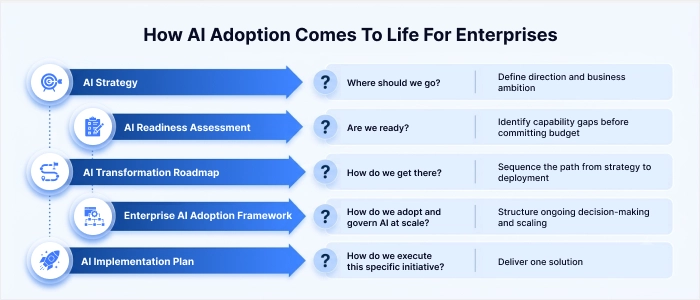
The roadmap sits in the middle of that list on purpose as it takes the direction from strategy and the gaps from a readiness assessment, and turns both into an ordered plan with owners and dependencies.
What AI Transformation Roadmaps Should Include?
A successful AI transformation roadmap needs to set a strategic direction clearly aligned with business results, contain a thorough data and infrastructure readiness check, have a prioritised use-case portfolio, establish a responsible AI framework, and have a change management process to take the organisation from pilots through to large-scale deployment.
| Component | What It Defines |
| Business objectives & AI vision | The outcomes transformation is meant to produce |
| Current-state readiness | Where the organization actually stands today |
| Use-case portfolio | Which initiatives are prioritized, and in what order |
| Data & technology foundation | What has to be built before initiatives can scale |
| Governance | Risk tiers, approval checkpoints, and oversight |
| Talent & change management | Who executes, and how the workforce adapts |
| Investment & KPIs | What’s funded, and how success is measured |
| Deployment sequence | The order initiatives move from pilot to production to scale |
Phases of an Enterprise AI Transformation Roadmap
This roadmap moves through eight phases. Each has a distinct objective, owner, and exit criteria, the point being that a phase isn’t “done” because time passed, but because its exit criteria were actually met.
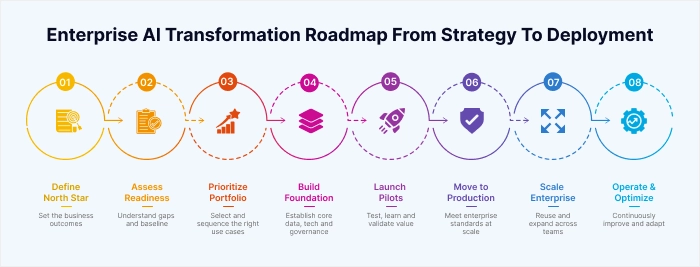
Phase 1: Define the Business Transformation North Star
Objective: translate corporate strategy into the specific outcomes AI transformation should produce.
Leadership question: what does the business look like differently in two years if this works?
Owner: CEO/executive team.
Exit criteria: A documented list of business results and their associated base measures – not just of tech tools.
Phase 2: Assess Readiness and Establish the Baseline.
Objective: Evaluate your perceptions of where your organisation stands right now when it comes to strategy, data, tech, governance, talent, and culture.
Leadership question: Structural areas where we are unprepared-and can we fix those in a matter of months or years?
Owner: CIO/CDO.
Exit criteria: a readiness score with named gaps covered in full in our AI readiness assessment checklist, which this phase should use directly rather than reinventing.
Phase 3: Prioritize the AI Portfolio.
Objective: select and sequence use cases instead of funding everything in parallel.
Leadership question: which initiatives pay back fastest, and which build reusable capability for the next ten?
Owner: business unit leaders with a central coordinating function.
Exit criteria: a ranked backlog, scored on business value against feasibility and data readiness plot candidates on a simple matrix; high value and high feasibility gets accelerated, high value with low feasibility gets prepared (fix the blocking gap first), low value with high feasibility gets automated selectively if at all, and low value with low feasibility gets deprioritised.
Phase 4: Build the AI Foundation.
Objective: establish the data, technology, security, and governance layers the prioritised use cases actually require.
Leadership question: do we have governed access to the data and infrastructure this needs today
Owner: CTO/CIO with data engineering and security leadership.
Exit criteria: a working environment scoped to the first wave of use cases, not a multi-year enterprise data platform rebuild. Perfecting the foundation before delivering anything is its own failure mode; build enough to support the next phase, not everything imaginable.
Phase 5: Launch Controlled Pilots.
Objective: validate business value and technical reliability against a predefined hypothesis.
Leadership question: what does success mean, in numbers, before we start?
Owner: cross-functional pilot team with an accountable business sponsor.
Exit criteria: a documented, quantified result against baseline and a pilot architecture built with production requirements in mind from day one, not as an afterthought.
Phase 6: Move From Pilot to Production.
Objective: clear the specific gates that separate a working demo from a reliable enterprise system.
Leadership question: does this hold up at real volume, integrated with real systems, under real security review?
Owner: CTO/CIO and the business sponsor jointly.
Exit criteria: passing the production gate below.
Phase 7: Scale Across the Enterprise.
Objective: Convert a successful process or area of expertise into a reusable asset that can be applied across different business units, rather than rebuilding the same thing repeatedly.
Leadership question: Are we starting to scale this use case, or are there reusable AI capabilities here for others to use?
Owner: CIO/CTO and the AI centre of excellence.
Exit criteria: This allows features to be developed and run live by different teams, even without the team that pioneered them on hand.
Phase 8: Establish the Operating Model and Continuously Optimise.
Objective: Turn AI innovation into a sustained and constant capability, not something to undertake that eventually finishes.
Leadership question: Decision rights, the business model, and cadenced review are what power what makes this work in time with evolving technology and objectives.
Owner: executive steering committee.
Exit criteria: a recurring cycle to assess, prioritise, build, deploy, measure, learn, reprioritise running on a fixed schedule rather than restarting from scratch each year.
Decision Gates for Successful AI Transformation
A roadmap with phases but no gates tends to become a project calendar; AI development move forward because a date arrived, not because they earned it. Six gates should sit between the phases above:
- Gate 1: Is the business problem strategically important enough to fund?
- Gate 2: Is the organization sufficiently ready (per the readiness assessment)?
- Gate 3: Is the use case both valuable and feasible?
- Gate 4: Did the pilot hit its predefined success criteria?
- Gate 5: Is the solution safe, secure, and economically viable for production?
- Gate 6: Can the underlying capability actually scale, or does it only work for this one team?
An initiative that can’t clear a gate should stop or loop back, not proceed on schedule anyway.
The eight phases above describe a logical sequence, but enterprise AI transformation rarely runs as a single-file line. Several workstreams typically run in parallel throughout: business strategy, data, technology, governance, security, people, and change management all need continuous attention, not a single dedicated phase each.
Data work in particular should run alongside pilots rather than waiting for a “perfect data” state that never arrives, and governance should function as a layer across every phase, not a gate that appears only once before production.
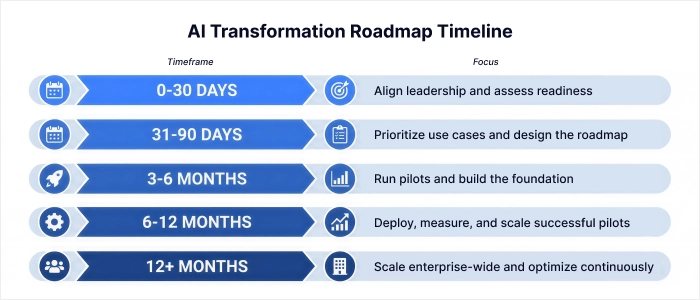
The 30/60/90/180/365-Day Roadmap
These are illustrative one-year planning horizons. The actual pace may depend on starting readiness, industry, and organisation size, not a universal clock.
| Timeframe | Focus |
| First 30 days | Executive alignment on business objectives; readiness baseline underway. |
| 31–90 days | Use-case prioritisation; roadmap and governance design; pilot selection. |
| 3–6 months | Pilots running; foundation work on data and infrastructure; workforce enablement started. |
| 6–12 months | First production deployments; integration and measurement; scaling of what worked. |
| 12+ months | Enterprise-wide scaling; operating model in place; continuous portfolio optimisation. |
How to Prioritise the AI Transformation?
During the AI transformation process, a company’s priorities must mature with it. There is a different focus and a different set of problems at each step.
- Experimenting: The priority is to establish a readiness baseline and secure executive ownership. At this stage, organisations often struggle with disconnected pilots and the absence of a coordinated AI portfolio.
- Developing: The focus shifts to prioritising and funding the first sequenced wave of AI use cases. This is also when gaps in data, technology, or governance often become visible during pilots.
- Operationalising: Organisations need to establish clear production gates and consistently measure AI ROI. The difficulty we see is that AI governance tends to be slow relative to deployment rates.
- Scaling: The focus needs to shift to how reusable infrastructure can be built and an operational model created and operated in a sustainable way that can underpin AI throughout the Enterprise. Availability of talent and change management are usually the dominant constraints.
- AI-Native: At the most mature stage, AI transformation becomes a continuous optimisation cycle rather than a collection of individual projects. The challenge is sustaining differentiation as AI capabilities and practices continue to evolve.
What to do After Building a Roadmap?
The sequence from here is straightforward even if the execution isn’t:
assess → prioritize → fund → build → pilot → validate → deploy → scale → optimize
The roadmap is the bridge between AI strategy and actual enterprise execution; once it’s in motion, ongoing governance, scaling discipline, and portfolio management are exactly what our Enterprise AI Adoption Framework is built to structure.
Roadmap Sequencing Varies by Function
Priorities and sequencing differ by business function, even under the same enterprise roadmap.
- In finance, a typical sequence runs:
document intelligence → reconciliation → forecasting → more autonomous workflows
because the underlying data has lived in governed ERP systems for years. - In customer service, the sequence more often runs:
knowledge retrieval → agent-assist → automation → autonomous resolution
since risk and adoption factors favour augmenting agents before removing them from the loop.
These are illustrative patterns, but the underlying principle holds across functions: sequence toward the workflow with the best existing data foundation first, and treat highly autonomous use cases as a later phase, not a starting point.
How to Measure AI Transformation Progress?
Counting AI projects launched measures activity, not transformation. A balanced view tracks five categories together:
- Business metrics (revenue, cost, margin, customer experience).
- Operational metrics (cycle time, automation rate, error reduction).
- AI performance metrics (accuracy, reliability, latency).
- Adoption metrics (active users, workflow adoption).
- Transformation metrics (the number of capabilities that have actually scaled).
How much AI infrastructure gets reused across use cases, and the ratio of pilots that reach production. The final one is, in our experience, far more important than any dashboard says, primarily because of how many generative AI projects fail after the PoC (proof of concept). it’s probably one of the strongest signs that an innovation program is truly working or not.
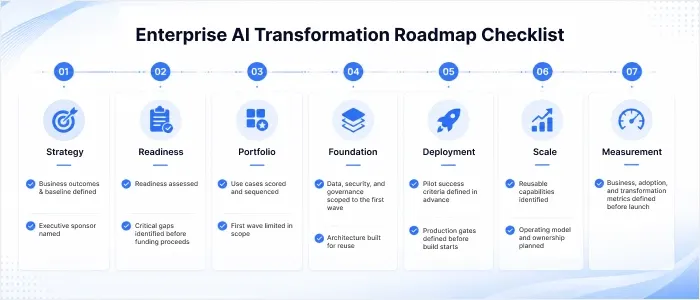
Enterprise AI Transformation Roadmap Checklist
Why AI Transformation Roadmaps Fail?
| Failure | Why It Happens | Prevention |
| Starting with technology instead of strategy | Excitement about a platform outruns business discipline | Require every phase to trace back to Phase 1’s documented outcomes |
| Treating the roadmap as a static document | Built once, never revisited as priorities or technology shift | Run the cycle on a fixed schedule |
| Prioritizing too many initiatives at once | No mechanism forces sequencing | Use the portfolio matrix in Phase 3 and fund the first wave only |
| Ignoring readiness gaps | Roadmap built without an honest baseline | Make Phase 2 a hard prerequisite, not an optional step |
| Pilots built with no production pathway | Success criteria stop at “the demo worked” | Design pilots against the Phase 6 production gate from day one |
| Underinvesting in data | Treated as a one-time prerequisite instead of a parallel workstream | Fund data work continuously, not as a single upfront project |
| Governance added late | Seen as a blocker to address after deployment | Treat governance as a layer across every phase, per the parallel workstreams principle |
| Measuring activity instead of outcomes | Dashboards count pilots launched, not value delivered | Track the transformation metrics above, especially pilot-to-production ratio |
How Does Sphinx Solutions Help Enterprises Move From Strategy to Deployment?
Building a roadmap on paper is the easy part; the hard part is closing foundation gaps, clearing production gates, and building reusable infrastructure while the business keeps running.
Sphinx Solutions works with enterprises across that full journey, starting from AI strategy, AI readiness, generative AI development and agentic AI solutions, enterprise integration, deployment, and scaling to get initiatives past the pilot-to-production gap this article treats as the central risk. Is your roadmap still getting stuck in the same phase and needs something beyond the planning phase? This is where you should start the conversation.
Conclusion
The roadmap is valuable not due to its phases, but because of gates and sequences that provide context. Any organisation can list “strategy, pilot, scale” on a slide. So what makes those 5% of AI-transformed companies identified in the report as “future built” differ from those that create “little or no value”.
Ultimately, it’s a question of whether every stage of the journey has legitimate exit criteria, whether data and governance have been implemented and considered in workstreams and not simply tickbox items – do failed pilots actually die in the field, or do they drift into phase 2?
Build the roadmap as a gated system- a living, breathing system; check in as a fixed cycle and put the pilot-to-production gate under the heaviest review; this is where most transformation programs die silently.
FAQ’s:
What is enterprise AI transformation?
Enterprise AI transformation is the systematic integration of AI across multiple business functions to improve operations, decision-making, customer experiences, and business outcomes. It involves changes to technology, data, governance, talent, processes, and the operating model, and not simply deploying AI tools.
How can a company begin an AI transformation?
A company should begin by defining clear business outcomes, assessing AI readiness, identifying high-value use cases, and establishing executive ownership. From there, it can prioritise initiatives, build the required foundation, run controlled pilots, and scale proven solutions.
What is the first step in AI transformation?
The first step is to define the business transformation North Star; the specific business outcomes AI is expected to deliver. This establishes measurable goals before the organisation invests in technologies or individual AI use cases.
What’s the difference between an AI strategy and an AI transformation roadmap?
AI strategy defines direction where the business should go and why. The transformation roadmap sequences how to get there: the order of initiatives, dependencies between phases, and decision gates that determine what proceeds and what doesn’t.
How long does enterprise AI transformation take?
Timelines vary by starting readiness and organisation size, but Gartner reports an average of roughly eight months from AI prototype to production; enterprise-wide scaling typically extends well beyond that, often 12 months or more.
How do you move from AI pilots to enterprise deployment?
By clearing defined production gates before scaling: validated business value, tested integration with production systems, completed security review, established monitoring, transferred ownership, and cost modelled at real production volume.
What is the role of data in an AI transformation roadmap?
Data should be treated as a continuous workstream running alongside every phase, not a one-time prerequisite completed before pilots begin. Waiting for a fully perfected data foundation before starting typically delays transformation without meaningfully reducing risk.
How does AI governance fit into enterprise transformation?
Governance should function as a layer across every roadmap phase, not a single gate before production. Risk tiers, approval checkpoints, and oversight built in from Phase 1 are faster and safer than retrofitting governance after a pilot already works.
Why do enterprise AI transformation initiatives fail?
Common causes include starting with technology instead of strategy, treating the roadmap as static, funding too many initiatives in parallel, skipping the readiness assessment, building pilots with no production pathway, and measuring activity instead of business outcomes.
How does an AI readiness assessment fit into a transformation roadmap?
The readiness assessment establishes Phase 2’s baseline; it identifies the specific capability gaps the roadmap needs to close before later phases can succeed, rather than the roadmap assuming readiness that doesn’t actually exist.
How do you choose an AI transformation partner?
Evaluate partners based on their AI expertise, enterprise transformation experience, industry understanding, technical capabilities, governance approach, ability to integrate with existing systems, and track record of delivering measurable business outcomes. The right partner should help with strategy through deployment and scaling, rather than only building individual AI solutions.


 Shaili Gupta

 Ajay Wadne