Key Takeaways
- An enterprise AI adoption framework helps turn AI ideas into measurable business results.
- AI creates value when it is built into real workflows, supported by good data, clear ownership, and governance.
- The process is: Define goals → Assess readiness → Prioritize use cases → Build → Govern → Pilot → Measure → Scale.
- Common problems include poor data, disconnected pilots, weak governance, unclear ownership, and unrealistic ROI expectations.
- Successful enterprises start with business problems, focus on a few high-value use cases, build governance early, and prioritize scaling over experimentation.
An enterprise AI adoption framework is what separates organisations that experiment with AI from those that turn it into measurable business value. Suppose an enterprise can run forty AI pilots, license every major foundation model, and still have almost nothing to show for it a year later. That isn’t hypothetical, it’s the default outcome. And shockingly, the problem isn’t necessarily the quality of the models. It is the way AI adoption is structured.
That’s why enterprises need a deliberate enterprise AI adoption framework. Without that connective framework, isolated AI development can succeed on its own merits, but the organisation lacks the integrated system of business value creation.
This guide runs through enterprise AI adoption as an operating business system, a framework to assess readiness, focus investments, justify AI funding and identify the causes of stagnation in past efforts.
What is Enterprise AI Adoption Framework?
An enterprise AI adoption framework is a structured, enterprise-wide approach for planning, governing, and scaling AI initiatives to deliver measurable business outcomes rather than isolated technical demonstrations.
It’s a business and organisational outcome; a system is only “adopted” once it’s used reliably, trusted by the people who depend on it, and connected to measurable results.
MIT’s NANDA research has highlighted a striking gap between generative AI experimentation and measurable enterprise value, with its research finding that around 95% of organisations in its study saw no measurable P&L impact from their GenAI investments. So. the lesson is that successful AI adoption requires far more than deploying capable models.
The terms around AI adoption get used almost interchangeably in practice, and that confusion causes real strategic mistakes. Each term below describes a different stage of maturity, not a synonym for the others.
| Concept | Meaning | Primary Goal |
| AI Experimentation | Testing a model or tool in a limited, low-stakes setting | Learn what’s technically possible. |
| AI Adoption | Systematic use of AI within defined workflows and governance | Establish reliable, repeatable use |
| AI
Implementation |
The technical work of integrating AI into systems and processes | Get the technology working correctly |
| AI Transformation
|
Redesigning business models, roles, and processes around AI capability | Change how the enterprise operates |
| AI Absorption | The organization internalizes AI so deeply that it becomes invisible infrastructure | Make AI a durable, self-reinforcing capability |
AI Adoption Vs AI Absorption
| AI Adoption | AI Absorption |
| Employees begin using AI in their work. | AI becomes embedded into how the organization works. |
| Getting people to use the AI capability. | Making AI a sustainable part of business operations. |
| Often measured during rollout or early implementation. | Measured over the long term. |
| AI may be added to existing workflows. | Workflows are redesigned around AI-assisted work. |
| Employees use AI when encouraged or required. | AI becomes the default way of performing relevant tasks. |
| May depend on specific champions or teams. | Continues even when champions, budgets, or teams change. |
| Employees are trained to use the tool. | New employees are onboarded into AI-enabled workflows by default. |
| Usage, active users, and feature adoption. | Sustained business outcomes, continuous improvement, and capability maturity. |
| Can decline after the initial rollout. | Remains embedded through reorganizations or leadership changes. |
| Successful AI implementation and usage. | Sustainable organizational capability and business value. |
Why Enterprises Need an AI Adoption Framework?
Enterprise AI initiatives require a framework, or they all fail in the same way: business units operate isolated pilots without communicating with one another, data issues are discovered only after a model has been presented to end users, there is no one executive with responsibility for outcomes across the portfolio, and each pilot solves the same security and compliance issues from scratch. Individually, none of these is a problem. Collectively, they ensure that truly valuable pilots will never scale.
A framework exists to connect the parts of the organisation that otherwise operate in isolation:
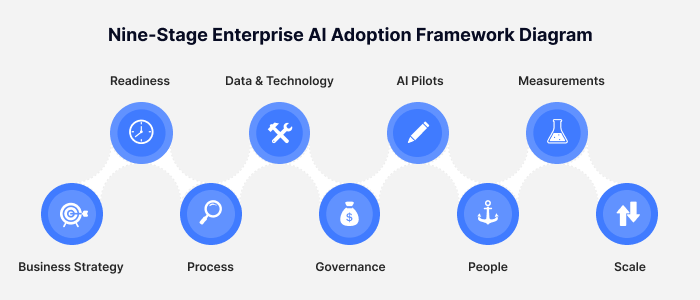
Each link in this chain matters.
- Business strategy sets which problems are worth solving.
- People and process determine whether a solution actually gets used.
- Data and technology determine whether it works reliably.
- Governance determines whether it’s safe to expand.
- Measurement determines whether leadership keeps funding it.
If you skip a link, and the chain doesn’t scale, it breaks at exactly the point that was skipped. This is also why enterprise AI adoption is fundamentally an organisational scaling problem rather than a technology deployment problem: the hardest parts are rarely the model or the API integration.
Setting Up The Enterprise AI Adoption Framework
The structure framework breaks down enterprise AI adoption into nine ordered (and in some cases iterative) steps. These steps have their own goal, owners and evidence of success, which is where it becomes a practical planning tool.
Stage 1: Define the Business North Star
- Objective: Identify the business outcomes AI should influence, before selecting any technology.
- Key activities: Translate strategy into 3–5 measurable priorities like cost, revenue, risk, speed, experience.
- Leadership question: What result are we trying to move, and who is accountable if it doesn’t move?
- Deliverable: A one-page AI intent statement tied to existing KPIs.
- Common mistake: “We need an AI strategy” instead of “we need to cut claims processing time 30%.”
- Success indicator: Every later use case traces back to this document.
- Owner: CEO/business unit leadership, with CIO or Chief AI Officer co-sponsoring.
Stage 2: Assess Enterprise AI Readiness
- Objective: Establish an honest baseline across data, technology, talent, and governance before committing budget.
- Key activities: Run the readiness assessment across all dimensions.
- Leadership question: Where are we structurally unprepared, and is that fixable in months or years?
- Deliverable: A readiness score by dimension, with named gaps and owners.
- Common mistake: Skipping this because leadership assumes “we’re already tech-forward.”
- Success indicator: Gaps are documented before the first use case is funded.
- Owner: CIO/ CTO, with CDO and CISO.
Stage 3: Identify and Prioritise AI Use Cases
- Objective: Select a small, sequenced portfolio instead of funding every idea in parallel.
- Key activities: Score candidates on value, feasibility, data readiness, and risk.
- Leadership question: Which use cases pay back fastest, and which build reusable capability?
- Deliverable: A ranked use-case backlog with owners and target metrics.
- Common mistake: Prioritising the most visible use case over the one with the best data foundation.
- Success indicator: The first 2–3 funded AI use cases share infrastructure or data.
- Owner: Business unit leaders, facilitated by an AI/analytics centre of excellence.
Stage 4: Prepare Data, Technology and Infrastructure
- Objective: Build the technical foundation the prioritised use cases actually need.
- Key activities: Data cleansing and access, platform selection, integration architecture, security baseline.
- Leadership question: Do we have governed access to this data today?
- Deliverable: A working data/technology environment scoped to the pilot, not the whole enterprise.
- Common mistake: Attempting a full data-platform rebuild before running a single pilot.
- Success indicator: The pilot team can access clean data without a six-month data project.
- Owner: CTO/CIO and data engineering leadership.
Stage 5: Establish AI Governance and Risk Controls
- Objective: Put decision rights, risk tiers, and oversight in place before deployment takes place.
- Key activities: Define risk classification, approval checkpoints, monitoring, escalation paths.
- Leadership question: Who can approve a new use case, and what triggers human review?
- Deliverable: An enterprise AI governance charter mapped to a recognised framework such as the NIST AI RMF.
- Common mistake: Treating governance as legal’s problem to solve after the pilot works.
- Success indicator: Every pilot has a named risk owner and review checkpoint before go-live.
- Owner: CISO, legal/compliance, enterprise governance committee.
Stage 6: Build and Validate AI Pilots
- Objective: Prove business value and technical reliability under controlled conditions.
- Key activities: Build against a defined metric, test with real users, measure against baseline.
- Leadership question: What does “success” mean, in numbers, before we start?
- Deliverable: A pilot results report with quantified before/after performance.
- Common mistake: Declaring success based on user enthusiasm rather than the predefined metric.
- Success indicator: A documented, positive delta against baseline.
- Owner: Cross-functional pilot team and accountable business sponsor.
Stage 7: Prepare People and Manage Change
- Objective: Ensure the humans in the workflow actually adopt the new way of working.
- Key activities: Role redesign, training, communication, incentive alignment.
- Leadership question: What does this change about someone’s job, and have we told them directly?
- Deliverable: A change plan tied to each use case, not a generic training deck.
- Common mistake: Treating change management as communications instead of redesign.
- Success indicator: Usage holds or grows once the novelty fades.
- Owner: HR/people leadership and business unit managers.
Stage 8: Measure ROI and Business Impact
- Objective: Prove value in terms the business already tracks financial, operational, and adoption.
- Key activities: Instrument the solution, track against baseline, report to the governance committee.
- Leadership question: Is this delivering the outcome defined in Stage 1?
- Deliverable: A recurring ROI report on a fixed cadence.
- Common mistake: Measuring model accuracy while never measuring business impact.
- Success indicator: Leadership can state the dollar or time impact without qualification.
- Owner: Finance, with the business sponsor.
Stage 9: Scale AI Across the Enterprise
- Objective: Turn a proven pilot into a reusable enterprise capability.
- Key activities: Standardize the architecture, extend to other business units, industrialize support and monitoring.
- Leadership question: What has to be true organizationally not just technically for this to run everywhere?
- Deliverable: A scaling plan with infrastructure, ownership, and budget attached.
- Common mistake: Assuming a successful pilot scales itself without dedicated investment.
- Success indicator: The capability runs in production, across teams, without the original pilot team present.
- Owner: CIO/CTO and the AI center of excellence, with sustained executive sponsorship.
Is Your Enterprise Actually Ready to Scale?
Companies don’t fully understand where they stand on the AI-readiness scale. They often mistakenly equate ‘we have applied some AI tools’ with ‘we are ready organizationally to scale AI’. The AI enterprise adoption readiness framework measures readiness across 12 dimensions and includes a score from 0 to 4.
0 (Not Ready): No defined strategy, ownership, or data access for the dimension.
1 (Emerging): Awareness exists; isolated, unsanctioned activity is happening.
2 (Developing): A pilot or policy exists but isn’t consistently applied.
3 (Operational): The dimension is functioning reliably for at least one production use case.
4 (Scalable): The dimension supports multiple use cases across business units without rework.
| Dimension | Key Question | Low Readiness Signal | High Readiness Signal |
| Strategy | Is AI tied to specific business outcomes? | “We need an AI strategy” with no metrics attached | Every use case maps to a funded business KPI |
| Leadership | Is there a named executive owner? | AI is “everyone’s job,” meaning no one’s | A CIO/CDO/ Chief AI Officer owns the portfolio |
| Data Readiness | Is relevant data clean and accessible? | Data lives in silos with unclear ownership | Governed, documented, accessible data pipelines |
| Technology | Does the AI/ infrastructure stack exist? | Every pilot builds its own stack from scratch | A shared platform supports multiple use cases |
| Talent | Do people with AI/ML skills exist internally? | Fully dependent on external vendors for every task | In-house capability for at least core use cases |
| Governance | Are risk and approval processes defined? | Governance is discussed only after an incident | Documented risk tiers and review checkpoints exist |
| Security | Are AI-specific security controls in place? | No policy on data sent to external AI tools | Access controls, monitoring, and audit trails exist |
| Culture | Do employees trust and engage with AI tools? | Visible resistance or silent avoidance | Employees request AI capability proactively |
| Process | Are workflows designed to incorporate AI? | AI is bolted onto an unchanged process | Processes are redesigned around AI-assisted work |
| Budget | Is funding sustained beyond the pilot? | One-time pilot budget, no scaling funds | Multi-year budget tied to a roadmap |
| Change readiness | Is the organization prepared for role change? | No communication plan for affected roles | Role redesign and training are planned in advance |
| Measurement | Can outcomes be tracked reliably? | Success is judged anecdotally | Metrics are instrumented before launch |
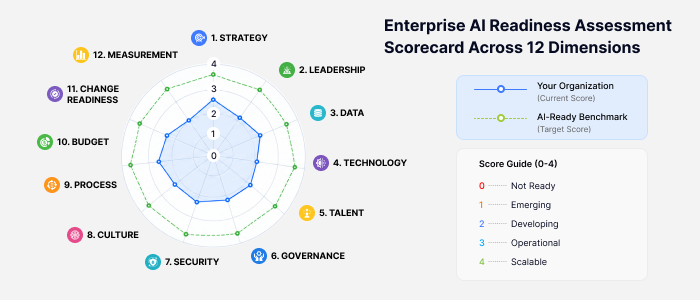
In the above mentioned AI readiness assessment, an organization scoring mostly 0–1 across these dimensions isn’t wrong to explore AI, but it should invest in foundational readiness before funding multiple parallel pilots. An organization scoring mostly 3–4 is ready to shift its focus from piloting to scaling.
How to Build an AI Adoption Strategy?
An enterprise AI adoption strategy sits between AI readiness assessment and implementation roadmap. It needs to have an undeniable, step-by-step process:
Assess → Prioritize → Design → Pilot → Measure → Scale
Strategy should always start with business outcomes. Choosing a platform before clearly defining the business problem can lock an organization into technology that serves the vendor’s roadmap rather than its actual needs.
A strong AI strategy should define:
- The business goals AI needs to support
- The most valuable AI use cases
- The operating model, whether centralized, federated, or hybrid
- Governance and decision-making responsibilities
- Talent and sourcing requirements
- Budget for both pilots and scaling
- KPIs that leadership will track regularly
Skipping the operating model can also create unnecessary duplication. Different business units may end up building their own governance processes and technology infrastructure, increasing costs and making enterprise AI adoption harder to scale.
Technology and AI Infrastructure
A scalable enterprise AI adoption strategy needs the right technology foundation, including cloud infrastructure, AI/ML platforms, LLMs, APIs, RAG, AI agents, integration, security, and MLOps/LLMOps.
Choosing the right approach build, buy, customize, or partner, is the critical judgment call. Build for differentiating strategic capabilities or when unique data is the cornerstone. Buy or customize when well-developed solutions are available on the market, or partner when you lack specific expertise or capacity.
For a detailed comparison of costs, control, scalability, and use-case fit, see our guide to AI Build Vs. Buy.
How to Prioritize Enterprise AI Use Cases?
Many enterprises today have a robust backlog of AI use cases and concepts but are at a loss as to how to rank or prioritise them. Review the value of each enterprise AI use cases based on the following eight dimensions:
- Business value
- Feasibility
- Data readiness
- Risk
- Time to value
- Integration complexity
- Scalability
- User adoption
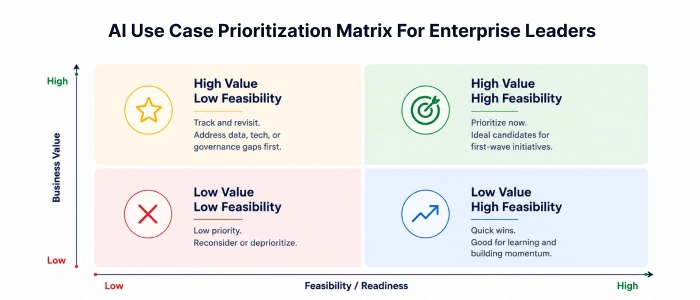
Rank the use cases across their value and feasibility with scores 1-5 and then map the ranked use cases onto a value versus feasibility matrix. Start with high value and high feasibility use cases. Where possible, address the high value but lower feasibility opportunities once the critical missing data, infrastructure or governance pieces have been established.
Microsoft AI Adoption Framework & How It Fits?
Microsoft provides AI-specific adoption guidance under their Cloud Adoption Framework (CAF) called the Microsoft AI adoption framework. It helps organizations determine their AI strategy, plan adoption, prepare for adoption, prepare their technical environment (called “AI Ready”), govern their AI (both “Copilot-like” tooling and custom Azure workloads), and operate their AI in production, including a section specific to adopting AI Agents responsible.
The framework is genuinely useful, particularly for organizations standardized on Azure and Microsoft 365, because it ties adoption guidance directly to governance, security, and data tooling, such as Microsoft Purview and Microsoft Foundry, those organizations already operate. It’s strong on the technical and platform-governance layer of adoption.
A broader enterprise framework is still required everywhere Microsoft stays platform or business-agnostic: outcome prioritization across a multi-cloud estate, cross-functional change management, enterprise-wide use-case prioritization, and AI ROI measurement tied to the organization’s own KPIs rather than platform adoption metrics.
In practice, mature enterprises use a framework like this one to set direction and priorities, and use platform-specific guidance like Microsoft’s, or equivalents from AWS, Google Cloud, or IBM, to execute within the chosen platform.
From AI Adoption to Enterprise-Scale Impact
Scaling enterprise AI adoption involves more than just putting a validated AI model into production. Businesses also have to: scale and train their workforce, take pilots to production, quantify ROI and business value, know their current capabilities, and address the barriers that prevent AI from scaling.
How change management and adoption work are so important is due to the fact that not because the technical systems will be implemented; the people who are involved in that solution would actually use them. This means we need well-structured communication and workflow planning as well as useful training sessions and human supervision.
If a use case is validated, then a transition from pilot to production can be followed up through integration, security, and monitoring, all the way through to cost, ownership, training and rollback. There should also be an AI ROI framework in place to report on financial, operational, adoption, AI, and strategic gains.
Where Does Your Enterprise Stand?
Use an enterprise AI adoption maturity model to determine where you currently stand:
AI Curious → AI Experimenting → AI Operational → AI Scaled → AI-Native Enterprise
The company then just needs to solve the biggest roadblock holding them back from next steps rather than trying to acquire all the necessary capabilities simultaneously. A pragmatic enterprise AI adoption roadmap could then follow:
- 0–30 days: Define business goals, governance, and AI readiness.
- 30–90 days: Prioritize use cases and launch the first pilots.
- 3–6 months: Validate pilots, close key data gaps, and establish change management.
- 6–12 months: Move successful pilots into production and measure ROI.
- 12+ months: Scale proven capabilities across business units and build reusable AI capabilities.
Some of the reasons enterprise AI fails are: blurry objectives, unconnected experiments, incomplete data preparedness, absent governance, poor executive support, fragmented implementations, exaggerated ROI expectations, and a lack of investment into expansion efforts. Understanding these areas early will accelerate you towards a continuous cycle of value-generation rather than scattered experiments.
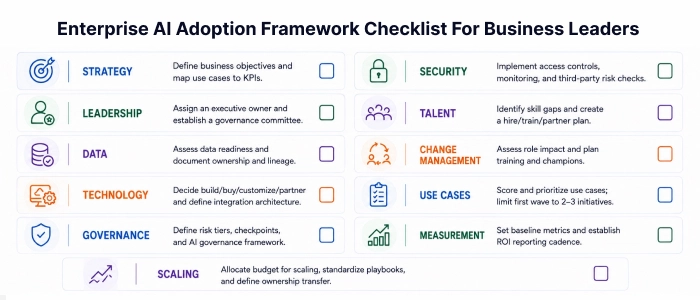
Enterprise AI Adoption Framework Checklist
What Successful Enterprise AI Adoption Looks Like?
Mature AI organizations share a recognizable set of characteristics:
- AI investment is business-led, sponsored by the executives who own the outcome, not driven solely by IT.
- Outcomes are measured with the same rigor applied to any other capital investment.
- Data foundations are strong enough that new use cases don’t each require a separate data project.
- Experimentation continues, but inside governance that catches problems early rather than after deployment.
- Capabilities are built to be reusable; an integration pattern built for one use case gets reused for the next, rather than every team starting from zero.
- Employees are enabled, not bypassed, and executive sponsorship persists past the first budget cycle because the organization has already seen measurable return.
None of this requires an enterprise to be a technology company first. It requires treating enterprise AI adoption as what it is; an organizational capability-building exercise that happens to involve AI, not an IT project that happens to involve the organization.
How Sphinx Solutions Can Help in AI Adoption?
Most organisations get stuck because adapting to an enterprise AI adoption framework requires strategy, data, governance, and change management to move together, and few internal teams are resourced to run all of them at once.
Sphinx Solutions works with enterprises as an AI-first technology and digital transformation partner across that journey from AI strategy and readiness assessment, through use-case discovery and prioritisation, into development, integration, and deployment, and on to scaling. That includes hands-on capability in generative AI and agentic AI solution design, enterprise application development, intelligent automation, and the custom software and mobile engineering needed to embed AI into real workflows rather than bolt it onto the side of them.
At what point is your company poised to benefit from a transformation partner?
When the AI has proven to work from a technical perspective from the team you already have but your team just doesn’t have the extra capacity for productionization and governance, and they need to go it on their own – or when that first “wave” of pilots failed, and you need an external “set of eyes” for finding the root cause.
Are you ready to start rolling out AI adoptiion across your organization and move beyond just experiments?
Sphinx Solutions can identify your organization’s place on the AI adoption maturity model, then help you create a path to get to the next level.
Conclusion
Enterprise AI initiatives don’t fail because the technology doesn’t work. They fail because companies use technology in disconnected “installations” as opposed to an enterprise-wide initiative.
To make enterprise AI work, there needs to be an orchestration around business strategy, data, technology, governance and measurement metrics. There’s an established enterprise AI adoption framework designed just to bring those pieces into sync and transition pilots into a cumulative asset rather than something that dies a slow death.
The nine-stage framework in this guide, the readiness scorecard, the prioritisation matrix, and the maturity model are meant to be used together. Enterprises that follow that sequence are the ones that move past the 95% failure rate and turn AI adoption into AI absorption: a durable capability the business can keep building on.
FAQ’s:
What is an enterprise AI adoption framework?
An enterprise AI adoption framework is a structured approach that helps an organization assess readiness, prioritize AI use cases, prepare data and technology, govern risk, manage organizational change, measure outcomes, and scale successful initiatives. It connects business strategy to execution so AI investment produces measurable value rather than isolated pilots.
How do you build an AI adoption strategy for an enterprise?
Start by defining specific business objectives AI should influence, then follow a sequence of assess, prioritize, design, pilot, measure, and scale. An effective enterprise AI adoption strategy also defines the operating model, governance structure, talent plan, and budget across both the pilot and scaling phases
What’s the first step in implementing an AI adoption framework?
The first step is defining the business outcome the initiative is meant to influence, before selecting any AI technology. Skipping this step is the most common reason AI initiatives struggle to justify continued investment, because there’s no baseline metric to measure success against later.
What are the key stages of an enterprise AI adoption framework?
The core stages are: define the business objective, assess AI readiness, prioritize use cases, prepare data and technology, establish governance, build and validate pilots, manage organizational change, measure ROI, and scale across the enterprise. These stages connect business strategy to technical execution and measurable outcomes.
Why do most enterprise AI pilots fail without a proper framework?
Without a framework, pilots run in isolation, duplicate infrastructure, and skip governance until problems appear. Research from MIT’s NANDA initiative found that roughly 95% of generative AI pilots deliver no measurable profit-and-loss impact a pattern tied to organizational and process gaps, not model capability.
Why is data readiness so critical in an AI adoption framework?
Data readiness determines whether an AI system produces reliable output in the first place. Poor data quality leads directly to unreliable AI results, which erodes user trust, causes pilots to be abandoned, and prevents the organization from ever reaching the scaling stage.
How does change management fit into an AI adoption framework?
Change management ensures the people affected by an AI system actually adopt it, since technology deployment doesn’t guarantee organizational adoption. It covers role redesign, training, communication, and incentive alignment, moving employees from awareness through experimentation to genuine, sustained proficiency.
What’s the difference between AI “adoption” and true AI “absorption” in a framework?
AI adoption means a system is in active, systematic use within governed workflows. AI absorption means the organization has internalized that capability so deeply it survives staff turnover, budget changes, and reorganizations, and continues improving rather than merely being maintained. Absorption represents the actual long-term return on AI investment.
What are the biggest challenges of enterprise AI adoption?
The biggest challenges are fragmented, disconnected pilots; poor data quality and accessibility; unclear executive ownership; weak or late-stage governance; underestimated change management needs; and unrealistic ROI expectations set against vendor demos rather than internal baselines. A structured framework is designed specifically to address these challenges together, rather than one at a time.


 Shaili Gupta

 Ajay Wadne