





Redefining Healthcare

Comprehensive Healthcare Software Development Services

From remote diagnosis and treatment to medical administrative management, we build the systems clinicians actually work in: secure, interoperable, and compliant with the regulation your organisation answers to.

  • HIPAA and GDPR compliant
  • 200+ in-house engineers
  • 1500+ solutions delivered

Trusted By

750+ happy clients, including top Fortune 500 companies

Solutions

Responsive and Effective Healthcare Systems

From remote diagnosis and treatment through to medical administrative management, our healthcare software opens up new ways to care for a patient. Technology should raise the quality of care you deliver, not add another screen between you and the person in front of you.

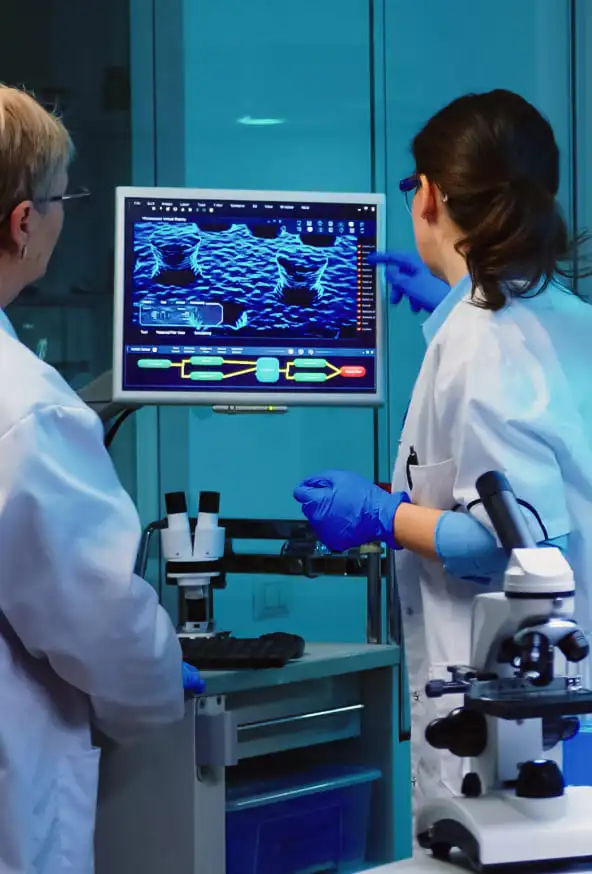
Two clinicians in a laboratory reviewing scan imagery on a monitor

Advanced telemedicine systems for contactless care and real-time consultation, letting patients reach a clinician over chat or video without waiting for a slot in a diary.

  • Convenient access to patient care
  • Quick medical appointments
  • Automated billing with EHR integration

Custom electronic medical and health record systems built to lift clinical productivity and make the doctor’s side of a consultation faster rather than slower.

  • Fast access to medical records
  • Better appointment management
  • Improved patient engagement

End-to-end systems designed around long-term conditions, where the care plan is personalised and the software has to hold a picture of the patient over years rather than a visit.

  • Manage chronic conditions in one place
  • Telemedicine appointments
  • Medication intake management

Feature-rich monitoring that lets clinicians track a patient’s condition between visits and act on a deterioration while it is still preventive care.

  • Accurate vitals tracking
  • Fast access to healthcare assistance
  • Alerts on abnormal symptoms

A coherent experience from registration and appointment booking through online visits and record maintenance, rather than four disconnected tools the patient has to reconcile.

  • Improved patient engagement
  • Web portals for quick appointments
  • Accurate medical data tracking

Systems for in-home care management, coordinating the visit schedule, the clinician and the billing so a home visit runs on the same rails as a clinic one.

  • Hassle-free scheduling and appointments
  • Accurate, faster billing
  • Improved healthcare management

Expertise

Transformative Healthcare Software Solutions

Four service lines, from the first conversation about what to build through to the analytics that tell you whether it worked.

Healthcare IT consulting

Complete IT consulting for better patient outcomes, starting from what the organisation is actually trying to fix rather than from a product.

  • Healthcare strategy consulting
  • Digital health consulting
  • Medical solution consulting

Healthcare software development

Custom systems that raise the quality of care you deliver, built to slot into the estate you already run.

  • Quick integration into healthcare IT
  • Robust security for patient data
  • GDPR and HIPAA compliance

Integration services

Healthcare IT integration that improves connectivity between systems that were never designed to speak to each other.

  • Better security and interoperability
  • Third-party integration support
  • Room for future extension

Healthcare data analytics

Turning raw clinical and operational data into something a decision can be made on.

  • Better patient care through analytics
  • Patient-generated information analysis
  • Resource optimisation from process analytics

What are you waiting for?

Consult our team and kickstart your project today.

Let’s get started

Guide

Understanding Healthcare App Development

Five questions that come up in every healthcare build, answered in the order they tend to arrive. Pick the one you came for.

How custom software accelerates healthcare growth

Custom healthcare software has become a strategic investment rather than an IT line item. What it returns depends entirely on which side of the industry you sit on.

  1. Hospitals and healthcare institutions

    • Improved operational efficiency
    • Cloud technology integration
    • Transitions that do not stop the ward
  2. Medical practices

    • Better electronic health record management
    • A scheduling process that holds up under load
    • Telemedicine that widens access
  3. Pharmaceutical agencies

    • Drug development from research to trial
    • Thorough adverse-reaction monitoring
    • Optimised supply chain operations
  4. Diagnostic centres

    • Efficient management of imaging and appointments
    • Results written straight to the record
    • Prompt access to patient information
  5. Health insurance firms

    • Claims processing and policyholder data in one place
    • Analytics that surface fraud and error
    • Fewer handoffs between claim and answer

Important features of healthcare software systems

These are the capabilities that separate a clinical system people use from one they work around, each shaped by how care actually gets delivered, not by how software usually gets built.

  1. Interoperability

    Data has to move between laboratory systems, electronic health records, health information exchanges and pharmacy systems without a person retyping it. That is what keeps the quality of care consistent as a patient moves between providers, rather than each system holding its own disconnected version of the truth.

  2. Reporting and analytics

    Analysis of trends, performance metrics and outcomes, so decisions rest on what the data says. It is also how you find the areas worth improving next rather than guessing at them.

  3. Appointment scheduling

    Patients book without friction, clinicians keep control of their diary, and reminders go out on their own. Cancellation and rescheduling are part of the feature, not an exception to it.

  4. Data security

    Patient data is the most sensitive record most organisations hold. The system needs advanced protection, multi-factor authentication, and adherence to the standards its regulator actually audits against.

  5. A clear interface

    A simple, direct interface is what makes a clinical system usable during a consultation. Information should be one action away rather than four levels down a menu.

How software stays compliant with healthcare regulation

Compliance is not a milestone the project passes once. It is a property the system has to keep as the rules around it move.

  1. Regular updates

    A clinical system has to be updated to stay compliant. Treating that as routine rather than as a project is what keeps an organisation current with regulatory change instead of catching up after it.

  2. Access control

    Only the authorised person reaches a given record. Done properly, access control removes most of the surface for unauthorised disclosure rather than merely logging it after the fact.

  3. Audit trails

    The system records user activity and every interaction with a record, so an administrator can trace access, spot activity that should not have happened, and evidence it later.

How the software handles the data migration

Moving to a new system is where the record is usually lost, corrupted or quietly truncated. Three things decide whether it arrives intact.

  1. Data mapping tools

    Mapping fields from the existing system before anything moves is what keeps the record accurate and consistent on the other side. Skipping it is what makes a migration a data-integrity problem.

  2. Migration assistance

    Hands-on support through the transition rather than a handover document. Less disruption while it happens, and the integrity of the record preserved through it.

  3. Compatibility

    A system built to industry standards migrates cleanly. Compatibility is what stops a record arriving corrupted, truncated, or not at all.

Dedicated developers, or freelancers

Engaging a dedicated team offers clear advantages over freelancers, and the gap widens once the system has to hold real patient data.

  1. Reliability and consistency

    On communication, availability and commitment to the project, a dedicated team is predictable. A freelancer is working several projects at once, which shows up as inconsistent responsiveness at the point you need it.

  2. Better collaboration

    A dedicated team aligns to your objectives, your workflows and the business context around them, and starts from your requirements rather than from a brief.

  3. Long-term commitment

    Support and maintenance continue after launch. Freelancers mostly prioritise short-term commitments, which makes continuity the client’s problem to solve.

  4. Skill and expertise

    A dedicated team carries experience across technologies, industries and domains, and with it the best practices that custom healthcare software actually depends on.

Highly Rated Across Top Platforms

Why Sphinx Solutions

A Pioneer in Healthcare Software Development

Building IT infrastructure for healthcare is more than shipping a system. It is strengthening the core of an organisation and simplifying the parts of it that have grown complicated. From conception through to deployment, we deliver end-to-end and to the client’s own requirements.

200+

In-house engineers

1500+

Solutions delivered

1.5x

Faster delivery

99%

Client satisfaction

Resources

Insights by Industry Experts

Connect with us

Turn Your Ideas Into Reality. Let’s Connect and Create Something Groundbreaking.

  • USA
  • UK
  • UAE
  • India

Enter your contact details

We’ll get back to you in 1 to 2 business days.

Questions &
Answers

Everything you need to know about building healthcare software. Can’t find your answer? Get in touch.

Custom software is what moves a traditional healthcare operation onto a footing it can grow from. The reasons that come up most often:

  • Improved patient care
  • Scalability and flexibility
  • Stronger security and compliance
  • Competitive advantage
  • Streamlined healthcare operations

Building a system that handles healthcare work, appointment scheduling, patient record management, telemedicine, remote monitoring and the rest. These systems are built for healthcare organisations, clinics and hospitals rather than adapted from something generic.

A dedicated healthcare system typically runs between $50,000 and $200,000. Where a given project lands depends on complexity, the feature set, the size of the system and the rates of the team building it.

Robotic process automation takes the rule-based work out of the day: appointment scheduling and reminders, patient registration, asset tracking and payment handling. It streamlines the workflow around care rather than the care itself.

From idea to launch, the sequence runs:

  • Define the goals and objectives
  • Conduct market research
  • Select the tech stack
  • Design the interface
  • Build the front end and back end
  • Integrate the core functionality
  • Establish regulatory compliance
  • Test and assure quality
  • Deploy and launch

It depends on size, complexity, the feature set and the size of the team. As a rough guide: a basic healthcare application takes two to four months, a mid-size one four to six, and an advanced one six to twelve.

Gathering, interpreting and analysing large datasets to draw out something useful, better operational efficiency, better patient care. The components that make it up:

  • Data collection
  • Data integration
  • Data analysis
  • Predictive modelling
  • Clinical decision support

Because the operation you are running is not the one the product was designed around. Custom systems give you:

  • Fit to specific business needs
  • Scalability
  • Integration with the systems already in place
  • Adaptability
  • Improved productivity

Proper planning, domain expertise and adherence to the standards the sector is held to. The process runs:

  • Identify the project needs
  • Research the market and plan
  • Design the architecture and interface
  • Build the system
  • Implement the security measures
  • Test and assure quality
  • Deploy
  • Maintain and monitor