Designed for autonomous execution
AI agents that don’t just assist but plan, decide, and execute multi-step tasks independently, aligned with your business logic.
Agentic AI to automate workflows and scale operations. We build custom AI agents that don’t just assist. They plan, decide, and drive business outcomes on their own.
Trusted By
750+ happy clients, including top Fortune 500 companies













The Agentic AI Revolution
Agentic AI represents a fundamental shift from reactive AI tools to autonomous intelligent systems that can perceive their environment, make decisions, and take actions to achieve specific goals without constant human supervision.
Agentic AI solutions operate independently as systems plan multi-step workflows, adapt to changing conditions, learn from outcomes, and execute complex business processes with minimal human intervention.
As an agentic AI development company, Sphinx Solutions specialises in building custom AI agents that don't just assist, they autonomously drive business outcomes. Our agentic AI software development approach pairs proven frameworks with domain-specific customisation for every engagement.
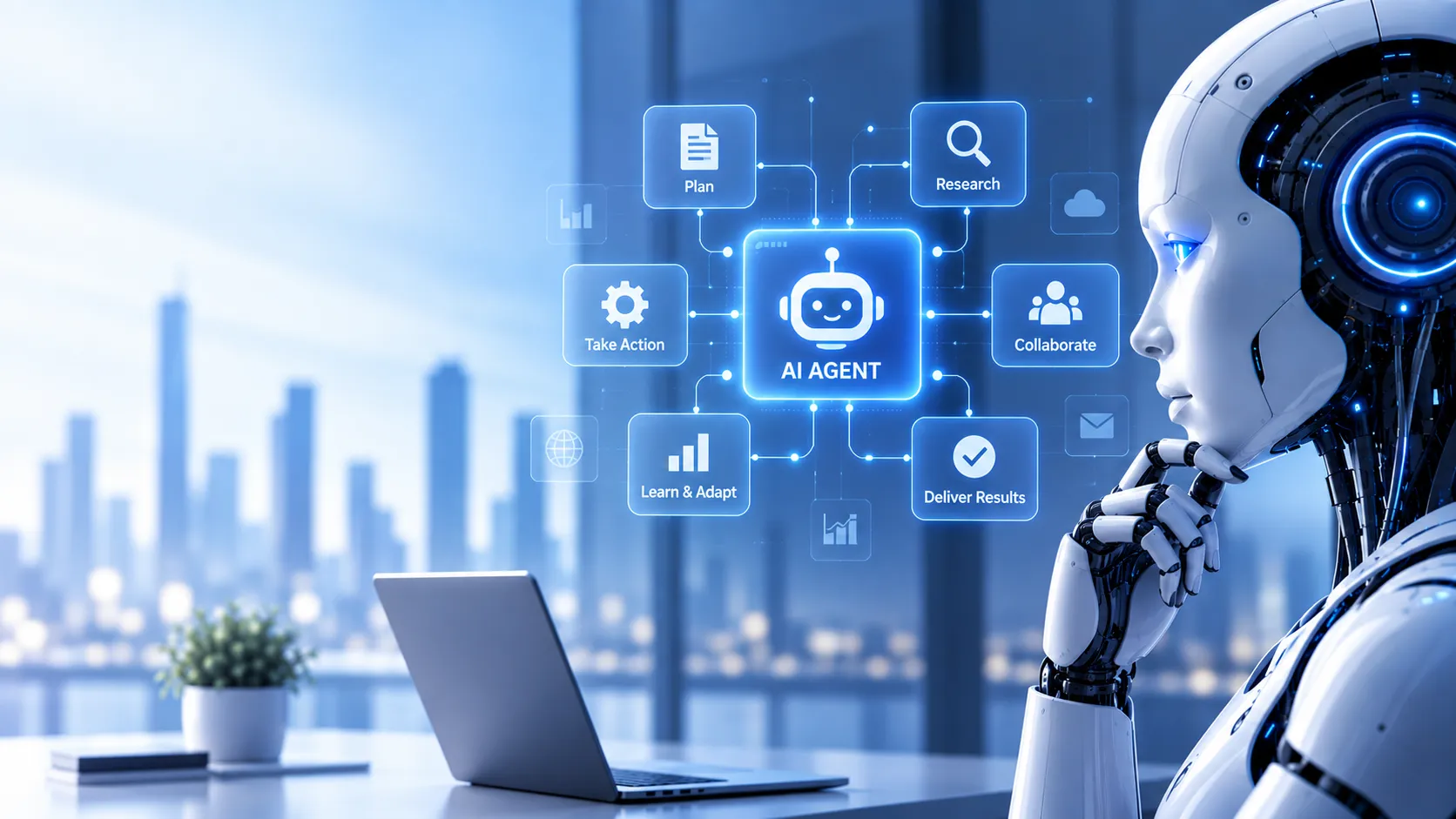
AI agents that don’t just assist but plan, decide, and execute multi-step tasks independently, aligned with your business logic.
Collaborative AI agents working together across workflows, tools, and data to handle complex processes end to end.
Agents that retain context, adapt in real time, and improve decision-making with every interaction and data input.
What We Build
We build AI agents that don’t just assist. They act. Autonomous systems that integrate with your business to automate workflows and drive real results.
01
We design and build tailored AI agents for your specific business requirements, from conversational assistants to complex decision-making systems that handle intricate workflows autonomously.
Talk to our service experts02
Deploy coordinated networks of specialised AI agents that collaborate, share context, and execute parallel tasks. Our multi-agent systems ensure seamless orchestration across complex business processes.
Talk to our service experts03
As a trusted ai copilot development company, we build ai agents for business teams that augment human expertise, offering real-time insights, automating repetitive tasks, and accelerating decision-making across sales, support, engineering, and operations.
Talk to our service experts04
Replace manual processes with intelligent automation that adapts to changing business conditions. As a form of agentic process automation, our AI workflow solutions handle everything from data processing to customer interactions without human oversight.
Talk to our service experts05
Leverage cutting-edge large language models from OpenAI, Anthropic, and open-source alternatives. We customise and fine-tune LLM-powered agents to align perfectly with your domain expertise and compliance requirements.
Talk to our service experts06
Design hybrid systems where AI agents handle routine decisions while escalating critical situations to human experts. This approach balances automation efficiency with human judgment where it matters most.
Talk to our service expertsWhat We Solve
AI agents that evaluate options, weigh trade-offs, and make intelligent decisions aligned with your business objectives.
Plan and execute complex workflows spanning multiple systems, APIs, and decision points without human intervention.
Maintain conversation history, learn from interactions, and build contextual understanding across sessions.
Seamlessly connect with your existing tech stack: CRMs, databases, communication tools, and business applications.
Continuously improve performance based on feedback loops, outcomes, and changing business conditions.
Built on cloud-native infrastructure that handles enterprise-scale workloads with reliability and performance.
How We Work
Our Agentic AI lifecycle is designed to build autonomous, decision-making systems with clarity, speed, and zero guesswork. From discovery to deployment, every step ensures your AI agents are aligned with real business outcomes.
Step 1
What we do: We analyse your business workflows, identify automation opportunities, and define where agentic AI can deliver the most impact. Through stakeholder interviews, process mapping, and feasibility studies, we establish clear goals and technical direction.
What you get
Step 2
What we do: Our architects design the foundation of your agentic system, selecting the right models, frameworks, and integrations, and defining agent behaviours, decision logic, data flows, and scalability.
What you get
Step 3
What we do: We build a functional prototype within weeks to demonstrate core agent capabilities and workflows, allowing early interaction, feedback, and validation before scaling further.
What you get
Step 4
What we do: We integrate AI agents into your existing systems, including CRMs, ERPs, databases, APIs, and communication tools. Agents are trained on your data and customised to match your business logic.
What you get
Step 5
What we do: We rigorously test your AI agents for performance, reliability, and security. This includes functional testing, edge case validation, and security audits to ensure enterprise readiness.
What you get
Step 6
What we do: We deploy your agentic AI systems with monitoring and logging in place. Your team is trained to manage and optimise agents, while we provide continuous support and improvements.
What you get
Proof Of Work
Every solution we build is AI-ready by architecture, so your business grows smarter. We engineer software around the way your business, processes, integrations, and growth targets. We bring years of delivery precision to every project across the world.
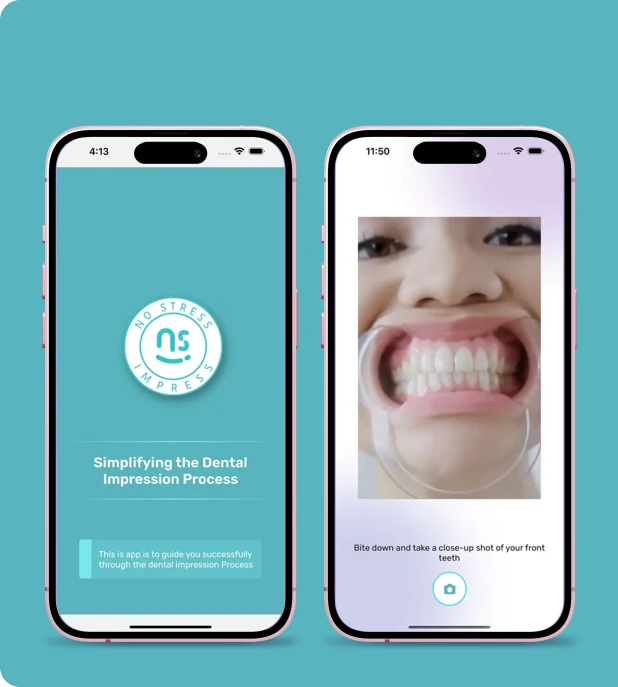
NO STRESS IMPRESS
AI-powered student productivity and mental wellness platform
Students struggled to balance academics, deadlines, and mental well-being. Existing tools were too generic or lacked personalisation, causing low engagement, poor productivity, and ineffective stress management.
To build an AI-driven platform that manages tasks and schedules while understanding user behaviour, stress patterns, and productivity gaps, ensuring a simple, engaging, and personalised experience for students.
Developed an AI-powered mobile platform with task planning, mood tracking and behavioural insights, integrating smart recommendations and analytics to enhance productivity, engagement, and consistency.
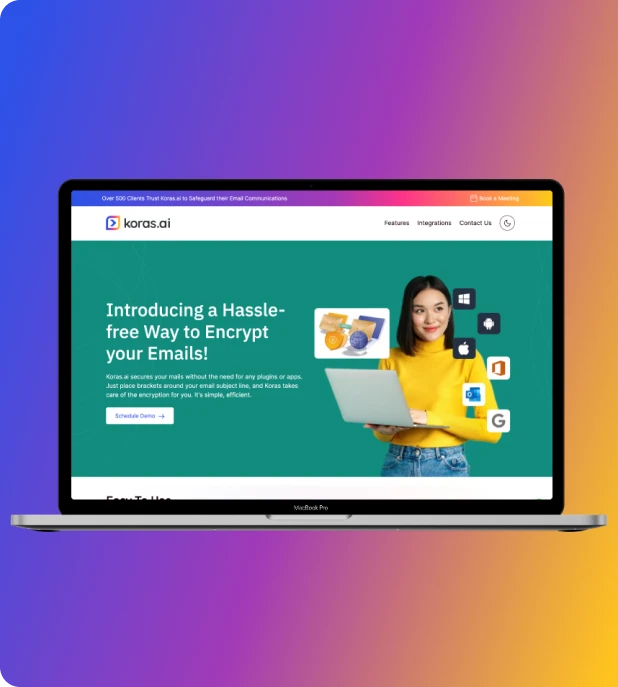
KORAS.AI
Zero-plugin AI email encryption platform
Email communication lacked simple encryption. Existing solutions required plugins, technical setups, or complex workflows, making secure communication inaccessible, inconvenient, and difficult for everyday users globally.
Design an AI-powered encryption system working directly within existing email platforms, eliminating the need for installations, integrations, or training while maintaining simplicity, usability, and strong security standards.
Developed an AI-based encryption platform enabling users to secure emails by adding brackets in the subject line, automating encryption, decryption, and key management without disrupting existing workflows seamlessly.
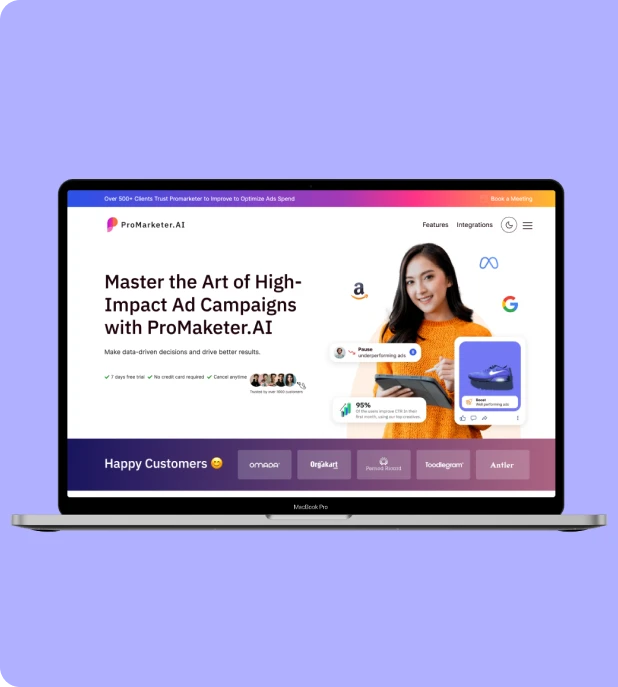
PROMARKETER.AI
AI-driven marketing automation and optimisation platform
Marketers struggled to manage campaigns across platforms, analyse performance data, and optimise ads in real time. Manual processes led to inefficiencies and missed growth opportunities.
To create a centralised AI platform that automates campaign management, delivers actionable insights, and continuously optimises marketing performance across multiple channels.
An AI-powered marketing automation system with campaign tracking, audience segmentation, and real-time optimisation, plus performance dashboards and smart recommendations to maximise ROI.
Comparison
Both are called AI, and they behave nothing alike once a workflow gets complicated. Here is where the difference actually shows up.
| Aspect | Agentic AI | Traditional AI |
|---|---|---|
| Core intelligence & functioning | Operates as an autonomous, goal-driven system that can plan, reason, and execute multi-step tasks independently. It doesn’t just respond, it decides what needs doing next and adapts based on outcomes. | Primarily reactive and task-specific. It follows predefined models, rules, or training data to generate outputs, but does not independently plan or adapt workflows beyond its programmed scope. |
| Decision-making & autonomy | Capable of autonomous decision-making with minimal human input. It evaluates context, breaks down complex objectives, and chooses optimal action paths dynamically. | Requires human-defined inputs, prompts, or rules. It cannot independently manage end-to-end processes or adjust decisions beyond its training limitations. |
| Workflow execution | Handles multi-step, interconnected workflows by orchestrating multiple agents or tools, suiting complex business processes like automation, research, and operations. | Typically executes single-step or narrowly defined tasks (classification, prediction, simple automation) without cross-task coordination. |
| Learning & context awareness | Continuously adapts using contextual memory and environmental feedback, improving across tasks over time and adjusting strategies dynamically. | Learns during training but remains static in deployment. It lacks real-time adaptability unless retrained or fine-tuned. |
| Tool & system integration | Integrates with APIs, databases, external tools, and other AI agents to complete goals, functioning as a connected intelligent ecosystem. | Integration is possible but usually limited to predefined pipelines or fixed integrations, requiring manual configuration and updates. |
| Error handling & self-correction | Can self-evaluate outcomes, detect errors in workflows, and retry or adjust strategies autonomously to improve success rates. | Error handling is mostly external, requiring human monitoring, debugging, or rule-based fallback systems. |
| Scalability & enterprise use | Highly scalable for enterprise-grade automation: autonomous operations, AI-driven decision systems, intelligent assistants, and multi-domain workflows. | Best suited to isolated applications, chatbots, recommendation systems, forecasting models, task-specific automation. |
| Operational intelligence | A shift towards AI agents that act like digital workers, thinking, planning, and executing as semi-independent systems. | A tool-based intelligence system that enhances human decision-making but does not operate independently. |
Expert Insights
Agentic AI is changing how companies automate work. Earlier, systems followed fixed steps and could only do what they were programmed for. Now AI agents can plan tasks, adjust when things change, and handle multiple steps together. Automation is becoming more independent, where systems make decisions, adapt in real time, and work towards better results on their own instead of just reacting.
How We Engage
Every Agentic AI project is different; some need full-scale ownership, others need speed, flexibility, or expert augmentation. We offer engagement models designed to match your goals, timelines, and level of control.
01
A fully committed team working exclusively on your agentic AI project. Ideal for long-term builds and complex multi-agent systems.
02
End-to-end development with a fixed scope, timeline, and cost. Best for clearly defined agentic AI use cases.
03
Extend your in-house team with specialised AI experts. Perfect for faster execution without full hiring.
04
Expert guidance to plan and validate your agentic AI roadmap. Ideal for early-stage exploration and decision-making.
Book a 30-minute engagement consultation.
How We Build It
The models, frameworks, and infrastructure our agents are built on, each chosen for the job in front of it rather than out of habit.
Industries
Why Choose Us
Sphinx has completed 16 successful years in the industry, helping businesses with technology and digital transformation, including AI-powered solutions across major industry verticals.
We have a dedicated and reliable team of AI engineers, ML scientists, data engineers, and MLOps specialists covering every role in the AI development lifecycle.
We have delivered more than 1,500 solutions through a results-driven approach, many to recurring clients who keep expanding their AI capabilities with us.
We have a dedicated in-house team, experienced and skilled across AI development, software engineering, QA, DevOps, and cloud infrastructure.
We are trusted by 750+ clients for best-in-class AI solutions at competitive rates, with the delivery accountability enterprise clients demand.
Our client-centric approach and high-calibre AI engineering, built on current models and frameworks, have made us a trusted partner for businesses building AI.
Connect with us
Everything you need to know about building agentic AI with us. Can’t find your answer? Talk to us.
Agentic AI tackles the things that quietly slow a business down: manual workflows, slow decisions, systems that don’t talk to each other, and repetitive busywork. The difference from ordinary automation is that it can reason about a task, work across several tools, and carry a process through without someone watching every step.
RPA follows fixed rules to handle repetitive, structured jobs like data entry or filling in forms. Agentic AI goes further: it understands the goal, makes decisions along the way, and copes with workflows that change as they run. Put simply, RPA does the task you scripted, while agentic AI runs the whole process and adapts.
Yes. It connects to APIs, CRMs, databases, cloud platforms, and other enterprise tools. Because it is built to work across several systems at once, it fits companies that already have a lot of digital infrastructure in place. Instead of replacing what you run, it sits on top and coordinates between your existing tools.
Often, yes. Chatbots and automation tools tend to handle one task or one conversation at a time. Agentic AI takes on a full workflow, makes decisions, and coordinates several steps across different systems on its own. It is less a single feature and more something that manages the whole job from start to finish.
We build agentic AI systems that cut operational costs and take repetitive work off your team. They make decisions in real time, scale as your workflows grow, and connect to the systems you already run. We start by finding where your team loses the most time, then build around those points first.
It depends on complexity. A simple workflow can be up and running in a few weeks, while an enterprise-grade multi-agent system can take several months. Either way, the work covers planning, integration, testing, and deployment. We scope the timeline with you up front so there are no surprises partway through.