Key Takeaways
- Collaborative AI systems combine several AI agents to partition the work, exchange information, and collaborate to solve a business problem.
- The right architecture matters. Using an orchestrator, domain specialisation, communication, memory, tools, and governance to coordinate them, a multi-agent collaborative AI system can be reliable.
- Multi-agent systems combine a bunch of AI agents, so they can split up work, communicate with each other, and achieve a single business goal. More isn’t always better (AI) agents.
- Multi-agent architectures are well suited for problems that need a significant amount of domain knowledge, high levels of parallelism and/or non-trivial problem solving.
- Go for the business problem, not the technology. First, establish whether multiple agents will deliver greater efficiency, scalability, lower costs, or higher quality results.
The reason multi-agent systems are emerging in enterprise AI, when a workflow crosses multiple tools, multiple types of decisions, or even multiple domains, even the best AI agent out there will give up. Rather than trying to build a single generalist agent, companies are breaking the task into multiple specialist agents working together.
That’s different from simply running several AI tools side by side. In a multi-agent system, there are roles agents can take on, there is a method for the agents to communicate or delegate, and there is at least some mechanism for ensuring the task is still going to end up finished. Knowing when you need this particular infrastructure is more important than the language.
What are Multi-Agent Systems?
Multi-agent systems are a collection of AI agents, with clearly defined responsibilities, working in cooperation to attain a common goal through task sharing, context sharing, and coordination, as opposed to a single agent doing everything.
These other agents usually have a specific, limited scope on the problem: one could do the research, another the actual writing, yet another the fact-checking. They may be connected through a shared context, structured communications, or a higher-order orchestrator layer which queues work to different agents. In most instances, an arbitrator agent determines who does what and produces the final answer.
An easy example: a vendor quoting process with a dedicated agent to quantify quotes, a dedicated agent to determine whether quote terms are within policy, and a dedicated agent to route approved offers for final approval. Each agent is less broad and more predictable than a single generalist agent.
How Do Multi-Agent Systems Work?
Most multi-agent AI systems follow a recognisable flow:
Business goal → Orchestrator/planner → Specialized agents → Tools and data → Agent collaboration → Validation → Final outcome
This stops the orchestrator from having to understand everything. It breaks down the question into sub-questions, and then allocates those sub-questions to agents that can do it. The agent makes use of resources (data or tools ex: retrieve or an API call) and provides the context back to the orchestrator, which then also provides it to the other agents.
Additional validation, which may be done by a second agent, compares the combined output against the final or human-facing version. Context and history also play a role: agents must have sufficient shared context between them so that they don’t end up recreating or contradicting each other midway.
What is Multi-Agent System Architecture?
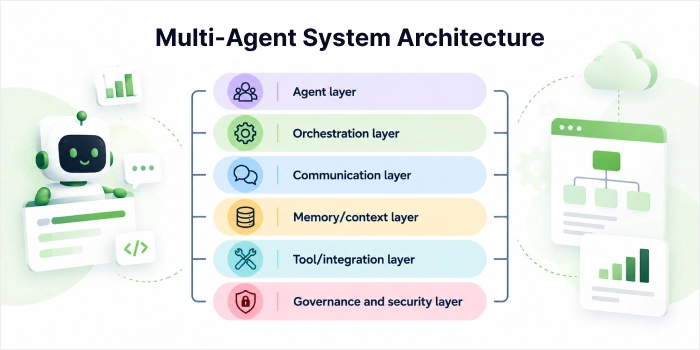
A production-grade multi-agent system architecture generally includes six layers:
- Agent layer — the specialized agents, each responsible for a narrow task.
- Orchestration layer — routes work, delegates tasks, and coordinates sequencing.
- Communication layer — how agents exchange messages, outputs, or context with each other.
- Memory/context layer — shared state, history, and knowledge each agent can draw on.
- Tool/integration layer — the APIs, databases, and enterprise systems agents act on.
- Governance and security layer — identity, permissions, monitoring, and human approval points.
These layers interact constantly. The orchestration layer depends on the communication layer to actually deliver instructions and results between agents, while the governance layer sits across all of it, controlling what each agent is allowed to touch regardless of what the orchestrator asks for.
What are Common Multi-Agent Architecture Patterns?
Different business problems call for different ways of organizing how AI agents work together. Here are the most common patterns:
1. Supervisor / Orchestrator-Worker
A central “supervisor” agent delegates tasks to specialist agents and combines their outputs into a single result. This works well when multiple specialists need to contribute to one unified output, but the supervisor can become a bottleneck as complexity grows.
2. Sequential / Pipeline
Agents run one after another in a chain the first agent completes its task, passes the output to the next, and so on. This pattern fits naturally when the use case is inherently sequential (each step depends on the previous one).
3. Router
A routing agent examines each incoming request and directs it to the appropriate specialist agent. This is useful for businesses handling many different types of requests at scale, though poor routing decisions can degrade overall performance.
4. Hierarchical
Agents are organized into multiple levels, with coordinators overseeing smaller groups of agents beneath them. This suits complex, large-scale workflows but tends to add latency and makes debugging more difficult.
5. Peer-to-Peer
Agents communicate directly with one another without any single agent in control. This works well for relatively limited coordination needs, but as the system scales, managing and controlling agent behavior becomes increasingly complex.
The majority of organisations find it easier to begin with a supervisor or router pattern. When the system has demonstrated the usefulness of the technology, then a more complex solution such as a hierarchical or peer-to-peer system can be considered.
The Multi-Agent Complexity Test
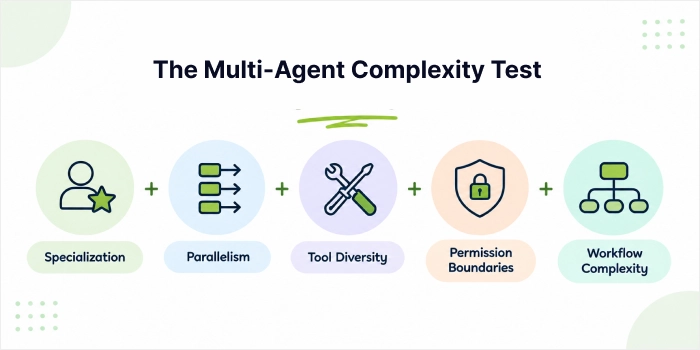
Before committing to a multi-agent build, score the workflow against five independent factors:
Specialization + Parallelism + Tool Diversity + Permission Boundaries + Workflow Complexity
- Specialization: Are there separate parts of the task that truly require a different skill set or knowledge domain?
- Parallelism: Can other useful portions of the work be performed simultaneously instead of sequentially?
- Tool diversity: Do different parts of the task need access to different tools, APIs, or data sources?
- Permission boundaries: Do different parts of the task require different access levels or approval authority?
- Workflow complexity: Does the task span multiple systems, teams, or decision points rather than staying contained?
The more of these five factors a workflow scores strongly on, the stronger the case for a multi-agent architecture. A workflow that scores low across most of them is very likely better served by a single, well-scoped agent.
This is a Sphinx Solutions framework, not an industry-standard metric, but it’s built from the same reasoning enterprise teams already apply when deciding whether to split a team into specialized roles or keep one generalist owning the whole process.
Sphinx Solutions’ Multi-Agent Architecture Decision Matrix
| Business Requirement | Recommended Pattern | Why |
| Sequential, predictable workflow | Pipeline | Fixed order keeps execution predictable and easy to trace |
| Multiple distinct specialist tasks feeding one outcome | Supervisor / orchestrator-worker | Centralized coordination keeps the final output consistent |
| High volume of varied request types | Router | Sends each request straight to the right specialist |
| Independent tasks that can run at the same time | Orchestrator-worker | Enables genuine parallel execution |
| Workflow spans multiple departments or decision layers | Hierarchical | Supports coordination across sub-teams of agents |
Use the Complexity Test to decide whether multi-agent architecture is justified at all, then use this matrix to choose the coordination pattern once it is.
What is the Difference Between Multi-Agent Systems Vs. Single-Agent Systems?
| Factor | Single-Agent System | Multi-Agent System |
| Architecture | One agent, broad responsibility | Multiple agents, narrow responsibilities |
| Specialization | Limited | High |
| Task complexity | Best for moderate, contained tasks | Better for complex, multi-domain tasks |
| Parallel execution | Limited | Possible across agents |
| Coordination | Not needed | Required |
| Cost | Lower | Higher, more calls and orchestration overhead |
| Latency | Generally lower | Generally higher |
| Debugging | Simpler | More complex, failures can be hard to trace |
| Scalability | Limited by one agent’s scope | Scales by adding specialists |
| Governance | Simpler | Requires permissions per agent |
| Best suited for | Contained, well-defined workflows | Cross-domain workflows needing specialization |
More agents do not automatically mean a better AI system. More agents mean another potential coordination failure point, another permission boundary, another cost. Pick one agent with a clear scope of responsibility, the bigger it can do, and let it do it, because that is cheaper, faster, and orders of magnitude simpler to debug and govern. There needs to be a real case for a multi-agent architecture-that’s higher levels of specialisation, parallelism, or organisational complexity, not simply more agents.
What are the Benefits of Multi-Agent Systems?
But the real gains, I think, are the fact that the work is really being done across multiple domains: specialisation means you get better at a narrower set of activities, parallelism means all the subtasks, independent of one another, can be done in parallel, and modularity means you can change one out without destroying everything.
Fault isolation is another overlooked advantage: if one of the specialist agents goes down, the others often can keep going or gracefully degrade rather than all quit. Multi-agent AI makes it easier to bucket models and different levels of access to different jobs, which is important for both cost and compliance.
None of this guarantees better accuracy. Dividing a task between agents introduces several coordination steps, each of which is an opportunity for miscommunication and mistakes to occur. Therefore, the advantages have to be significant enough to justify all that.
What are the Challenges of Multi-Agent Systems?
More agents mean more model calls into and out of the infrastructure, increased latency (as chunks are handed off from one agent to another), and (if you’re not careful with your architecture) context gets lost in the rush of handoffs, and errors snowball. For example, a single error with one agent early in the chain can silently derange everything downstream. Observability and debugging get harder because a failure could originate in any agent or in the coordination logic itself.
Security and governance also get more demanding, since every agent needs its own permission boundaries, and a poorly scoped agent can become an unexpected point of exposure. Left unchecked, agents can also fall into runaway loops, repeatedly retrying or escalating a task without resolving it.
Adding agents creates coordination overhead. It doesn’t create free intelligence.
Enterprise Use Cases of Multi-Agent Systems
- Customer service: A triage agent determines intent and routes to billing, technical support, or refund specialist agents, and a verification agent ensures the resolution before it gets to the customer.
Business value: faster resolution without collapsing every issue type into one generalist workflow.
- Software Development: Planning, coding, testing, security review, and documentation agents work through parts of the development cycle, each peers on a different dimension of the same change.
Business value: more thorough review coverage without adding proportional headcount.
- Financial Services: Fraud detection, control validation, and risk evaluation are separate, specialised processes leading to a converged outcome.
Business value: each domain gets appropriately deep, specialised scrutiny.
- Supply chain: There are four teams of demand planning, inventory, purchasing, and logistics experts working on the same set of decisions.
Business value: fewer blind spots between functions that used to operate independently.
- Sales and marketing: Research, lead qualification, content drafting, and campaign analysis agents each handle a distinct stage, feeding a shared CRM.
Business value: less manual handoff between tools that previously required separate manual steps.
- IT operations: Incident monitoring, incident detection, incident root-cause, and incident remediation agents collaborate on one incident from inception to resolution.
Business value: faster mean time to resolution on incidents that touch multiple systems.
When Should a Business Use a Multi-Agent System?
Multi-agent structure is appropriate when the task can be broken down into clearly separate parts, genuinely different expertise or instruments are needed for some tasks, some tasks can be executed concurrently, and the process crosses the boundaries of teams or existing systems that are already more or less independent.
This is when you should not consider multi-agent workflows: if the process is basic and mostly sequential, a competent agent should be able to perform the task consistently on his own, or the company doesn’t have the visibility to know what several agents are really doing.
Two helpful questions to ask:
Can I even describe what an agent would be responsible for, and why?
How to Build a Multi-Agent System?
- Define the specific business outcome the system needs to produce
- Map out the tasks involved and how they depend on each other
- Test whether a single agent could reasonably handle the whole thing
- Define clear responsibilities for each agent if multiple are justified
- Choose an architecture pattern that fits the coordination needs
- Design how agents will share context and communicate
- Connect the tools, APIs, and enterprise systems each agent needs
- Build in permissions, guardrails, and security boundaries per agent
- Add evaluation and observability before anything goes live
- Pilot with one well-scoped, measurable use case
- Track cost, latency, output quality, and reliability against a baseline
- Scale to additional workflows only once the pilot proves its value
Conclusion
Multi-agent systems should not be used just for the sake of having multiple agents; more sophisticated. They are justified where specialisation, parallelism or organisational complexity can bring a quantifiable advantage to the business that an individual agent really can’t.
Getting this right starts with the same question every time: can one agent reliably do this, and if not, exactly what would each additional agent own? That question, more than any framework or pattern, is what separates a well-architected multi-agent deployment from an expensive coordination problem.
It’s also where multi-agent design connects back to the broader shift toward agentic AI and enterprise AI automation more generally, since the same discipline applies whether you’re deploying one agent or ten.
FAQ’s:
How do multi-agent systems work?
An orchestrator breaks a goal into smaller tasks, delegates them to specialized agents, and those agents use tools and shared context to complete their part before results are validated and combined into a final outcome.
What is multi-agent architecture?
Multi-agent architecture refers to how agents, orchestration logic, communication, memory, tools, and governance controls are structured together so specialized agents can collaborate reliably on a shared goal.
What is the difference between single-agent and multi-agent systems?
A single-agent system uses one agent to handle an entire task, while a multi-agent system splits the task across several specialized agents that coordinate, trading simplicity for the ability to handle more complex, multi-domain work.
What are the benefits of multi-agent systems?
The main benefits are specialization, parallel execution, modularity, and fault isolation, letting different agents use different tools, models, or permissions suited to their specific job.
What are common multi-agent architecture patterns?
The most common patterns are supervisor/orchestrator-worker, sequential/pipeline, router, hierarchical, and peer-to-peer, each suited to different levels of task complexity and coordination needs.
When should a business use a multi-agent system?
A business should consider a multi-agent system when a workflow can be cleanly split into specialist tasks that benefit from parallel execution, and should avoid it when a single well-scoped agent can already do the job reliably.


 Shaili Gupta

 Ajay Wadne