
Imagine this: You want to take a 10-day trip to Tokyo and Kyoto. Instead of spending six hours browsing blogs, flight aggregators, and hotel reviews, you simply type, “Plan a family-friendly trip for four under $8,000, including a mix of high-tech attractions and traditional tea ceremonies.” Within three seconds, a complete, day-by-day itinerary appears, complete with booked flights, restaurant reservations that meet your dietary needs, and a real-time weather-adjusted packing list. That’s exactly the kind of experience businesses aim for when they build AI trip planner platforms for modern travelers.
In 2026, this isn’t science fiction: it’s the standard. As the AI marketing market is projected to reach $47 billion this year, the travel industry is being radically reshaped by intelligent automation. If you are a startup founder or an enterprise leader in the travel space, the question is no longer if you should integrate AI, but how fast you can build AI trip planner software that captures this exploding market.
The 2026 Market: Why AI Travel Apps are Winning
The shift in traveler behavior is staggering. Recent data shows that 90% of travelers are now aware that AI tools can assist in their bookings, and more importantly, 94% of users trust AI-generated recommendations as much as (or more than) traditional sources.
Why is this happening now?
- Hyper-Personalization: Traditional filters (price, location, rating) are too blunt. AI analyzes “intent” and “sentiment,” matching a user’s unique vibe rather than just their budget.
- Revenue Efficiency: Organizations that have pivoted to AI-driven models report a 15-25% increase in revenue within just 18 months.
- Trust & Satisfaction: 96% of travelers who use AI for planning report being satisfied with the results, leading to higher retention rates for apps that get it right.
Think about your current platform: Are you still forcing users to do the manual labor of research, or are you providing them with finished answers?
Must-Have Features to Build AI Trip Planner Experiences
To compete as a top-tier ai app development company, you need to build AI trip planner capabilities that move beyond basic search.
1. Generative Itinerary Engines
Users don’t want a list of links; they want a narrative. By leveraging Large Language Models (LLMs), your app can create cohesive schedules that account for travel time, opening hours, and personal interests.
2. Real-Time Budget Tracking & Optimization
Integrating with fintech APIs allows the app to track spending in real-time and suggest pivots. “You’ve spent 60% of your food budget on day 3; here are three incredible but affordable street food spots for tonight.”
3. Conversational AI Chatbots for Seamless Booking
Stop making users fill out forms. An intelligent AI chatbot can handle the entire booking flow: from flight selection to room upgrades: through a natural conversation.
4. Predictive Pricing Alerts
By analyzing historical data and current market trends, your app can tell a user, “Don’t book that flight to Paris yet; our model predicts a 15% price drop in the next 48 hours
The Technical Foundation to Build AI Trip Planner Apps
Building a robust AI travel app requires a blend of traditional mobile app development services and cutting-edge machine learning infrastructure. If you want to build AI trip planner solutions that scale, your architecture needs to support personalization, real-time recommendations, and seamless booking workflows.
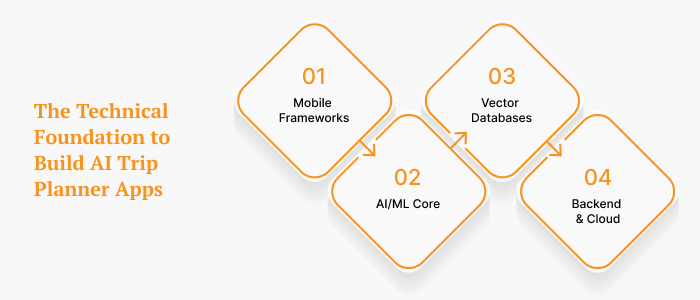
- Mobile Frameworks: For cross-platform efficiency, React Native or Flutter are the industry standards, ensuring a 100% consistent experience on both iOS and Android.
- AI/ML Core: You’ll likely use a combination of OpenAI’s GPT-4o or Google Gemini for natural language processing, paired with custom Python-based models for recommendation engines.
- Vector Databases: Tools like Pinecone or Weaviate are essential for “Semantic Search,” allowing your app to understand that “a quiet place to read” means a library or a secluded park, not a noisy café.
Backend & Cloud: Node.js or Python (FastAPI) hosted on AWS or Azure provides the scalability needed to handle millions of real-time queries.
Step-by-Step: How to Build AI Trip Planner Apps
Step 1: Define Your Niche
Don’t try to be “Expedia but with AI.” If you want to build AI trip planner products that stand out, focus on a specific segment: sustainable travel, luxury solo trips, or budget-friendly family vacations.
Step 2: Data Acquisition & Integration
Your AI is only as good as its data. You need to integrate with GDS (Global Distribution Systems) like Amadeus or Sabre, and use Web Scraping or APIs (TripAdvisor, Yelp) to get real-time reviews and local insights.
Step 3: Develop the Core AI Logic
This involves hiring expert AI developers to build the “Prompt Engineering” layer that translates user queries into actionable search parameters.
Step 4: Design the UI/UX
In AI apps, “less is more.” The interface should feel like a conversation, not a dashboard. Focus on clean, minimalist designs that highlight the AI’s suggestions.
Step 5: Testing & MVP Launch
Start with a Minimum Viable Product (MVP). When you build AI trip planner apps, launch in one geographic region, gather user feedback on the accuracy of the AI itineraries, and iterate rapidly.
The Sphinx Advantage: Your Partner in AI Innovation
At Sphinx Solutions, we don’t just write code; we build business-ready intelligence. With over 15 years of experience and 1500+ solutions delivered, we specialize in helping brands navigate the complex world of custom software development services.
When you partner with us, you gain access to:
- 200+ In-house Resources: Our team includes dedicated prompt engineers and AI specialists.
- 80% Faster Time-to-Market: We use proven frameworks and agile methodologies to get your app live while the market window is wide open.
- End-to-End Transparency: From the first wireframe to post-launch support, you are involved in every step of the journey.
Challenges to Consider: Balancing Speed with Security
While the benefits are immense, building an AI app in 2026 comes with specific risks:
- Data Privacy: Handling travel documents and payment info requires GDPR and SOC2 compliance.
- AI Hallucinations: Sometimes AI might suggest a restaurant that closed three years ago. Implementing a Verification Layer that cross-checks AI suggestions against live Google/Yelp data is non-negotiable.
- API Costs: Running high-volume queries through LLMs can become expensive. Token Optimization is a key technical skill your development team must master to protect your ROI.
Are you prepared to handle the security implications of storing user-specific travel patterns? Ensuring your website and app security is up to par is the first step toward building user trust.
Frequently Asked Questions (FAQ)
Q: How much does it cost to build AI trip planner software?
A: Costs vary depending on complexity, but a robust MVP typically ranges from $40,000 to $100,000. The primary cost drivers are the number of API integrations and the complexity of the custom AI models.
Q: Can I integrate my existing travel booking site with AI?
A: Absolutely. Most of our clients use our generative AI development services to add “intelligent layers” to their existing platforms rather than rebuilding from scratch.
Q: How long does development take?
A: A standard MVP can be ready for launch in 12 to 16 weeks. Our focus on agile development ensures you see a functional version of your app within the first month.
Q: Is AI travel planning just a trend?
A: With 63% of frequent travelers already relying on AI for every single trip, it’s no longer a trend: it’s the new industry standard.
Final Thoughts: Your Journey Starts Here
The travel industry has reached its “iPhone moment.” The companies that embrace AI-driven planning today will be the market leaders of tomorrow. If you want to build AI trip planner experiences that win, focus on personalization, real-time utility, and a rock-solid tech stack so you can create an experience that doesn’t just help people travel: it helps them discover.
Ready to transform your vision into a world-class application?
Contact Sphinx Solutions today to discuss your project with our expert consultants. Let’s build the future of travel, together.


 Shaili Gupta



 Ajay Wadne
