Output quality
Fewer vague, irrelevant or off-topic responses.
Structured, tested prompts for GPT, Claude and Gemini, with the context and guardrails that turn an inconsistent demo into a feature you can put in front of customers.
Trusted By
750+ happy clients, including top Fortune 500 companies













Overview
Prompt engineering is the practice of designing, testing and refining the instructions given to a large language model (LLM) to produce accurate, relevant and consistent output.
It pairs natural language skills with an understanding of how models like GPT, Claude and Gemini interpret context, so the same underlying model performs noticeably better once it’s live.
In practice, that means writing clear instructions, supplying the right context and examples, structuring multi-step prompts, and testing outputs against edge cases before anything reaches an end user. Good prompt engineering makes an AI development project actually behave as intended in production.
Why It Matters
A model is only as useful as the instructions behind it. Well-engineered prompts directly affect six things.
Fewer vague, irrelevant or off-topic responses.
Prompts aligned to the actual task, not generic use.
Added context and constraints that keep the model grounded.
Prompts that hold up across thousands of runs, not just a demo.
Standardised prompt structures across teams and use cases.
Prompts built within compliance, security and data-handling constraints.
What We Provide
We keep our LLM prompt engineering services focused and practical, designed to plug into your existing AI initiatives rather than exist as a bolt-on product. These services are typically delivered as part of a broader AI development, generative AI or AI chatbot development engagement.
01
We design prompts around your specific use case: a customer-facing chatbot, an internal copilot, or a document-processing workflow for teams still shaping their approach.
Talk to our service experts02
Every prompt is tested against real inputs and edge cases, with structured evaluation before deployment.
Talk to our service experts03
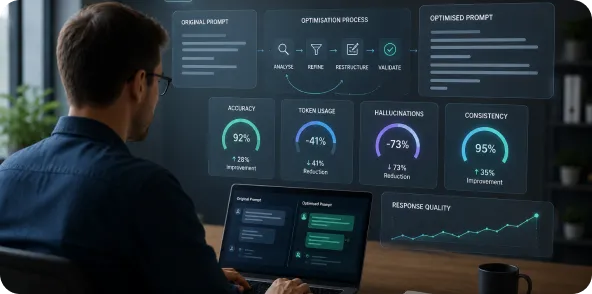
We iterate on existing prompts to improve accuracy, cut token usage, and reduce hallucinations and inconsistent responses.
Talk to our service experts04
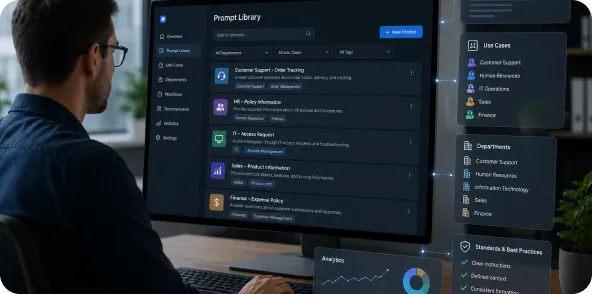
For teams scaling AI across departments, we build reusable, documented prompt libraries so results stay consistent as usage grows.
Talk to our service experts05
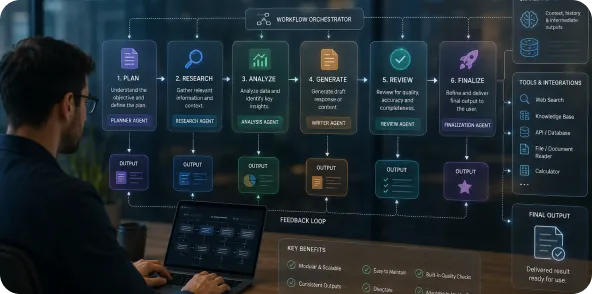
We design prompts for multi-step, agentic workflows, where one model’s output feeds the next step in an automated process.
Talk to our service expertsUse Cases
Five places where the prompt layer, rather than the model, is what decides whether the feature works.
Design prompts that enable AI chatbots and virtual assistants to deliver accurate, context-aware and brand-consistent responses. Well-crafted prompts help improve customer experiences while reducing repetitive support workloads.
Develop prompts for AI assistants that integrate with organisational knowledge, internal tools and business workflows. This enables employees to access relevant information, automate routine tasks, and make faster, informed decisions.
Create structured prompts that produce high-quality content with a consistent tone, format and messaging. This supports scalable content creation for marketing, documentation, customer communication and knowledge management.
Build prompts that help AI retrieve, interpret and summarise information from large document repositories. This makes enterprise knowledge more accessible while reducing the time spent searching through complex datasets.
Develop prompt workflows that guide AI through multi-step tasks, decision-making processes and business operations. By combining prompt engineering with automation, organisations can streamline repetitive processes and improve operational efficiency.
Benefits
What changes once the prompt layer is engineered rather than improvised, measured against the same model you are already paying for.
Generate more accurate, relevant and context-aware responses without modifying or retraining the underlying AI model.
Minimise unnecessary token usage and API consumption to optimise AI performance while reducing overall operating costs.
Deliver reliable, standardised AI outputs across users, teams, departments and multiple business applications.
Reduce development time with structured prompt engineering, enabling faster implementation and quicker time-to-value.
Enhance the performance of existing AI models and LLMs, helping organisations achieve greater value from their AI initiatives.
Build prompt strategies that adapt seamlessly as AI adoption expands across teams, workflows and business functions.
How We Work
Our prompt engineering process follows a structured and iterative approach designed to improve the quality, consistency and reliability of AI-generated outputs. From understanding your business objectives to deploying production-ready prompts, each stage is built to make the model behave the same way on the thousandth run as it did on the first.
Step 1
What we do: We begin by understanding your business objectives, AI use case, target audience and existing AI ecosystem. Our team evaluates where current AI outputs are underperforming and identifies opportunities to improve response quality, accuracy and user experience.
What you get
Step 2
What we do: We analyse your requirements to determine the most suitable AI model, prompting methodology and response strategy. This stage ensures the prompts are designed around your business workflows and expected outcomes.
What you get
Step 3
What we do: Our prompt engineers develop structured prompts using industry best practices, including role prompting, contextual instructions, few-shot prompting, chain-of-thought guidance where appropriate, and output formatting. Every prompt is tailored to generate reliable results.
What you get
Step 4
What we do: We evaluate prompts across multiple real-world scenarios, edge cases and complex user inputs to assess accuracy, consistency, safety and response quality. Testing helps identify opportunities for refinement before deployment.
What you get
Step 5
What we do: Based on testing insights, we refine prompts to improve response quality, reduce unnecessary token usage and optimise overall AI performance. We focus on balancing accuracy, scalability, cost efficiency and response speed.
What you get
Step 6
What we do: Once the prompts are finalised, we help integrate them into your AI application, chatbot or enterprise workflow. We also provide documentation and ongoing optimisation support as your AI use cases evolve.
What you get
Comparison
Anyone can write a prompt that works once. The difference shows up at scale, when the same instruction has to hold across thousands of runs, different users and inputs nobody anticipated. These ten factors are where the two approaches separate.
| Feature | Basic AI prompting | Professional prompt engineering |
|---|---|---|
| Prompt design | Simple, one-time prompts | Structured, reusable and goal-oriented prompts |
| Response quality | Inconsistent and unpredictable | Accurate, reliable and context-aware outputs |
| Business context | Limited understanding of workflows | Tailored to business objectives and domain requirements |
| Output consistency | Varies between users and sessions | Standardised responses across teams and applications |
| Testing & validation | Minimal or no testing | Comprehensive testing across multiple scenarios and edge cases |
| Prompt optimisation | Trial-and-error improvements | Continuous refinement based on performance metrics |
| Scalability | Difficult to manage across projects | Easily reusable across products, teams and workflows |
| Token efficiency | Higher token consumption | Optimised prompts that reduce unnecessary API costs |
| Enterprise readiness | Suitable for individual use | Designed for production-grade AI applications |
| Long-term maintenance | Manual updates and inconsistencies | Well-documented prompts with ongoing optimisation support |
If your organisation is using generative AI for customer support, content creation, workflow automation or enterprise applications, investing in professional prompt engineering can significantly improve response quality, consistency and overall AI performance.
While basic prompting may work for simple tasks, structured prompt engineering helps businesses build reliable, scalable and production-ready AI solutions that deliver long-term value.
How We Engage
Whether you need a dedicated prompt engineer for long-term AI initiatives or short-term support for a specific use case, we offer flexible engagement models that align with your business objectives, project scope and delivery timelines. Each model is designed to provide the right level of expertise while ensuring seamless collaboration with your internal teams.
Ideal for organisations with ongoing AI initiatives that require continuous prompt design, testing and optimisation. A dedicated prompt engineer works closely with your team, helping improve AI performance, support evolving business requirements and maintain consistent prompt quality throughout the engagement.
Best suited for businesses looking to solve a specific AI challenge, such as developing prompts for an AI chatbot, enterprise copilot, document processing solution or content generation workflow. Our engineers support your project from prompt design through testing and optimisation until the defined objectives are achieved.
For organisations building enterprise AI applications or generative AI products, our prompt engineers can work alongside AI developers, ML engineers and software teams as an integrated part of your delivery process. This model ensures prompt engineering aligns with the broader AI architecture, product roadmap and deployment strategy.
Expert Insights
The gap between a demo and a production AI feature is almost always the prompt. Teams assume a better model fixes inconsistent output, but the real leverage is in structured, tested prompts with the right context and guardrails. Get the prompt engineering right and the same model becomes reliable, cheaper to run, and safe to put in front of customers.
Why Choose Us
Sphinx has completed 16 successful years in the industry, helping businesses with technology and digital transformation, including AI-powered solutions across major industry verticals.
We have a dedicated and reliable team of AI engineers, ML scientists, data engineers, and MLOps specialists covering every role in the AI development lifecycle.
We have delivered more than 1,500 solutions through a results-driven approach, many to recurring clients who keep expanding their AI capabilities with us.
We have a dedicated in-house team, experienced and skilled across AI development, software engineering, QA, DevOps, and cloud infrastructure.
We are trusted by 750+ clients for best-in-class AI solutions at competitive rates, with the delivery accountability enterprise clients demand.
Our client-centric approach and high-calibre AI engineering, built on current models and frameworks, have made us a trusted partner for businesses building AI.
Not sure which engagement model is right for you?
Connect with us
Tell us where your AI output goes wrong today and we’ll come back with a prompt strategy, a test plan and a timeline.
Everything you need to know about hiring a prompt engineer through us. Can’t find your answer? Talk to us.
A prompt engineer is an AI specialist who designs, tests and optimises prompts that guide AI models to generate accurate, relevant and consistent outputs. They work with leading generative AI technologies such as OpenAI GPT, Claude, Gemini, Midjourney, Stable Diffusion, Imagen and DALL·E to support AI-powered applications, automation workflows and business solutions.
Prompt engineering is the process of creating and refining instructions that help AI models produce reliable and context-aware responses. Well-designed prompts improve the accuracy, consistency and relevance of AI-generated outputs while reducing errors, making them essential for building high-performing generative AI applications across industries.
Yes. Prompt engineers specialise in working with leading Large Language Models (LLMs), including OpenAI GPT, Gemini, Claude, Llama and Mistral. They design and optimise prompts that improve response quality, align outputs with business objectives, and help organisations maximise the effectiveness of their AI-powered applications.
The cost of hiring a prompt engineer typically ranges from $15 to $25 per hour, depending on factors such as experience, technical expertise, project complexity and engagement model. Pricing may also vary based on whether you require a dedicated resource, project-based support, or an engineer embedded within a larger AI development team.
Hiring a prompt engineer from Sphinx Solutions is a simple three-step process. First, share your project requirements so our experts can evaluate your needs. Next, interview shortlisted engineers to assess their technical and communication skills. Once finalised, your dedicated prompt engineer can be onboarded quickly after completing the NDA and service agreement.
Hiring prompt engineers from Sphinx Solutions provides a faster and more flexible alternative to building an in-house team or working with freelancers. You benefit from quicker onboarding, transparent pricing, enterprise-grade security, experienced AI professionals and scalable engagement models designed to support projects of varying sizes and complexity.
Yes. Prompt engineering plays an important role in Retrieval-Augmented Generation (RAG) systems by helping AI models retrieve, interpret and utilise relevant information from enterprise knowledge bases. Optimised prompts improve the quality, accuracy and contextual relevance of AI responses, making RAG applications more reliable and effective.