Key Takeaways
- AI copilots function as team members that assist with tasks and provide advice or decisions, with a human always in control of the operation.
- Autonomous AI agents take multi-step processes to execute a task with reduced human intervention.
- The main difference between AI copilots and AI agents is autonomy. Copilots assist with work, while agents can plan, decide, and execute tasks.
- No one solution is ideal for every company. The best option will vary depending on the task at hand, its associated risk level, and how many stages of automation it contains.
- Copilots and Agents can also be paired, letting human judgment guide, while an agent executes the action more efficiently.
The topic of AI copilots vs AI agents may be one of the most confusing topics in the enterprise AI landscape these days, mostly because the term is used without distinction. An AI agent can be given a goal and carry it through multiple steps, calling tools and systems on its own, with a person only stepping in where the business decides that’s necessary.
That one difference between who’s actually driving the workflow is more useful than any feature list when you’re deciding what to build or buy.
What is an AI Copilot?
An AI copilot stays within a workflow in the background and assists humans in doing their tasks quickly. It drafts, summarises, suggests or alerts, while the human analyses it and determines the next step. The copilot doesn’t own the outcome. The human does.
What it actually looked like was support agents with copilot suggestions used for writing responses that are then proofread and sent by the agent, salespeople reviewing lead history from notes taken by a bot before making a call, and developers given suggestions by a coding copilot but still reviewing and accepting those code suggestions. The AI produces something useful; the person remains the last checkpoint.
Copilots vary in how much initiative they take. Some only respond when asked. Others proactively surface suggestions. What they share is that the human retains authority over the final action, which keeps the risk profile relatively low and adoption relatively fast.
What is an AI Agent?
An AI agent has a goal, not a single prompt, which it must figure out how to achieve. It comes up with a plan-a sequence of steps to take-calls the tools and APIs that are necessary, reviews the results of those calls at each step, and corrects itself. All without intervention by a human at each step.
Take a finance team automating overdue invoice follow-ups. An agent can identify which accounts are overdue, check payment history, send a reminder through the appropriate channel, log the interaction, and escalate anything unusual to a human, on its own within the boundaries it’s been given. That’s meaningfully different from a chatbot that only answers “what’s my invoice status” when someone asks.
It’s characterised by the actions: planning, using tools, enabling execution on systems without a person doing each step by step. Supervision continues but in the form of limits and checks rather than pre-approval at each stage.
AI Copilots Vs. AI Agents: Key Differences
The key difference between AI copilots and AI agents are:
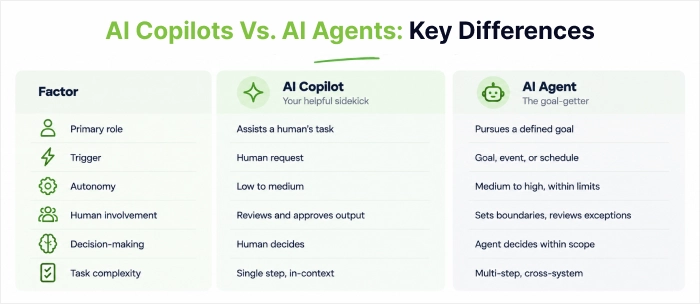
| Factor | AI Copilot | AI Agent |
| Primary role | Assists a human with a task | Pursues a defined goal |
| Trigger | Human request | Goal, event, or schedule |
| Autonomy | Low to medium | Medium to high, within limits |
| Human involvement | Reviews and approves output | Sets boundaries, reviews exceptions |
| Decision-making | Human decides | Agent decides within scope |
| Task complexity | Single step, in-context | Multi-step, cross-system |
| Planning | Minimal or none | Plans a sequence of actions |
| Tool/API usage | Limited or none | Core capability |
| Workflow execution | Human executes | Agent executes |
| Cross-system interaction | Rare | Common |
| Oversight | Continuous, in the loop | Boundary-based, exception-driven |
| Error handling | Human catches it before it matters | Needs built-in guardrails |
| Best suited for | Judgment-heavy, variable tasks | Repeatable, well-defined workflows |
| Implementation complexity | Lower | Higher |
| Governance requirements | Light | Substantial |
| Typical business outcome | Faster human output | Completed task, less manual work |
The distinction that matters most isn’t autonomy in the abstract. It’s who executes the action and who’s accountable when something goes wrong. A copilot’s mistake gets caught before it reaches a customer or a system of record, because a person is still in the loop before anything happens.
An agent’s mistake can propagate several steps before anyone notices, which is exactly why agent deployments need stronger guardrails, not just a more capable model.
Real-World Examples of AI Agents Vs. AI Copilots
Let’s understand with a real-world example of AI agents vs Copilots:
One customer submits a dispute of an invoice.
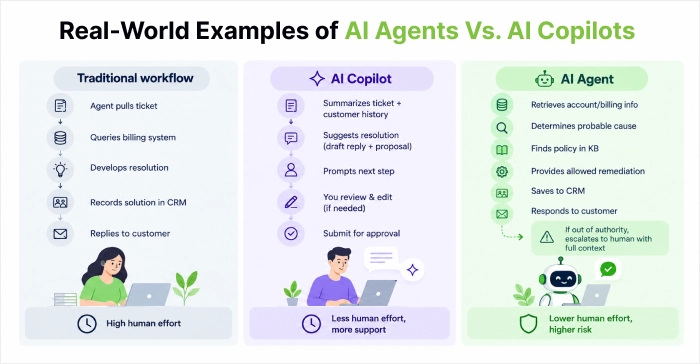
- Traditional workflow: Agent pulls ticket, queries billing system, develops resolution, records solution in CRM, replies. Every step takes human time.
- AI copilot workflow: It will then sum up the ticket and Customer History, offer a resolution (draft a reply with its own proposal) and prompt the next step. Then you’ll review the reply and edit if necessary and submit it for approval. Your decision ultimately, Copilot simply removed the necessary effort in finding and drafting it.
- AI agent workflow: When the agent receives the ticket, the agent retrieves the customer’s account/billing info, determines probable cause, finds applicable policy in KB, provides allowed remediation (within agent capabilities) if applicable, saves to CRM, and responds to the customer. If the case falls outside its authority, such as a refund above a set threshold, it escalates to a human with full context attached.
The same starting point, with three vastly different amounts of human labour and three vastly different risk levels.
Which is a Better Option: AI Copilot or AI Agent?
None is better than the others; they run on different workflows, and we just happened to settle on the one that sounds better.
A copilot is the right choice when you need to maintain a role for the human in the decision-making process, decision points have some level of significance or reputation risk, the job has enough variability that a standard process is hard to document, and the final consumer of the output wants to retain approval.
Usually, an agent makes more sense to implement if there’s an easy, repeatable AI workflow automation, it has a definite goal, spans multiple systems/steps, control can be exerted via permissions/guardrails, and there’s an ability to measure the ROI on an automation.
Rule that’s worth remembering: choose based on the workflow, not the AI label. A “copilot” that silently does things behind the scenes is effectively an agent using a less scary name. An agent that merely suggests and never acts is in effect a copilot; so always think about what the system is capable of, regardless of the vendor’s terminology.
Can AI Copilots and AI Agents Work Together?
Yes, this will soon be more the case than not for mature enterprise deployment a typical hybrid implementation looks something like:
copilot → human decision → AI agent → execution → human review
A copilot helps a person make a judgment call on something ambiguous or high-stakes, and once that decision is made, an agent takes over the repeatable execution that follows it.
A procurement example: A copilot helps the category manager assess the comparison between the vendors to choose the preferred one, with the caveat that there needs to be discretion that cannot be assigned to AI. After it is approved by the manager, the repeatable section is taken care of by the agent by getting the contract approved by various signatories, making the relevant updates to the procurement system, and notifying the necessary stakeholders.
Judgment stays with a person; repeatable execution moves to the agent. This is also where agentic AI, as a broader design approach, becomes relevant to how these systems are architected together rather than as isolated tools.
How to Decide Between an AI Copilot and an AI Agent?
Answer these questions before you buy:
- Is it essential that humans intervene in all the tasks in the workflow, or just in all decision points in the workflow?
- Is the process reproducible in such a way that the flow can be determined with ease, or does each execution of the workflow differ in shape?
- Can the desired outcome be formulated into specific, measurable definitions?
- Is it essential for the solution to access APIs or business applications to accomplish the required activity?
- What to do if the AI fails, and how much is the price for failure to occur?
- Can the actions involved be restricted through permissions and guardrails?
- Does the business need suggestions to work from, or completed outcomes?
- Can success be measured against a clear baseline?
A simple rule follows from those answers: if the human needs to own the workflow, start with a copilot. If the AI can safely own execution within clearly defined boundaries, consider an agent.
When one condition exists at some point in a process and the other at another point in a process, create a hybrid. Use this as a pragmatic first step and not as an inviolable technical constraint. The answer is usually much clearer post-pilot than on paper.
What are the Benefits & Challenges?
Copilots are a quick-to-adopt, human-in-the-loop approach that offers less risk of unintended action on the part of the AI. They may not reduce as much manual effort as execution-level automation because human involvement is ongoing.
Each has benefits and drawbacks. Why use AI agents? They let us have complete automation, scale them across multiple instances of the same task, and use them to coordinate work across different systems without human intervention. The challenge is increased governance, security, integration, and oversight-and unintended actions are a very real risk if you don’t plan for guardrails.
What Businesses Should Consider Before Deploying AI Agents?
Before you go from copilot to agent, or build an agent from scratch, ask yourself, in honesty:
- Do I have good data I can easily get?
- What APIs and system integrations do we actually have?
- What access and permission boundaries do I need?
- What human-in-the-loop checkpoints do I need?
- Do I have the observability and audit trails of the actions we take?
- How do I test this in the real world?
- What fallback behaviour do I want when something goes wrong?
- What are the KPIs?
If you don’t have at least some of these, it will be a production incident, not a planning discussion.
Conclusion
The answer to the “AI copilot vs AI agent” question is not about which technology is better. The matter is what the two accord as the authority that should and can be yielded to in a workflow. The judgmental, emotionally charged or variable tasks stay firmly with the copilot human at the helm.
It’s the predictable, bounded, defined work where the agent is valuable. Most enterprise AI agents that get this right end up running both, often in the same process, rather than picking one label and standardising on it everywhere.
If you’re trying to work out where your own workflows fall on that spectrum, and what governance an agent deployment would actually require, that’s the kind o f assessment Sphinx Solutions works through with enterprise teams before any build begins.
FAQ’s:
Can AI copilots and AI agents work together?
Yes. A common hybrid pattern uses a copilot to support a human decision, then hands the repeatable execution that follows to an agent, combining human judgment with automated follow-through.
What is the difference between an AI copilots and an AI agents?
An AI copilot assists a person who stays in control of the task and the final decision. An AI agent is given a goal and can plan, act, and execute multiple steps across systems largely on its own, within defined boundaries.
Is ChatGPT a copilot or an AI agent?
On its own, ChatGPT functions more like a copilot: it drafts, answers, and suggests, while a person decides what to do with the output. It can become part of an agentic system when connected to tools and given the ability to act autonomously.
Are AI agents more advanced than AI copilots?
Not necessarily more advanced, just built for a different job. Agents handle repeatable, multi-step execution well; copilots handle judgment-heavy, variable work better. The right fit depends on the workflow, not which one sounds more sophisticated.
Can an AI copilot become an AI agent?
Yes, in practice this is a common evolution. A copilot that starts by only suggesting actions can be given tool access and permission boundaries over time, gradually taking on execution and shifting toward agent-like behaviour.
What should a business consider before deploying an AI agent?
Data quality, system integrations, access controls, human-in-the-loop checkpoints, audit trails, and clear success metrics all need to be in place first. Skipping these tends to surface as production problems rather than planning issues.


 Shaili Gupta

 Ajay Wadne