Key Takeaways
- There is no one-size-fits-all approach: Choosing between in-house and outsourced software development depends on our budget, project requirements, available skills, and long-term business goals.
- In-house development gives greater control: Having a permanent team makes it easier to manage daily activities, protect sensitive information, collaborate closely, and maintain long-term product knowledge.
- Outsourcing helps to move faster: Businesses can access experienced developers, specialized technical skills, and ready-to-work teams without spending months on recruitment and training.
- Look beyond the initial development cost: In-house teams involve salaries, infrastructure, employee benefits, and recruitment expenses. Outsourcing has vendor fees, contract costs, and possible additional charges. Compare the total cost before committing.
- Choose an outsourcing partner carefully: Technical expertise alone is not enough. Check the provider’s communication practices, security standards, project experience, code ownership terms, and ability to support future requirements.
- A hybrid model can offer the right balance: We do not always have to choose one approach. Keep core product decisions, business knowledge, and intellectual property within our organization while using external teams for specialized skills and additional development capacity.
The major decision to go for in house or outsourced team is purely based on the key criteria like cost, flexibility, and expertise. Outsourcing means hiring an external vendor or talent pool, while in house development goes for a long-term engagement with fixed costs and certain employee benefits.
Each choice corresponds with its own complexities and opportunities. This is where outsourcing software development, with its capability to expedite hiring and training, stand outs as a realistic option. For businesses weighing in-house vs outsourced software development, these data points help in decision-making.
Worldwide IT outsourcing revenue is estimated by Statista, to reach out $618.36 billion in 2026, Mordor Intelligence puts the market at USD 638.65 billion in 2026, rising to USD 752.08 billion by 2031. These figures make the picture clear that businesses are still depending upon outsourcing to fill gaps, drive value, and offer end-to-end solutions as they build a blueprint for the future. The IT outsourcing industry’s rapid growth doesn’t mean it’s the right choice for us. Selecting between in-house and outsourced software development depends on our budget, project requirements, available skills, and long-term business goals.
In-House vs. Outsourced Software Development: Quick Comparison
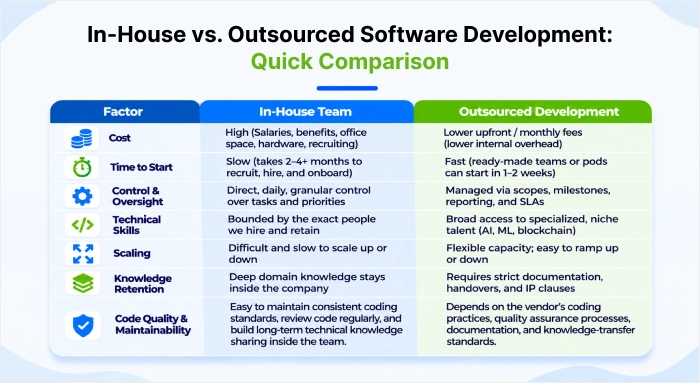
The brief comparison helps to see the two model’s side by side. The in-house vs outsourced software development decision usually comes down to factors such as how much we can spend, how fast we need to start, how much control we want, and whether our team has the required skills as per the project requirements. The table below gives us a quick idea of where each model stands, so we can spot early on which one leans closer to our preferences i.e. priorities.
| Factor | In-House Team | Outsourced Development |
| Cost | High (Salaries, benefits, office space, hardware, recruiting) | Lower upfront / monthly fees (lower internal overhead) |
| Time to Start | Slow (takes 2–4+ months to recruit, hire, and onboard) | Fast (ready-made teams or pods can start in 1–2 weeks) |
| Control & Oversight | Direct, daily, granular control over tasks and priorities | Managed via scopes, milestones, reporting, and SLAs |
| Technical Skills | Bounded by the exact people we hire and retain | Broad access to specialized, niche talent (AI, ML, blockchain) |
| Scaling | Difficult and slow to scale up or down | Flexible capacity; easy to ramp up or down |
| Knowledge Retention | Deep domain knowledge stays inside the company | Requires strict documentation, handovers, and IP clauses |
| Code Quality & Maintainability | Easy to maintain consistent coding standards, review code regularly, and build long-term technical knowledge sharing inside the team. | Depends on the vendor’s coding practices, quality assurance processes, documentation, and knowledge-transfer standards. |
What Is In-House Software Development?
In-house software development means a company builds its software with its own employees(resources). No outside agency or vendor is involved. The business hires a full-time team, often from scratch, and that team designs, builds, tests, and maintains the software. The team works inside the company like any other department, like sales or finance.
The idea is easy to understand. What many people don’t think about is what it takes to set up and run this team.
Who will be in the In-House Team?
It depends on what you’re building. A small tool for one department may need only one or two developers. A complete product usually needs a big team, with roles like these:
- Business analysts: work out what the business needs and write it down clearly
- UI/UX designers: plan how the product will look and how easy it is to use
- Software developers: write the code for the web, mobile, and back-end
- Software architects: make the key technical decisions at the start
- QA and test engineers: find and report bugs before users see them
- Team lead and project manager: organize the work and keep everyone on track
Hiring Is only the First Step
Building an in-house development team takes effort. We need to write job descriptions, post the openings, review applications, and run several rounds of interviews. After that come job offers, salary talks, and onboarding. HR, managers, and senior engineers all spend time on this, on top of their regular work.
Our responsibility doesn’t end once people join. Like other employees, developers want guidance, regular feedback, chances to learn, and a clear path to grow in their careers. If the company doesn’t offer these, good developers often leave.
What In-House Teams Make?
Many people picture internal developers building big, exciting products. In practice, most of their work is more practical. In-house teams usually build tools the company uses itself, such as:
- Dashboards and reports that managers check regularly
- Automations that handle boring, repetitive tasks
- Connections between systems like the CRM, ERP, and accounting software, so staff don’t have to copy data by hand
- Small apps solving one specific problem for one team
Maintenance is another big part of the job. The developers team fixes bugs, updates old code, applies security patches, and keeps important systems running smoothly. When this work is done well, nobody notices it, and that’s one of the main reasons companies keep developers on staff.
What is Outsourcing Software Development?
When a company outsource software development, it hires an external team with the required staff, experience, and skill set to develop a certain software solution.
We can deploy the development team either locally (onshore) or, in a neighbouring country with a similar time zone (nearshore), or in any other geographic area and time zone (offshore).
Additionally, outsourcing a software development team allows us to utilise their certifications, skills, and industry experience, irrespective of their location and time zone.
There are three main outsourcing models depending on the need to choose a type of developer team:
- Staff Augmentation
Staff augmentation works best when the team is strong but stretched. The vendor offers skilled developers who join the existing team, follow processes, and report directly to the concerned tech leads. The team management keep full control over tasks, priorities, and code quality, while filling skill gaps in weeks over months. It is also the easy model to scale down or exit if needs change. The key factor is that solid internal management is really required to guide the added talent.
- Dedicated Team
A dedicated team is a group of software engineers the vendor develops and manages to work only on the company product. They act as an extension of company team, but day-to-day people management, hiring, and replacements stay with the vendor. This gives us long-term continuity and deep product focus without any overhead of recruiting and retaining staff. It suits growing products needing for steady development capacity over months or years. To make it work, one need clear goals, regular reviews, and well-defined ownership between both sides.
- End-to-End Outsourcing
End-to-end outsourcing hands the entire development lifecycle to the vendor, from discovery and design to development, testing, launching, and support. We can define the vision and business goals, and the vendor delivers a finished product against an agreed scope and timeline. A well-defined software discovery phase helps businesses identify project requirements, technical challenges, expected outcomes, and resource needs before development begins.
This is ideal for companies without an internal technical team or for well-defined projects with a clear end point. It needs the least management effort on our side. it also offers the least daily visibility, too strong contracts, milestones, and IP clauses are required.
In-House vs. Outsourced Software Development: Pros and Cons
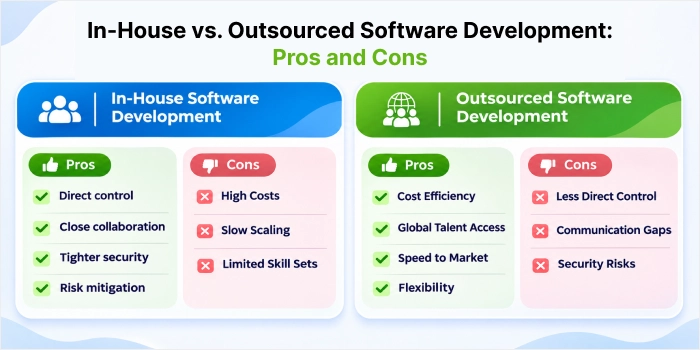
Choosing between in-house and outsourced software development covers understanding what each model brings to the table and where its limitations lie. Both approaches come with cost, management, and security challenges. Understanding these pros and cons helps businesses choose a development model that fits their immediate needs and future growth.
In-House Software Development
One can find in-house software development advantages are greater control, closer collaboration, and long-term product ownership, outsourcing offers access to specialized skills, faster delivery, and flexible resources.
Pros
- Direct control: The biggest advantage of in-house software development is the fact that we are directly supervising the complete process. This gives us more control to shift various features and control the pace at which the product is developed.
- Close collaboration: When all is done in-house, collaboration is tight, and communication is more reliable. This means that separate teams all work toward the same goal. For example, the marketing team knows which features to advertise, and our customer service knows whom to contact or connect with when there’s a problem.
- Tighter security: Some of the information involved in development is particularly sensitive, which is why we may not want unvetted external people accessing these files.
- Risk mitigation: When handling the project on own, it’s much easier to mitigate challenges and ensure project success. Still, this will take extra skill and effort.
Cons
- High Costs: We pay fixed salaries, benefits, equipment overhead, and recruitment fees regardless of project volume.
- Slow Scaling: Finding, interviewing, and onboarding qualified tech talent can take months to complete.
- Limited Skill Sets: Our team may lack specialized expertise required for niche or advanced technologies.
Outsourced Software Development
Businesses that outsource software development can access experienced developers across the globe, specialized technical skills, and faster ready-to-work teams without spending months on recruitment and training.
Pros
- Cost Efficiency: Paying for active development time, skipping long-term payroll overhead and benefits.
- Global Talent Access: Working with specialized domains resources, tech stacks, and global engineering expertise.
- Speed to Market: External agencies can deploy a ready team to build our product in weeks.
- Flexibility: We can scale the workforce up or down rapidly as project scopes change.
Cons
- Less Direct Control: Management relies on milestone tracking rather than hands-on oversight of daily coding.
- Communication Gaps: Working across different time zones, languages, and cultures can delay urgent updates.
- Security Risks: Sharing intellectual property with a third party demands strict compliance and legal vetting.
Side-by-Side Cost Comparison: In-House Development Vs Outsourced Development
Selecting between in-house and outsourced development includes more than comparing initial project costs. Businesses should consider employee salaries, recruitment, infrastructure, software tools, ongoing maintenance, and other operational expenses.
A side-by-side cost comparison given here helps reveal the actual financial commitment of each approach, making it easy to decide which option gives better value within the available budget.
When estimating the custom software development cost, businesses should consider not only the initial development budget but also ongoing maintenance, infrastructure, feature upgrades, and expenses for support.
| Factor | In-House Development | Outsourced Development |
| Total Cost of Ownership (TCO) | High upfront asset acquisition, but cheaper ongoing maintenance without vendor markups. | Cumulative feature upgrades, bugs, and expansions incur continuous vendor hourly fees or new SOWs. |
| Regional Cost Dynamic | Tied to local talent markets; high hub salaries with moderate savings via regional remote hiring. | High geographic arbitrage; leverages nearshore/offshore regions to drastically lower hourly engineering rates. |
| Hidden Costs | Recruitment fees (15–20% of salary), severance, training, and full payroll during project lulls or pivots. | Contract/IP legal fees, offboarding knowledge transfers, and internal hours spent managing and auditing vendors. |
| Common Budget Risks | Key developer attrition causing hiring delays, alongside internal scope creep that burns runway. | Vague specs trigger expensive change orders, and low-quality code risks a costly ground-up rewrite. |
When To Choose In-House or Outsourced Development?
The decision becomes clear when businesses evaluate their internal capabilities, project complexity, and long-term technology requirements. While an internal team may be best suited for products needing for long-term ownership, specialised domain knowledge, and strict security, outsourcing can be a practical option when you need additional expertise, faster execution, or flexible development capacity. Let’s look at when each approach makes more business sense.
When In-House Development is possible:
In-house software development is preferred when the software forms the core of our competitive advantage, needs deep institutional domain knowledge, or handles sensitive data under strict regulatory constraints.
- Core Business IP
The software is the primary product or proprietary ownership on algorithm or a dedicated platform rather than a utility or side tool.
- Deep Domain & Operational Context
The system requires continuous, real-time collaboration with internal business processes, operational workflows, or physical environments.
- Strict Compliance & Security
Industry faces heavy regulatory, privacy, or data-governance rules that restrict third-party or offshore access to sensitive code and user information.
- Long-Term Evolution
We anticipate endless, iterative updates, pivots, and feature rollouts over years, making an internal team more cost-effective and committed.
- Established Technical Leadership
Already having or can afford to hire an experienced engineering manager or chief technology officer who can architect the product and lead the team.
When Outsourcing Development is possible:
As businesses adopt new technologies and replying to changing customer expectations, building and maintaining the right digital capabilities has become increasingly important. Every business not necessarily has the budget, right domain expertise, or resources to manage software development entirely in-house.
Outsourcing can help businesses to access specialized skills, manage development costs, and complete projects more efficiently. Before deciding whether outsourcing is the right approach, businesses need to evaluate their internal capabilities, project requirements, and long-term technology goals.
- Determine If our Business can Benefit from Outsourcing:
Digital experiences are at the heart of almost every enterprise and are powered by customer insights and digital strategy. We cannot analyze which new technology or platform will come up in the next few years. It’s impossible for every small business to go with technological trends and make internal teams. So, this leads for requirement of outsourcing.
- Consider Different Funding Cycles and Processes:
Many companies have another process for funding an internal project vs. an outsourced project. When a company funds an external project there are often several layers or project approvals from several groups with many perspectives like IT, Project management office (PMO), Finance Executives. Having the project pass through so many people enable you to identify issues before the project kick-off like insufficient budget, unrealistic timelines, and adoption and support issues. This can help improve the chances of success.
So, before going to Outsourcing Management heads must consider below 5 factors:
- Define the business goal
- Define the role of software development in meeting the business goal
- Define outcomes of software development
- Draft a clear and comprehensive RFP
- Assess in-house capabilities in strategy, design and software engineering
By keeping these parameters in mind, business decision makers can more confidently decide about outsource software development needs.
Code Ownership, Control & Data Security
Choosing between in-house and outsourced software development involves balancing direct oversight against speed and cost, with distinct trade-offs across control, intellectual property (IP), and security.
Control & Workflow Management
The control level of a business retains over development activities may influence decision-making, project timelines, and the ability to respond to changing requirements. In-house and outsourced teams offer different levels of involvement in daily operations and workflow management.
- In-House Development: Offers maximum authority over the product vision, architectural decisions, and daily work pace. Permanent employees align closely with company culture, making it easy to pivot priorities, handle immediate fixes, and manage deep long-term integrations.
- Outsourced Development: Results in less direct control over daily execution and management. Workflow relies heavily on the vendor’s project manager, and coordination may be slowed or complicated by time zone gaps, language differences, and communication barriers.
Intellectual Property (IP) & Ownership
Ownership of the product, source code, and technical knowledge is an important consideration when selecting a development model. Businesses need to understand how each approach protects their intellectual property and makes sure for long-term access to critical assets.
- In-House Development: Gives clear and standard employee IP clauses. All source code, proprietary algorithms, and institutional knowledge stay directly inside corporate repositories and local environment.
- Outsourced Development: Carries structural IP risks depending on jurisdiction, contract terms, and vendor reliability. While well-drafted Master Services Agreements (MSAs) and Non-Disclosure Agreements (NDAs) legally assign IP to company, enforcing them across international borders can be complex. Furthermore, institutional knowledge tends to leave with the vendor when the contract ends.
Security & Data Protection
Software development mostly involves access to confidential business information, customer records, and proprietary systems. The choice between in-house and outsourced development can affect how this data is accessed, stored, monitored, and protected.
- In-House Development: Retains sensitive data, user records, and trade secrets strictly behind own corporate firewall, reducing the number of external entry points for prospective breaches.
- Outsourced Development: Offers security boundary outside the organization into the vendor’s infrastructure. Risks increase if the third party lacks strict data handling protocols. Mitigating these risks require rigorous standards like individual corporate VPN access, data obfuscation, adherence to OWASP guidelines, and regular security audits.
Key Risks of In-House and Outsourced Development
Each software development approach comes with its own challenges. An in-house team offers great control but can bring hiring difficulties, talent retention issues, and high operational costs. Outsourcing may reduce these pressures, but it also covers trusting an external partner with project delivery, technical decisions, and sensitive business data. Knowing these risks for in-house and outsourcing development types help businesses choose a development model meeting their needs without creating complications in the long run.
Key Risks of In-House Development
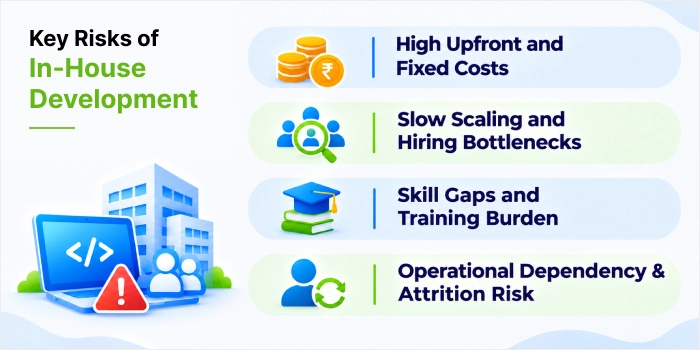
Building an internal team gives highest control, but it also takes business to heavy fixed overhead. When company hire in-house, primary vulnerabilities shift from external communication issues to long-term financial responsibilities and talent retention.
- High Upfront and Fixed Costs: Salaries, benefits, hardware, software licenses, and office infrastructure make heavy financial commitments irrespective of project fluctuations.
- Slow Scaling and Hiring Bottlenecks: Recruiting, interviewing, and onboarding qualified engineer’s takes months, making it tough to scale capacity up or down quickly.
- Skill Gaps and Training Burden: An internal team may not have specialized domain knowledge (like advanced AI/ML, blockchain, or complex security auditing), needing continuous and costly upskilling.
- Operational Dependency & Attrition Risk: If key internal architects or developers leave, core and codebase knowledge can leave with them, hampering delivery.
Key Risks of Outsourced Development
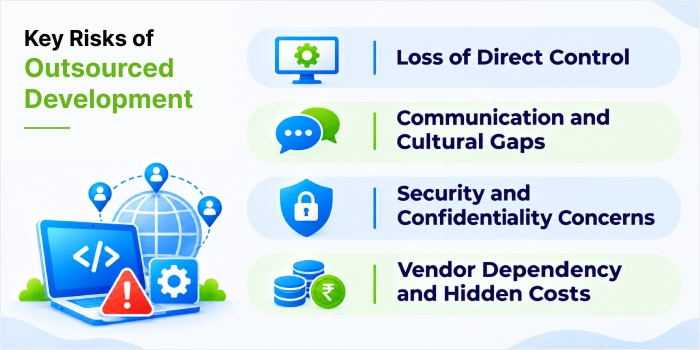
Delegating the project to an external vendor accelerates delivery, but it introduces variables outside our direct oversight. While outsourcing solves immediate capacity issues, it exposes the business to intellectual property vulnerabilities and misaligned quality standards. Let us discuss them here.
- Loss of Direct Control: Managing priorities, daily workflows, and technical decisions happens indirectly, which could lead to misaligned expectations or scope fail.
- Communication and Cultural Gaps: Time zones, language differences, and remote collaboration may slow down feedback loops unless strict communication frameworks are enforced.
- Security and Confidentiality Concerns: Sharing proprietary code, trade secrets, and sensitive user data with an external vendor increases exposure to intellectual property risks or data breaches.
- Vendor Dependency and Hidden Costs: Over-dependence on a third-party provider can lead to lock-in, while poor initial estimates may result in expensive rework, integration delays, or unexpected additional charges.
The Hybrid Approach: Combining In-House and Outsourced Teams
The name itself indicates that it’s a mix of both- Inhouse and outsourcing development. Progressive organizations are actively moving away from rigid, single-vendor frameworks to develop a unified ecosystem. Technical leaders now depend on an internal core to anchor business context, system architecture, and proprietary data ownership while bringing in trusted external specialists to handle the heavy lifting, extra workload, or highly specific tech tasks.
This approach also works well for businesses building scalable enterprise software, as internal teams can manage core architecture while external developers support additional features, integrations, and growing development needs.
Rather than handing off full projects blindly, used as a deliberate decision, the hybrid approach bridges the deep domain knowledge of an in-house team with the capacity of outsourcing. It keeps businesses agile, helps launching faster, and makes sure that our team doesn’t burn out in trying to do everything at once.
In-house software development model with external expertise makes a hybrid approach.
Key Benefits of the Hybrid Approach
Find below the key benefits of Hybrid approach:
- Smarter spending: Businesses can fix up the payroll and only pay for extra or specialized skills exactly when they are needed.
- Instant scaling: We can upgrade team up for a major launch or down during quiet periods without the tough process of hiring / layoffs.
- No talent limits: Local hiring shortages will be reduced, giving access to global specialists who can jump right in.
- Fast delivery: With an external team taking care of regular coding and testing, our core team is free to focus fully on innovation and launching features fast.
- Total control: As internal team stays at the centre of all, business’s proprietary code, data, and big-picture vision remain under control.
How to Choose the Right Development Model for Business
The old choice between only hiring in-house or only outsourcing is no more. The most successful teams look closely at their runway, their roadmap, and their daily bandwidth to see where they fit.
To know what business needs right now, refer the decision through three simple lenses mentioned below:
- Standing out: If we are building the core technology, proprietary algorithms, or unique features giving a competitive edge, keep it inside our walls. Internal team is the real owner. If we are building standard APIs, routine dashboards, or secondary features, hand them to a trusted partner.
- Speed versus stability: If we need to rush a functional MVP out the door in three months to secure funding or catch a market, hiring locally will slow us down. Outsourcing gives instant speed. But if we are building an enterprise model to run smoothly for the next five years, we need internal developers who care deeply about the long-term code quality.
- Actual management bandwidth: Building an internal team takes time, recruiters, and heavy overhead. Managing an external team takes clear documentation, strict processes, and constant communication. Refer to the current leadership team. Select the model that matches the amount of daily attention one can realistically give it.
Ultimately, we aren’t picking a side, we are designing a balance where our internal vision and external execution work in sync.
How to Choose the Right Software Development Partner
Finding the right partner isn’t about hiring a vendor. It’s about choosing a long-term partner for our next product cycle. When we move away from a strict in-house setup, we aren’t just buying code. We are trusting someone else with our vision. Mistakes happen because of a mismatch in communication, culture, and trust.
To find a partner who feels like a true extension of our team, look for these three traits:
- They aren’t afraid to challenge us: Avoid teams that simply nod and say “yes” to everything. A great partner brings their own expertise to the table. They will gently push back on our ideas, suggest simpler integrations, or warn us about hidden technical debt before writing any code.
- They fit into our daily rhythm: The right partner doesn’t work in a dark silo. They use our Slack, join our standups, and adopt our project management tools. They should feel so integrated into our workflow that our internal developers view them as true peers, not distant contractors.
- They respect our boundaries and code: True partners respect our security guardrails from day one. They ensure all intellectual property, source repositories, and cloud accounts stay firmly in our hands. Most importantly, they write clean, well-documented code that our internal team can easily take over later.
- They follow proper security practices: A good development partner must know how to protect your business data, source code, and customer information. Ask if they have ISO 27001 certification or a SOC 2 report. Also, check how they manage data access, storage, and security checks.
- They make ownership and exit terms clear: Before starting the project, make sure the agreement clearly states who owns the source code, designs, and other project files. It must explain what happens when the contract ends, including access to code, project documents, and knowledge transfer. This helps you to retain control of your software even after the partnership ends.
Shifting from Outsourced to In-House Development
Moving our project from an external agency back within our own roof isn’t just a logistical switch. It is a significant operational change. This pivot usually happens when a product hits its growth phase and we need total control over continuous updates. The safe approach is to treat this as a phased migration, never a sudden breakup.
Businesses planning legacy software modernization can also use this transition to review their current codebase, address technical limitations, and bring back critical development knowledge within their internal teams.
To pull off a smooth insourcing transition without breaking the live application, follow this three-step blueprint:
- Audit before we hire: Bring in a technical leader or a trusted internal CTO to dive deep into the existing codebase before making any hiring moves. They need to map out the system architecture, evaluate documentation quality, and identify potential bugs or dependencies that the external agency is currently managing.
- Run a parallel roadmap: Avoid a hard cutoff date. The most secured approach is to hire our new internal team in waves and have them work alongside the outsourced agency for a few months. Let the external team continue managing the core infrastructure while our new hires slowly take over smaller features and code reviews.
- Mandate a strict knowledge transfer: The context our vendor holds will not automatically transfer to new team. Make detailed system walkthroughs, direct repository ownership, and environment credentials standard deliverables well before the agency’s contract wraps up.
Conclusion
Selecting in-house vs outsourced software development depends on your business goals, budget, technical capabilities, and long-term product requirements. In-house development gives greater control, stronger internal collaboration, and better ownership of core technology, while outsourcing provides access to specialised talent, faster delivery, and flexible development costs.
However, no approach is without challenges. Businesses must consider recruitment expenses, skill availability, communication gaps, security risks, and intellectual property protection before deciding.
A hybrid development model can also offer a practical middle way out great to work on. By retaining core technical knowledge and product ownership internally while bringing in external experts for additional development needs, businesses can balance control, cost, and speed.
Ultimately, the right approach is not about choosing one model over the other. It is about building a development strategy that supports your current needs while giving your business enough flexibility to grow and adapt.
FAQs
What is the difference between in-house and outsourced development?
In-house development means we hire full-time employees to develop our software, with maximum control and long-term commitment. Outsourced development means we award contract to an outside agency to do the work, which gives us fast setup times and immediate access to global talent.
Why do companies use a hybrid development model?
Companies use a hybrid development model to get the best of both worlds. Internal team keeps full control over our core business strategy and data security, while an external team handles extra coding tasks or specialized technical needs without adding permanent payroll costs.
Is it cheaper to hire in-house or outsource?
Outsourcing is usually cheaper for short-term projects because we only pay for the work done without the recruiting costs, benefits, and equipment. For a core software product needing constant updates for years, building a permanent in-house team becomes more cost-effective over time.
What are the main risks of outsourcing software?
The biggest risks are communication gaps due to different time zones and losing control of our project. If we do not have clear contracts, we also risk poor code quality or legal issues over intellectual property and source code.
What parts of software development should we never outsource?
We should never outsource our core strategy, final software architecture decisions, and direct access to our cloud infrastructure. Internal team must always hold the keys to main code repositories and data platforms to keep our business safe.


 Shaili Gupta


 Ajay Wadne