Key Takeaways
- It’s more than a tech choice: Software development tech stack decides how quickly it will launch, how much to spend, and how far the product can grow.
- Start with what we are building: A content site, a SaaS dashboard, and a live chat app all need different tools. Pick for a project, not for what’s popular right now.
- Work with the skills we have: A stack team already knows will usually get to launch sooner, and for less, than one they must learn from scratch.
- Don’t confuse tools with structure: Stack and architecture are two separate decisions. For most new products, one well-organized application beats a dozen microservices.
- Know our numbers before we commit: Estimate traffic, data growth, and busiest moments early, then try selected stack on a small prototype before going all in.
Every business works on set of decision. A few businesses can revise their strategies; they can go for some collaborative platform or tool to get sound with their technical front. This will improve the required technical stack in software development of a project and will define project’s journey.
Every software project starts with one big decision: which technologies to build on. The software development tech stack shapes how fast we deliver, what to spend, and how easily our business grows. Right will do the job and wrong will make delays and errors.
Before finalising the technology choices, businesses need to understand the type of the problem they intend to resolve and the ecosystem in which the software will operate. Not every project needs the latest frameworks or complex development tools.
Some applications need fast data processing, while others depend on smooth communication between multiple business functions. Understanding these priorities offers a clear direction for technical decisions and keeps the development process aligned with the project’s actual objective.
What Is a Tech Stack in Software Development?
First, we need to understand tech stack for software development.
A tech stack is the set of technologies that gear up an application, right from the engaging user interface to the infrastructure working quietly in the background. The technologies in a stack unitedly work to scale up performance, guide user interaction, and identify if the product may grow seamlessly over time.
There is purpose- led key components in a technical stack in software development.
Frontend (Client Side)
It is the front-end interface which users see and experience. It can be fully engaging, intuitive or overwhelming.
- Markup and Styling: HTML decides structure, while CSS controls design and layout. Together, they develop the building blocks of each page or screen.
- Interactivity: JavaScript provides movement and responsiveness. Today’s applications are heavily depending upon frameworks like React, Angular, and Vue.js to simplify feature development.
- User Experience Layer: Frontend frameworks offer tools for state management, routing, and reusable components, making the user journey smooth while keeping development time under control and monitoring.
Backend (Server Side)
The backend is the warehouse for information, data and processing centre. It processes requests, executes business rules, and secures data.
- Programming Languages: Options like Python, Java, Node.js, Ruby, and more are available. Each comes with trade-offs in performance, developer availability, and ecosystem maturity.
- Frameworks: Tools like Django (Python), Spring Boot (Java), and Express.js (Node.js) reduce redundant work and bring consistency to the codebase.
- Databases: Structured (PostgreSQL, MySQL) or unstructured (MongoDB, Redis) systems save the data the application depends on. Selecting suitable one will impact all from query speed to reporting capabilities.
- Servers and Middleware: Apache, Nginx, or cloud-native runtimes like Node.js control traffic and connect communication between users and the application.
Supporting Technologies
Apart from the core layers, a tech stack adds the tools that keep smooth running of development and deployment.
- Operating System: Linux, Windows Server, or cloud-based environments lead compatibility and performance at the lower level.
- Version Control: Git, mainly paired with GitHub or GitLab, allows teams to track changes and collaborate.
- CI/CD Pipelines: Jenkins, GitHub Actions, or GitLab CI automate testing and deployment, lowering release bottlenecks.
- Containers and Orchestration: Docker and Kubernetes streamline packaging applications and scaling them across environments.
- APIs: APIs connect the dots, linking frontend and backend, or tying system into third-party services like payments, maps, or identity management.
Tech Stack vs Architecture: What’s the Difference?
These two terms get mixed up all the time, but they’re separate decisions. Software development tech stack is the tools we build with, like languages, frameworks, and databases. Our architecture is how those tools are organized and work together. The same stack can power a simple monolith or a full set of microservices, so it pays to make each choice on its own.
In daily use, people mostly count infrastructure and tooling as part of the stack, as we did above. Separating them, though, makes it easy to see which decision we are taking.
| Layer | What it means | Examples |
| Tech stack | The technologies we use | React, .NET, Python, PostgreSQL, Kafka |
| Architecture | How those technologies are organized and work together | Monolith, modular monolith, microservices, event-driven |
| Infrastructure | Where everything runs | AWS, Azure, Kubernetes, on premises |
| Tooling | The products that help to build, deliver, and monitor | GitHub Actions, Sentry, Datadog, OpenTelemetry |
Picking React, PostgreSQL, and .NET won’t tell us whether our app should be one application or a set of microservices. Many teams assume the architecture comes with the stack, but it’s a choice of its own, and it often has a bigger impact on what we will spend to run the product over the years.
For most new products, a modular monolith is a sensible place to start. We explain ‘why’ in the performance section below.
Importance of Right technical Stack
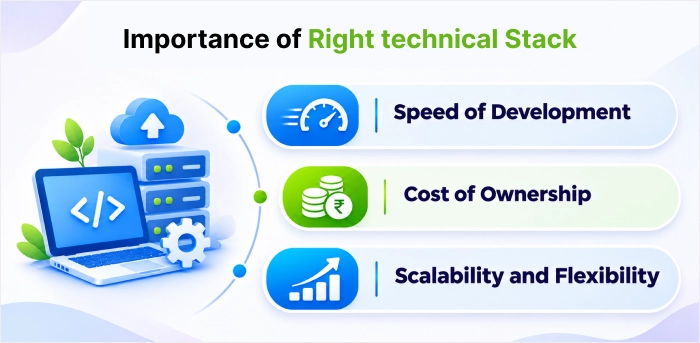
Having a choice for a tech stack is a strategic decision of business. It directly shapes how projects move further, and how easily they can adapt to future demands. The choice will affect project timelines, hiring strategies, and customer experience, as the underlying technology decides how fast new features may be delivered and how reliable the application feels in daily use. Right choice delivers movement. Wrong choice creates technical debt as well as project delays.
Some benefits of choosing a right technical stack for software development are as per below given:
- Speed of Development
The right stack clears obstacles before they slow us down. Mature frameworks with strong communities save team from reinventing the wheel.
For instance, a project built entirely in JavaScript allows developers to move seamlessly between frontend and backend, reducing friction and simplifying code reviews. By contrast, a mismatched environment where half of the team works in an old backend language may hamper the progress as workarounds pile up and integration issues multiply. A thoughtful stack keeps the focus on solving business problems instead of wrestling with technical hurdles.
- Cost of Ownership
Upfront expenses are only part of the picture. Every choice in a stack creates long-term financial commitments. Open-source tools can lower licensing fees, but they may increase the need for specialized in-house expertise. Cloud-native services might simplify scaling, but usage-based pricing models can climb quickly if they’re not monitored closely.
Staffing consumes a big amount of cost. Popular languages like Python or JavaScript come with large developer communities, making recruitment easy and more affordable. A niche language, by contrast, might deliver performance advantages but leave us paying a premium for scarce talent. Databases follow the same approach: a system seems inexpensive at first may need costly optimization later if it can’t handle higher transaction volumes.
Selecting with the full lifecycle in mind helps skip surprises. What looks inexpensive today can become the costlier part of the project when scaling and maintenance demands arrive.
- Scalability and Flexibility
Stack decides how easily the product may grow. Some technologies scale smoothly by adding servers, while others hit limits in database performance or memory much earlier.
Just as important is flexibility. A good stack allows to add new features without costly rework. We look at scaling in more detail in the performance section below.
Common Tech Stack Examples
The best stack is the one fitting to the project’s unique goals and constraints. Still, some below mentioned combinations have become true standards upon trials:
- MERN (MongoDB, Express.js, React, Node.js): A JavaScript-heavy stack popular for startups and web applications with React. It offers speed, flexibility, and a single language across frontend and backend.
- MEAN (MongoDB, Express.js, Angular, Node.js): Like MERN with Angular for frontend development, O often used in enterprise apps requiring structure and scalability.
- LAMP (Linux, Apache, MySQL, PHP): Old stack, this is exclusively used for web applications and content management systems like WordPress.
- JAMstack (JavaScript, APIs, Markup): A modern approach focussing static sites and decoupled architectures for speed and security. Popular in marketing websites and content-heavy projects.
- WISA (Windows Server, IIS, SQL Server, ASP.NET): A Microsoft-centric stack favoured by enterprises already invested in Microsoft infrastructure.
How To Choose the Best Tech Stack for a Project: Factors of Selection
There’s no single best software development tech stack, only the one that suits our project. The right choice depends on what we are building, who’s building it, and how far we plan to grow. Weighing a few key factors up front can save from costly rework (technical debt) later. The best time to weigh these factors is during the software discovery phase, before any code is written.
This is where business teams, architects, and developers agree on goals, map out user needs, and check technical constraints also. Creating stack decisions at this stage means our choice relies on real requirements rather than assumptions, which minimises the risk of switching technologies midway across the project.
- Set Business Goals: Business must work towards obtaining fast launching in the market, flexible pivot. Technical stack must be selected with these business end goals in mind.
- Match Skills to Technology: Latest technologies will be of no use, if they are not utilised with expertise. Understand what team knows now, and how complex the learning curve will be.
- Balance Performance with Maintainability: High-performance technologies bring complexity. One must bring those tools which teams can work upon comfortably in the long run without any resource scarcity.
- Consider Compliance and Security: Industries like healthcare, finance, or government have certain compliance requirements. Some stacks offer built-in security frameworks and audit features; others will need significant custom work. Anticipating compliance needs early will save costs and reduce risk.
- Think About Scalability Early: Even if we are starting small, select technologies that can grow with us. Growing into a stack is very easy than migrating away from one later. (See “Choosing a Tech Stack for Performance and Scale” below for how to plan it.)
- Assess Ecosystem and Community Support: A moving developer community means best documentation, more libraries, and quick problem-solving. Stacks with declining communities are becoming older technologies may leave us unsupported when challenges arise.
- Run a Proof of Concept: Before commitment, test critical workflows with a small prototype. It’s a lower-cost way to reveal unseen bottlenecks, integration issues, or missing functionality.
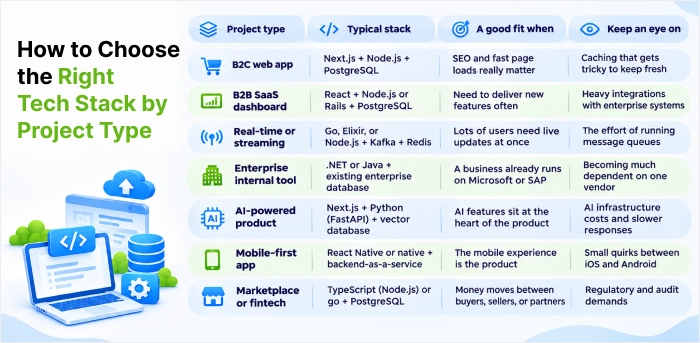
How to Choose the Right Tech Stack by Project Type
| Project type | Typical stack | A good fit when | Keep an eye on |
| B2C web app | Next.js + Node.js + PostgreSQL | SEO and fast page loads really matter | Caching that gets tricky to keep fresh |
| B2B SaaS dashboard | React + Node.js or Rails + PostgreSQL | Need to deliver new features often | Heavy integrations with enterprise systems |
| Real-time or streaming | Go, Elixir, or Node.js + Kafka + Redis | Lots of users need live updates at once | The effort of running message queues |
| Enterprise internal tool | .NET or Java + existing enterprise database | A business already runs on Microsoft or SAP | Becoming much dependent on one vendor |
| AI-powered product | Next.js + Python (FastAPI) + vector database | AI features sit at the heart of the product | AI infrastructure costs and slower responses |
| Mobile-first app | React Native or native + backend-as-a-service | The mobile experience is the product | Small quirks between iOS and Android |
| Marketplace or fintech | TypeScript (Node.js) or go + PostgreSQL | Money moves between buyers, sellers, or partners | Regulatory and audit demands |
If the project doesn’t align in one row, that’s useful to know. It usually means its requirements need breaking down a little more before we commit to a stack.
How to Choose a Tech Stack for Performance and Scale
How well the application scales depend more on the work it does than on the language it’s written in. A well-planned application in any modern language can serve millions of users, while a poorly planned one can stall at a few thousand. The key is knowing the pressure point and picking a software development tech stack that can handle it. Let us roll it down.
Start with real numbers
- Traffic: how many requests we expect per second at 6, 12, and 24 months.
- Speed: the longest users should wait for the slowest action in the application.
- Data growth: how much new data will be added each month.
- Peak load: how many users, connections, or background tasks will run at the same time.
Match the stack to the bottleneck
- Heavy computation: Go, Java, Rust, and C# are all solid choices. Test them with the actual workload rather than going by reputation.
- Lots of simultaneous connections: Node.js, Elixir, and Go handle this well. Even so, connection pooling, queuing, and caching usually make a bigger difference than the language.
- Memory-heavy work: smart data structures and external caching tend to help more than switching runtimes.
- Heavy content delivery: cater content from a CDN, close to user.
Plan for these from day one, whatever stack to choose
- Run many app servers behind a load balancer.
- Keep these servers stateless, so no user session lives on a single machine.
- Cache at both the CDN and application level, for example with Redis.
- Add read replicas to the database or move to a distributed database like CockroachDB or Google Spanner, if users are spread across regions.
- Send anything that doesn’t need an instant answer to a background queue.
- Set up logging, metrics, and tracing, for example with Prometheus and Open Telemetry, so one can detect problems before users do.
Don’t rush into microservices
- One of the most common mistakes is starting with a dozen services when one well-organized application would do. Make the switch only when the team size or traffic really calls for it.
- As per Martin Fowler, microservices come with actual costs: network calls that are slower and can fail, data that’s harder to keep consistent, and a much heavy load on operations team.
Common Tech Stack Selection Mistakes
Each software project starts with one big decision: which technologies to build on. The organization’s software development tech stack shapes how fast it delivers, what the organization spends, and how easily it grows. The right one will do the job, while the wrong one selected will give delays and errors, too.
Some selection mistakes are:
- Selecting the stack before the requirements. This is a most common mistake.
- Optimizing for the developer’s resume instead of the product.
- Premature microservices before there is a team or load profile needing them.
- Picking a “modern” stack that is less than two years old for a production-critical system. Innovator’s-dilemma; comes with a fallback.
- Overlooking data residency and compliance until procurement asks.
- Underestimating running cost. Managed services look cheap until the business at scale.
- No exit plan. Proprietary lock-in with no documented path for migration.
- Allowing one enthusiastic engineer pick the stack without team-level agreement.
- Mixing tech-stack and architecture decisions i.e. picking the technology and the topology in one breath.
- Avoiding the spike because “we’ve used it before.”
Conclusion
Selecting a software development tech stack can feel like a purely technical call, but it shapes everything that follows. It affects how quickly the team delivers features, how much organisation spend on hiring and hosting, and whether the product can sustain growth without a painful rebuild. Selecting it right, and the technology does its job. Choosing it wrong, and will experience delay, workaround, and budget review.
There’s no single “correct” stack to search. A startup racing to launch might do well with MERN, while an organisation invested in Microsoft tools may be better to serve by WISA. What matters is the fit: business objectives, the skills team already has, security and compliance needs, and where organisation must be in a few years. Start as small with a proof of concept, see how the stack carries the real workflows, and then deliver with confidence.
FAQs
How do I compare two tech stacks?
One need to compare their speed, cost, security, community support, and how easy it is to find developers. Select the one that fits your project best, not the most popular one.
Does the project type affect the choice of tech stack?
Yes. The main job of your software should guide the choice. JAMstack works well for content websites, React and Node.js with PostgreSQL suit SaaS dashboards and transaction-heavy apps, and MERN is a common pick for building an MVP quickly.
How do budget and team skills affect tech stack choices?
A stack your team already knows helps you build faster and spend less. Your budget decides what you can afford in licenses, cloud services, and specialist hires, so plan for long-term maintenance costs, not just the initial build.
What is the best tech stack for real-time apps?
Pick up tools replying fast and handle many users at once. A common setup is WebSockets for live updates, Node.js or Go for the backend, and Redis or Kafka for messages. Firebase may help to launch fast.
What is the best tech stack for secure user verification?
Use an identity provider like Auth0, Okta, or Keycloak to manage logins and access. Add multi-factor authentication with passkeys or security keys instead of SMS codes, extra checks for sensitive actions, and a KYC API if someone need identity checks. Encrypt stored data and keep audit logs to track activity.


 Shaili Gupta


 Ajay Wadne