Smartphones have great transformation power. It has reshaped various industries’ functioning, customer acquisition, and serving trends. eCommerce and various other domains, travel, and tourism industry are adopting mobility at a faster pace.
A recent study from Statista has revealed that by September 2015 travel is the 7th most popular category in the Apple App Store. 40% of People plan a trip with a mobile device so smartphones will be a driving force in 2015 and onwards and is the most exciting opportunity for travel companies.
Here is an insight of the activities of travelers with mobile phones:

- Communication and media sharing – 65%
- Web Browsing– 54%
- Navigation – 52%
- News – 48%
- Playing games – 38%
Not just in travel planning, the smartphone helps travelers at various stages when they need it during their journey- such as checking the ticket status, and flight information, finding nearby restaurants, searching for top destinations, hotel booking, sharing images to social media, etc.
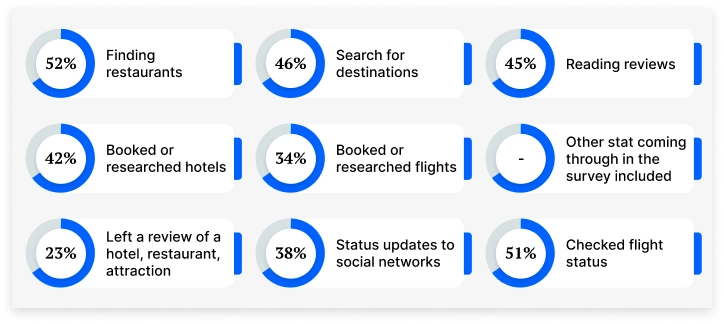
A survey was carried to identify the use of smartphones. Here are responses from travelers:
- Finding restaurants – 52%
- Search for destinations – 46%
- Reading reviews – 45%
- Booked or researched hotels – 42%
- Booked or researched flights – 34%
- Other stat coming through in the survey included:
- Left a review of a hotel, restaurant, attraction – 23%
- Status updates to social networks – 38%
- Checked flight status – 51%
Fostering Mobile technology in the Travel & Tourism industry
The advent and application of mobile technologies have had an astounding impact on the tourism and travel industry. Travelers make a complete roadmap of their journey; and choose various travel destinations and tourism spots by surfing the internet through their mobile phones. SMS (Short messaging) services are used to provide information for booking confirmation and even as a ticket which can simply be presented to the airline or the hotel and one is allowed to enjoy the service. Hotels are increasingly incorporating a hotel TV solution to offer entertainment, room service options, and local information in one place. The emergence of new and high-tech mobile apps has again stirred a revolution in mobile technology. This is especially helpful to allow a user to access the internet and book services online. Hence, one can also book tour packages and other travel-related services through the mobile.
The relationship between TWO T’s travel and technology has rubbed their shoulder together to counter challenges faced by travelers and other stakeholders from the industry. In this smartphone era, each customer looks for personalized care. To compete with this demand most of businesses adopting mobile apps to serve and interact with customers in a more exclusive way.
But what does this mean for the tourism industry?
Mobility is considered the best ally for the travel industry. This helps businesses to acquire new customers, retain old ones and serve customers in the most convenient way. This is why tourism enterprises need to adapt to this new technological shift and make sure they are able to reach their customers in the mobile environment and become an active part of their digital life.
How People use Travel apps:

Businesses with a strong mobile presence and frequently interacting with their audience in the mobile media environment have more chances to increase their revenue streams and to get repeat and loyal customer base. 59% of people admit being more likely to purchase products and services from businesses operating mobile.
Travel Technology: World Key Performance Indicators 2013-2015
Internet value % growth (US$) 2013 2014 2015
Car Rental 7.2 7.1 7
Air Transport 8.4 7.5 7.7
Other Transportation 7.9 6.7 6.6
Hotels 10.1 9.3 8.0
Travel Retail 7.8 7.9 7.8
Some Key Findings:
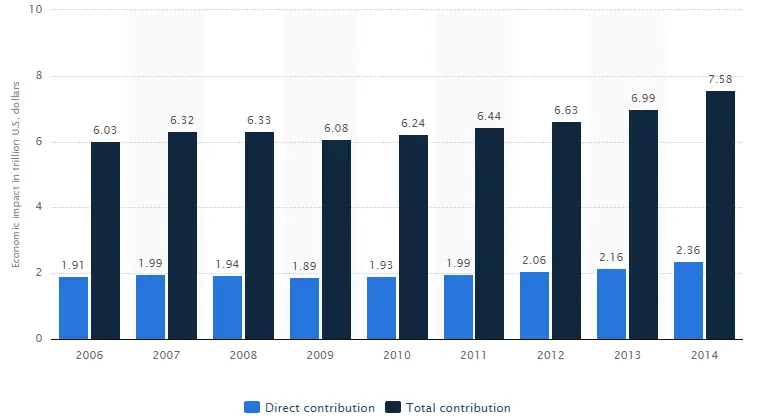
In the recent few years, the travel and tourism industry has contributed around seven trillion U.S. dollars to the global economy annually, nearing eight trillion in 2014. This makes it a highly valuable industry contributing to the global economy.
- Asia Pacific is expected to drive global growth in online travel, with its online travel sales set to double from US$90 billion in 2013 to US$180 billion in 2018.
- By 2018 Mobile bookings are expected to reach 35% of online travel bookings.
- The fastest-growing trends in the online travel industry are – Big data analytics, peer-to-peer services, and in-destination services.
Wearable Technology is Intervening in Travel:
- A recent study carried out by Euromonitor International Consumer Electronics research has predicted that by 2016 wearable Technology will be the major recipe.
- By 2018 there will be 180 Million Wearable internet-connected devices, which were merely 9 Million globally in 2013. Products currently on sale include Sony SmartWatch, Samsung Galaxy Gear, and Google Glass. Google also developed Android Wear software for wearable electronics.
- Apple Watches, and Android Wearables are expected to take this sector by storm, as Apple products have done for smartphones and tablets.
The pace of adaptation for fast response and to be a lead role:
- Travel companies need to be swift to squeeze wearable technology as part of their strategy which will help them to onboard new customers as well as prevent from losing existing ones.
- Notifications, Personal assistance, exclusive service, and additional support are the keys to the current and future marketing scenario. These elements should be adopted in an effective manner so consumers can have a hassle-free travel experience in terms of finding relevant information.
Middle East – Enormous opportunities for Tour and Travel Companies in Mena Region
Middle East: Key Performance Indicators 2013-2015
% Growth 2013 2014 2015
Real GDP Growth 3.2 3. 9 4.8
Arrivals 4.4 6.3 7.0
Incoming Tourist Value(US $) 4.4 10.9 10.4
Air Transport Value (US$) 6.1 10.0 12.0
Hotels Value (US$) 7.4 8.6 9.1
Tourism is an emerging sector that has a major impact on the economic vitality of the Gulf Cooperation Council (GCC) countries. In recent years the economic dependency on petrochemicals has been lowered. An amalgamation of regime policies, socio-economic trends, and geopolitical forces will usher in a radical transmutation in the travel landscape of this region.
Middle Eastern travelers take leverage of Mobile devices, tablets, and computers in every aspect of trip planning, booking hotels and flights, and even post-travel reviews. The transformation in user behavior due to the online channels’ influence and greater control gives tremendous growth opportunities for key players in the travel industry.
Digital-Savvy and Young Population Feeds Travel and Tourism Online
- With the broad web use of the means of portable devices at all phases of the travel experience, players in the travel and tourism industry are quickly adopting the latest technology and platforms for a digital itinerary management system to expand their capabilities and to keep up an upper hand.
- According to a global market research company Euromonitor International, Middle East online travel penetration will grow from 18% in 2013 to 22% in 2014.
Data from various trusted sources has revealed that in the last 12 months, 48% of Middle East travelers have used their smartphones for travel-related searches; out of them, about 70% have used either tablets or smartphones to plan their travel.
This data gives vital marketing opportunities to travel companies to devise their strategy to engage with potential customers.
The fostering mobile platform is playing a significant mantle in devising the business strategies of travel and tourism businesses in the UAE region. 85% of business travelers used mobile app in 2013, out of the 62% used them on every trip. The overall response was from business travelers that mobile apps improved their travel experience and helped them at various stages of travel!
Critical Travel And Technology Trends in UAE:

It is expected that by 2030 the UAE region will have 81 million outbound travelers. The online travel booking tool penetration in the Middle East was 18% in 2012 and amounted to 22% in 2014.
97% of UAE Passengers See Technology as the Answer to Stress-Free Travel
A forecast for UAE tourism is expected to rise by 67% by 2018. The UAE’s hospitality market is about to reach US$7. 5 billion by 2016, up from US$4. 5 billion in 2011, to a significant 67% increase.
Inbound travelers in the UAE are expected to grow at a CAGR of 5% between 2012 and 2022. It will lead to an increase in hotel supply from 96,992 hotel rooms in Dubai and Abu Dhabi in 2012 to a total of 125,383 hotel rooms in 2016.
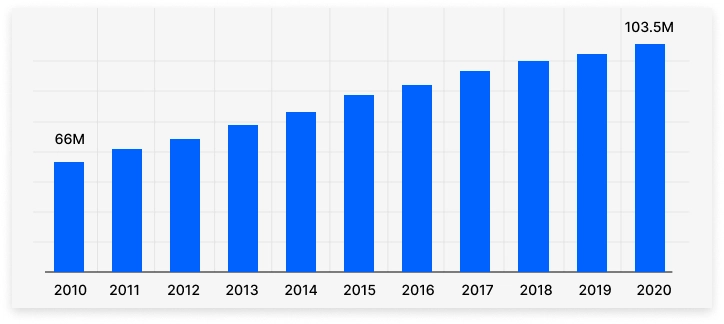
This statistic shows the passenger traffic at Dubai Airports from 2010 to 2020. In 2013, the number of passengers passing through Dubai Airports was 66 million. This figure was forecasted to increase to 103.5 million by 2020.
We can also predict significant growth in Hotel revenues up 6% to US$1.2 billion over the period of 2012-2020. It has been found travelers prefer to use mobile apps for booking and managing hotel rooms for them.
The foremost reason for travel across the United Arab Emirates and Saudi Arabia is – “Visiting Family”. 71% of Saudi Arabia Travellers and 55% of UAE travelers visit for this purpose.
According to Moodie: Airports in the Middle East recorded year-on-year growth of +22.3% in passenger traffic in July 2015.
Middle Eastern hub airports all recorded significant gains, with Dubai at +29.5%, Doha, at +24.9%, and Abu Dhabi at +23.3% In 2014, 60% of airline booking and ticketing made through online means in Dubai. Though there is a huge market share for traditional travel agencies; online travel agencies are gaining superiority in the Middle East region.
Tourism Technology: Paradigm for Attracting Customers-
- Deals Discounts and Offers: Personalized offers, incentive schemes, and bargain opportunities attract Consumers towards the businesses! A recent study carried out on mobile customers’ behavior reveals that special deals, discounts, coupons, or additional services specifically devised for app users are the primary influencing factors for users to engage with a company. Businesses that offer incentive group travel packages can further enhance user engagement by creating tailored offers that meet the preferences of group travelers, providing them with memorable experiences and added value.
- Local Targeting:
Travel agencies have a big contribution to travel and tourism revenue. In 2014 the overall sales in the Middle East contributed by travel agencies was USD$3 billion, which had a contribution of 17% of total sales.
Local targeting plays a crucial role in strong growth in tourism and travel, for example, MakeMyTrip and Cleartrip.com focused on developing web pages with Arabic content. There is an ocean of opportunities for online travel agencies in the region. In Saudi Arabia, 80% of Google searches are done in Arabic, to tap these opportunities online travel agencies should emphasize local online marketing with a strategy of creating content in the local language, even the transactions.
Smartphone and Social Media – The key Influencers
Internet marketing is all about intervening yourself in the decision-making process of a customer through the right channel at the right time. In the Middle East travelers, 50% used mobile for their travel-related decisions in the past year. Travel agencies can use mobile technology to engage with customers and to convert these opportunities into bookings. Bookings through smartphones are one of the keys for the travel industry as we have discovered that in Saudi Arabia both leisure and business travelers go for last-minute bookings.
Mobile technology for the tourism Industry and its significance:
Smartphone’s internet capabilities thrill users to obtain travel information, read reviews, and book tickets and hotels while traveling.
Smartphone:
A smartphone is a mobile phone that is an amalgam of communication with technology that has great internet capabilities of the internet and a large array of sophisticated applications. With the additional advantage of portability and flexibility, it has a cutting-edge difference over the traditional desktop for the research, planning, and booking of tickets, hotels, and cabs for their trips. Though laptops are portable, they are not very easy to carry with travelers all the time, which is why smartphones are dominating the whole world
Giving a Seamless Experience with Mobile Technology!
In the current scenario travelers have high expectations when it comes to availing travel services, quick and authenticated pricing, availability information, mobile booking, user ratings and reviews, past travel history and preferences, real-time alerts, hassle-free check-ins, online concierge services are the major elements what your customer is looking for.
To make a major impact and dominance across the region, there is a much-required necessity for digital travel portals and mobile apps. The technology can leverage and extend customer base
Offer native and web-based apps to monitor and communicate with potential customers.
Deploying mobile first for your business exposure can dramatically increase your customer base. For instance
- Users can access your website from a smartphone
- Customers can engage with you through social media apps at your social channels, they can leave a review.
- Travelers can locate your business with the help of a mobile app.
- Benefits of having a smartphone in the business
Having a mobile app gives your business countless opportunities, just not in terms of serving your customers, but managing your business in a more controlled way: Here are some silent benefits:
- They track, respond, and reply to your emails.
- Customers can check their occupancy using the online booking system app and website.
- Travelers can take photos of destinations and can post them on Flickr, Facebook, and other sites
- Take videos and post them on YouTube, Facebook, and other sites
- Manage your online reputation
- Check and post on your Facebook Page
- Do your online banking
- Answer your live chat system present on your website using a mobile app
- Utilizing a customer relationship management system
How to check whether your business needs to adopt a mobile-first strategy?
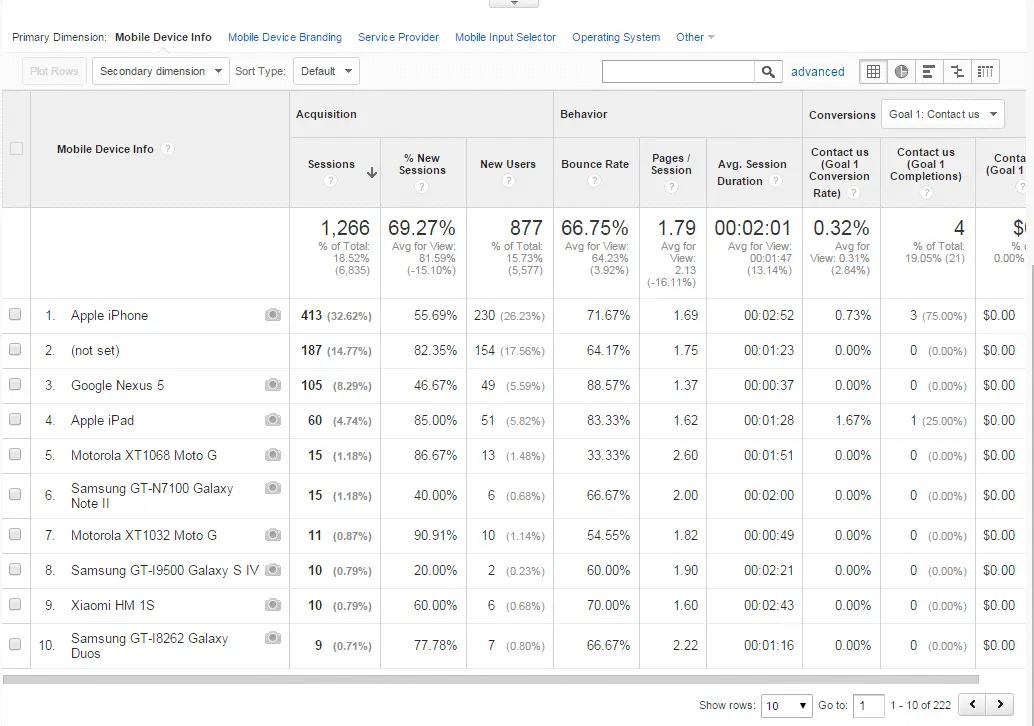
Check your Google Analytics account:
Go to Audience -> Technology ->Mobile section
Mobile App for Travel Business:
Mobile apps are the major driving force to increase the internet capabilities of travelers. You can offer your users a free app for download.
Travelers find apps as more convenient, a controlled source that saves time and helps them to organize their travel planning. Many popular apps such as TripAdvisor help smartphone users make better decisions with reviews of restaurants, hotels, and topmost destinations.
Takeaways:
Smartphones are becoming the game changer for tourism businesses that serve “away from home” customers in the best possible way.
- Have a responsive website that gives optimum experience for mobile users.
- Take leverage of tools and apps available for businesses that cater to smartphone customers.

 Shaili Gupta

 Ajay Wadne