

Businesses are looking for innovative ways to get more engagement from the audience. Thus, we have a hybrid app developer. Because of the increased spotlight on hybrid apps, this gap between the web and mobile platforms has been enormous. The reason for hybrid apps is to optimize a user experience across different devices. In this blog, we discuss why you would need a skilled hybrid app developer for your next project, the benefits, challenges, and best practices that will make your app stand out in this competitive marketplace.
What is Hybrid App Development?
Hybrid app development refers to the process of using web technologies, CSS, and JavaScript while producing applications that are natively deployable across the iOS and Android platforms.
This approach helps the hybrid app developer write once for multiple platform deployments, thus reducing the time as well as the cost of development sharply. Utilizing a single codebase will enable a business to reach a wider audience more efficiently while upholding high-quality user experiences.
Uncertain about how much your app development will cost?
Get an accurate estimate with our app cost calculator in minutes.
Key Benefits of Hiring a Hybrid App Developer
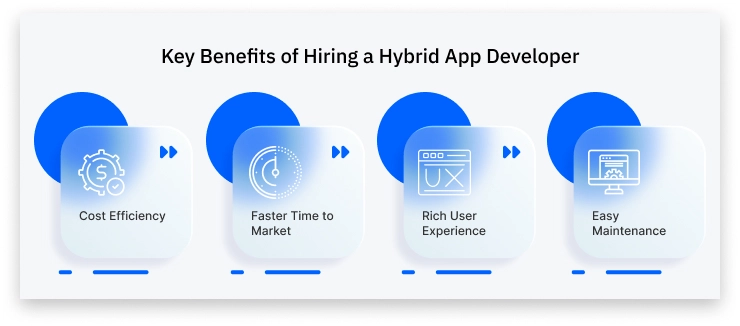
Hiring a hybrid app developer offers several key benefits that can significantly enhance your business’s mobile strategy.To maximize these benefits, it’s crucial to hire a vetted developer who brings proven expertise and reliability to your project.
- Cost Efficiency: A company needs hybrid applications as they are cost-effective. Cross-platform Mobile App Development can make the same codebase run both on Android and iOS through a single developer, without maintaining two separate teams for both iOS and Android.
- Faster Time to Market: Hybrid applications work faster to release the product to the market due to the reusability of code between different platforms. This fast development cycle enables businesses to get their products out to the market much quicker than their competition.
- Rich User Experience: Device-specific features such as GPS, camera, and push notifications can also be accessed by hybrid apps through plugins. This has handed the power of developing rich user experiences and hybrid apps with native equivalent functionalities over to a hybrid app developer.
- Easy Maintenance: It’s easier to maintain one code base than it is to run several versions of an application. With hybrid app development, a single developer can push updates and fixes across all platforms at the same time, offering consistency but also reducing downtime.
Development Process for Hybrid Apps
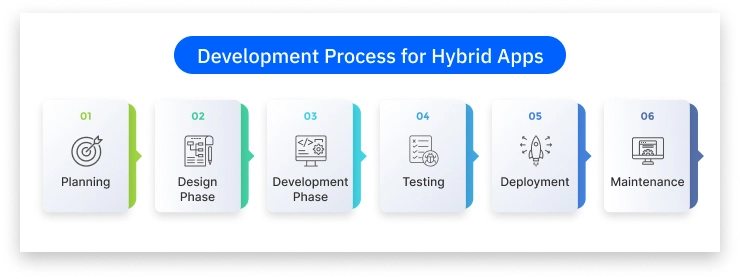
Hybrid app development is usually done in the following order such as:
1. Planning: In this stage, a hybrid app developer will discuss the app’s purpose and target audience with stakeholders to identify key features. Well-defined goals guide the entire process of development.
2. Design Phase: It helps to come up with wireframes and prototypes that allow the envisioning of the user interface and the user experience. A good hybrid app developer designs a responsive layout so it will work well on devices.
3. Development Phase: This stage includes coding the application using frameworks such as React Native or Ionic. A good hybrid app developer does the same with the help of these tools, thereby incorporating the basic features and then optimizing performance.
4. Testing: Proper testing ensures that the hybrid app works fine on all the devices and operating systems intended for use. A serious hybrid app developer would carry out compatibility tests and resolve all those issues before pushing them out.
5. Deployment: After the testing, the hybrid application is submitted for publication on various app stores, such as Google Play and Apple App Store. In this stage, a hybrid app developer needs to adhere to the guidelines of publishing.
6. Maintenance: Maintenance after launching is of prime importance in making an application in a functional state with the latest changes. A hybrid app developer monitors the performance metrics and user feedback to implement updates accordingly.
Finding skilled developers for seamless cross-platform apps can be challenging.
Hire expert hybrid app developers for efficient, cost-effective solutions.
Popular Frameworks for Hybrid App Development
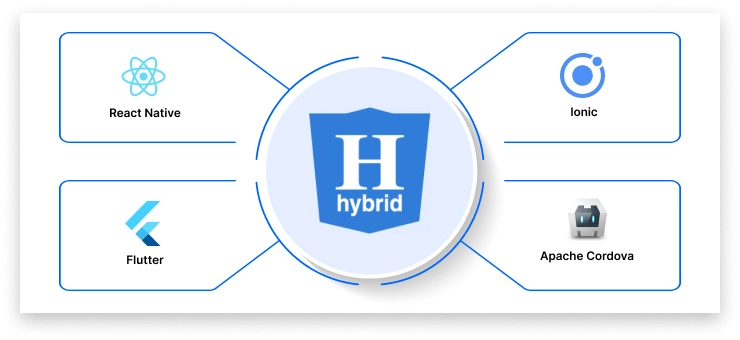
Hybrid application development has gained significant traction in recent years, with various frameworks emerging as front-runners in the field. Each framework offers unique features and capabilities, making them suitable for different project requirements. Here’s a closer look at some of the most popular frameworks and notable organizations that have successfully adopted hybrid applications.
Prominent Hybrid Development Frameworks
- React Native: Developed by Facebook, React Native is highly regarded for its ability to deliver near-native performance using JavaScript. This framework allows developers to create mobile applications for both iOS and Android simultaneously, making it a popular choice among businesses looking to optimize development time and costs.
- Ionic: Ionic is an open-source SDK that leverages web technologies such as HTML, CSS, and JavaScript to build high-quality mobile applications. It integrates seamlessly with popular frameworks like Angular, React, or Vue, making it versatile for developers with varying expertise levels.
- Flutter: Created by Google, Flutter stands out for its rich set of pre-built widgets that facilitate the creation of visually stunning applications. It uses the Dart programming language and provides a modern reactive framework that allows for smooth animations and transitions.
- Apache Cordova: Cordova is an open-source platform that allows developers to wrap web applications in a native container, enabling access to device features such as GPS and camera functionalities. It utilizes standard web technologies and is particularly appealing to developers familiar with HTML5, CSS3, and JavaScript.
Successful Organizations Utilizing Hybrid Applications
Many successful organizations have adopted hybrid applications to enhance their mobile presence, leveraging the unique advantages of hybrid app development. Here’s an in-depth look:
Instagram: Instagram was initially launched as a native application, providing a robust platform for sharing photos and videos. This strategic transition allowed the company to maintain its core functionality while ensuring that users enjoyed a consistent experience whether accessing the platform on a mobile device or through a web browser.
By adopting hybrid technology, Instagram could quickly implement updates and new features across platforms without significant delays, thereby enhancing user engagement and satisfaction..
Uber: Uber has revolutionized the transportation industry with its innovative app, which employs hybrid technology to facilitate rapid updates across multiple platforms. The Uber driver application is a prime example of how hybrid apps can provide flexibility and efficiency.
Combining both approaches, Uber is able to quickly implement any improvements and offer new tools for drivers, allowing them to work with the most recent equipment, information and solutions for their tasks.
Gmail: The mobile version of Gmail has shown how the hybrid aspect can improve the interaction between the application and its users. Through the use of hybrid technology, Gmail is able to incorporate email features and functionality on different devices without any limitation.
The performance and interface remain the same whether the user is accessing the application on an Android smartphone or an Apple iPad. Such measures not only enhance the overall satisfaction of the users but also enable Gmail to use the benefits of the native devices.
Facing challenges in creating apps that work seamlessly across platforms?
Hire hybrid app developers to deliver efficient, cross-platform solutions fast.
Complication Aspects for Hybrid App Developer
There are numerous advantages of hatch approaches but these are the challenges that accompany it.
Thus, one of the most serious limitations of hybrid applications is the emulation aspect: they claim native performance yet do not provide it under heavy load scenarios.
Or else hybrid applications act differently depending on the defined capabilities of the browsers and the quality of the network. However, many companies tend to think that this negative aspect is minor compared to the advantages that one gets from working with a competent hybrid application developer.
How to Determine the Best Hybrid App Developer?
- Picking the right hybrid app developer is of utmost importance because it can either make or break the success of the project. This will equip you with better hints which should be applied in selecting the best hybrid app developer:
- Experience with Frameworks: The hybrid developer must have experience with the most popular hybrid frameworks relevant to your project.
- Portfolio of Previous Work: Review past projects to gauge their expertise in developing successful hybrid applications.
- Understanding Business Objectives: A good developer should understand your business objectives and exactly how the app ties into your ove
- Good Communication Skills: Good communication is a basic requirement for effective collaboration during the development process.
Why Select Sphinx Solution as Your Partner in Developing a Hybrid App?
Standing among the best hybrid app development companies dealing in hybrid app development, there is what makes them different from the rest:
- Excellent Tools: Sphinx Solutions applies the latest technology in the development of applications across all platforms whether it be iOS, Android or Windows using complete frameworks such as React Native, Flutter and Xamarin. Skill in this area means that the latest fast apps are made available to you.
- High Output Quality: Corners are not cut in any way. Every application developed by Sphinx Solutions undergoes stringent quality assurance measures. This is done by fully testing the application to assure high performance and reliability of the application, with no bugs present. And thus, the app is dependable.
- Personalized Service: Sphinx Solutions customizes their processes and services to respond to the client’s requests. You will have a team that is devoted to comprehending and achieving what you want.
- Creative Solutions: Sphinx Solutions is always on its toes searching for the new and the inventive. They know how to design applications that are stunning in the present market.
Uncertain about how much your app development will cost?
Get an accurate estimate with our app cost calculator in minutes.
Wrapping Up
Hiring a good hybrid app developer can be something very good to do to enhance one’s business’s capability to reach its potential customers with mobile applications. Hybrid apps, in general, have the advantage of cost efficiency, faster deployment time, and the features of availability on devices. Since businesses can make informed decisions, therefore, by following this information on the process of development, popular frameworks, and potential problems in developing a hybrid app.
FAQs
1. What distinguishes native from hybrid applications?
Hybrid Applications. Hybrid applications are built using the standard web technologies such as HTML, CSS, and JavaScript but are embedded in a native shell in order to be used across different platforms. Hybrid applications are cost effective as well as time effective especially during the development phase, however, their equipment to access devices and in the use of certain functions is usually not on the same level as that of native applications.
By definition, native applications are developed for a particular mobile OS using native tools and languages belonging to that specific OS. This means that Swift for iOS will be used as well as Kotlin for Android. Native apps will provide the best processing power and overall user experience with respect to the use of the app on the mobile device and will require usage of all the features of the device.
2. What is meant by native app development?
With building a cross-platform app, you may save some expenses, however, you will incur a greater cost if the application you are developing is a native application since you will need to switch between several different codebases for each platform separately prohibiting all that extra time needed for development. The process involves creating, designing, and testing every version of the application in addition to primary one, which adds to the total expenses.
3. Discuss situations in which it is best to employ hybrid and native strategies.
When deciding to choose native mobile development or hybrid mobile development many aspects are taken into account:
Performance: Many applications that are developed on a platform are otherwise referred to as performance oriented applications since such applications are built strategically for the specific console.
Cost: Usually hybrid applications are less expensive because the majority of the cost of development goes in creating the application after one code base for the application has been developed and launched across the various platforms.
Time-to-Market: Hybrid applications normally take less time to go mainstream since they usually have single codebase and therefore, make releases more often.


 Ajay Wadne
 Shaili Gupta


