
Key Takeaways
- Choosing a custom software development company starts with knowing our own business goals, scope, budget, and timeline. Get those clear before we speak to any vendor.
- Use one scorecard for each vendor. Compare technical expertise, references we may call, communication, engineering process, security, and post-launch support.
- Good communication and enough overlap in working hours matter as much as code quality. Pay attention to how a vendor communicates during the sales process, because that’s what we’ll get after our sign.
- AI-accelerated teams can cut delivery time from months to weeks, but only if a person reviews and tests each piece of AI-assisted code.
- Compare quotes by what’s driving the cost, not the final number. The cheapest bid mostly becomes the most expensive once our add up rework and rebuilds.
Companies need to develop custom software for their core business functionality and outstanding customer experience for their product to be ahead in the market. An IT company or business can have two options Inhouse and Outsourcing, to develop a custom software development. Rather we can say that Most businesses weighing this up face the same choice: in-house vs outsourced software development.
Companies with proper domain expert teams, right technology stack and proper framework with infrastructure will always choose to develop custom software inhouse. But companies with other business priorities ore from different niche, must prefer to go for outsourcing of their custom software development work, to choose a custom software development company for their goals.
In this blog article, we are emphasizing on how to choose the right custom software development company for our business needs and accomplish the objectives.
What Is Custom Software Development?
Custom Software Development is the process of designing, building, deploying, and maintaining tailored software applications built from zero to address the certain workflows, requirements, or goals of a particular organization, group of users, or business.
Unlike to generic, mass-market off-the-shelf software (like Microsoft Word or Salesforce), custom software acts like a customized suit, designed to fit our exact business operations without forcing employees to adapt to rigid features.
Now, let us discuss the reasons for outsourcing the software development.
Why Outsource Custom Software Development?
Let us find out why outsourcing of custom software development is needed in this section. First understand the meaning of outsourcing. Outsourcing is the process for hiring an external vendor, agency, or offshore/nearshore team to build the software. This gives many strategic and financial benefits as explained below:
- Cost Savings & Reduced Overhead: Outsourcing removes the heavy costing of recruiting, training, salaries, infrastructure, and software licenses for an internal team. It converts high fixed internal costs into predictable operational expenses.
- Access to Global Talent & Specialized Skills: It opens access to a worldwide talent pool with deep domain expertise in specialized domains (like AI automation, cloud architecture, or ERP/CRM development) that will be expensive from the local market.
- Focus on Core Business Competencies: By delegating technical execution to an external vendor or agency or company, internal leadership and staff can focus on core business strategies, product growth, and customer acquisition. (similarly, Slack did by outsourcing early mobile app development).
- Faster Time-to-Market: Settled external teams have ready-to-use workflows, mature project management practices, and pre-vetted engineers, allowing them to build and deploy solutions rapidly than spinning up a new department from scratch.
- Scalability and Flexibility: Outsourcing allows us to upgrade our engineering team up or down dynamically depending on project phases without the burden of long-term hiring / layoffs.
- Comprehensive Post-Launch Support: Reliable partners do not provide only deployment; they offer ongoing maintenance, security updates, and performance monitoring to keep the software sync with business evolution.
Custom vs. off-the-shelf software: A Brief Comparison
Selecting between custom software (also known as bespoke development) and off-the-shelf software (Commercial Off-The-Shelf or COTS) is a core strategic decision. The right selection depends on whether the task is a generic function or a unique competitive advantage in the market.
If we are building scalable enterprise software that must connect with legacy systems and grow with the business, custom software development is usually the stronger choice.
| Factor | Off-the-Shelf Software | Custom Software |
| Upfront Cost | Low (initial purchase or subscription) | Higher (built from scratch) |
| Time to Start | Immediate / Days (fast deployment) | Weeks to months (typically 3–9 months) |
| Workflow Fit | We adapt our processes to the tool | The tool is built to match our exact workflows |
| Ongoing Costs | Recurring per-user/seat licensing fees | Hosting, updates, and maintenance |
| Ownership & Control | Vendor controls roadmap, pricing, and features | We own the source code, data, and future direction |
| Integrations | Limited to what the vendor natively supports | Built to connect with our specific legacy/current systems |
How to Choose the Right Custom Software Development Company: Key Requirements Criteria
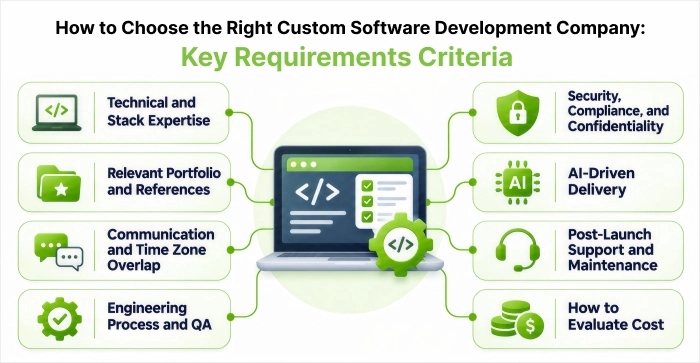
Before choosing the right custom software development company, we must assess our key requirements to get fulfilled from this company. A company following these criteria will be the best one to work with. After a few discoveries, every custom software development company on our shortlist starts to be the same. They all have decent case studies, they all say they’re agile, and they all claim to have built something exactly like our project. These below checkpoints help us to see past the pitch.
We can rate them as per their service offerings. We can add some extra weight to the most suitable one, close to our project. Also, we can refer the red flags of each to look for.
Let us refer them here, in detail.
- Technical and Stack Expertise
A team that has solved problems like project’s barriers and how to maintain a timeline on track. A team learning on our budget may not do these things. Search for real technical expertise in the languages and frameworks our product needs, and the judgement to pick the right software development tech stack rather than compelling everything into one. Ask how they stay updated, including how responsibly they use AI in their software development process. If we are building on Python, get specific about async APIs, data pipelines, testing, and scaling.
Then ask them to explain a latest architecture decision. Good engineers talk through the trade-offs clearly. Weaker ones got stuck on buzzwords.
Red Flag: Same technical stack for every project is not a good idea in the long run.
- Relevant Portfolio and References
Client references are evidence of quality and genuine development work. Logos and case studies are part of marketing. Ask for two or three clients in our industry or of a same size and check out. Did the team hit its deadlines? How did they deal with scope of work changes, or got failed? Is the software still running and easy to maintain now? Would they hire the team again?
A strong software development portfolio shows products which are shipped and the business results they delivered, apart from a list of features.
Red Flag: If a vendor goes vague and can’t name a single client we could talk to, treat that as a clear warning sign.
- Communication and Time Zone Overlap
Several software projects that fail have ideal code structures. Communication sinks them. In case we want a named point of contact, written updates us can rely on, and enough overlap in working hours to clear blockages the same day. Without that overlap, each question may cost us a full day.
Distributed and offshore development teams can work in a great way, if the rhythm is planned well, like a shared backlog, regular demos, clear escalation paths, and async updates working for both time zones. Many software companies work with clients across the USA, UK, Canada, Australia, Singapore, the Netherlands, and Germany, and time-zone overlap and clear written updates are treated as core engineering practice.
Test this well during the sales process. The speed and clarity of a company’s replies before we paid them is a fair preview of how they’ll communicate after our signing done.
Red Flag: Slow replies, language friction, no overlap with team
- Engineering Process and QA
Ask the vendor to show a walkthrough how work gets from an idea to production. A credible answer includes a defined SDLC, version control with a clear branching strategy, mandatory code review, automated testing, and CI/CD.
Trustworthy partners deliver on time and stay focused on the goal. They’re also mature enough to call it when a feature or initiative isn’t working, rather than keep spending money on it.
Red Flag: If we hear “we just start coding,” or there’s no automated testing at all, that’s a red flag.
- Security, Compliance, and Confidentiality
Our vendor will be using our source code and sensitive data, so any gap in their security becomes a gap in ours. Ask for their secure SDLC: dependency scanning, secrets management, and least-privilege access. Then check about data handling and residency, how they reply to a breach, and what experience they have with the compliance rules that apply to us, whether that’s GDPR, SOC 2, HIPAA, or sector rules in finance and healthcare. Confirm in the contract that we own the source code and IP.
A good partner protects our data without any much check. This simply indicates that they have written security policies and take our regulatory obligations seriously. Get confident well in writing, in the contract and in how they work. A one-line promise in a proposal isn’t protection.
Red Flag: No policies, vague answers ignore our regulatory context.
- AI-Driven Delivery
AI has changed how fast good teams can build. Engineers who use AI for code generation, test scaffolding, review, and documentation now finish in some days or weeks, what used to take months. For us, that’s a short time-to-market and a small bill for the same result.
The catch is quality. AI can develop code looking fine and still breaks, or opens a security gap nobody spots. So, check out with the vendor who reviews AI-assisted output, how it gets tested, and what they do when the model gets wrong.
Also check whether they can build AI-powered features like agents, RAG, or workflow automation into our product, or whether they only use AI for their own work.
Red Flag: Either bans AI outright or ships unreviewed AI output
- Post-Launch Support and Maintenance
No software stays finished for longer time. A few months after launch, a library needs updating, a security patch arrives, or more users show up than our expectation. Before we sign, find out exactly who handles the product from there: bug fixes, framework upgrades, monitoring, incident response, and maintaining the infrastructure stable.
A partner offering ongoing software maintenance and support with a clear SLA keeps our investment working. A vendor that leaves after handover leaves us with clumsy code nobody on our side understands, and we are back to zero for searching a new team. Ask about support earlier, while we keep on comparing vendors.
Red Flag: Leaves after handover; no SLA.
- How to Evaluate Cost
Two quotes can look apart in their dollar pricing and still be closer than they seem, or further apart. The total on its own doesn’t tell us much.
Check out with each vendor to break down what’s driving their price:
- Scope and complexity: how many features and integrations we need.
- Team composition: who’ll write our code, and how many of them are senior.
- Engineering quality: testing, code reviews, and documentation add time early on and save a lot of reworks later.
- Delivery speed: teams that use AI well hit milestones sooner, which brings the total down.
- Total cost of ownership: cheap code breaking easily is expensive to keep alive.
A partner we can trust ties the estimate to real scope, often through a short discovery sprint, and shows us where each part of the budget goes. If a company gives a price before it understands our problem, be careful.
The lowest bid mostly turns into the most expensive one once we pay for fixes and rebuilds. When we compare our custom software development cost across vendors, look at what we’ll get back for it and the ROI over time.
Red Flag: Quotes before understanding the problem.
Conclusion
Selecting a custom software development company is one of those decisions we’ll live with for a long time. A good choice gets our product out soon and keeps it running well. A bad one usually shows up months later, as missed deadlines, messy code, and a second round of vendor search nobody wanted.
We need to get clear with time on what we need, before we talk to anyone. Then use the scorecard: check each team’s technical depth, call their references, see how quickly and clearly, they reply, and ask how they handle testing, security, AI, and support post launch.
Look at how each quote is built before we look at the total. The best custom software development company is the one that asks the hard questions sooner and is still around when our software needs its next update.
FAQs
How do I pick the best custom software development company?
Start with a shortlist of three to five vendors. Score each on technical skill, references, communication, engineering process, security, AI use, support, and how clearly, they explain cost. Then run a small paid pilot or discovery sprint with our top choice before we sign anything big. The partner who communicates well and delivers results is worth more than the one with the lowest quote.
Which questions should I ask a vendor before hiring them?
Ask them to walkthrough a recent technical decision and why they made it. Ask for two or three clients we can call. Find out how they test and review code, how they protect our data, and who checks AI-written code before it ships. Finally, ask what support we will get after launch, and get the SLA in writing
Is offshore or nearshore development risky?
It doesn’t have to be. Distributed teams work well when communication is planned: one named contact, a shared backlog, regular demos, and enough overlap in work hours to fix problems the same day.
What difference does AI make to software development in 2026?
A lot, when it’s used well. Coding, testing, and documentation move faster, so a project that once took months can be done in weeks. AI also makes it practical to build features like agents and RAG into our product. Just make sure a person reviews every piece of AI-generated code and that it goes through automated tests.
How should I compare costs between vendors?
Look past the final number and see what’s behind it: scope, how senior the team is, testing and code quality, delivery speed, and future maintenance. Ask for an estimate tied to clear scope, ideally after a short discovery sprint. A cheap quote can become the most expensive one once the rework bills come in.


 Shaili Gupta

 Ajay Wadne