Key Takeaways
- AI agent use cases are valued when they solve real business problems and handle multi-step workflows.
- Enterprise AI agents may support functions like finance, banking, healthcare, manufacturing, retail, HR, customer service, and IT.
- The main benefits of AI agentsare less manual work, fast processing, better workflow coordination, and fewer routine errors.
- The right use case must possess a clear outcome, reliable data, suitable system access, manageable risk, and measurable results.
- Businesses should begin with a focused workflow, test it in real conditions, measure the outcome, and expand gradually.
- Successful implementation relies on data quality, security, integration, human oversight, and clear governance.
- AI agents vary from chatbots and RPA because they can work towards a defined outcome, use connected tools, and take approved actions.
- The choice to build, buy, or partner depends on the workflow complexity, internal capabilities, and integration needs.
For most enterprises, the AI has become more vital than their basic needs. The ultimate question is whether AI resolves their business problems or make another complex battlefield for them. This is a reason why AI agent use cases are increasingly arising in technology roadmaps, operating plans, and investment discussions.
Apart from a regular chatbot, an AI agent may work toward a certain objective. It can gather or collect information from business systems. It decides what needs to happen next, take an approved action, and respond to changes along the way. Gartner says that agentic AI is about to become a substantial part of enterprise software applications by 2028, up from 2024 which is less than 1% at present.
The real bottleneck is in moving from a promising demo to a trusted production workflow. Various AI pilots fail to progress because the underlying process is clumsy. The risk is much higher. The required data is inaccessible, or the project is not aligned with a measurable business result.
This blog nicely elaborates 10 practical AI agent examples across industries. It covers benefits of AI agents in every area, and the essential factors to consider by businesses while choosing, measuring, and implementing an AI agent.
What Are Enterprise AI Agents?
Before looking at specific AI agent use cases, it is worth separating an AI agent from other automation types. AI agents for enterprises are software systems. They can work toward a fixed goal by reasoning over available information, with the use of connected tools, and taking actions within permitted boundaries.
| Capability | Chatbots | RPA | AI Agents |
| Understands unstructured input | Limited | No | Yes |
| Makes context-based decisions | No | No | Yes |
| Acts across multiple systems | Rarely | Yes, rule-based | Yes, goal-based |
| Adapts when processes change | No | No | Yes |
A simple distinction is helpful: a chatbot mainly gives an answer, an RPA bot processes predefined instructions, while an AI agent is made to work toward an outcome.
That flexibility alone does not make an agent perfect for enterprise deployment. The system requires controlled access to business applications, correct permissions, audit logs, human review for sensitive decisions, and controls for regulatory and security requirements. Relying on the industry and use case, those requirements may be having GDPR, HIPAA, SOC 2, or other applicable standards.
Top 10 Enterprise AI Agent Use Cases by Industry and Function
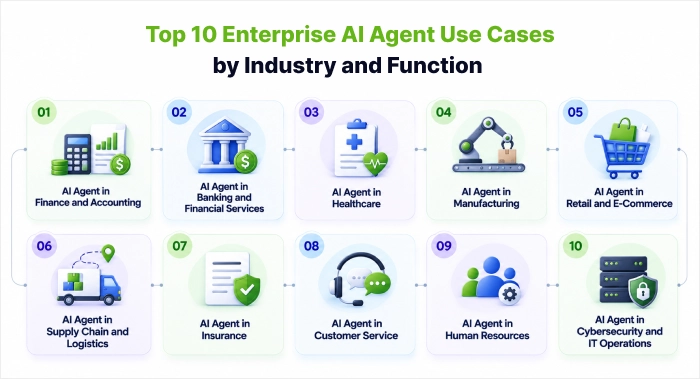
The examples of AI agents explained below focus on business functions where multiple-step work, system integration, and decision-making make a practical opportunity for automation. Each AI agent application briefs about the type of work involved, how an agent can handle it, and the resulting business value.
1. AI Agents for Finance and Accounting
Finance teams process big- volume transactions, but many workflows still need people to move information from system to system, check for exceptions, and follow up with interested parties. Finance is a fertile ground for AI agents, with repetitive work and clearly defined decision points.
For example, an accounts payable agent can match an invoice to the associated purchase order and goods receipt. If the values are within approved tolerances, it can push the invoice forward. If something does not match, the agent can identify it, collect supporting information, and route it to the suitable person.
This lowers manual check and gives finance teams more time for activities needing for judgement, like cash-flow planning, supplier management, and financial analysis. It can improve the consistency of the month-end process and offer a clear audit trail.
2. AI Agents for Banking and Financial Services
Banking workflows are usually very controlled and often have multiple data sources. AI agents can help employees speed up investigations while keeping critical decisions within existing approval processes.
Typical applications include:
- Investigating suspicious transactions with data from multiple systems
- Perform KYC and AML checks (including screening against watchlists)
- Loan and credit file preparation for human underwriters
Consider a fraud investigation. When a transaction triggers an alert, the agent can retrieve the relevant account history, recent activity, device information, and other approved signals. Then it can summarise the case for an analyst.
Now the analyst does not have to collect information to start the investigation, but he gets a structured view of the case and can focus on the decision. This reduces investigation time while still maintaining the required compliance workflow.
3. AI Agents for Healthcare
Healthcare is full of paperwork, rules, different systems, and constant follow-ups—all part of the daily grind. AI agents can handle parts of these workflows—but clinical decisions will always stay with trained professionals.
Common uses include preparing and sending prior authorization requests, as well as writing clinical notes for physician review.
Check for coding or documentation errors before submitting claims.
For example, a prior authorization agent could review a treatment order, check the payer’s rules, grab relevant EHR records, and put together the submission. When something’s missing, it’s smarter to spot the gap than to decide without enough info.
4. AI Agents for Manufacturing
Manufacturing operations create large amount or volume of information. They are production schedules, maintenance systems, equipment sensors and quality systems. The actual challenge is transforming those signals into timely operational decisions.
AI agents can support activities such as:
- Analysing IoT sensor data to identify signs of equipment failure
- Creating maintenance work orders and checking spare-part availability
- Aligning production plans with varying equipment or supply conditions
For example, an agent may detect an unusual vibration pattern in a motor, review it with maintenance history, check if a replacement component is available, and instruct for a maintenance window that will minimise disruption.
This connects many steps that might otherwise be handled separately by maintenance, procurement, and production teams. The results in fewer unexpected stoppages, best maintenance planning, and more efficient equipment usage.
5. AI Agents for Retail and E-Commerce
In retail and e-commerce industry segment, AI agents can take care of tasks that sit between the customer and the back-end operation, from finding products to checking stock and handling orders.
Possible applications are:
- Helping shoppers find and compare products
- Adjusting prices based on demand and inventory
- Tracking stock and raising replenishment requests
- Handling routine order and return queries
For example, an agent may help a shopper find out a product fitting for their needs and budget. AI agent is useful in monitoring stock and flags when it needs to be updated. Linking these tasks will reduce manual work, regulate customer responses, and help retailers to skip lost sales from stock shortages.
6. AI Agents for Supply Chain and Logistics
Supply chains rarely operate exactly as planned. Port congestion, weather events, supplier delays, transport capacity, and demand changes can quickly affect delivery schedules.
AI agents can help teams reply to these changes by:
- Forecasting demand using historical & external data
- Tracking shipments and identifying potential delays
- Assessing supplier risks and available alternatives
For example, if a shipment is needed to miss a connection because of port congestion, an agent can search the affected orders, compare approved transport alternatives, estimate the impact, and make a rerouting recommendation.
Where the workflow allows automated action, it can rebook within predefined limits. Where approval is required, the agent can present the available options to the logistics team. This helps to save time between finding a disruption and responding to it.
7. AI Agents for Insurance
Insurance workflows have large volumes of forms, policy documents, claims records, photos and supporting documentation. One of the more useful AI agent applications for insurers is claims processing.
Typical uses:
- Photographs, policy details and initial notification of loss
- Simple case routing and claim validation against policy conditions
- Reviewing for possible fraud indicators and preparing underwriting summaries.
For an uncomplicated motor claim an agent could gather the information provided, check coverage, examine supporting documentation, anticipate the next step in the processing and have the case ready for settlement.
Simple claims can be processed with minimal help, and unusual or high-value claims can be escalated to an adjuster with all the information already organised.
8. AI Agents for Customer Service
Customer service is one of the most familiar AI agent use cases, but the more important shift is from answering questions to completing service workflows.
Agents can potentially:
- Resolve order tracking, refunds, account changes, and routine troubleshooting
- Maintain context across chat, email, voice, and messaging channels
- Escalate complex cases while providing the human agent with a case summary
Klarna’s AI assistant is a widely cited example in this area. The company reported that its assistant handled a substantial share of customer service interactions after launch.
The enterprise value is not simply the ability to answer customers at any time. An effective service agent can access the systems required to check an order, apply an approved action, update a case, or initiate an escalation. That is what turns conversational AI into an operational workflow.
9. AI Agents for Human Resources
HR teams handle a wide range of repetitive requests and coordination tasks. Many of these involve documents, employee records, calendars, policies, and internal systems.
AI agents can support areas such as:
- Screening resumes against defined job requirements
- Coordinating interviews across multiple calendars
- Managing onboarding tasks and responding to employee policy questions
For example, once a candidate accepts an offer, an onboarding agent can send the required documents, track signatures, raise approved IT access requests, and schedule orientation activities.
Human involvement remains important for hiring decisions and sensitive employee matters. The agent’s role is to coordinate the workflow and reduce the administrative effort required to keep the process moving.
10. AI Agents for Cybersecurity and IT Operations
Security and IT teams often work under constant alert and ticket volume. The difficulty is not always finding information; it is deciding which issue needs attention first and completing routine actions quickly.
AI agents can assist with:
- Triaging security alerts and prioritising them by risk
- Correlating logs and other approved data during incident investigation
- Resolving routine IT requests such as password resets
Consider a suspicious login. An agent can compare the event with approved identity and access signals, review relevant activity, and flag the incident for an analyst. Depending on the organisation’s policies, it may also be able to take a predefined containment action.
The important distinction is control. Security agents must operate within strict permissions with logging, escalation rules and human approval for actions. These factors may materially affect systems or users.
How to Identify the Right AI Agent Use Case for Your Enterprise
Not each business process needs an AI agent. The strongest candidates usually have enough transaction volume to justify automation, a clearly defined outcome, and enough structure to measure whether the agent is performing correctly.
Look for processes with several of these characteristics:
- The task occurs frequently enough to justify investment
- The expected outcome can be defined and measured
- Multiple systems or information sources are involved
- Required data can be accessed through APIs or approved integrations
- Errors can be detected, reversed, or escalated
- Human approval can be introduced where the consequences are significant
A realistic path to select or sort opportunities is to assess each and every process against business value, technical feasibility, risk, and implementation effort. A use case may look best in a demo, but it may not be ready for production if the data is unarranged or any wrong action could be costly.
How to Measure the ROI of Enterprise AI Agent Use Cases
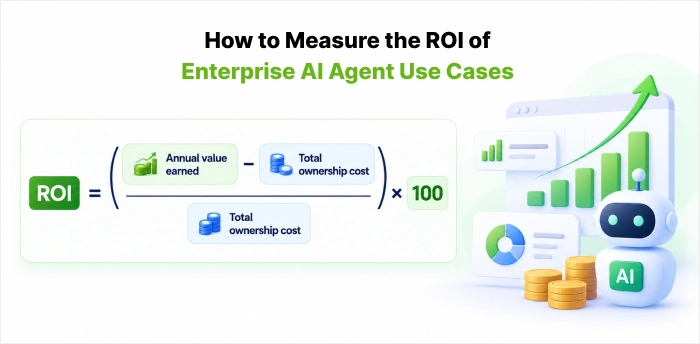
An AI agent’s return on investment should be compared to how the procedure operated prior to deployment. It is simpler to distinguish real progress from conjecture when a baseline is established prior to the pilot.
The advantages of AI agents for businesses may typically be divided into four major categories:
| Metric Category | What to Measure |
| Efficiency | Time saved per task, cycle time, throughput |
| Cost | Cost per transaction, reduced outsourcing |
| Quality | Error rates, rework, compliance exceptions |
| Experience | Customer and employee satisfaction |
A basic ROI calculation is:
ROI = (Annual value earned − Total ownership cost) ÷ Total ownership cost × 100
The total cost should go beyond the model or API bill. Integration efforts, infrastructure, security measures, monitoring and maintenance, and human examination all contribute to the economics of an AI agent.
Another important metric is the automation rate, meaning the percentage of cases performed by the agent without requiring human involvement. However, a higher automation rate is not necessarily better; for some critically important operations, a lower automation rate with more rigorous human review might be the right approach.
Build, Buy, or Partner for Enterprise AI Agents?
The selection between building, buying, or partnering relies on the workflow, internal capabilities, integration requirements, and the differentiation degree involved.
| Approach | Best For | Trade-offs |
| Build | Core processes using proprietary data | Full control, but requires strong AI and engineering capability |
| Buy | Standard functions such as IT service management | Faster deployment, but less customisation |
| Partner | Complex, multi-system workflows | Access to specialist expertise with faster implementation |
A practical enterprise strategy may combine all three approaches. Standard workflows can use an existing product, while a differentiated business process may justify a custom agent.
A partner for AI development can be specifically useful when the project has ERP, CRM, data platforms, legacy applications, security controls, and many approval points. The technical challenge is mostly not the model itself but making the entire workflow must function with reliability across the enterprise ecosystem.
How to Implement AI Agents in the Enterprise Stepwise
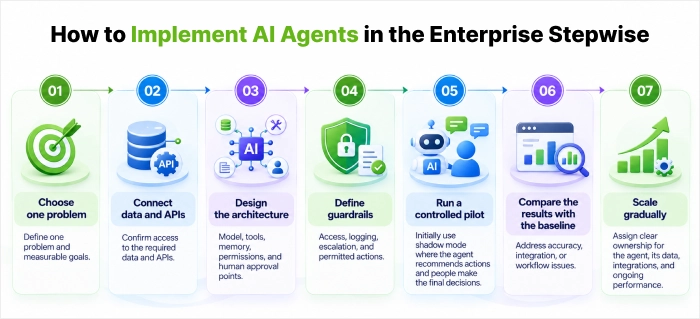
A phased approach minimises the risk of moving much quickly right from a promising prototype to a production system.
Img or info graphics for below
- Choose one problem and define measurable goals.
- Confirm the agent can access the required data and APIs.
- Design the architecture, including the model, tools, memory, permissions, and human approval points.
- Define guardrails for access, logging, escalation, and permitted actions.
- Run a controlled pilot, initially using shadow mode where the agent recommends actions and people make the final decisions.
- Compare the results with the baseline and address accuracy, integration, or workflow issues.
- Scale gradually and assign clear ownership for the agent, its data, integrations, and ongoing performance.
Production deployment should also include monitoring. An agent can behave differently as application interfaces, user behaviour, business data and implicitly models change.
Main Challenges of Enterprise AI Agent Adoption (and How to Overcome Them)
The main barriers to deploying agents successfully usually involve data, integration, governance, and operating processes, not the AI model itself. Gartner has warned that many agentic AI projects might be stopped before they deliver the value people expect.
The table below outlines common issues that organisations need to address as they scale their AI agent use cases.
| Challenge | How to Overcome It |
| Poor data quality and silos | Clean, standardise, and connect relevant data before deployment |
| Security risks | Apply least-privilege access, authentication, and detailed audit logs |
| Hallucinations and incorrect actions | Ground agents in verified data and require approval for high-impact decisions |
| Legacy integration | Use APIs or middleware and involve enterprise IT early |
| Unclear ROI | Establish measurable baselines before starting the pilot |
| Employee resistance | Involve affected teams early and position agents as workflow support |
Conclusion
The most advanced AI agents can be given easier tasks sometimes. They sort real issues, fit right into current running workflows, and trim down time without adding new risks.
Businesses in the financial, banking, healthcare, retail, human resources, and information technology sectors are employing these systems to routinize operations, derive value from data, and perform end-to-end business processes that require a combination of different tasks.
The teams that want to adopt enterprise AI agents should begin with one well-defined business process, test it in real-life settings, and then look to expand.
Choose a simple process with clear, trackable results. Humans can easily monitor these ones. If it works in real life, the same idea could easily be applied elsewhere.
FAQs
In what ways are AI agents applied?
AI agents can be applied when multiple-step processes are needed to complete a query rather than offer a simple response. They can extract data, interface with integrated systems, and perform routine tasks with minimal amount of human input. Common AI agent use cases include customer support, invoice processing, fraud detection, claims processing, recruitment coordination, and IT service management.
What are a few examples of AI agents?
An accounts payable agent may reconcile an invoice against a purchase order, whereas a customer service agent can handle an approved refund. A banking agent can extract data for a fraud investigation, and an IT agent is able to process a service ticket. These AI agent examples are valuable because they can perform a portion of the actual business processes as opposed to simply providing a response.
Which use cases for AI agents are best in business?
The most fitting AI agent use cases are typically those that are frequent, follow a roughly standard procedure, and produce an easily measurable outcome. Customer support, invoice processing, IT service management, and employee onboarding, as examples of such processes in a business setting. The AI agents benefit in these scenarios are the possibility of reduced repeat tasks, fast processing speeds, and a lower risk of human error in regular procedures.
How is an AI agent different from a chatbot?
A chatbot is used to answer questions and deliver reply to prompts. By carrying out tasks that drive progress toward those goals and by making use of the resources at hand, an AI agent can work toward specific objectives.
In which way do AI agents operate?
An AI agent begins with a task or objective and determines the following procedures. The system is able to extract data, utilize connected tools or API, verify the results, and continue with the task or ask for human input. In the case of enterprise-level AI agents, permission, logging, validation, and approval functions help prevent unauthorized actions.
What types of AI agents are there?
Simple reflex, model-based, goal-based, utility-based, and learning agents are among the most common types. Businesses can utilize specialized agents those operate together in a multiple-agent system. In which, every agent is responsible for a segment of a large process specifically.
What does agentic AI mean, and how is it different from generative AI?
Agentic AI treats the AI model as a component of a system that has the ability to plan, use tools, make choices within certain constraints, and complete a task. In short, generative AI produces the result, whereas agentic AI utilizes AI to achieve a particular outcome.
Generative AI is mainly used to create text, images, code, and other content based on a prompt.

 Shaili Gupta

 Ajay Wadne