Zenyum
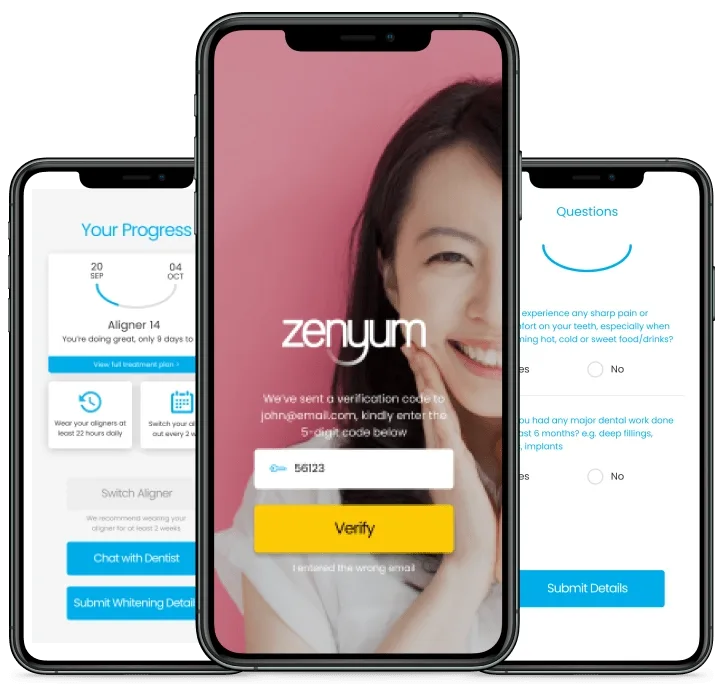
The patient app for an invisible braces service: track the aligner you are on, get told when to switch, chat with a dentist, and follow the treatment plan, with a separate console for the clinics.
Overview
Zenyum sells invisible braces. A patient has their teeth scanned at a partner clinic, gets a set of custom aligners posted to them, and works through the treatment at home.
What was missing was the bit in between: an app connecting the patient to the dentist and showing them the whole treatment as it progressed.
They came to Sphinx Solutions to build it, on both platforms, for patients and for the clinical side at once.
With 16 years across a wide range of application work behind us, the planning mattered more than usual here. Two very different user groups, a medical treatment in the middle, and no obvious product to model it on.
We took the ideation from Zenyum, worked out what could realistically be built and what it should be built with, and set a plan against that before any of it started.
Zenyum wanted a platform connecting dental patients and clinicians online, and there was no reference implementation to work from. Building it from scratch was the challenge before any feature was discussed.
Two interfaces, not one. Everything the patient sees, and a separate console for the dental experts and the admin team.
To hold the feature list together we produced a logic-based blueprint of the application first, then chose the technology against it rather than the other way round.
On the patient side it had to carry sign-up, real-time data on how the teeth were changing, chat and push notifications, and it had to stay consistent from the first screening survey all the way to watching the treatment progress.
Reminders were part of it: telling somebody when it is time to switch aligners or see the dentist, because a treatment that depends on the patient remembering is a treatment that slips.
On the clinical side the console needed a proper database behind it: which patients are assigned to whom, the treatment details, and the chat history that goes with each one.
We delivered the Android and iOS applications and the clinical console, built around the treatment rather than around the shop.
The point of all of it is that a patient going through a months-long treatment at home can see where they are in it and reach somebody who knows.
Sphinx Solutions delivered the Zenyum patient app on iOS and Android with a clinical console behind it: aligner progress tracking, treatment plans, reminders, live chat with a dentist, screening and a clinic finder.
“Zenyum and Sphinx Solutions partnership has proven to be a successful one. They have helped us launch the most advanced applications with user-friendly interfaces and hi-tech features.”
Tech stack
What people usually ask about Zenyum and about building something like it.
Define the goals, research the market, design and concept the product, choose the stack, build the front end and back end, test, then launch. On anything clinical the order matters: the treatment workflow has to be understood before the screens are drawn, because the screens exist to serve it.
A medical appointment platform along the lines of Practo runs roughly $25,000 to $100,000, and a treatment-tracking app like Zenyum sits higher, around $50,000 to $100,000. The spread comes from complexity, the feature set, the platforms, compliance and who builds it. Our app cost calculator will price your own brief.
Compliance and data security are requirements rather than features, and they shape the architecture from the first week. There is also regulatory documentation to produce alongside the software. Budget for both at the start; retrofitting either is where medical projects overrun.
Because the patient and the clinician need opposite things. The patient wants one clear answer: which aligner, how long left, who do I ask. The clinician needs the caseload, the treatment detail and the history for every patient assigned to them. Trying to serve both from one interface produces something that serves neither.
Connect with us