TenX
A collaborative web and mobile network for entrepreneurs: find a vendor, post a requirement, get matched to the right people, and run it all on a subscription. Somewhere between LinkedIn and Facebook, for business owners.

Overview
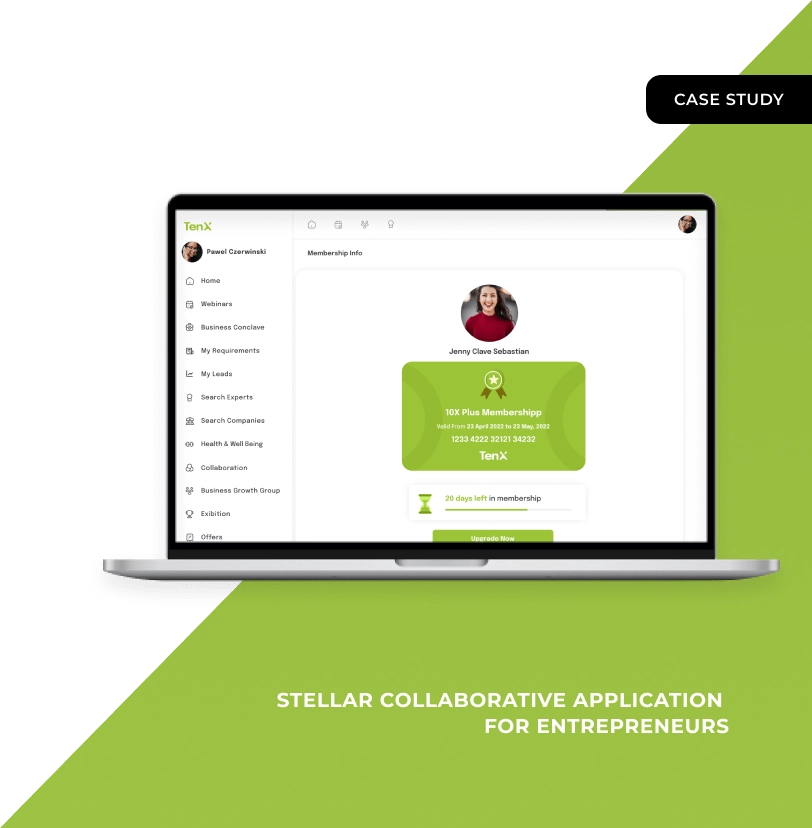
TenX is a collaborative web and mobile application that connects entrepreneurs across the globe. It was built around the things that actually slow a business owner down: finding the right vendor, finding the right solution, and networking across industry segments.
A community application for entrepreneurs, somewhere between LinkedIn and Facebook, built so the people who need each other can find each other.
TenX’s founder, Manish Gupta, is an entrepreneur, investor, TEDx speaker and founder of the Chrysalis Group. He knows how daunting entrepreneurship can be, and he believes networking is what makes it easier, that it can resolve most of the struggle. What he saw was that entrepreneurs in different verticals badly need to talk to each other.
He came to Sphinx Solutions with the idea, knowing we had built community applications at scale before, Vivino, Whiskypedia and Chocoholics among them.
Manish found a gap in the way things worked: business owners were losing opportunities simply for want of collaboration. Building the answer meant testing every aspect, design, functionality, features, usability, recommendations and personalisation.
The application suggests vendors automatically against a requirement someone has posted, matching on interests and several other parameters.
Filters: effective filtering was the hard part, and the part the product lives or dies on.
UI/UX: keeping the interface simple and usable is difficult in proportion to how many things the application can do, and this one does a lot.
Payments: TenX runs on subscriptions, so the payment gateways had to be genuinely secure.
Scalability: the platform is kept flexible enough to take growing demand without trouble.
TenX’s objective was to widen its reach and improve the experience for its members, and we built to that rather than to a feature list.
Sphinx Solutions helped TenX build a cost-effective platform once the business model had been validated. In a short space of time the application took more than 1,000 subscriptions.
Those three are the framework we evaluated TenX against while building it, and they are why a community application succeeds or quietly stops.
“We are very glad we chose Sphinx Solutions as our technology partner. The application they delivered works exactly the way we wanted it to, and the dedication the whole team put into building TenX is evident. We have had a lot of appreciation from our own customers about the application and what it does.”
Tech stack
What people usually ask about TenX and about building something like it.
Business networking app development takes a number of stages: defining the project requirements, market research, choosing the tech stack and platforms, designing the interface, building the front end and back end, testing performance, and launching.
A feature-rich networking app ranges from $40,000 to $100,000. What moves it is the features and functionality, the level of complexity, the app category and the developer’s hourly rate.
Grouped by function and purpose, the main types are client-server applications, distributed applications, and peer-to-peer applications.
Connect with us


