01
A hyperlocal marketplace
One platform connecting the food places, stores and service providers of Ahmednagar with the people who live there.
Overview
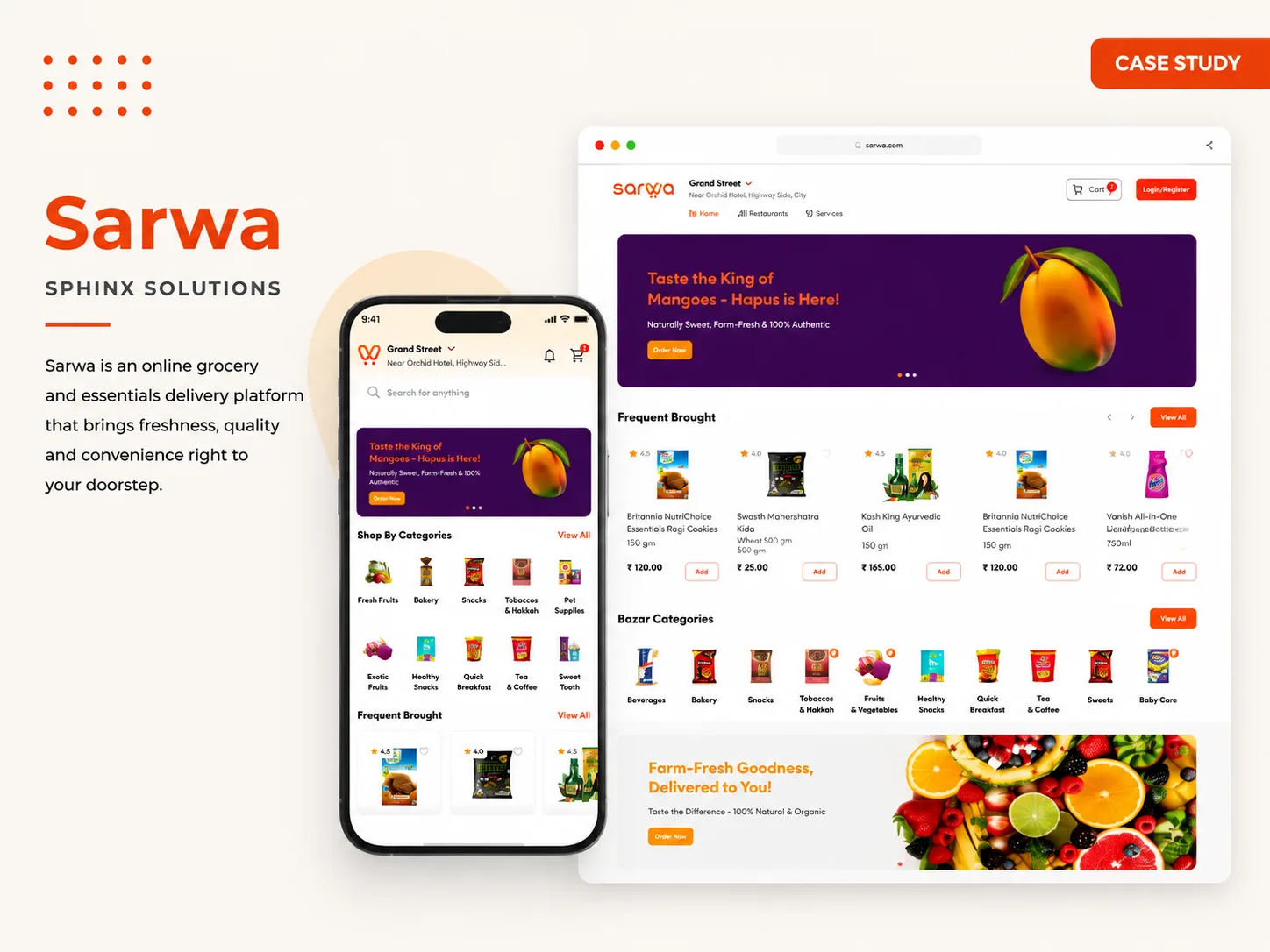
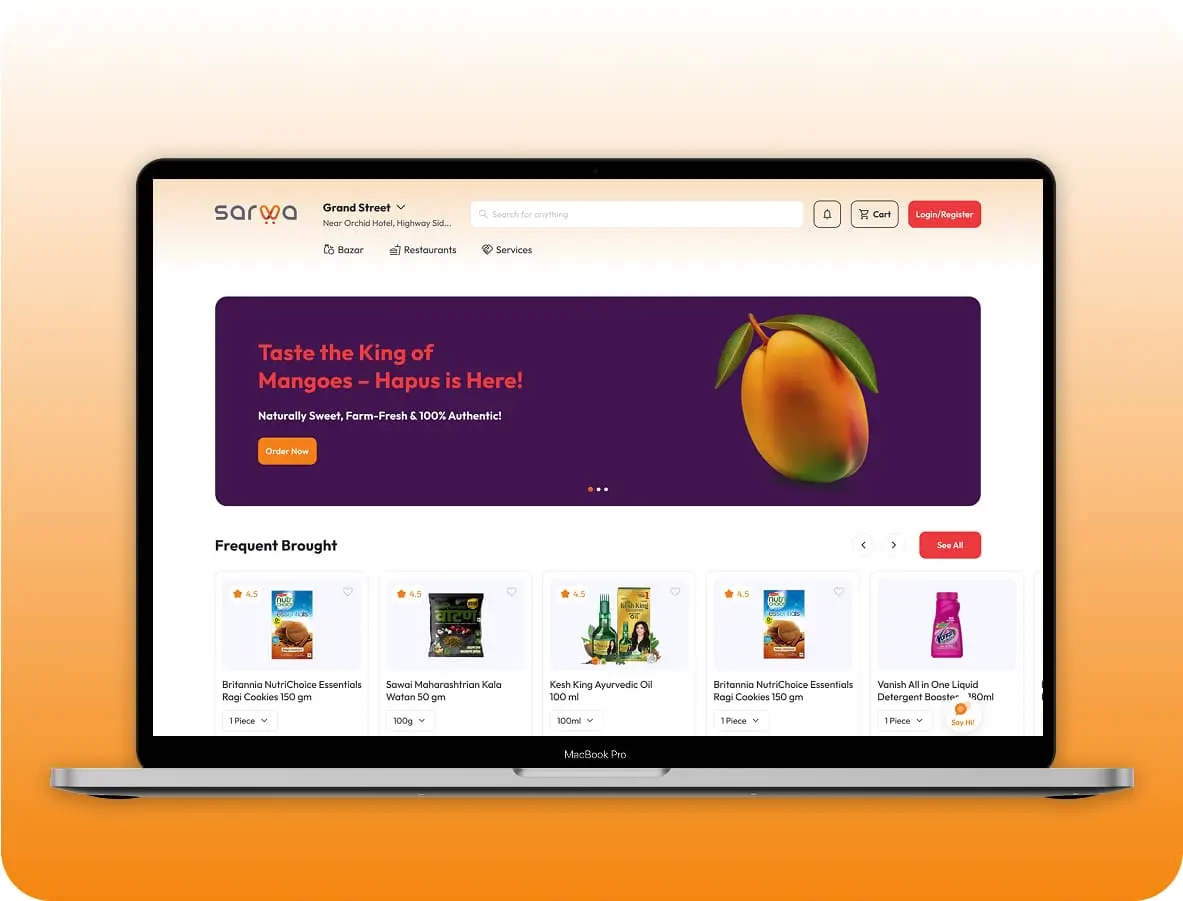
Sarwa is a hyperlocal shopping and delivery marketplace. It puts the local suppliers, shops, restaurants, bakers and service providers of one town into a single app.
Sphinx Solutions built the customer app, the vendor panel, the delivery app and the backend that connects the three.
The engineering emphasis was on the backend rather than the shopfront: many categories, many vendors, and order volume that spikes at predictable times of day. A vendor has to be able to manage their inventory and clear a rush without the system slowing down.
On top of that sits the ordinary requirement, which is that it has to be simple. Real-time ordering, safe payment, straightforward navigation, and a seller console somebody running a shop can actually operate between customers.
What it comes to is a marketplace that puts local businesses online in a town where most of them were not, which is a more useful thing than another national delivery app.
Client Requirement
01
One platform connecting the food places, stores and service providers of Ahmednagar with the people who live there.
02
A safe way to run several vendors at once: product listings, inventory, pricing and performance, each seller in control of their own.
03
Order assignment, real-time tracking and delivery updates, so the customer and the shop both know where an order has got to.
04
Simple enough that somebody can buy something, follow the delivery and find an offer without being taught how.
05
New vendors, new product categories and new towns addable without rebuilding the platform to take them.
06
A quick, dependable experience for the customer and for the seller. A marketplace fails on whichever side gives up first.
Buying food, daily essentials and local services meant moving between several shops, several apps and a few phone calls, because no single place carried all of it.
Sarwa wanted one digital place to buy goods and services from nearby businesses: find the shop, place the order, book the service, follow the delivery.
The sellers needed the other half of that, which is often forgotten: a straightforward way to manage their orders, their stock and their products in real time, without which nothing on the customer side stays accurate.
The hard parts were the ones any multi-vendor platform meets. Handling many sellers across different categories, each with their own prices, stock and order patterns.
Keeping order tracking genuinely live for the customer. And building for an audience with a wide range of comfort with apps, which constrains how clever the interface is allowed to be.
Then doing all of it on infrastructure that would carry more suppliers, more products and more service categories as the platform grew.
We built a platform that links customers to local suppliers and service providers through one app, with the seller and rider tooling behind it.
The result groups a town’s commerce in one place: groceries, household goods, restaurants, services and the bill payments that go with them.
Sphinx Solutions delivered the Sarwa marketplace: a customer shopping app, a vendor panel, a delivery app and the web store, over a backend carrying orders, listings, customer records and live delivery tracking.
“Team Sphinx has demonstrated exceptional dedication throughout the development of our multi-vendor food platform. Their commitment and work ethic have been truly commendable. The final outcome is highly impressive, and we are excited about the potential for many more milestones together in the future.”
How We Work
Five stages, from understanding how the vendors actually work to supporting the platform after launch.
Step 1
We started with the business model, the vendor operations and what customers expected, then settled which features the sellers and the buyers each genuinely needed.
Step 2
Layouts that let a supplier handle stock and orders quickly, and let a customer browse, order and track without instruction. Two different jobs, two different designs.
Step 3
A secure backend for orders, product listings, customer data and delivery, with a vendor panel over it for catalogue, pricing and order status.
Step 4
The customer app: buying food and goods, booking services, paying bills and following orders in one place.
Step 5
Tested across devices and configurations, concentrating on the two things that lose a marketplace its users: order updates arriving late, and payments that do not feel safe.
Implementation
The six pieces the build came down to.
Detailed sessions with the Sarwa team on the business model, the customers and the vendor operations, which set the milestones and the delivery timeline for the app and the panel.
Every step of both journeys mapped: the customer from browsing to buying, and the seller from listing to fulfilment and tracking.
Mockups for the app and the vendor panel, refined against the client’s feedback before development rather than after it.
The app and the site, with live order status, seller tooling, inventory checks and instant alerts.
A tidy, secure backend and a seller console that runs products, prices and order status from one dashboard.
Tested for speed, security and behaviour across devices, then launched on the app stores with the vendor platform live alongside.
Impact
Groceries and local services from nearby suppliers, bought through one app rather than assembled from several.
Suppliers got a straightforward way to manage products, track orders and reach customers they were not reaching before.
Real-time ordering, instant notifications and a clean interface, which is what makes somebody use a marketplace twice.
The infrastructure takes more suppliers, more categories and more places without the platform being rebuilt for them.
Tech stack
In closing
Sarwa took the shops, restaurants and service providers of one town and put them in a single app, with a vendor panel that lets each of them run their own catalogue and a delivery app that closes the loop.
It is a community-scale piece of software rather than a national one, and that is the point of it: it makes local buying straightforward for the customer and gets small businesses online without asking them to build anything.
What people usually ask about Sarwa and about building something like it.
Broadly $15,000 to $70,000 and up, depending on the feature set, the complexity, whether it ships on one platform or both, and what has to be integrated. Real-time tracking, in-app payments and a vendor panel are the three things that move the number most. Our app cost calculator will price your own brief.
Decide the market and the services first, because a hyperlocal marketplace and a national courier are different products with different economics. Then the platform: order management, delivery tracking, secure payments and vendor management are the four things it cannot launch without.
Because the vendors are the hard part and the delivery is the easy part. A delivery app moves things; a marketplace has to get local businesses to list, price and maintain their own catalogues. Get the vendor tooling right and the rest follows. Get it wrong and you have an empty shop.
Keeping order tracking genuinely live, holding many vendors’ inventories accurate at once, integrating payments so they feel safe, and staying quick during the daily peaks. All four are load problems, and they all arrive on the same evening.
Yes, and the platform was built expecting it. The customer app, the vendor panel and the delivery app are the same three pieces wherever you put them; what changes is the catalogue, the categories and the local logistics. Tell us the place and we will tell you what it takes.
Connect with us


