01
A digital loan lifecycle
Application through to closure on one platform, replacing a process that was diligent, slow and largely paper-based.
Overview
Nityadhan Finance Private Limited is a non-banking financial company, registered with the Ministry of Corporate Affairs and authorised by the Reserve Bank of India. It lends to people and to small businesses that conventional credit scoring tends to turn away.
They came to Sphinx Solutions to take a loan operation that ran largely on paper and make it a platform.
The brief was custom software for small and medium enterprises that would streamline loan approval and sanction, and make the process transparent to the borrower while it happened.
Their co-founder had a clear list of what was going wrong: operations that had grown complicated, debt to manage, regulatory compliance to satisfy, and data spread across places that did not agree with each other. All of it manual, and all of it slow.
We went through design, functionality, features, usability and personalisation against those problems before proposing a system, because in lending the process is regulated and the software has to fit it rather than the other way round.
Client Requirement
01
Application through to closure on one platform, replacing a process that was diligent, slow and largely paper-based.
02
A way to check the details a borrower and their nominee provide, since in unsecured lending the verification IS the underwriting.
03
Their collection management was ad hoc and mostly written down, which made it impossible to see where anything stood.
04
Storage and systems robust against attack, on a platform holding financial and identity data for a regulated lender.
05
An interface that makes applying straightforward and lets somebody see their balance, their EMI and their due date without ringing anyone.
06
UPI integration, so a repayment happens in the app rather than through a separate transfer somebody has to be chased about.
The problems were the ones any lender running on paper eventually meets: complex operations, debt to keep track of, compliance to evidence, and data nobody could get a straight answer out of.
The manual process was cumbersome and slow, and slow is expensive when what you are selling is access to money.
Security was the first constraint rather than a later concern. A lender holds identity documents, bank details and repayment histories, and the threats against that are the familiar ones: data breaches, phishing, ransomware and the insider risk that sits behind all three.
Waiting was the second. Long waits come from high volume against limited staff, and get worse when the transaction is complicated or the system behind the counter is old. Both were true here.
Verification was the third, and it is where the delay actually lived. Checking an applicant properly takes time, and doing it by hand at volume is what makes a borrower wait days for an answer.
We built the web and mobile applications, and the systems behind them, for both the borrower and the office.
The team on it was a full one: senior developers, UI/UX, QA, a business analyst and a project manager. On a regulated product that composition is not overhead, it is how the compliance questions get answered while the thing is being built.
Sphinx Solutions delivered the Nityadhan Finance platform: a borrower app on iOS and Android with UPI repayment, a web application, and an admin console covering the loan lifecycle, applicant and nominee verification, and collections that used to be run on paper.
How We Work
The four systems this came down to, and what each one replaced.
Step 1
A digital platform automating every stage of the loan lifecycle, from application to closing. The traditional version of this is painstaking and slow, and most of that time goes on establishing who the applicant is and whether they are good for it.
Step 2
Checking the details given by loan applicants and by the nominees on investments. Doing this systematically is what lets the rest of the process be fast without being reckless.
Step 3
In our sessions with their business leads it became clear the collection system was discrete and largely on paper, which made it ambiguous. We replaced it with something wholly digital and reportable.
Step 4
Storage and defences built for financial and identity data, on a platform that has to satisfy an RBI-authorised lender and its auditors.
Impact
Application, sanction, repayment and closure stopped being separate manual steps and became stages of the same record.
A process that was ambiguous and paper-based turned into something reportable, with collection performance on the dashboard.
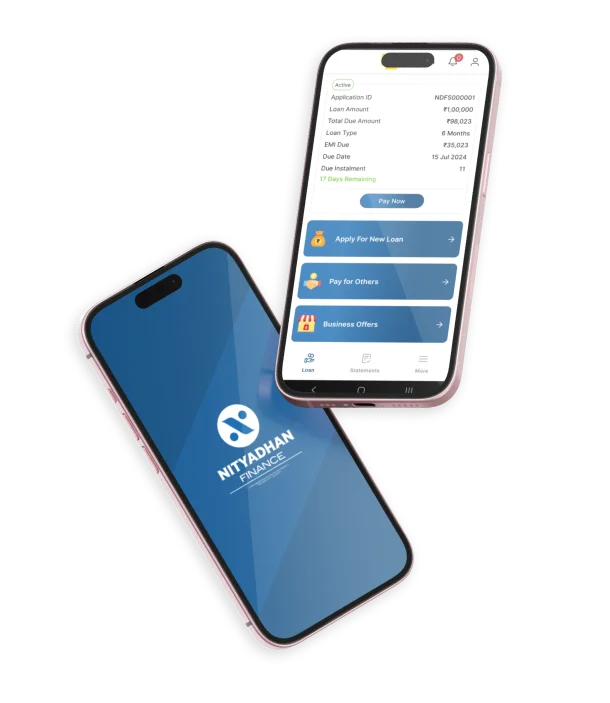
The amount, the EMI, the due date and the days remaining are in the app, which removes most of the reasons somebody would have phoned.
Security, verification and record-keeping designed for the standard an NBFC is held to rather than retrofitted to it.
Tech stack
In closing
Nityadhan Finance lends where conventional credit scoring will not, which means the speed and the rigour of their verification is their business. We built the platform that carries both: the loan lifecycle end to end, applicant and nominee checks, digital collections and UPI repayment.
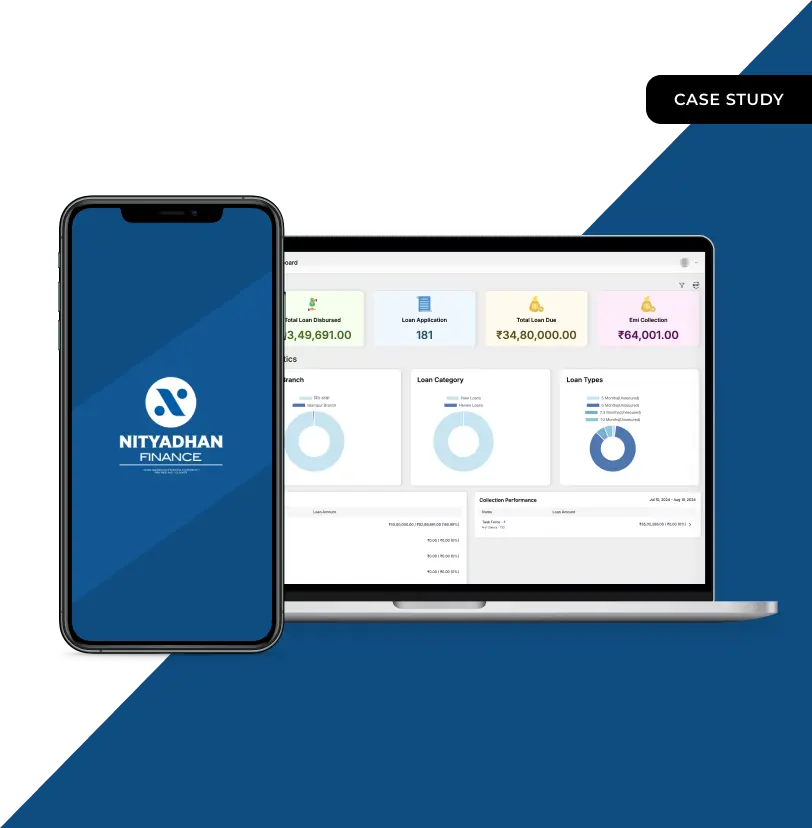
It runs as a borrower app on iOS and Android, a web application, and an admin console that reports disbursement, dues and collection performance by branch, category and loan type.
What people usually ask about Nityadhan Finance and about building something like it.
A platform that carries the whole loan lifecycle: origination, sanction, disbursement, repayment scheduling, collections, reporting and customer service. The point of it is that the state of a loan is one record rather than something reassembled from several systems and a spreadsheet.
It is regulated, so the process it automates is not yours to redesign freely. Verification, record retention, disclosure and reporting are prescribed, and the software has to evidence that it did them. That constrains the architecture from the first week rather than the last.
Because checking an applicant and their nominee properly takes work, and at volume by hand it becomes the bottleneck the borrower experiences as a wait. Systematising it is what lets an approval be both quick and defensible. It is where most of the improvement in a lending platform actually comes from.
Mostly, it makes the position knowable. A paper collection process cannot tell you what is overdue by how much across which branches this morning. A digital one can, and that changes what the business can decide.
Yes. The loan lifecycle, verification, collections, repayment and reporting are common to the sector, and what changes is the product rules and the regulator you answer to. Tell us which, and we will tell you what it takes.
Connect with us