01
Archiving across every channel
Capture, store and analyse messages in real time from the full spread of platforms a regulated firm’s people use, not just email.
Overview
Firms regulated by the SEC and FINRA have to keep and supervise what their people say to clients, wherever they say it. That used to mean email. It now means a dozen channels, most of which live on a phone.
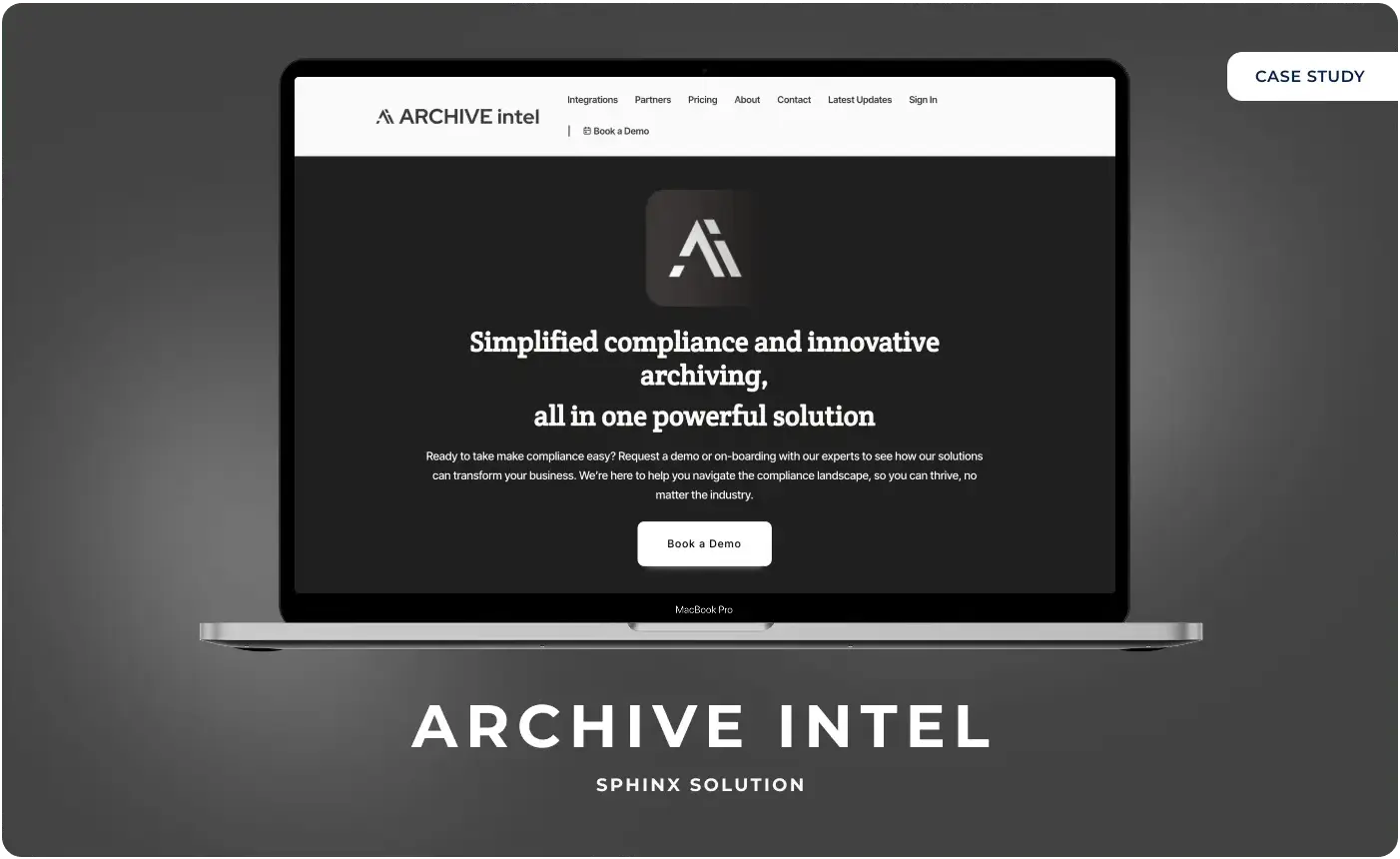
Archive Intel partnered with Sphinx Solutions to build an AI compliance archiving system: capture the communications, work out which ones matter, and prove it later.
The system captures, stores and reviews electronic messages across the platforms people actually use, from iMessage, WhatsApp and Android SMS through to LinkedIn, Slack, Teams, Zoom and Bloomberg IB, and holds them to the standard the regulator expects.
On top of that sits the part that makes it usable: AI reading for risk and language, so a compliance officer opens the messages that need a human and not the thousands that do not.
Archive Intel report a 99% reduction in false flags and a 95% reduction in manual compliance tasks. Their own description of the approach is the shortest and the best: contextual AI, with human oversight.
Client Requirement
01
Capture, store and analyse messages in real time from the full spread of platforms a regulated firm’s people use, not just email.
02
Flag potential violations automatically, and cut the false positives down far enough that the flags get read.
03
Instant notification for compliance teams, so a risk is dealt with while it is still small.
04
A cloud platform certified to the standard regulated clients require, that stays quick as the message volume grows.
Compliance archiving is easy to build badly. The hard parts are the ones that only show up at volume.
An AI that flags too much is the same as no AI at all: the queue stops being read.
Risk detection threw too many false positives. Models flagged communications that were perfectly compliant, and manual review became the bottleneck the software was meant to remove.
Regulation and security demanded encryption, secure storage and audit trails that stand up to scrutiny, because in this industry the archive is evidence.
Capturing and analysing from a dozen sources in real time is a genuinely awkward integration problem, and every platform behaves differently.
And all of it had to keep working at volume, without the delays that make a monitoring system useless.
We built the archiving system with the AI reading alongside the capture rather than bolted on after it.
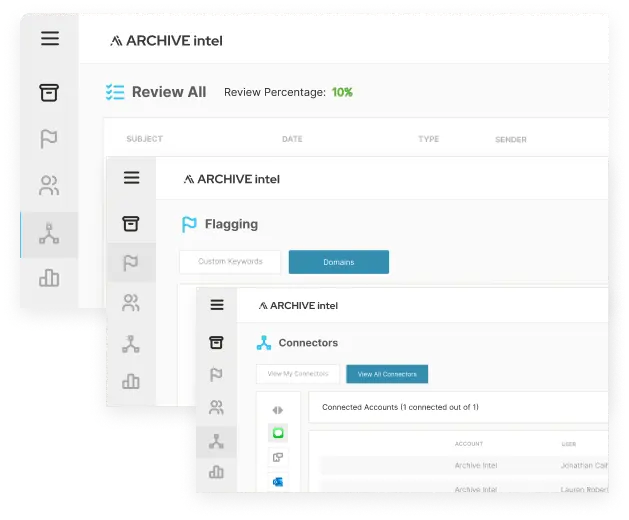
Automated alerts, readable reporting and a review flow that a compliance team can actually work through are what turn an archive into supervision.
Sphinx Solutions delivered an AI compliance archiving system for Archive Intel: real-time capture across the channels regulated firms actually use, contextual AI risk detection, a review and flagging dashboard, and SOC 2 Type II certified cloud infrastructure behind it.
How We Work
Step 1
We learned the regulatory environment with the Archive Intel team: what SEC and FINRA require, where the data comes from, and what the AI is actually being asked to catch.
Step 2
A scalable, secure design joining AI-driven monitoring, cloud storage and real-time processing.
Step 3
Machine learning and NLP models trained for compliance monitoring, tuned for accuracy and against false positives.
Step 4
A workspace for compliance teams to review flagged communications, generate reports and track risk without fighting the interface.
Step 5
Extensive testing of data accuracy, system performance and compliance with the SEC and FINRA standards the product exists to satisfy.
Step 6
Launched, then continuing AI improvements, updates and monitoring as the compliance requirements themselves change.
Impact
Archive Intel report a 99% reduction in false flags, which means a team spends its time on real risks rather than on dismissing imaginary ones.
Email, text, chat, social and the rest are captured and kept reviewable, which is the whole regulatory obligation in one sentence.
Real-time alerts mean a problem is found and fixed while it is still a problem rather than an enforcement matter.
Certified cloud storage and real-time processing keep the archive safe, usable and able to grow with the firm.
Tech stack
In closing
Archive Intel is a good example of AI doing the unglamorous job well. The obligation on a regulated firm is to keep and supervise everything its people say to clients, and the volume of that has grown far past what anyone can read. The value is not in capturing the messages, which is the easy part, but in deciding which of them a human needs to see.
We built the capture, the contextual AI reading it, the dashboard the compliance team works in and the certified infrastructure underneath, so the firm can prove what was said and the officer can get through the queue.
What people usually ask about Archive Intel and about building something like it.
It captures, monitors and archives electronic communications so a firm can meet its SEC and FINRA supervision obligations, and it reads them for risk so somebody does not have to read all of them.
By reading for meaning rather than matching keywords. Contextual analysis cuts the false flags dramatically, which is what makes a review queue something a team gets through instead of something they fall behind on. Human oversight stays in the loop on what the AI surfaces.
iMessage, WhatsApp and Android SMS, LinkedIn, email, Slack, Teams, Instagram, Facebook, X, Zoom and Bloomberg IB, captured and stored securely.
Yes. It is cloud-based and scales with the volume, which matters because message volume in a growing firm only ever goes one way.
By moving the work from reading everything to reviewing what matters. Real-time detection and far fewer false flags streamline the workflow, but the direction of travel is assistance rather than replacement: the regulator still expects a human to be accountable.
Connect with us