01
Matching that is actually competent
Compare a job description against a resume properly, and surface the best candidates rather than everyone who used the right keyword.

Overview
Recruitment has a volume problem. A single opening draws hundreds of applications, most of them irrelevant, and somebody has to read them all before the shortlist exists.
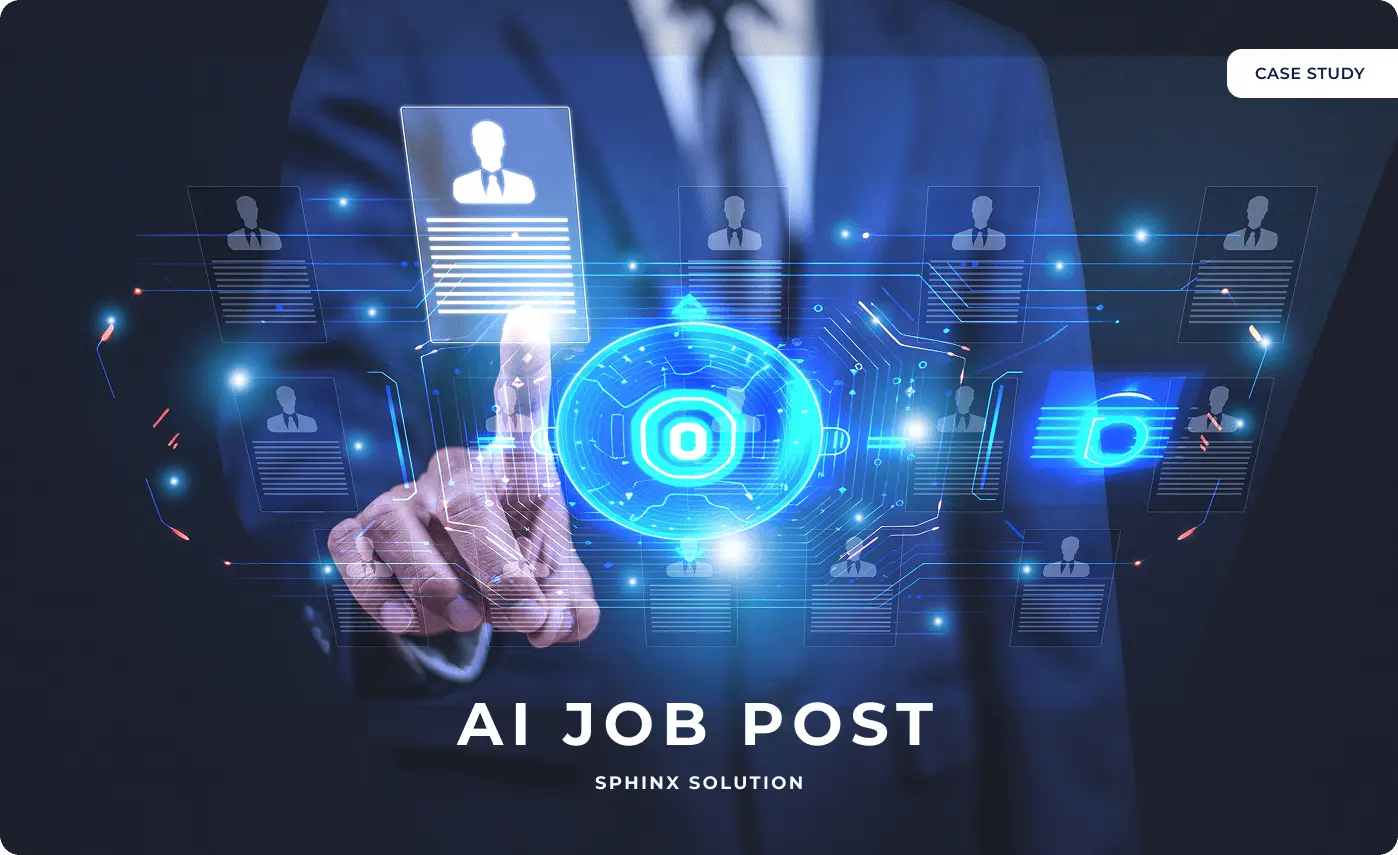
AI Job Post reads the job description and the resumes, and shows an HR team only the candidates worth their time.
Sphinx Solutions built the AI job screening system: resume parsing, contextual matching between a description and a profile, and automated shortlisting on top of both.
Around that sits the part that makes it usable day to day. Candidates are ranked in real time, with predictive analytics and data-driven recommendations, so a hiring decision is made faster and on better grounds.
It runs on secure cloud infrastructure that scales and integrates with the HR tools a team already uses, because a screening tool nobody can plug in does not get used.
Client Requirement
01
Compare a job description against a resume properly, and surface the best candidates rather than everyone who used the right keyword.
02
AI reads and sorts the applications so HR finds the right people without working through the pile by hand.
03
Candidates ranked, with data-driven suggestions attached, so a decision can be made rather than deferred.
04
A cloud platform that keeps candidate data safe and works alongside the HR tools already in place.
Manual screening is slow, inconsistent and quietly biased. Reviewing hundreds of resumes takes days, and without a standard process two reviewers reach two different shortlists from the same pile.
Traditional recruitment methods do not scale, and they rarely integrate with anything modern.
Matching was the core problem. Keyword screening surfaces the wrong people, and the wrong people reaching an HR team is worse than no shortlist at all.
Bringing resumes, job descriptions and applications together from different sources in real time was awkward, because none of those sources agrees on a format.
The system also had to stay quick under a lot of candidate data, and protect it: this is personal information, held at volume.
We built the screening system so the AI reads for meaning rather than for keywords.
By automating the screening, the system takes the tedious part out and takes some of the inconsistency with it.
Sphinx Solutions delivered an AI screening platform for AI Job Post: resume parsing, contextual matching, automated shortlisting and real-time ranking, integrated with existing HR tools on secure cloud infrastructure.
“AI Job Post has completely changed the way we recruit. The matching feature has saved us so much time by automatically shortlisting the right candidates, and we no longer spend hours going through irrelevant resumes. The real-time recommendations help us decide faster and better, it was easy to integrate with our existing tools, and we have seen a real improvement in how quickly we hire and how accurate our selections are.”
How We Work
Step 1
We went through the hiring process with the HR team, where it breaks down and where AI could genuinely help rather than merely be present.
Step 2
Gathered job descriptions and resumes to train the matching, then cleaned and structured them, because the quality of that data sets the ceiling on the result.
Step 3
AI models that read both sides and find the candidates who genuinely fit each role.
Step 4
Scoring the matches so a shortlist arrives ordered, with the reasoning attached rather than as a verdict from nowhere.
Step 5
Checked the matches were right, corrected what was not, and improved speed and accuracy together.
Step 6
Deployed the platform and connected it to the hiring software already in use.
Impact
AI Job Post report screening time cut by 90%, which is the difference between reading a pile and reading a shortlist.
Contextual matching surfaces people who fit the role rather than people who matched the wording, so the shortlist is worth having.
Real-time ranking and data-driven recommendations give a hiring decision something to stand on, and make two reviewers more likely to reach the same answer.
Candidate data is encrypted and access-controlled, and the platform works inside the HR stack a team already has rather than beside it.
Tech stack
In closing
AI Job Post is a straightforward use of AI that earns its place: the reading is the bottleneck in recruitment, and reading is the thing a language model is genuinely good at.
We built the parsing, the contextual matching, the ranking and the integrations, on cloud infrastructure that scales and protects the personal data it holds, so HR teams spend their time on the hiring rather than on the sorting.
What people usually ask about AI Job Post and about building something like it.
An AI screening tool that matches job descriptions against candidate resumes, so the hiring process starts from a shortlist rather than from a pile.
It shortlists the most suitable candidates automatically, which removes most of the manual resume screening and the days that go with it.
Yes. It connects to your current applicant tracking system and HR tools rather than asking the team to work somewhere else.
Yes. It is built for HR teams rather than for technical users, and it does not assume any expertise beyond the job itself.
Natural language processing reads both the description and the resume for what they mean, not for which words they share, which is what separates a relevant shortlist from a keyword search.
Connect with us