Ease of management
An intuitive admin dashboard lets non-technical teams manage products, inventory, orders, discounts and content without relying heavily on developers.
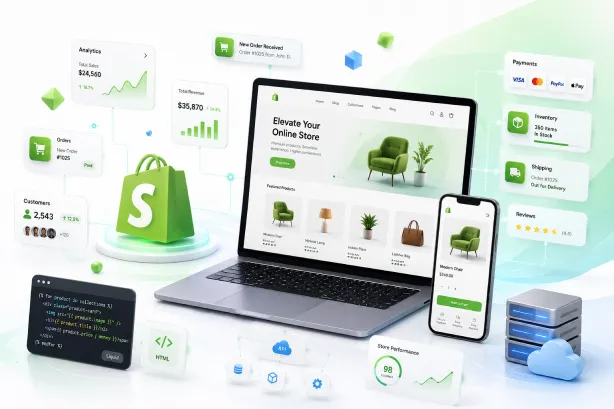
Shopify development is the process of building, customising and optimising an online store on the Shopify platform. We cover store setup, theme design, custom functionality, third-party integrations and the maintenance that follows launch.
Trusted By
750+ happy clients, including top Fortune 500 companies













Overview
Shopify development is the process of building, customising and optimising an online store on the Shopify platform. It covers everything from initial store setup and theme design through to custom functionality, third-party integrations and ongoing maintenance, so the store keeps working as the business behind it changes.
Businesses use Shopify development services to launch new stores, migrate from legacy platforms, extend capabilities with custom apps and improve the performance of existing storefronts. As an ecommerce development company we use Shopify as part of a broader set of platform capabilities, alongside Magento, WooCommerce and custom-built solutions, so the technology matches the need.
Why It Matters
Shopify has established itself as one of the world’s leading ecommerce platforms by helping businesses launch, manage and scale online stores. From startups and direct-to-consumer brands to growing retailers and enterprises, it offers a reliable ecosystem that simplifies selling online while supporting long-term growth.
An intuitive admin dashboard lets non-technical teams manage products, inventory, orders, discounts and content without relying heavily on developers.
Businesses can start with a basic store and expand as they grow. Shopify handles increasing traffic, larger catalogues and seasonal spikes without major infrastructure changes.
Built-in SSL certificates, PCI-DSS compliance, secure payment processing and regular platform updates help protect customer data and transactions.
Most Shopify themes are fully responsive, delivering a consistent shopping experience across smartphones, tablets and desktops.
With thousands of apps and integrations available, businesses can extend store functionality for marketing, shipping, customer support, analytics and loyalty programmes.
Sell across social platforms, online marketplaces and physical retail, all managed from a single centralised dashboard.
For larger organisations, Shopify Plus offers advanced automation, higher customisation flexibility and features designed for enterprise-level operations.
What We Build
Seven services covering the whole life of a Shopify store, whichever point you are joining us at. They run from a store built around your business logic rather than an off-the-shelf theme, through setup, theme work, migration, integration and Shopify Plus, to the maintenance that keeps it selling.
01
Build a Shopify store tailored to your brand identity, product catalogue and customer journey. We go beyond off-the-shelf themes to deliver stores designed around your business logic, checkout flow and conversion goals.
Talk to our service experts02
Get your store up and running quickly with a properly configured Shopify environment: products, collections, payment gateways, shipping zones and taxes. A strong setup prevents costly fixes later.
Talk to our service experts03
Your storefront is your first impression. Our UI/UX team creates responsive, brand-consistent Shopify themes using Liquid, Shopify’s templating language, with a focus on visual hierarchy, mobile usability and conversion performance.
Talk to our service experts04
Moving from Magento, WooCommerce, BigCommerce or a custom platform? We manage your Shopify migration end to end, including product data, customer records, order history, SEO redirects and store configuration, with minimal downtime and zero data loss.
Talk to our service experts05
Connect your store with the tools your business already uses: ERP systems, CRMs, payment gateways, shipping carriers, marketing platforms and inventory management software. We handle custom API integrations when the Shopify App Store does not cover your exact use case.
Talk to our service experts06
For high-volume merchants and enterprise brands, Shopify Plus offers advanced customisation, higher API limits, dedicated support and automation through Shopify Flow. We implement B2B storefronts, multi-store setups and custom checkout experiences.
Talk to our service experts07
Post-launch support matters. We provide ongoing Shopify maintenance including performance monitoring, bug fixes, feature updates, security patches and store optimisation, so your team can focus on selling.
Talk to our service expertsWhat We Solve
Every ecommerce business has different requirements, from managing large product catalogues to improving customer experience and expanding into new sales channels. Our Shopify solutions are designed to help businesses overcome operational challenges and build stores that support long-term growth rather than just a launch date.
Direct-to-consumer brands need fast, conversion-focused storefronts. We help D2C businesses create engaging Shopify stores that support acquisition, retention and repeat purchases while maintaining a strong brand identity.
Modern customers shop across multiple platforms. Shopify lets businesses manage online stores, social commerce channels, marketplaces and retail operations from one place, keeping every touchpoint consistent.
Businesses moving from legacy platforms often face data loss, SEO issues and downtime. Our migration solutions ensure a smooth transition to Shopify while preserving important business data and customer information.
As businesses grow, their platform must support increased traffic, larger catalogues and evolving expectations. Shopify provides the flexibility to scale operations without significant infrastructure investment.
An attractive storefront alone is not enough. We improve user journeys, simplify checkout, optimise product pages and create customer-focused experiences that support higher conversions.
Many businesses rely on multiple systems. Shopify can be integrated with payment gateways, CRM platforms, inventory systems, shipping providers, marketing tools and third-party applications to create a connected ecosystem.
For larger organisations and high-volume merchants, Shopify Plus offers advanced features, automation and greater customisation, supporting businesses that need more flexibility and operational efficiency.
Ecommerce keeps moving. Regular updates, performance improvements, feature enhancements and customer experience work help businesses stay competitive as market demands change.
How We Work
Our process is structured and collaborative, designed to reduce project risk, improve visibility and deliver scalable ecommerce on time. Seven stages run from discovery and UX strategy through development, migration and testing to launch and the continuous optimisation that follows it.
Step 1
What we do: We begin by understanding your business model, products, target audience, customer journey and operational requirements. Our team analyses competitors, identifies technical dependencies and defines scope so the solution aligns with your objectives.
What you get
Step 2
What we do: Our designers create wireframes, user journeys and visual concepts that align with your brand identity and conversion goals. We focus on intuitive navigation, responsive layouts and seamless shopping experiences before development begins.
What you get
Step 3
What we do: Our developers build your store using scalable theme architecture, custom sections, Liquid templates and the platform customisations the project needs. Integrations and custom functionality are implemented to requirement.
What you get
Step 4
What we do: Where required, we migrate products, customer data, orders and content from your existing platform, and integrate payment gateways, shipping providers, CRMs, ERPs and marketing tools into a connected commerce ecosystem.
What you get
Step 5
What we do: Before launch we test your store across devices, browsers and user scenarios, verifying checkout flows, product functionality, mobile responsiveness, performance and overall experience.
What you get
Step 6
What we do: Our team manages the deployment process, including domain configuration, SSL setup, SEO redirects and final pre-launch checks, to ensure a smooth transition to your live store.
What you get
Step 7
What we do: After launch we continue supporting your store with updates, enhancements, performance monitoring and ongoing optimisation, so the business can adapt and grow.
What you get
How We Build It
Successful ecommerce development involves more than launching a store. It means selecting the right technologies, integrating the business systems behind them and building experiences that support growth. Our Shopify work combines platform expertise with broader ecommerce experience across seven layers of the stack.
Industries
Our Shopify experience is supported by broader expertise in software, web and digital commerce across multiple industries. Understanding sector-specific challenges, customer expectations and operational requirements is what lets us build stores that fit the business rather than just the category.
Comparison
Choosing the right ecommerce platform shapes your store’s cost, scalability and day-to-day effort. Shopify trades some control for hosting and maintenance you never have to think about; WooCommerce and Magento give that control back at the price of running it yourself. Here is how the four compare. If the answer turns out not to be Shopify, our ecommerce development team builds on Magento, WooCommerce and BigCommerce too.
| Feature | Shopify | WooCommerce | Magento | Custom ecommerce |
|---|---|---|---|---|
| Setup time | Fast | Moderate | Longer | Long |
| Hosting included | Yes | No | No | No |
| Maintenance effort | Low | Medium | High | Very high |
| Scalability | High | Medium | High | Depends |
| Security management | Built-in | User-managed | User-managed | Fully custom |
| Technical expertise needed | Low | Medium | High | Very high |
| App ecosystem | Extensive | Large | Moderate | Custom |
| Upfront cost | Moderate | Low | High | Very high |
| Best for | SMBs, D2C, retail | Small businesses | Enterprises | Unique requirements |
Best for startups, D2C brands, retailers and businesses seeking a scalable, low-maintenance ecommerce solution.
Suitable for WordPress users who require flexibility and have access to technical resources.
Ideal for large enterprises with complex requirements and dedicated development teams.
Recommended for businesses with unique workflows, advanced integrations or highly specialised requirements.
Why Shopify
The scale of Shopify and of the ecommerce market is a large part of why businesses invest in a well-built store rather than a quick theme install. These are the data points that shape the recommendations we make, each one attributed to the organisation that published it.
$1T+
Cumulative sales generated by Shopify merchants worldwide.
Shopify (2024)
4.6M+
Live Shopify stores across more than 175 countries.
BuiltWith (2025)
$6.9T
Projected global retail ecommerce sales in 2025.
Statista (2025)
2 to 3%
Average ecommerce store conversion rate, the benchmark good UX aims to beat.
Figures cited from third-party sources as of the dates shown; refer to each source for the latest data. Last reviewed: 30 June 2026.
How We Engage
Every Shopify project arrives with different requirements, timelines and business goals. Whether you are launching a new store, migrating from another platform or expanding an existing operation, these three engagement models offer different balances of cost, speed and delivery transparency, so you can pick the one that fits.
01
A clearly defined scope, timeline and budget make this model ideal for Shopify store launches, theme customisations, migration projects and small to medium engagements. Agreed deliverables and milestone-based execution give complete visibility into costs and timelines.
02
For businesses with evolving requirements, our agile model enables continuous improvement, feature releases and iterative development. Priorities can be adjusted based on business needs, customer feedback and market changes.
03
Businesses requiring continuous development, store enhancements, integrations and long-term support can work with a dedicated team of designers, developers and project managers, for greater flexibility with consistent delivery.
Expert Insights
The biggest Shopify mistake we see is treating the store as a theme install rather than a business system. Shopify’s real value is not the storefront you launch on day one, it is how easily it scales as your catalogue, channels and order volume grow. Get the data model, integrations and checkout flow right early, and Shopify quietly handles Black Friday traffic and multi-market expansion. Skip that groundwork and you end up fighting the platform with apps and workarounds that slow the store down and erode conversions.
Why Choose Us
Sphinx has completed 16 successful years in the industry, helping businesses with technology and digital transformation, including AI-powered solutions across major industry verticals.
We have a dedicated and reliable team of AI engineers, ML scientists, data engineers, and MLOps specialists covering every role in the AI development lifecycle.
We have delivered more than 1,500 solutions through a results-driven approach, many to recurring clients who keep expanding their AI capabilities with us.
We have a dedicated in-house team, experienced and skilled across AI development, software engineering, QA, DevOps, and cloud infrastructure.
We are trusted by 750+ clients for best-in-class AI solutions at competitive rates, with the delivery accountability enterprise clients demand.
Our client-centric approach and high-calibre AI engineering, built on current models and frameworks, have made us a trusted partner for businesses building AI.
Connect with us
Discuss your requirements, timelines, integrations and growth plans.
Everything you need to know about building on Shopify with us. Can’t find your answer? Talk to us.
Shopify is a strong choice for startups and SMBs because it offers an easy-to-manage platform, lower startup and maintenance costs, fully responsive design, a choice of over 1,000 free and paid themes, multiple payment integrations for a seamless checkout, and apps that extend store functionality.
There are two costs to plan for. The first is your Shopify subscription: Shopify sells four tiers, Basic, Grow, Advanced and Plus, priced per month with lower payment-processing rates on the higher tiers. Prices differ by country and Shopify revises them, so check the current figures on Shopify’s pricing page for your market. The second is the build. Development cost from Sphinx Solutions depends on scope: a configured store on an existing theme sits at the low end, a custom-built storefront, a platform migration or a Shopify Plus implementation with ERP and CRM integrations at the high end. Tell us the catalogue size, the integrations and the launch date and we will quote against those.
Shopify Plus is Shopify’s enterprise-level plan, designed for high-volume businesses that need advanced performance, deeper customisation and greater scalability. Our Shopify Plus team helps brands with design, development, integration, migration, marketing support and ongoing store optimisation.
Shopify developers need proficiency in HTML, CSS and JavaScript to customise themes and storefronts, knowledge of Shopify’s Liquid templating language, an understanding of APIs and webhooks for custom functionality and external services, and experience with data import, export and third-party integrations.
The transfer runs in four steps: log into the Partner Dashboard and click Stores, select Transfer Ownership next to the relevant store, choose a new owner from the eligible owners list in the Transfer Store Ownership dialog, then click Transfer Store to begin the process.
Yes. We can customise existing Shopify themes or develop tailored storefront experiences that align with your brand identity and business requirements. Our team focuses on visual design, user experience, mobile responsiveness and overall store performance to support retention and conversions.
We optimise stores by improving site speed, simplifying navigation, enhancing mobile experiences, streamlining checkout flows and optimising product pages. The approach focuses on reducing friction throughout the customer journey while making design and usability improvements that lift engagement.
Yes. Shopify can support multi-vendor marketplace models through custom development and third-party integrations. Vendor management, commission tracking, product approvals and seller dashboards can all be implemented to help businesses run multiple vendors at scale.
The timeline depends on scope, design complexity, required features and third-party integrations. A standard Shopify store may take several weeks to complete, while larger projects involving custom functionality, migrations or Shopify Plus implementations may require several months.