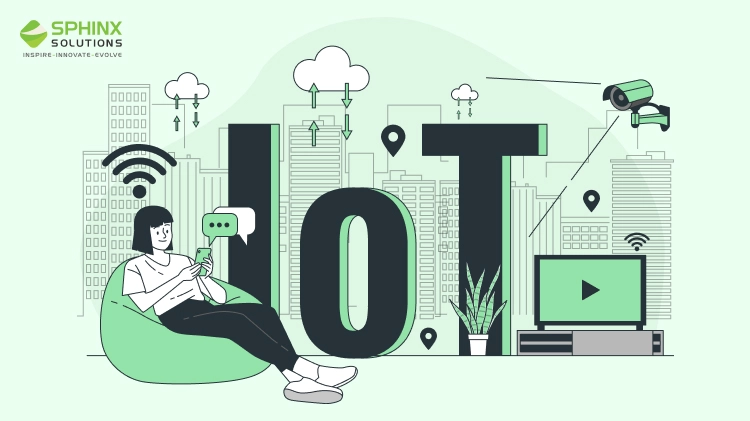
Connectivity in IoT is going through a paradigm shift, enabling devices to connect and exchange data. From smart homes that use BLE (Bluetooth Low Energy) to wide area networks that use LoRaWAN to cover long distances, connectivity glorifies the potential of IoT technology solutions.
As IoT is thriving at an alarming rate, the future of IoT technology solutions is expanding with Artificial Intelligence (AI) and 5G networks. In collaboration with new IoT applications, AI-powered algorithms can improve data analysis while 5G networks offer faster speed with low latency.
Smart cities are adapting more IoT solutions to improve urban living. For example, smart street lighting systems control energy consumption and reduce costs. Also, environmental monitoring for pollution control can help cities track pollution levels and take appropriate measures to improve air quality.
Let’s discuss how connectivity is evolving with IoT technology.
Is your business missing out on the benefits of connected devices?
Our IoT technology solutions drive efficiency and innovation.
Tracing the Path to IoT Technology Solutions
The Internet of Things (IoT) we know today has evolved after decades of innovation and advanced technological solutions. The journey of simple data transmission evolved slowly into a complex network of interconnected devices after decades of innovation and advanced technological solutions.
IoT technology solutions originated in the mid-twentieth century but were developed in the 1960s. Coca-Cola was the first ever company to introduce vending machines with internet-connected inventory. The early telemetry system also employed phone lines, radio waves, and satellite connections to convey data. Machine-to-machine communication thrived as technology matured into the Internet of Things (IoT).
Components of IoT Technology Solutions

Understanding the complexity of IoT technology solutions can be challenging at times. At its core, IoT technology solutions are made possible by the four components: hardware, software, connectivity, and platforms. Let’s break down the points to know more about the pillars of IoT.
Read More Related Blogs
Hardware: The Physical Foundation
The IoT device hardware is a physical embodiment of “things” in all shapes and sizes. Device hardware like sensors, actuators, and microcontrollers collect data and communicate with the user. These devices are the ‘eyes, ears, and mouth” of the IoT.
From tiny, pinhead-sized microphones to heavyweight construction machines, all are different forms of IoT devices. Any object can be transformed into an IoT device, whether a living being or an animal. To ensure reliable performance, many businesses also rely on specialized wiring solutions such as WellPCB custom wire harness to integrate multiple electronic components efficiently. This type of wiring harness helps improve durability, organization, and connectivity across IoT hardware systems.
It’s a mathematical method that combines suitable sensors, actuators, and software for IoT functions. The only limitations are each IoT use case’s specific criteria, such as size, ease of deployment, dependability, longevity, and cost-effectiveness.
Software: The Intelligent Core
The hardware components are essential for the IoT, so software makes them intelligent. A smartphone without the right software is a junk of metal and glass. It’s the software that makes connected devices truly “smart.”
The software runs directly on a microprocessor/microcontroller to perform essential functions like interacting with sensors and handling the data processed. The cloud platforms are available to store the data storage and analytical capabilities.
The IoT ecosystem has a variety of devices with unique languages. The device’s software is a translator between the device and its user. This ensures an understandable communication between cloud-based platforms, enabling real-time data exchange and remote management.
Communication: The Digital Bridge
The communication layer is the sturdy bridge between interconnected IoT devices and the broader internet. The data travels through the communication layers so the devices can exchange information securely.
This layer is vital in device-to-device and device-to-cloud communication in IoT technology solutions. The communication layers can be physical connectivity (Cellular, Satellite, LANs) or protocols (Zigbee, Thread, Z-Wave, MQTT, LwM2M).
The communication solution for data transfer, device management, and interoperability have their set sof advantages and disadvantages in different IoT scenarios.
Read More Related Blogs
IoT Platforms: The Backbone of IoT
The smart IoT devices collect all of their data on the IoT Platforms. The primary roles of an IoT platform are data aggregation, management, processing, and visualization.
The important factors include:
- Architecture and Technology Stack
- Reliability
- Customization
- Protocols
- Hardware Agnosticism
- Security
- Cost-Effectiveness
Cloud services like AWS IoT, Azure IoT Hub, and Google Cloud IoT often host them for scalability and ease of management. IoT platforms can also be deployed on-premise, which offers greater control and security with proper infrastructure. Businesses seeking a balance between the two often turn to the best colocation providers, housing their IoT servers in secure, high-availability data centers while retaining full hardware control.
Connectivity in the IoT Technology Solutions
Connectivity is the cornerstone of IoT technology solutions. The complexity of the projects is growing along with the upcoming IoT projects. There is a greater demand for dependable connectivity in IoT technology solutions. So, the amalgamation of hardware, software, connectivity, and platforms has accelerated the Internet of Things (IoT) to other levels.
Connectivity solutions in IoT technology solutions bind the IoT devices with systems and networks. It refers to the communication protocols and technologies enabling devices to transfer real-time data across environments.
Urban living is almost consumed by IoT devices at every point in time. For example, consider smart home IoT devices that we use in our daily lives.
- We will use the connectivity of short-range and low-power consumptions for indoor devices like thermostats and light bulbs. Bluetooth LE will likely be a good fit for short-range connectivity.
- We will opt for long-range connectivity with higher consumption for outdoor devices like weather sensors or security cameras to ensure reliable communication. LoRaWAN or Sigfox is the best fit for long-range connectivity.
Businesses should carefully evaluate the factors for choosing the proper connectivity that can make or break an IoT deployment. Each component works in tandem, and the network ensures the data flow between the physical and digital worlds, driving innovation across industries.
Is your business missing out on real-time data and automation?
Our IoT Technology Solutions provide seamless connectivity and efficiency.
Short-Range Connectivity in IoT Technology Solutions
Short-range connectivity is a significant part of many small IoT devices. These solutions are ideal for scenarios where devices are nearby, such as smart homes, wearables, and industrial automation.
Short-range connectivity takes advantage of radio waves to form a wireless network between devices. These IoT technology solutions are designed for localized, indoor environments where devices are typically close together with maximum power efficiency.
Some benefits of Short-range IoT solutions include:
- Minimum Coverage
- Less Power Consumption
- Reliable
- Secure
- Cost Effective
With the benefits mentioned above, the most commonly used short-range connectivity solutions are discussed below:
BLE (Bluetooth Low Energy):
IoT technology solutions that are nearby use Bluetooth Low Energy for connectivity. It works within 100 meters of the range to send small chunks of data with minimum power consumption. The battery life can go on for hours.
Fitness trackers, medical gadgets, smartwatches, smart locks, and asset-tracking devices are examples of popular BLE connectivity devices.
Read More Related Blogs
RFID (Radio Frequency Identification):
RFID Is among the first IoT applications ever implemented for automatic identification and data capture. This technology uses electromagnetic fields to transmit data between an RFID tag and the user.
RFID can be considered the positioning of IoT technology solutions that are required to locate the position of an object in a building. It is used in supply chain management, asset tracking, hospital patient tracking, and logistics.
Zigbee:
Zigbee is a mesh networking network protocol, which means devices can communicate with each other to extend coverage. It operates within 30-100 meters of range with low data exchange rates and power consumption. Built on the IEEE 802.15.4 standard, it’s the best fit when you want dozens (maybe even hundreds) of devices to cooperate.
Zigbee is most commonly used in traffic management systems, smart home electronics (smart lights, security devices), and the manufacturing industry. Zigbee is why Amazon Echo can control your lights and security cameras without troubling your fingers.
Wi-Fi:
Wi-Fi is known for its high-speed data transfer capabilities. The most popular short-range connectivity protocol offers high data rates (upto gigabits per second) within 50-100 metres. The power consumption of Wi-Fi is higher than that of BLE or Zigbee, which can drain the device’s battery life.
Wi-Fi is used in smart homes (smart TVs or security cameras), industrial IoT devices, and consumer electronics.
Thread:
Thread is also a mesh networking protocol with low data transfer capabilities. An IPv6-based low-power connectivity enables connected devices to communicate, access services in the cloud, and interact with users. Its range is around 100 metres, designed to be more scalable than Zigbee or Zwave.
Thread is intended for smart home devices such as thermostats, smart lighting, and security systems (alarms, cameras).
Curious About How Iot Services Can Boost Your Efficiency?
Use Our Iot COst Calculator to See the Benefits for Yourself!
Long-Range Connectivity in IoT Technology Solutions
Long-range connectivity can connect devices across vast distances that span hundreds of kilometers. These solutions are ideal for applications that require wide coverage, such as smart cities, logistics, and agriculture.
Long-range connectivity uses radio waves to create a network that covers multiple kilometers. They are energy efficient and cannot be affected by obstacles like buildings and trees with low power consumption.
Some benefits of Short-range IoT solutions include:
- Extensive Coverage
- Low Power Consumption
- Reliable
- Scalable
- Cost Effective
With the benefits mentioned above, the most commonly used long-range connectivity solutions are discussed below:
LoRaWAN (Long Range Wide Area Network):
LoRaWAN transfers data in a range of 10-15 km using low power. It can run for years without changing the battery now and then. It allows bi-directional communication, meaning devices can receive and send data.
LoRaWAN includes IoT projects like remote weather stations, smart agriculture sensors, utility meters, etc, for M2M (Machine to Machine communications.
Sigfox:

Sigfox is yet another Low-Power Wide Area Network (LPWAN) technology, making the devices last for years. It’s a straightforward low-range network built for small, regular data bursts and not real-time data streaming. It offers global coverage at a low cost.
Sigfox uses a common M2M (Machine-to-machine) application for asset tracking, environmental monitoring (pollution checker, air index checker), Smart street lights, patient monitors, and security cameras.
NB-IOT (Narrowband-IoT):
Narrowband IoT is the newest radio technology. It operates on a licensed cellular spectrum, benefiting from the telecom operator’s infrastructure. It has deficient power consumption and approximately ten years of battery life and handles a maximum number of devices.
NB-IoT is probably used in smart meters, smart parking, asset tracking, industrial IoT, and wearables for healthcare, agriculture, and environment monitoring.
5G:

5G is a network with ultra-fast data speeds and massive device connectivity. It is still in its early stages for IoT but will bring advancements by offering unprecedented speed, reliability, and capacity compared to previous network generations.
5G connectivity will introduce network slicing that divides the network into multiple virtual networks. Examples of 5G are smart cities, remote surgery, autonomous vehicles, augmented reality (AR), and virtual reality (VR).
The contributions of Sphinx Solutions in IoT projects related to connectivity are innovative and efficient. We have a proven track record addressing diverse connectivity challenges and delivering customised IoT solutions.
Read More Related Blogs
Sphinx Solutions for IoT Technology Solutions
Sphinx Solutions is a leading provider of IoT technology solutions. It helps businesses to harness the power of IoT projects. The IoT developers and experienced professionals are committed to providing IoT solutions to the best of their abilities. Here are some reasons to choose Sphinx Solutions as your IoT project developer:
- Domain Experts: Sphinx Solutions has a team of IoT developers who work solely with IoT devices and software. Their expertise in IoT technologies helps them deliver appropriate IoT technology solutions.
- Comprehensive IoT Solutions: Sphinx Solutions provides a comprehensive range of IoT services, including consultancy, development, platform deployment, IoT device management, and data analytics.
- Advanced Technology: The company stays up-to-date with the latest market trends. Experts use advanced tools and techniques appropriate for various IoT projects.
- Proven Track Record: Sphinx Solutions has a history of handing over successful deployments for IoT-based projects across various industries like healthcare, education, retail, and finance.
- Customer-Centric Approach: Sphinx always believes in customer satisfaction and works closely with clients for their unique IoT projects. It builds a long-term partnership based on mutual success.
Is your business missing out on the benefits of connected devices?
Our IoT technology solutions drive efficiency and innovation.
Conclusion
The future IoT technology solutions are on the verge of transforming how we interact with technology. From traffic management to smart home devices – the innovation of IoT is becoming limitless. The connectivity in the IoT technology solutions with such low power consumption and speed data transfer is a milestone.
The advancements in IoT technology solutions connectivity will drive innovation across industries. The future of IoT is here in Sphinx Solutions, and it promises to be interconnected like never before.

 Shaili Gupta