

Every business has a different way of solving real-life problems, and so should their software. That’s the idea behind custom software development. It is set to develop digital solutions that can be especially tailor-made to your employer, based on how you work, what your clients require, and where you ought to expand.
Unlike those ready-made software options that provide the same capabilities to each person, custom software is customised from scratch. Whether it’s a mobile app on your delivery carrier, a steady platform for dealing with information, or internal software to manipulate your workflow, it’s designed to fit your commercial needs.
And in 2025, with tendencies like AI development and integration, cloud-based apps, and RPA automation tools on the rise, more companies are deciding on custom solutions to stay flexible.
In this blog, we’ll walk you through “What is custom software development?”, how it works, its foremost benefits, what’s trending in this space, and how to determine if it’s proper for your business.
What is Custom Software Development?
Custom software development is the process of developing, deploying, and maintaining software applications that are specially designed for the unique demands of a particular business.
Instead of utilizing traditional software such as accounting programs or project management apps, businesses are utilizing custom software that aligns with their individual workflows, processes, and business goals.
Unlike commercial off-the-shelf programs, which have a fixed set of features geared at ordinary consumers, custom software is adaptable. It may be designed to incorporate only the functionality you require, interface seamlessly with your existing systems, and expand as your company expands.
Custom Software Development Market in 2025
The demand for tailored solutions is booming. According to The Business Research Company, the global custom software improvement market is expected to hit $105.02 billion by 2028, developing at an outstanding 23.7% CAGR. More organisations are moving closer to bespoke software to deal with growing digital demands, automation, and facts security demanding situations.
Searching For The Best Custom Software Developers?
From concept to launch, our custom software development solutions cover every stage of your project
Why Do Businesses Choose Custom Software?
Custom software is utilised by companies in a variety of areas, including healthcare, logistics, retail, and finance.
- Automate specific internal processes
- Improve customer experiences through personalised apps
- Strengthen statistics, privacy and compliance
- Integrate new technology like AI, Cloud, IoT development, and Blockchain
- Gain an aggressive side by way of presenting services that competitors can’t fit with popular tools
Even global brands like Netflix, Uber, Amazon and Google use custom software solutions to run operations, personalise customer reviews, and manipulate huge amounts of statistics effectively.
What Makes it Different?
A typical custom software application development process involves:
- Requirement analysis to understand business needs.
- UI/UX design to create intuitive user interfaces.
- Coding and development using the latest technologies.
- Testing and deployment to ensure reliability.
- Ongoing maintenance and upgrades to keep it running smoothly and securely.
What are the Key Features of Custom Software Development?
The vast features of Custom software development make it stand out among businesses. When firms employ custom software, they get exactly what they want. Custom software creation, with its unique features, distinguishes itself from pre-developed, off-the-shelf solutions.
- Tailored Specific Business Needs:
Custom software is designed with your company’s goals, processes, and users in mind; each feature, integration and workflow are designed to mirror the way your company operates, allowing you to complete your daily task much faster.
- Enhanced Security and Compliance
Since a custom software program is developed completely for one business, it allows you to enforce strict statistics security protocols and comply with enterprise rules like GDPR, HIPAA, or PCI DSS. You get to govern what facts are collected, the way they’re saved, and who can get the right of entry to it.
- Seamless Integration With Existing Systems
Custom software can be built to easily connect software, platforms or databases you already use. Whether integrated with CRM tools, cloud services or payment gateways, make sure there is no gap in your workflow.
- Scalability for Future Growth
Unlike packaged software that could restrict you as your business grows, a custom software program is scalable. You can effortlessly upload new features, modules, or integrations over time without beginning from scratch. It evolves alongside your business.
- Complete Ownership and Control
When you invest in custom software development, you personalise the product. This method decides when to update it, which features to add, and the way it must function. No dependency on third-party vendors or subscription models.
- Better Reporting and Analytics
The software may contain real-time data analytics and reporting dashboards that can be tailored to report on the key performance indicators (KPIs) and indicators that are most important to your business because it is tailored for your organisation. This enables smarter decision-making.
What are the Types of Custom Software Solutions?
Different businesses need their brand-related types of software. Some may need a tool to manage their workflow or a mobile app for their customers, or a secure platform to handle sensitive data. This is the beauty of custom software application development services, that it can be shaped for any business-related purpose.
Let’s take a closer look at the different types of custom software solutions businesses typically invest in:
Content Management System (CMS)
A Content Management System (CMS) is a sort of specialised software program that allows corporations to manipulate, generate, and distribute digital content, including blogs, websites, and marketing materials, without requiring sizeable technical knowledge. A custom CMS, including headless content management, allows corporations to optimise content workflows and encompass capabilities particular to their industry.
Key Features of CMS:
- User-friendly content editor
- Multi-user permissions and editorial workflows
- SEO tools and media library integration
- Custom modules for plugins, themes, or monetisation
- Role-based access controls
Real-World Example:
- TechCrunch (custom CMS for high-volume publishing)
- Wix & Squarespace (used as inspiration for modular CMS design)
- Custom CMS by Sphinx Solutions for news & media clients needing fast, scalable content publishing.
Custom Relationship Management (CRM)
A Custom CRM software enables agencies to build better relationships with customers by dealing with leads, tracking communications, and automating advertising and marketing and sales approaches. Unlike regularly occurring CRM tools, custom solutions provide integration with specific enterprise tactics and information formats.
Key Features of CRM:
- Lead and sales pipeline tracking
- Customizable dashboards and reporting
- Marketing automation and email campaigns
- Integration with third-party tools (e.g., Mailchimp, WhatsApp, Google Workspace)
- Custom workflows for different departments
Real-World Example:
- Airbnb CRM (personalised guest communication system)
- Custom CRM for Real Estate Agencies developed by Sphinx Solutions, with location-based lead mapping and agent performance tracking.
Enterprise Resource Planning (ERP):
Custom ERP software program brings all departments, finance, HR, supply chain, stock, and income onto a unmarried platform. Instead of relying on a couple of disjointed structures, organizations can automate middle operations using ERP tailor-made to their needs.
Key Features of ERP:
- Centralised database for all departments
- Custom modules (Finance, HR, Inventory, Procurement)
- Real-time information analytics and KPI tracking
- Role-based access with business enterprise-level safety
- Integration with POS, fee gateways, and logistics tools
Real-World Example:
- McDonald’s ERP system (integrated POS, supply chain, and HR)
- Custom ERP for Manufacturing Businesses by Sphinx Solutions with IoT device integration and production scheduling
Operations Management Software (OMS)
Operations Management Software (OMS) is constructed to optimise internal workflows, field operations, and crew collaboration. A custom solution guarantees agencies can adapt operations in real-time, even as decreasing guide effort.
Key Features of OMS:
- Task assignment and project tracking
- Field agent tracking with GPS integration
- Real-time inventory and asset monitoring
- Automated notifications and performance reports
- Custom dashboards for managers and staff
Real-World Example:
- FedEx’s internal logistics platform
- OMS for Retail Chains developed by Sphinx Solutions for inventory control, shift scheduling, and vendor coordination
Custom e-Commerce Platforms
Custom-built eCommerce platforms go beyond Shopify or Magento templates. They’re designed to meet your brand’s unique shopping flow, product architecture, and customer journey. Whether you’re building a niche store or a global marketplace, custom platforms enable total control.
Key Features of custom e-commerce platforms:
- Custom checkout process and cart management
- Integration with payment gateways, CRMs, and ERPs
- Personalised product recommendation engine
- SEO optimisation and analytics
- Admin panel for product, order, and customer management
Real-World Examples:
- Sahanbook (a custom eCommerce solution by Sphinx Solutions)
- Luxury fashion brand store with integrated reward programs and real-time inventory syncing
Business Process Automation (BPA)
Business Process Automation answers help corporations remove repetitive tasks, lessen human errors, and boost operations. Whether it’s automating approvals, invoicing, or HR onboarding custom BPA software program aligns automation with your specific business judgment.
Key Features of BPA:
- Drag-and-drop workflow builders
- Integration with email, Slack, and internal tools
- Rule-based automation triggers (if-this-then-that)
- Performance dashboards and error tracking
- Real-time alerts and task escalations
Real-World Example:
- Automated HR onboarding platform by Sphinx Solutions for IT firms
- Invoice processing system with AI-based OCR to scan, approve, and store bills automatically
Enterprise Software Solutions

Custom enterprise software development is designed to help huge businesses, companies, or government organisations in managing their complex operations. It’s normally used for automating and streamlining internal operations like finance, human resources, the delivery chain, and customer support.
Examples:
- ERP Systems
- CRM (Customer Relationship Management) Software
- Business Intelligence (BI) Platforms
- Project Management Tools
Technical Note:
To effectively manage enormous volumes of data and procedures, these solutions frequently rely on cloud computing, big data analytics, and API-based connections.
Custom Mobile Applications
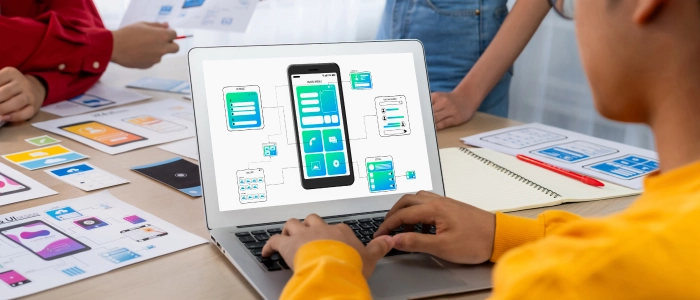
With mobile usage skyrocketing, businesses are investing heavily in custom mobile apps, designed either for internal use (employee apps, inventory checkers, logistics management) or external use (customer apps, loyalty programs, food delivery).
Why businesses go custom:
- To provide a personalised and branded mobile experience.
- New features include in-app payments, location monitoring, and AI-powered suggestions.
- To integrate with their existing back-end systems
Examples:
Food delivery apps like Uber Eats and Zomato use custom software to manage everything from order placements to delivery partner tracking and payment processing.
Web Applications

Web applications are tools that work on web browsers. They are frequently utilised for websites such as SaaS applications, booking systems, shopping platforms, and customer portals.
Key Benefits:
- Accessible from any device via a browser
- Easy to update and maintain centrally
- Can be scaled quickly for global audiences
Trending tech stack:
React, Angular, Node.js, Python development, and cloud hosting services like AWS and Azure are commonly used for building modern, responsive web applications.
Software As A Service (SaaS) Products

Businesses prefer to build custom SaaS products with software solutions hosted on the cloud and accessed via subscription. These solutions can be anything from accounting tools to video editing apps, wherein the software runs on remote servers and users access it through the internet.
Examples:
Zoom, Canva, HubSpot, and Trello are all SaaS products.Explore more Zoom alternatives.
Why go custom:
- Complete control over features, pricing, and customer management.
- Scalability without regard for infrastructure
- Regular updates and real-time data analysis
Industry-Specific Software

Some industries have very niche requirements that generic software can’t handle well. That’s where industry-specific custom solutions come in. These are designed to follow strict regulations, manage sensitive data, and optimise industry-specific workflows.
In industry-specific custom software, regulatory compliance is critical. For example, in the transportation sector, many business solutions must account for local legal standards and state laws such as car inspection protocols. Regular car inspections are not just best practice they are actually a legal requirement for drivers in Missouri. Such legal considerations often dictate how logistics management or fleet management software is designed for companies operating vehicles in this region. In heavily regulated call center environments, AI powered speech analytics software tools are used to identify quality and compliance issues, so they can be corrected in real time before they become a legal problem.
Key Features of Industry Specific Software Solutions:
- Domain-specific compliance integrations (e.g., HIPAA, PCI-DSS)
- Custom modules for sector-specific KPIs
- Niche workflows and reporting dashboards
- Data privacy and user access control
- Mobile app and cloud sync support
Examples include:
- Healthcare: Patient management systems, telehealth platforms
- FinTech: Custom payment gateways, fraud detection systems
- Retail: POS systems, inventory control software
- Logistics: Fleet management and real-time tracking tools
- EdTech: Virtual classroom platforms, learning management systems
Technical features often involved:
AI integration, IoT device connectivity, blockchain for secure transactions, and advanced data encryption.
Desktop Applications

While the internet and mobile apps have turned out to be famous, laptop packages are nevertheless relevant for industries in which performance, offline access, or local information storage is vital, like photo layout software program, economic modelling tools, or customised ERP structures for manufacturing flowers.
Example:
Adobe Photoshop, even though it has cloud versions, is nevertheless predicated on computer programs for advanced editing features.
API and Integration Solutions

Sometimes businesses don’t want entirely new software; they simply want their existing structures for betterment. That’s where custom API (Application Programming Interface) improvement and integration answers are available. These act as digital bridges, letting one-of-a-kind software program systems exchange facts and speak easily.
Example:
Connecting a CRM with an eCommerce platform to automate consumer orders and inventory management in real-time.
| Type of Software | Best For | Business Use | Real-World Inspiration |
|---|---|---|---|
| Content Management System (CMS) | Media, Blogs, Agencies | Manage and publish digital content easily | TechCrunch, Wix, WordPress (customized) |
| Customer Relationship Management (CRM) | Sales, Marketing, Real Estate | Track leads, manage customers, boost engagement | Salesforce (custom-built variant), Airbnb CRM |
| Enterprise Resource Planning (ERP) | Manufacturing, Retail, Healthcare | Integrate operations: finance, HR, inventory, etc. | McDonald’s ERP system, SAP (custom) |
| Operations Management Software | Logistics, Construction, Retail | Manage workflow, field ops, supply chains | FedEx tracking system, Zara’s inventory ops |
What are the Steps of Custom Software Development?
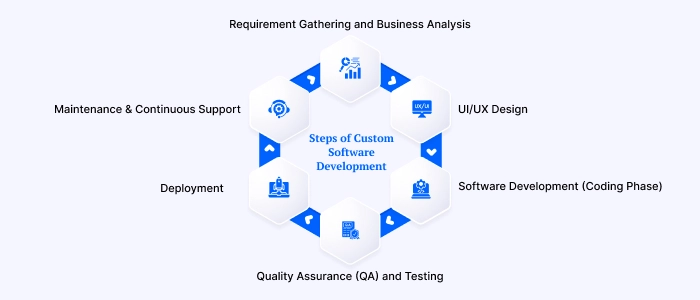
Custom Software Development is a method where developers, designers and business teams work together to turn a concept into a purposeful, secure, and scalable software program solution. Although there may be moderate variations in any project, the majority of custom software improvement processes adhere to these basic steps that are used similarly in SDLC (Software Development Life Cycle)
Step 1: Requirement Gathering and Business Analysis
The first step in anything is to understand what the business needs. Custom Software Developers and business analysts collaborate closely with clients during this phase to determine:
- What problem needs solving?
- Who will use the software?
- What features are required, and which can be optional?
- What systems need to connect with it?
This step usually involves creating Business Requirement Documents (BRD) and Software Requirement Specifications (SRS) to keep everyone aligned.
Step 2: UI/UX Design
Once the necessities are clean, it’s time to determine how the software program will appear and feel. A properly designed program guarantees that the software program is straightforward to navigate and exciting to apply.
- UI (User Interface) focuses on the visual facet, colours, buttons, and layouts.
- UX (User Experience) ensures certain the software program flows easily and solves customers’ issues without confusion.
Tools often used:
Figma, Adobe XD, Sketch
Why it matters:
Internal software efficiency improves with a clever, clean design, while customer-facing apps see increased user engagement.
Step 3: Software Development (Coding Phase)
At this point, the custom software developers start developing code using the tech stacks, frameworks, and programming languages of their choice. The software program’s front-end and back-end are constructed during this degree.
Popular languages and frameworks in 2025:
- Front-end: React, Angular, Flutter development
- Back-end: Node.js, Python, Java, PHP development
- Mobile apps: Swift (iOS), Kotlin development (Android)
This stage might follow different methodologies like:
- Agile Development: Fast, flexible, and collaborative
- Waterfall Model: Sequential and structured
- DevOps: Combines development and IT operations for continuous delivery
Step 4: Quality Assurance (QA) and Testing
Before any program is deployed, it must be extensively tested. QA teams look for:
- Bugs and errors
- Security vulnerabilities
- Performance under different conditions
- User experience issues
Different types of testing include:
- Functional Testing
- Security Testing
- Load/Stress Testing
- User Acceptance Testing (UAT)
Why it matters:
This guarantees that the finished product is dependable, safe, and prepared for practical application.
Step 5: Deployment
Once testing is complete and the client approves, the software program is formally launched. This stage is called the deployment stage. Depending on the type of application web or mobile it is connected to servers, cloud infrastructure, or app stores.
In modern-day software tasks, developers regularly use CI/CD pipelines (Continuous Integration/Continuous Deployment) to automate this stage, ensuring faster and error-free rollouts.
Step 6: Maintenance & Continuous Support
A custom software program isn’t a one-and-done deal. It desires ordinary updates to repair bugs, enhance features, or adapt to new generations and market changes.
Ongoing support typically includes:
- Security patching
- Feature enhancements
- Performance optimization
- Server maintenance
Most companies signal long-term preservation contracts with development organisations to keep their software program secure and up-to-date.
Looking for custom Software Development Services?
We focus on creating innovative custom software solutions
What are the Top Industries Relying on Custom Software Development?
Custom software development isn’t limited to global companies or IT industries. By 2025, companies of various sizes in a variety of sectors are using custom software application development to increase customer satisfaction, optimise processes, and maintain an advantage in cutthroat marketplaces.
The following are the sectors that benefit the most from tailored solutions:
Healthcare
The healthcare industry relies heavily on custom healthcare software development to manage sensitive patient data, scheduling, telemedicine services, and remote patient monitoring. Off-the-shelf solutions often fail to meet strict data privacy regulations such as HIPAA or accommodate the specific needs of hospitals and clinics.
Popular Custom Solutions are:
- Electronic Health Record (EHR) systems
- Patient portals and telehealth apps
- Medical billing and insurance management tools
eCommerce and Retail
From small online stores to worldwide eCommerce businesses, use custom software programs to deal with the whole thing from inventory control and order processing to personalised purchasing experiences.
Popular custom solutions in eCommerce and retail:
- Custom mobile shopping apps
- Loyalty program platforms
- AI-based product recommendation engines
- Payment gateway integrations
Financial Services (FinTech)
In FinTech, statistics, security and transaction accuracy are non-negotiable. That’s why banks, insurance companies, and startups invest in custom financial software for everything from online banking systems to fraud detection tools.
Popular custom solutions for FinTech:
- Digital Wallets and Payment Apps
- Investment and Wealth Management Platforms
- Automated Invoicing and Tax Calculation Tools
Logistics and Transportation
From fleet control systems to real-time cargo monitoring systems, logistics agencies rely on custom software to optimise their routes, reduce petrol expenses, and reveal deliveries.
Popular custom solutions in logistics and transportation:
- Warehouse Management Software
- Driver Performance Monitoring Apps
- Freight Scheduling and Billing Systems
Government and Public Sector
Government organisations want a stable, scalable, and regulatory-compliant custom software for dealing with citizen offerings, public information, and infrastructure projects.
Popular custom solutions in the government and public sector:
- Citizen Service Portals
- Public Health and Safety Reporting Systems
- Custom Voting Management Software
- Online Tax Filing Platforms
Education
Educational establishments and online learning platforms have unexpectedly followed custom, gaining knowledge of control systems (LMS) and digital lecture room apps, in particular put post-pandemic.
Popular custom solutions for education:
- Student Information Systems
- Online Exam Portals
- AI-based Adaptive Learning Apps
- Virtual Classrooms with Interactive Tool
What are the Differences Between Custom Software and Off-the-Shelf Software?
The difference between custom software and off-the-shelf software depends on the type of software that is required for your business. When it comes to choosing the perfect fit, look for a market opportunity, but the right choice always depends on how flexible you want your software to be and what kind of experience you want to offer your users.
| Feature | Custom Software | Off-the-Shelf Software |
|---|---|---|
| Definition | Software designed and built from scratch for a specific business or user group | Pre-built, generic software is available to the public |
| Customization | Fully customizable to match business needs, workflows, and branding | Limited customisation, often restricted to settings and add-ons |
| Ownership | Complete ownership of the software, including source code and licenses | License-based usage; ownership stays with the vendor |
| Development Time | Longer development cycle (weeks to months) depending on project complexity | mmediate deployment after purchase |
- Choose Custom Software if: you want a unique solution that scales with your business, need deep integration, or have industry-specific compliance needs.
- Choose Off-the-Shelf if: you’re a startup with limited budget, need quick deployment, or have generic use cases.
What are the Benefits of Custom Software Development?
When corporations put money into custom software development, they aren’t simply buying a product; they’re constructing a digital asset designed for their exact needs. From boosting performance to improving security and presenting a higher consumer enjoyment, custom software comes with an extended list of advantages. Let’s break them down clearly:
Tailored to Fit Your Business Needs
The most obvious advantage is personalisation. Custom software is created to fit your operational objectives, client choices, and organisation strategies. As long as each characteristic has a motive, you are free to pick how it functions, what it has, and the way it looks.
Better Scalability as You Grow
As your business expands, your software ought to grow with you. Custom solutions are constructed with scalability in mind, allowing you to easily upload new capabilities, modules, or customers without disrupting the complete device.
Improved Data Security and Compliance
With cyberattacks on the rise in 2025, agencies can’t have the funds to rely on regular safety capabilities. Custom software lets you enforce strong, industrial business enterprise-unique safety protocols and live completely compliant with enterprise regulations like GDPR, HIPAA, or India’s DPDP Act.
Seamless Integration with Existing Tools
Whether it is your CRM, payment gateways, third-party celebration APIs, or cloud offerings, a custom application development may be developed to seamlessly combine with the tools and structures you now utilise.
Cost-Effective in the Long Run
Yes, the initial outlay for custom software is more. However, it frequently proves to be more economical over time because:
- You only have to pay for the features that you truly require.
- No ongoing subscription or license costs.
- Reduced long-term maintenance expenses because you are in charge of improvements and updates.
What are the Pros and Cons of the Development of Custom Software
Like any important business decision, investing in custom software development comes with its own set of pros and cons. While it gives unmatched flexibility and management, it additionally calls for time, planning, and an affordable budget.
If you’re weighing your options, here’s a balanced observation of the pros and cons of developing a custom software:
| Pros | Cons |
|---|---|
| Fully tailored to your business needs, workflows, and branding | Higher upfront development cost |
| Scalable and flexible grows with your business | Longer development timeline compared to ready-made solutions |
| Offers stronger data security and regulatory compliance controls | Requires skilled developers and technical expertise |
| Seamless integration with existing software, APIs, and systems | Ongoing maintenance and support responsibilities |
What is the Cost of Custom Software Development in 2025?
When it comes to custom software development services, one of the first things businesses need to know is how it will cost. Furthermore, there isn’t a single, universally applicable remedy.
The cost of custom software in 2025 depends on numerous elements, inclusive of the form of software program, its complexity, the era stack, the number of capabilities, third-party integrations, and the way quickly you need it added.
Here’s a rough idea of the current price ranges based on program size and type:
| Type of Project | Estimated Cost (USD) |
|---|---|
| Simple Web App / MVP (Minimum Viable Product) | $10,000 – $30,000 |
| Medium-Complexity Web or Mobile App | $30,000 – $100,000 |
| Enterprise-Grade, Multi-Feature Platform | $100,000 – $300,000+ |
| AI-Powered or SaaS-based Applications | $50,000 – $250,000+ |
What are the Factors that Influence the Cost of Software Development?
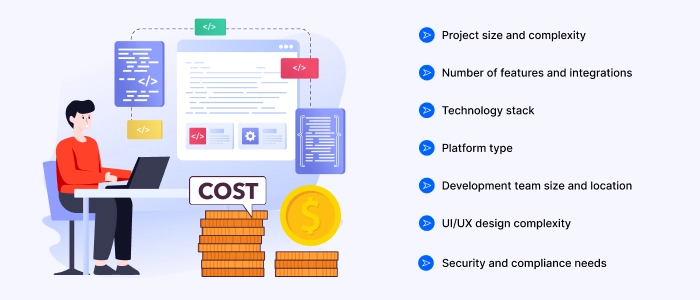
- Project size and complexity
A basic inventory management tool will cost far less than a multi-featured healthcare platform with AI and payment integrations.
- Number of features and integrations
More features imply extra improvement hours, layout work, and testing. Integrating with third-party tools like CRMs, fee gateways, or cloud structures can also increase costs.
- Technology stack
The front-end, back-end, database, and cloud services (like AWS or Azure) impact each improvement and hosting fees.
- Platform type
Developing a web app generally costs much less than a mobile app, and building for both iOS and Android collectively adds to the total.
- Development team size and location
Rates differ based on whether or not you hire an in-house team, freelancers, or associate with an established software development company. Offshore groups in countries like India, Ukraine, or the Philippines frequently provide more finance-friendly options without compromising quality.
- UI/UX design complexity
Custom, highly interactive, or animated designs cost more than simple, clean interfaces.
- Security and compliance needs
Higher protection standards and felony compliance are required by sectors including FinTech, healthcare, and law enforcement, which raises the overall cost of development.
How to Choose the Right Custom Software Development Company in 2025?
It may seem difficult to choose the best bespoke software development company for your project because there are so many of them available. We have jotted down some points to assist you in identifying the top custom software development companies for 2025:
- Define Project Requirements: Before drawing close to any employer, be clear about what you need:
– What trouble are you solving?
– Who will use the software program?
– What key features and integrations are required?
– What’s your financial situation and timeline?
Having a well-defined undertaking scope report or a basic idea equipped will assist improvement partners in offering correct proposals and suggestions.
- Check Industry Experience and Technical Expertise: Look for companies that have experience in your industry or have worked on similar projects. For example, a company that’s built FinTech apps will better understand data security, regulatory compliance, and payment integrations.
Also, review their technical stack:
- Do they work with brand-new frameworks like React, Node.js development, Flutter, Python, or AWS?
- Are they professional in AI integrations, cloud-local apps, API improvement, and cybersecurity protocols?
- Review Client Testimonials and References: The opinions of previous customers speak louder than anything else. Check reviews on platforms like:
- Google Business
- Understand their Development Process: A reliable software development partner should follow a structured, transparent process, preferably Agile methodology or Scrum framework. This ensures:
- Regular Updates
- Fast, flexible deliveries
- Client involvement at every stage
Key steps they should cover:
- Requirement Analysis
- UI/UX Design
- Development
- Quality Assurance and Security Testing
- Deployment and Ongoing Support
- Post-Launch Support and Scalability: As your company expands, your software shouldn’t reach its boundaries. Make sure the software development firm creates software that is adaptable, modular, and expandable for upcoming updates.
Also, clarify their post-launch support services:
- Do they offer maintenance packages?
- How fast is their response time for bug fixes?
- Are updates and patches included?
- Compare Pricing Models and Contracts: Custom software can be an investment, but it should be a fair one. Also, verify that the Compare:
- Fixed-price contracts for clearly defined projects
- Time and material models for flexible, evolving projects
- Dedicated resource models if you need an extended, remote team.
Verify that the contract addresses data confidentiality, intellectual property rights, and source code ownership.
Why Choose Sphinx Solutions for Custom Software Development?

At Sphinx Solutions, we embrace custom software development solutions and help businesses remedy real problems, improve productivity, and deliver memorable virtual reports. With over 15+ years of experience and a group of 150+ skilled developers, designers, and experts, we’ve worked with startups, enterprises, and Fortune 500 brands alike.
From healthcare and fintech to retail, logistics, and edtech, we’ve successfully delivered 450+ custom software projects tailored to diverse business needs. Whether you need AI development, SaaS platform development, secure mobile application development, or a complex enterprise solution, we’ve done it.
In short, all the above-mentioned checklist is ticked by Sphinx Solutions to qualify as your perfect partner for custom software projects. Also, we provide the option to have an estimated cost of the app development through our App Cost Calculator. You can always check the approximate budget required for any web app development or many other apps as well.
Real-World Custom Software Solutions by Sphinx Solutions
1. Field Management Software (B2B Web App)
Overview: A comprehensive subject service control platform designed for scheduling, invoicing, dispatching, time-and-payroll tracking, and reporting.
Features: Automation of day-to-day obligations, stable information handling, iterative UX/UI refinement, continuous aid submit-deployment.
2. ExecLibrary (Web-Based HR Intelligence Platform)
Overview: A platform offering smart profiling for executive-level professionals, aggregating bios, career data, and social insights.
Features: Advanced UI/UX design, powerful search/filter tools, real-time data updates, and seamless usage flows designed with client collaboration.
3. Doctor App (Healthcare Mobile Application)
Overview: A preventive cell app that uses facial scanning to measure vitals like coronary heart rate, oxygen saturation, blood pressure, and more.
Features: Integration of facial scanning tech, minimalist UX, reliable health metric readings, planned with UX best practices and client iteration.
4. HouseBytes (School & Teacher Engagement Platform)
Overview: A digital house-point system for schools, enabling teachers to engage students through gamified interactions and random selection tools.
Features: Grading systems, class leaderboards, stopwatch/timer utilities, secure teacher–student engagement—all within a web app designed for ease-of-use.
5. Tru Hair & Skin (Spotify-Based eCommerce Platform)
Overview: An Ayurvedic skin & hair care brand’s Shopify store rebuilt for performance, speed, and lead generation.
Features: Shopify migration, UI overhaul, custom lead-gen tools, marketing integration (e.g., WebMaxy), and mobile performance optimization.
6. Society Now (Gated Community Management App)
Overview: A digital visitor & guest management app built specifically for gated communities
Features: Real-time visitor check-ins, guest approvals, digital records, and mobile-friendly community access tools.
7. Rekha Metal Trends (Custom Shopify Store)
Overview: A bespoke Shopify store for a home-furnishing brand focused on unique UI and eCommerce conversions.
Features: Tailored Shopify subject, consumer-friendly navigation, responsive layout, and branding aligned with the patron’s project.
8. Gulf Islamic Investments (GII) (Corporate Web Platform)
Overview: A custom-constructed, characteristic-rich internet site for a UAE-based monetary firm.
Features: Brand-aligned UI/UX, stable finance-centered content structure, responsive designs, compliance-forward development.
Looking for Top-Tier Custom Software Developers?
Transforming ideas into fully deployed solutions—our custom software development covers your entire project journey
Conclusion
At the end of the day, each business runs differently, and that’s precisely why custom software development solutions is an experience for a lot of businesses. Instead of forcing your crew to adapt to a few familiar off-the-shelf software, you get software that’s built around your tactics, your clients, and your desires.
Sure, it takes more time and costs a chunk more upfront; however, ultimately, you get complete management, higher security, less complicated integrations, and a machine you own. Plus, it can scale and adapt as your enterprise grows or as new tech traits (like AI or cloud-native structures) roll out.
If you’re making plans to construct custom software, just be clear approximately what you want, choose a team that knows each tech and business, and don’t skip on safety or destiny scalability.
And if you’re attempting to find a reliable development accomplice, Sphinx Solutions has the experience and tech stack, whether or not it’s a web app, mobile platform, or enterprise-grade device.
FAQ’s:
1. How much does it cost to develop custom software?
The cost depends on what you’re building. A simple web app might start from $10K, while a big, multi-feature platform can easily cross $100K. Things like features, tech stack, security, and timelines affect the final price.
2. What are the best practices for building custom software?
Always start with clear requirements and a well-defined scope. Use modern tech stacks, follow Agile or iterative development, prioritise security from day one, and make sure your software is scalable and easy to maintain.
3. How to find the right agency to build custom software?
Look for a company with proven work in your industry, check client reviews, and make sure they’re good with the tech stack you need. Bonus points if they offer end-to-end services — from consulting to post-launch support.
4. Qualities you should look for in a custom software development company?
The right company should be technically strong, transparent with their process, good at communication, and flexible with updates and changes. They should also care about security, scalability, and delivering value, not just code.
5. What mistakes to avoid when building custom software?
Avoid starting without a clear plan or choosing the cheapest vendor without checking their track record. Also, don’t ignore security, future scalability, or user experience — those are the things that’ll hurt you later.


 Souradeep Kundu
 Anand Mahajan
 Shivraj Dhaygude


