Key Takeaways
- AI Governance is the confluence of the right people, processes, technology, risk controls, and accountabilities, all aimed at building and deploying AI responsibly throughout the enterprise.
- Governance guidelines should be decided on factors including business impact, sensitivity of data, level of autonomy, exposure to regulation and impacts of AI decisions.
- From selection, risk assessment, and deployment to monitoring, incident handling, to decommissions, AI governance has to be embedded within every step.
- Enterprises need to address hallucinations, prompt injection, sensitive-data exposure, overly generous permissions, unauthorised autonomous actions and reliance on third-party models.
- With clarity around ownership, feasible controls, sustained observation, and usable governance tools, the organisation can enhance its use of AI safely and effectively.
Enterprises need a reason for governance, and the reason is that once we start moving AI into production from an experiment, the profile and shape of the risk changes. A marketing team testing a chatbot carries different risk than a loan-approval model making real financial decisions on thousands of customers, but without an enterprise AI governance structure, both often get the same or no scrutiny. In fact, almost all of enterprise AI risk resides in that disconnect between the technology and its use case.
AI governance describes the mechanisms an organisation uses, including policies, processes, and controls, to control the design and deployment of AI systems (as well as the monitoring, modification, and disposal of these systems).
What makes this blog particularly relevant to where governance sits is that governance is a prerequisite input for our Enterprise AI Adoption Framework and is one of the most frequent root causes for failed enterprise AI projects.
What is AI Governance?
AI governance is the system of policies, processes, controls, roles, and oversight mechanisms that an organisation uses to manage AI throughout its lifecycle from development and deployment to monitoring and retirement.
For enterprises, it would enable AI governance to ensure accountability over the AI system, define risks to monitor, and establish controls and production methods for the AI system. It‘s a comprehensive strategy that includes business, technical teams, legal teams, security and compliance teams, as well as risk teams to ensure we’re building AI in a guided and responsible way.
Why is AI Governance Important for Enterprises?
The risk involved in an AI changes when moving from the experimental to the production environment. An AI chatbot used internally as an aid to prepare notes for meeting minutes does not have the same level of risk as an AI that will make hire and fire decisions, grant credit, assist medical recommendations, or manage business processes.
In the absence of a framework approach to governance, firms may treat both high-risk and low-risk systems with equal scrutiny, or neither. This results in a void of oversight in terms of security, privacy, compliance, risk management and accountability.
The features of AI Governance in enterprises equip organisations with the ability to scale their monitoring according to the likely risk of an AI use case, set controls and responsibility for its use of AI, determine higher-risk uses, and also enable a repeatable process of post-deployment and ongoing monitoring for AI risk.
At the end of the day, good AI governance isn’t about slowing AI down; it is about creating a safe, trustworthy and control-oriented structure to allow us to bring AI to scale within the enterprise.
The Layer-by-Layer AI Governance Framework
The AI governance framework is a stack of layers that rely on each other. A given layer needs to cover much more than just policies or compliance-it needs to spell out who is responsible for what, how the risks are evaluated, the controls needed, and what is being done to monitor the AI.
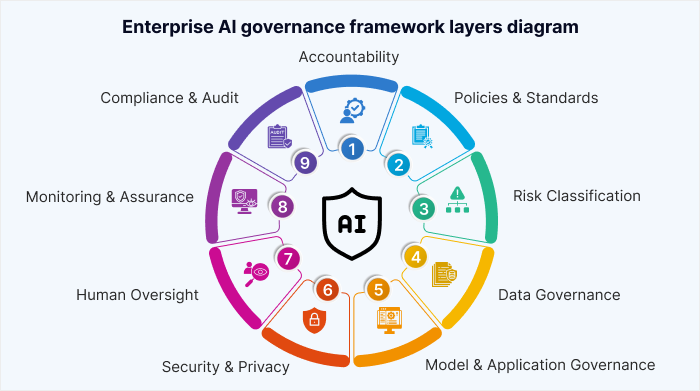
Layer 1: Accountability
Every AI system should have a clearly identified owner. The chain of accountability shouldn’t get lost as the business, technology, legal, and risk teams all have an interest in this one aspect.
An AI Governance committee would be the highest overarching body, while a named business or tech owner should exist for each specific AI use case, for responsibility and risk management. There can also be an executive sign-off process prior to deployment if the risk is more considerable.
Layer 2: Policies & Standards
AI governance needs clear policies that employees and teams can actually follow.
We need an effective AI governance plan with policies that employees can follow in their daily work. These should define what constitutes acceptable AI use, which applications require additional review, how sensitive information can be handled, and when human approval is mandatory.
Legal and compliance generally set the rules, whereas business and technology implement and operationalise those rules during AI development and usage.
Layer 3: Risk Classification
Not every AI system presents the same level of risk. A marketing assistant and an AI system influencing credit or employment decisions should not go through identical governance processes.
An AI governance framework can segment AI use cases by the impact on the business, the sensitivity of the data involved, the regulations to which it will be subject and the extent to which it will be autonomous or may cause harm.
An AI governance decision-criticality model, as it were, to determine the extent of testing, review, human involvement, and ongoing supervision that each use case will require.
Layer 4: Data Governance
Reliability of the AI systems in place relies on the data fed to the system; as such, data governance should be inherently part of AI governance from day one. Companies ought to exercise control as to which entity accesses which dataset, the source of the dataset, its quality, its privacy, location, storage time and the entity accessing it before the business-critical or sensitive information is put in an AI system.
A CDO or someone with equivalent leadership responsibilities across data can support the identification and implementation of these data needs.
Layer 5: Model and Application Governance
Governance should not stop once an AI model has been selected, or an application has passed development. The AI systems should be tested, validated, documented, and approved before use and periodically monitored once in operation.
The engineering and AI teams should make sure that controls are appropriately monitored and tested in case of large changes in models, data, prompts, workflow or use cases; system reassessment is done appropriately.
Layer 6: Security & Privacy
When it comes to AI, it brings about certain security and privacy concerns that a normal app security strategy might not cover sufficiently. A company will have to take into consideration access controls, revealing sensitive data, prompt injection, lack of secure integrations, model or application exploits and unauthorised usage of the AI.
The CISO and security teams should work alongside AI and engineering teams to ensure these risks are assessed before deployment and monitored throughout the system’s lifecycle.
Layer 7: Human Oversight
The impact of an AI-driven decision-making is another important factor determining how closely its judgments should be monitored by humans. Businesses should also determine whom they should ask to review the AI decision or action, as well as whom they want to approve or override it, and when they want them to escalate.
AI decisions that take place completely without human involvement could create risks in terms of operation and ethics depending on the type of use case and the impact the decision might have. The business owner should be responsible for defining the appropriate human intervention and escalation paths.
Layer 8: Monitoring & Assurance
An AI system that has passed its initial evaluation may still have issues when it comes to production. Factors such as change over time (model performance, data, users, new failure types).
As such, continuous monitoring should follow items including performance, dependability, unusual behaviour, policy exceptions, and AI events. Engineering and AI teams should establish appropriate monitoring and define what triggers reassessment or intervention.
Layer 9: Compliance & Audit
Having an AI policy is not enough. Enterprises also need evidence that their governance processes are actually being followed.
Documentation needs to record what AI systems are in place, who controls them, what risks were considered, what authorization received, what controls were implemented, and what monitoring was done. Internal audit, risk, legal, and compliance teams may utilise this evidence to ascertain that control governance is operating effectively and as intended.
The most common failure isn’t missing a layer entirely; it’s applying every layer with equal intensity to every AI system, which either creates bureaucracy that gets bypassed or misses the systems that actually need scrutiny.
AI Governance Decision Criticality
An AI tool drafting a marketing headline and an AI system screening loan applicants shouldn’t clear the same approval process but in most enterprises, they either both go through the same heavy review (which slows harmless use cases to a crawl) or both skip review entirely (which leaves high-stakes systems unchecked). This is the core design flaw in most governance programs: intensity doesn’t scale with actual risk.
An AI Governance Decision Criticality Model is built to fix that. It’s a practical scoring AI governance tool, and not an official standard. Scores each use case using an AI implementation against these five attributes:
- Impact on people (financial, physical, legal, or reputational consequences of a wrong output)
- Autonomy (does it recommend, or does it act?)
- Data sensitivity
- Reversibility (can a bad decision be undone?)
- Scale of deployment
Rate each 1-4 and combine to determine a criticality tier rather than a single score, because a low scale with high impact needs a different level of attention and treatment than a system with a large scale with low impact (like a system to tag content).
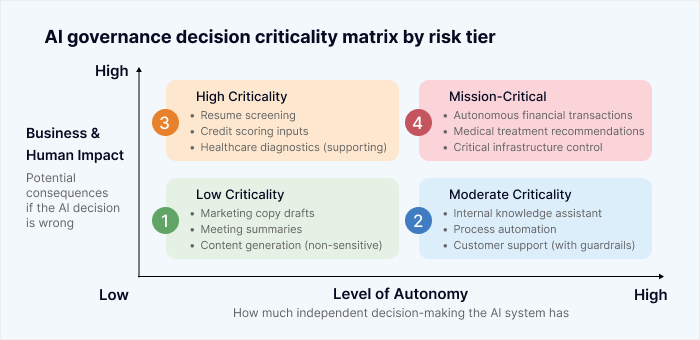
| Tier | Example | Approval Required | Human Oversight | Monitoring |
| Low | Marketing copy drafts | Team lead sign-off | Spot-check | Periodic review |
| Moderate | Internal knowledge assistant | Governance committee review | Review before wide rollout | Monthly |
| High | Resume screening, credit scoring inputs | Formal risk assessment + legal review | Mandatory human-in-the-loop | Continuous, with defined thresholds |
| Mission Critical | Autonomous financial transactions, medical treatment recommendations | Executive + legal + external review | Human approval required per action | Real-time, with kill-switch capability |
Tier 4 systems should also carry the shortest reassessment cycle and the most detailed audit trail, the two controls organizations most often skip because they seem administrative rather than technical.
What are the AI Risk Landscapes?
AI systems can create different kinds of risks, depending on the system’s design, the data it’s using and the decisions that it is allowed to make. The most common risks are:
Model Risk
It’s possible for a model to be very accurate in testing and in training but may not behave as one might expect during live production. Continuous monitoring and validation before deployment are required.
Data Risk
Make sure all data used in an AI model is accurate, up-to-date and legitimate to ensure all possible outputs are relevant. Data lineage and data quality controls should be exercised across all AI solutions.
Bias & Fairness
AI outputs may disadvantage certain groups if the underlying data or model introduces bias. Testing across relevant user groups before deployment can help identify these problems.
Hallucination & Reliability
It’s easy for generative AI to provide you with seemingly factual but wrong answers. Output validation and grounding responses in verified sources can reduce this risk.
Explainability
Some choices require the organisation to make sense of an AI system’s outputs.
There would have to be some amount of documentation, a degree of explainability, especially for critical, high-impact decisions.
Third-Party & Vendor Risk
With a model you source externally, perhaps a cloud service provider’s AI, there’s a degree of uncertainty on your end. They might tweak their models, rewrite policies, or alter their behaviour, all at times that are outside of your sphere of influence. Vendor assessments and clear contractual controls can help manage this risk.
Security Risk
AI applications are at risk from other forms of attack (including prompt injection, unauthorized data access, data loss, and data leakage). This new layer of governance controls must provide app-specific, security audit and data monitoring capabilities.
Agentic & Autonomy Risk
AI agents can take actions rather than simply generate information. An unintended action can therefore have much greater consequences. Permission boundaries and human approval gates are important when agents can perform sensitive or irreversible actions.
Why Govern Generative AI and Agentic AI Differently?
Model governance used to be about how to get model systems to predict. And, with generative AI, you have hallucinative output, leakage of private data into the prompts, and copyright claims, all that calls for deeper control not only at the model level test where every part of a system has to pass all sort of checks but also at the prompt’s log, the validation of the system output, to say anything about grounding techniques, like RAG chatbots.
Agentic AI needs a further shift, because agents don’t just generate content; they take actions: calling APIs, updating records, executing workflows. The governing principle here is to govern the action, not only the model.
What that means is the ability to establish agent identities and permissions, deny-on-purpose model access tooling with a principle of least privilege, enforce human consent in operations which produce destructive effects, and create a system for generating an audit log and a deadman switch for any unsupervised machine-run operations. Even models that pass all our benchmarks are going to do harm if they are granted wider access to systems then their purpose deserves.
Standards and Regulations: What Applies and What’s Voluntary?
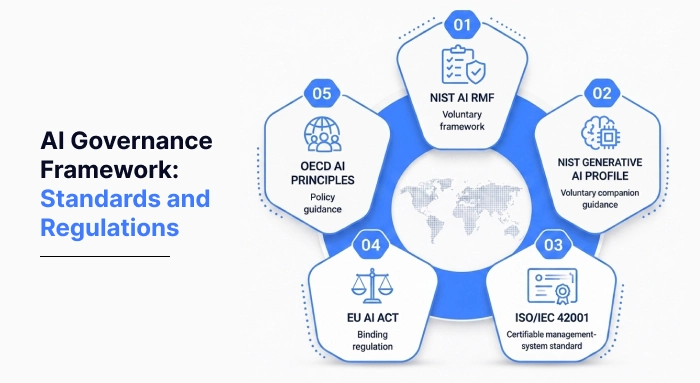
| Framework | Type | Mandatory? | Best For |
| NIST AI RMF | Voluntary framework | No | Structuring risk management (Govern, Map, Measure, Manage) |
| NIST Generative AI Profile | Voluntary companion guidance | No | GenAI-specific risk considerations layered onto the AI RMF |
| ISO/IEC 42001 | Certifiable management-system standard | No, but certifiable | Formalizing an AI Management System (AIMS) enterprise-wide |
| EU AI Act | Binding regulation | Yes, for in-scope EU operations | Legal compliance for AI affecting the EU market |
| OECD AI Principles | Policy guidance | No | High-level responsible AI principles across jurisdictions |
What are the AI Governance Best Practices?
- Design a governance program first, not post-deployment; putting a controls layer on a live system will always be more expensive than designing the control up front.
- Maintain a real AI inventory. You can’t govern what you don’t know exists, and shadow AI usage is often larger than official pilot counts suggest.
- Classify every use case by criticality using a model like the one above, and match oversight intensity to the score.
- Name one accountable owner per AI system not a committee, a person with actual authority.
- It’s the data governance that must be viewed as AI governance; the majority of AI failure instances are due to non-governed data (and not model errors).
- Build human oversight into the workflow, scaled to criticality tier, not applied uniformly everywhere.
- Monitor production continuously. A system validated at launch can still drift or degrade months later.
- Govern third-party and vendor AI with the same rigor as internally built systems you’re still accountable for the output.
- Document decisions as you go. Audit evidence built after an incident is far weaker than evidence built during development.
- Revisit governance as capability changes an agent given new tool access needs to be reassessed, not grandfathered in under its original approval.
Who Owns AI Governance?
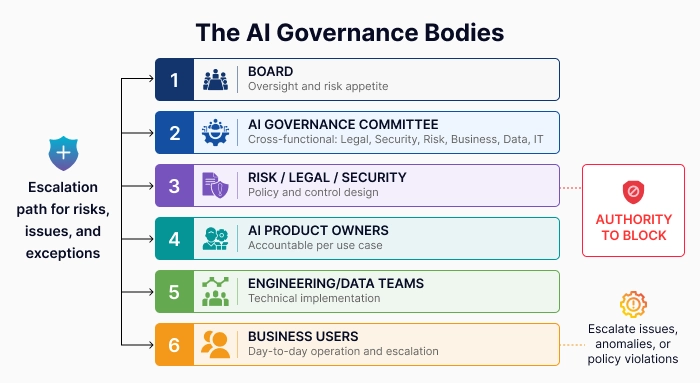
Conclusion
The purpose of AI governance isn’t to limit AI adoption; it is to create an environment with the necessary level of trust, responsibility and governance that allows a company to scale AI with a level of certainty rather than blindly trusting everything will work out.
In enterprises facing limitations progressing from pilots to full-scale implementation, the blockers aren’t always inadequate models; it is due to a lack of insight into what is critical to analyse versus what is not and what a criticality-focused system aims to solve.
Score your use cases, match oversight to actual risk, name real owners, and revisit the assessment as your AI systems gain more autonomy that’s what turns governance from a blocker into the thing that makes scaling possible.
FAQ’s:
What is AI governance decision criticality?
It’s an approach to scoring AI use cases by impact, autonomy, data sensitivity, reversibility, and scale, so that oversight intensity matches actual risk instead of applying uniform review to every system regardless of stakes.
How does AI governance differ for generative AI?
Generative AI adds hallucination risk, sensitive-data leakage through prompts, and copyright exposure, requiring prompt-level logging, output validation, and grounding controls not just the model-level testing traditional ML governance relied on.
How does AI governance differ for AI agents?
Agentic systems take actions, not just generate content, so governance must cover identity, permissions, least-privilege tool access, and human approval before irreversible actions governing the action, not only the underlying model.
What is the NIST AI Risk Management Framework?
A voluntary framework organized around four functions Govern, Map, Measure, and Manage that helps organizations manage AI risk across design, development, deployment, and use. It is not a legal requirement.
What is ISO/IEC 42001?
A certifiable international standard specifying requirements for an organization’s AI Management System (AIMS). It’s an organizational certification, distinct from individual professional credentials.
Is AI governance mandatory?
It depends on jurisdiction and use case. The EU AI Act imposes binding obligations for in-scope systems, with high-risk system deadlines currently deferred to December 2027, while frameworks like NIST AI RMF and standards like ISO/IEC 42001 remain voluntary.
What are the biggest AI governance risks?
Model risk, data risk, bias and fairness, hallucination and reliability, explainability gaps, third-party vendor risk, security exposure, and increasingly agentic autonomy risk from systems that can take unintended actions.
Is AI governance certification worth it?
It depends on the goal: individual certifications like IAPP’s AIGP validate personal expertise, while ISO/IEC 42001 certifies the organization itself. Neither substitutes for practical governance experience or guarantees regulatory compliance.


 Shaili Gupta

 Ajay Wadne