Key Takeaways
- Risk management in software engineering is the structured process of identifying, assessing, prioritising, and controlling anything that threatens a software project’s scope, schedule, budget, security, or quality.
- There are 19+ distinct risk types software teams must track, from technical and security risks to vendor, cloud, and AI-specific risks.
- The risk management process follows a repeatable cycle: identification, analysis, assessment, prioritisation, mitigation, monitoring, and reporting.
- Tools like the risk register, the probability-impact risk matrix, and risk heat maps turn abstract uncertainty into a trackable, visual system.
Software Projects are more likely to fail and the reason behind it is not the coding done by software engineers. They fail because no one anticipated what might go wrong: a vendor skipped a delivery, a security flaw went unreported for months, a crucial need changed halfway through the construction, or a cloud outage occurred on launch day. All these flaws need to be regulated timely with risk management.
Risk management in software engineering is the discipline that detects and controls threats to a project’s cost, schedule, security, and quality before they become costly surprises.
This guide is built for people who need to know about software risk management in depth for successful risk management in software development projects and enterprise risk management for software products and platforms. This is for you, if you’re:
- A CTO trying to protect a product roadmap.
- A project manager building a risk register for the first time.
- A founder deciding whether to trust a development partner with their next release.
You’ll find the complete picture here regarding every major risk category, the full risk management process, the tools professionals actually use, real industry data, and the frameworks that separate teams who ship confidently from teams who get blindsided.
By the end, you’ll know exactly how to define software risk management for your own team with risk analysis; how the process of risk management works step by step, and how to apply proven risk mitigation strategies to Agile, DevOps, cloud, and AI-driven projects alike.
What is Risk Management in Software Engineering?
Risk management in software engineering is the systematic process of identifying, analysing, prioritising, and controlling uncertain events that could negatively affect a software project’s scope, schedule, budget, security, or quality, then building plans to reduce their likelihood or impact before they occur.
To define risk management in software engineering properly, it is not a problem that has already happened; it’s an uncertain future event. If it occurs, it will have a negative effect on project objectives.
For example:
- A server crashing right now is an incident.
- A server crashing because your team never load-tested the checkout flow is a risk you could have caught weeks earlier.
Hence is a integral phase in Software Development Life Cycle (SDLC), that is responsible for requirements analysis, architectural decisions, defining sprints, performing code reviews, QA testing, rollout and post rollout phases.
Do’s and Don’ts of Defining Risk in Your Organisation:
| Do’s | Don’t |
|---|---|
| Describe risks as “cause → event → effect” (e.g., “Because requirements are unclear, scope may expand, delaying launch by 6 weeks”) |
Describe a risk vaguely as “the project might be late” |
| Separate risks (future, uncertain) from issues (present, confirmed) | Track risks and issues in the same undifferentiated list |
| Assign a specific owner to every identified risk | Leave risk ownership with “the team” in general |
| Quantify probability and impact wherever possible | Rely purely on gut feeling to prioritise risks |
Why Risk Management Matters in Modern Software Development?
Risk management in software engineering is important because a proactive risk management strategy improves project success rates, reduces costly failures, strengthens stakeholder confidence, and ensures predictable software delivery.
Software development has become increasingly complex, with projects involving distributed teams, cloud infrastructure, third-party integrations, AI, cybersecurity requirements, and evolving customer expectations. As complexity grows, so does uncertainty. Even a minor oversight during planning can escalate into a costly production issue if left unmanaged.
This is why risk management in software engineering has evolved from being a project management activity into a strategic business practice. Rather than reacting to problems after they occur, organizations that adopt structured risk management continuously identify potential threats, evaluate their impact, prioritize them based on business value, and implement mitigation strategies before they disrupt the project.
Industry Statistics Highlight the Importance of Risk Management
The single largest factor that correlates to software project success or failure is whether the project risk identification has been properly done and managed. Research based on the CHAOS study of The Standish Group over many years shows that only about 3/10 projects are completed successfully within time and budget. About half the projects show “challenged”, and 1/5 failed.
Why Do Software Projects Fail Without Risk Management?
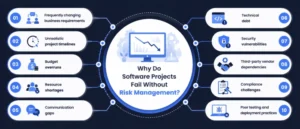
Many software projects fail not because of poor coding but because critical risks were never identified or addressed early. Common reasons include:
- Frequently changing business requirements Unrealistic
- project timelines
- Budget overruns
- Resource shortages
- Communication gaps
- Technical debt
- Security vulnerabilities
- Third-party vendor dependencies
- Compliance challenges
- Poor testing and deployment practices
Most of these issues are predictable risks rather than unexpected surprises. Effective risk management helps teams anticipate these challenges before they affect project outcomes.
What are the Objectives of Risk Management in Software Engineering?
There are various objectives of risk management, let’s break those down into specific, practical goals:
- Safeguard delivery promises: stay true to scope, schedule and budget that was committed to the stakeholders.
- Lower the chance of serious events: by vulnerabilities, down time, data loss, compliance breaches.
- Minimise the effect of events that do happen: by using contingency plans, rollbacks, and using an incident response plan.
- Increase decision quality: providing leadership with the information required to balance one against the other (e.g., hold up launch to clarify know unknowns versus go, unknown unknowns).
- Create institutional memory: a record of the risk’s history will help to ensure that you don’t make the same mistakes for your subsequent project.
- Build guarantee and governance into your business: Get covered under GDPR, HIPAA, SOC 2, ISO 27001 etc.
- Foster confidence among stakeholders and clients: robust risk management can be a key consideration when selecting enterprise vendors.
Key Benefits of Risk Management in Software Engineering
Key benefits of a software risk management framework include: reduced budget overshoots and faster time-to-market; enhanced security and credibility with clients and investors; efficient deployment of resources; and a hard number measuring reduced project failure.
| Benefit | What It Looks Like in Practice |
|---|---|
| Fewer budget overruns | Contingency reserves sized to known risks instead of guesswork |
| Predictable delivery | Schedule risk is identified and buffered before it becomes a missed deadline |
| Stronger security | Vulnerabilities caught in design and code review, not in production |
| Better decisions | Leadership can weigh trade-offs with data instead of assumptions |
| Higher team morale | Engineers aren’t blindsided by “surprise fires” late in the project |
| Regulatory confidence | Compliance risks tracked proactively instead of discovered during an audit |
| Stronger client trust | Enterprise clients increasingly require documented risk processes before signing |
Once these are used at project inception, and then ‘forgotten’ in the future they are worth nothing. This is when the real benefits derive from proven risk management techniques such as structured identification, scoring analysis and named ownership.
What are the Types of Risks in Software Engineering?
Software engineering risk falls into 19 recognised risk categories. Each requires a different detection method and a different mitigation strategy.
Most teams only actively track two or three of these. That’s how the other sixteen quietly sink a project. Here’s the full picture, in one reference table:
| Risk Type | What It Is | Typical Example | Primary Mitigation |
|---|---|---|---|
| Technical Risk | Risk from architecture, code quality, or technology choices | Choosing an unproven framework that can’t scale | Proof-of-concept, architecture review, technical spikes |
| Business Risk | Risk that the software won’t meet business goals or market needs | Building a feature nobody wants | Continuous stakeholder validation, MVP testing |
| Operational Risk | Risk from day-to-day processes, tooling, or human error | A misconfigured deployment script takes down production | Runbooks, automation, checklists |
| Financial Risk | Risk of cost overrun or funding shortfall | Budget doubles due to scope creep | Cost tracking, contingency reserves, change control |
| Legal Risk | Risk of lawsuits, IP disputes, or contract breaches | Using unlicensed third-party code | Legal review, license audits |
| Compliance Risk | Risk of violating regulations or standards | Storing health data without HIPAA safeguards | Compliance audits, GDPR/HIPAA/SOC 2 alignment |
| Security Risk | Risk of breaches, data leaks, or exploited vulnerabilities | SQL injection in an unvalidated form field | OWASP-aligned secure coding, penetration testing |
| Performance Risk | Risk the system won’t meet speed or scalability needs | App crashes under real-world traffic load | Load testing, performance benchmarking |
| Project Risk | Risk to overall project delivery (a rollup category) | Multiple small delays compound into a missed launch | Integrated risk register, PM oversight |
| Communication Risk | Risk from misalignment between teams or stakeholders | Offshore and onshore teams build conflicting assumptions | Clear documentation, regular syncs |
| Requirement Risk | Risk from unclear, incomplete, or changing requirements | Client redefines “done” mid-sprint | User stories, acceptance criteria, sign-offs |
| Resource Risk | Risk of losing key people or skills | Lead engineer resigns mid-project | Knowledge sharing, documentation, and bench strength |
| Schedule Risk | Risk of missing deadlines | Underestimated QA time | Buffer planning, realistic estimation techniques |
| Technology Risk | Risk from dependency on unstable or deprecated tech | A critical library stops receiving security updates | Dependency audits, tech radar reviews |
| Vendor Risk | Risk from third-party service providers or contractors | An outsourced module misses quality standards | Vendor SLAs, audits |
| Cloud Risk | Risk from cloud infrastructure, outages, or misconfiguration | Public S3 bucket exposes customer data | Cloud security posture management, IaC scanning |
| AI Risk | Risk from model bias, hallucination, or governance gaps | An AI feature gives factually wrong outputs to users | Model evaluation, human-in-the-loop review |
| Data Risk | Risk of data loss, corruption, or poor data quality | Migration script silently drops records | Backups, validation, data quality checks |
| Third-Party Risk | Risk from external APIs, integrations, or partners | A payment gateway API changes without notice | Contractual SLAs, integration monitoring |
Human Risks in Software Engineering
While technical challenges often receive the most attention, human risks in software engineering are among the leading causes of software project delays and failures. These risks stem from the people involved in planning, developing, testing, and maintaining software systems rather than the technology itself.
Common human risks in software engineering include:
- Skill gaps: Team members may lack expertise in new programming languages, cloud platforms, or emerging technologies.
- Knowledge silos: Critical knowledge concentrated in one or two individuals creates dependency risks if they become unavailable.
- Communication failures: Misunderstandings between developers, testers, designers, product owners, or distributed teams can lead to incorrect implementations.
- Employee turnover: Losing key personnel during development can significantly affect delivery timelines and product quality.
- Burnout and low morale: Excessive workloads often reduce productivity, increase defect rates, and contribute to higher attrition.
Human risks are best mitigated through documentation, cross-training, regular knowledge-sharing sessions, realistic workload planning, and fostering a collaborative engineering culture.
What are the Risk Categories?
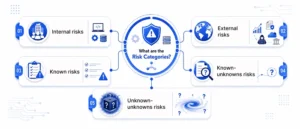
Beyond the above-mentioned 19 risk types, risk categories describe how risk analysis is done by source, by predictability or by SDLC phase. Risk categorisation matters because it determines who owns the risk and which mitigation toolkit applies.
A practical categorisation model used across enterprise risk management programs
- Internal risks within the team’s control (code quality, estimation accuracy, resourcing).
- External risks outside the team’s control (vendor failure, regulatory change, market shift).
- Known risks identified and documented (a legacy system with known scaling limits).
- Known-unknowns risks you know the category of risk exists but not its specifics (some third-party dependency will eventually cause an issue — you just don’t know which one, or when).
- Unknown-unknowns risks genuinely unforeseeable events (a novel zero-day vulnerability). These can’t be eliminated, but resilience practices, backups, redundancy, and incident response plans reduce their impact regardless of cause.
Risk Management Activities in Software Engineering
The core risk management activities in software engineering include:
- Risk identification
- Risk assessment in software engineering
- Software risk analysis and management
- Risk prioritization
- Software risk mitigation planning
- Risk monitoring and control
- Risk reporting and continuous review
These activities repeat throughout the SDLC and form the operational foundation of effective software risk management.
The Risk Lifecycle in Software Projects
The risk lifecycle describes the full journey of a single risk from the moment it’s spotted to the moment it’s closed. Therefore, every risk in a well-run project moves through a lifecycle.
A risk that isn’t actively moving through this lifecycle is a risk that’s been forgotten, and forgotten risks are the ones that cause the worst scenarios.
The Risk Management Process: A Step-by-Step Framework
The risk management process, sometimes called the process of risk management, is the cycle that repeats continuously throughout the software development lifecycle, not just once at project kickoff.
This is the engine room of risk management in software engineering, and it’s worth walking through each step in detail, since this is the part most teams get only partially right.
Step 1: Risk Identification
Risk identification is the process of systematically surfacing every plausible threat to the project before it happens. Effective teams don’t rely on one person’s intuition. They combine multiple risk identification techniques:
- Brainstorming workshops with cross-functional teams (engineering, QA, product, security, ops).
- Checklists built from past project retrospectives and industry-standard risk taxonomies.
- SWOT analysis (Strengths, Weaknesses, Opportunities, Threats) at the project or product level.
- Expert interviews with architects and senior engineers who’ve seen similar systems fail before.
- Assumption analysis, every unvalidated assumption in a project plan is a hidden risk.
Follow The Checklist:
Is your risk identification in software engineering complete?
- Have you reviewed risks by category (technical, business, security, vendor, etc.)?
- Have you consulted engineers, not just project managers?
- Have you reviewed lessons learned from prior, similar projects?
- Have you separated risks from issues that have already occurred?
Step 2: Risk Analysis
In mature engineering organizations, software risk analysis and management combines qualitative and quantitative techniques to evaluate technical, operational, security, and business risks. Effective risk analysis in software engineering enables teams to prioritize the most critical threats, allocate mitigation resources efficiently, and improve delivery predictability.
- Qualitative analysis, using descriptive scales (Low/Medium/High) to rate probability and impact quickly. Fast, subjective, good for early-stage triage.
- Quantitative analysis, using numerical models (e.g., Expected Monetary Value, Monte Carlo simulation) to estimate cost and schedule impact in hard numbers. Slower, more objective, better for high-stakes risks.
Most mature teams use qualitative analysis for the full risk register and reserve quantitative analysis for the top 10–15% of risks that could genuinely derail the project.
Step 3: Risk Assessment
Risk assessment in software engineering combines the probability and impact scores from analysis into a single comparative view, typically visualised in a risk matrix. This step turns a long, undifferentiated list into a ranked view of what matters most.
Step 4: Risk Prioritization
Prioritisation applies a consistent rule set, usually “impact × probability,” sometimes weighted further by urgency or proximity (how soon the risk could materialise) to rank risks. A high-impact, high-probability, near-term risk always outranks a high-impact, low-probability, distant one.
Step 5: Risk Mitigation & Response Planning
Software risk mitigation is the practical implementation of preventive and corrective actions that reduce the likelihood or impact of identified risks. The most effective risk management strategies in software engineering include risk avoidance, mitigation, transfer, and acceptance, while broader risk strategies in software engineering also emphasize automation, secure coding, continuous testing, architectural reviews, and proactive monitoring across the SDLC.
| Strategy | Definition | Example |
|---|---|---|
| Avoid | Change the plan to eliminate the risk entirely | Drop a risky third-party integration in favour of a proven one |
| Mitigate | Reduce the probability or impact | Add automated test coverage to catch regressions earlier |
| Transfer | Shift the risk to another party | Buy cyber-insurance; use a vendor SLA with penalty clauses |
| Accept | Acknowledge the risk and do nothing further (usually for low-impact risks) | Accept a minor UI inconsistency on a legacy browser |
Step 6: Risk Monitoring & Control
Monitoring means tracking each risk’s status against early warning indicators on a regular cadence, weekly in Agile teams, tied to sprint reviews or steering committee meetings in larger programs. Control means having the authority and process to trigger a response the moment a threshold is crossed, not after the fact.
Step 7: Risk Reporting
Reporting translates the risk register into decision-ready information for different audiences: a one-page heat map for executives, a detailed register for the project team, and an audit trail for compliance purposes. Good risk reporting is honest about uncertainty rather than sanitised to look good.
What are the Early Warning Indicators and Risk KPIs?
Early warning indicators (EWIs) are measurable signals that a risk is escalating before it becomes an incident, such as rising defect rates, slipping velocity, or increasing code churn. Risk KPIs track the health of the risk management process itself, such as the average time to close or the percentage of risks with an assigned owner.
Common Early Warning Indicators in software projects:
- Sprint velocity dropping for two or more consecutive sprints
- Defect density rising sprint over sprint
- An increasing number of “blocked” tickets in the backlog
- Code review turnaround time is slowing down
- Rising number of critical/high vulnerabilities in scans
- Vendor SLA breaches or missed check-ins
- Cloud cost anomalies signalling misconfiguration
Common Risk Management KPIs:
| KPI | What It Measures |
|---|---|
| Risk exposure trend | Whether total weighted risk is rising or falling over time |
| Time to identify | How quickly new risks are logged after they emerge |
| Time to mitigate | How quickly a response is implemented after identification |
| % risks with owners | Health of accountability across the register |
| Risk recurrence rate | Whether the same risk types keep reappearing (a process gap signal) |
What are the Risk Management Best Practices Vs. Common Mistakes?
Best practices include to initiate risk identification early in planning (not during execution), using individual named owners, checking the register regularly and parameterising impact where possible. The errors: managing risk in a one-off risk “kickoff,” ignoring the stale risk register and naivete.
| Best Practice | Common Mistake (the trap teams fall into) |
|---|---|
| Review the risk register every sprint or every two weeks | Creating a register once at kickoff and never opening it again |
| Assign one named owner per risk | Assigning ownership to “the team” |
| Separate risks from issues | Mixing unresolved bugs and future threats in one list |
| Use both qualitative and quantitative analysis for top risks | Rating every risk with a gut-feel “medium” |
| Update risk scores as new information arrives | Locking in probability/impact scores permanently at identification |
| Escalate early — bad news doesn’t improve with age | Waiting until a risk becomes a crisis before informing stakeholders |
| Build risk review into existing ceremonies (standups, retros) | Treating risk review as an extra meeting nobody attends |
| Track risk trends over time, not just snapshots | Reporting risk status without historical context |
Checklist:
- Is your team actually managing risk, or just documenting it?
- Has the risk register been updated in the last two weeks?
- Does every open risk have a named, reachable owner?
- Can you name your top 3 risks from memory right now?
- Has a risk ever actually changed a project decision (scope, budget, timeline)?
If you can’t check that last box, your risk management process is likely a documentation theatre, a register that exists for appearances rather than decision-making.
What are the Modern Tools, Automation & AI in Risk Management?
Modern risk management in software engineering has moved beyond spreadsheets. More teams have custom designed project risk engines, automated static and dynamic code scanning, and more increasingly, AI-driven risk scoring of code, Infra and Vendor activity that generate alerts for emerging anomalies in real time, rather than at the next quarterly or annual risk review.
Categories of Modern Risk Tooling
- Risk register and GRC platforms: dedicated governance, risk, and compliance software that replaces static spreadsheets with live dashboards and audit trails.
- Static and dynamic security scanning: automated tools that scan code and running applications against frameworks like the OWASP Top 10, catching security risks before release.
- Infrastructure-as-Code (IaC) scanning: tools that check Terraform, CloudFormation, and similar configurations for misconfiguration risk before infrastructure is ever deployed.
- Dependency and supply chain scanning: automated checks for vulnerable or outdated open-source components, directly addressing the software supply chain risk category highlighted in OWASP’s current guidance.
- AI-assisted risk scoring: machine learning models trained on historical project data to flag schedule and budget risk earlier than manual review typically would, by spotting patterns in velocity, defect rates, and code churn.
Automation as a Risk Mitigation Strategy in Itself
Automation deserves special mention because it doesn’t just detect risk; it removes entire categories of it. Automated testing removes regression risk. Automated deployment pipelines remove human-error risk during releases.
Automated compliance scanning removes the risk of a manual audit gap. This is why mature risk mitigation strategies increasingly favour “engineer the risk out of the process” over “monitor the risk closely” wherever automation makes that possible.
AI-assisted risk tools are genuinely useful for pattern detection at scale, but they should augment, not replace, human judgment on risk response. An algorithm can flag that velocity dropped 30%; only a human conversation with the team can tell you whether that’s burnout, a blocked dependency, or a genuinely resolved risk that simply needed more careful work.
Practical Examples of AI-Assisted Risk Detection
Modern AI platforms can continuously analyze project data from multiple development tools to identify risks long before they become visible to project managers.
Examples include:
- Monitoring Jira sprint velocity to predict schedule slippage.
- Analyzing Git commit frequency to identify development slowdowns.
- Reviewing Pull Requests to detect increasing code complexity.
- Monitoring Slack conversations for recurring blocker discussions.
- Identifying unusual defect trends from testing platforms.
- Detecting abnormal cloud spending patterns that may indicate infrastructure misconfiguration.
Rather than replacing project managers, AI serves as an intelligent early warning system that continuously monitors thousands of project signals simultaneously.
Agile Risk Management Vs. Waterfall Risk Management: What’s the Difference?
In waterfall risk management risk is identified early and analyzed during an initial planning phase before the development even starts. Agile risk management spreads these activities at all time during all the sprints, backlog refinement and any retrospective the same way and by treating risk from a dynamic discussion and not by creating a one off document.
| Dimension | Waterfall Approach | Agile / Scrum Approach |
|---|---|---|
| Timing | Upfront, during planning phase | Continuous, every sprint |
| Documentation | Comprehensive risk management plan, created once | Lightweight risk register, updated constantly |
| Ownership | Typically centralized with the project manager | Distributed across the team, facilitated by the Scrum Master |
| Response speed | Slower; changes require formal change control | Faster; risks are addressed within the next sprint |
| Best suited for | Fixed-scope, regulatory, or hardware-dependent projects | Evolving products, startups, iterative software delivery |
| Key risk tool | Detailed risk management plan and register | Risk-adjusted backlog, sprint retrospectives, burndown trend analysis |
Pros and Cons of Waterfall risk management and Agile / Scrum risk management:
- Waterfall risk management
- Pros: Thorough upfront analysis; strong audit trail; works well when requirements are genuinely stable.
- Cons: Risks discovered mid-project are expensive to address; rigid change control can delay response.
- Agile / Scrum risk management:
- Pros: Fast response; risk visibility baked into daily standups and retrospectives; adapts naturally to changing requirements.
- Cons: Requires discipline, without a deliberate cadence, risk conversations can get crowded out by feature work.
In practice, most enterprise teams today use a hybrid approach where, agile delivery cadences for day-to-day risk surfacing, combined with a Waterfall-style formal risk management plan for large, regulated, or fixed-scope components of the same program.
Risk Management Throughout Scrum Ceremonies
In Scrum, risk management is embedded into every sprint rather than treated as a separate project activity.
Each Scrum ceremony contributes to risk management differently:
- Sprint Planning: Identify technical, dependency, and estimation risks before work begins.
- Daily Stand-up: Detect blockers and emerging risks early through daily communication.
- Sprint Review: Validate completed work with stakeholders considering business risk management.
- Sprint Retrospective: Analyze recurring issues and improve processes to prevent similar risks in future sprints.
Embedding risk discussions into existing Scrum ceremonies helps teams respond quickly without introducing additional meetings or administrative overhead.
What is Risk Management in Cloud Projects?

Cloud risk management addresses threats unique to cloud infrastructure, misconfiguration, vendor lock-in, data residency violations, and shared-responsibility confusion across platforms like AWS, Microsoft Azure, and Google Cloud. Because cloud environments change fast and scale automatically, cloud risk requires continuous automated monitoring rather than periodic manual review.
Beyond cloud deployment, risk management in software implementation focuses on controlling risks during rollout, migration, configuration, user onboarding, data conversion, integration, and production deployment. Implementation-stage risks are reduced through phased releases, rollback plans, pilot deployments, user acceptance testing, change management, and post-implementation monitoring.
Probably the single most important point here is the shared responsibility model, you use the cloud infrastructure to secure your applications, storage buckets, database servers, but you need to use your own processes to secure your data, your access permissions, and your application configuration.
Most of the infamous cloud breaches come from something being misconfigured on the customer side of that line, an open storage bucket, a too-high access role, or a patch application layer, and not a cloud vendor screw up.
Top cloud-specific risks and mitigations:
| Risk | Mitigation |
|---|---|
| Misconfigured storage or access permissions | Automated cloud security posture management (CSPM) scanning |
| Vendor/cloud lock-in | Architecture reviews favoring portable, standards-based services |
| Data residency and sovereignty violations | Region-aware architecture aligned to GDPR and local data laws |
| Unexpected cost overruns | Budget alerts, tagging discipline, and usage monitoring |
| Multi-cloud complexity | Standardized IaC (Terraform) across environments |
What are the Future Trends in Risk Management for Software Engineering?
The future of risk management in software engineering looks like an ongoing process, automated, and increasingly aided by AI technologies. Transitioning from periodic manual reviews to signals and warnings integrated directly into the development pipeline, coupled with increasing regulation of AI-specific and software supply chain risk.
Trends shaping in risk management for software engineering in the next few years:
- Shift-left risk detection: Security and quality risk scanning moving earlier into design and code review, not just pre-release testing.
- AI-assisted risk scoring: Predictive models flagging schedule, budget, and quality risk based on real-time project telemetry.
- Software supply chain scrutiny: Accelerated by frameworks like the current OWASP Top 10, with growing demand for software bills of materials (SBOMs) and dependency transparency.
- Continuous compliance: Automated, always-on compliance monitoring replacing point-in-time audits for standards like SOC 2 and ISO 27001.
- Risk management as a product differentiator: Enterprise buyers increasingly evaluate a development partner’s risk practices as a core part of vendor selection, not an afterthought.
Conclusion
Risk management in software engineering is not just a checkbox placed in the filing cabinet. It is an ongoing discipline to identify potential risk factors at the earliest opportunity, to investigate them with maximum objectivity, to prioritise based upon true criticality and to monitor them on an on-going basis until the project is safely delivered.
Teams that approach it in this manner always end up performing better than teams that view risk as an afterthought: they deliver more predictably, invest less in rework, and create the kind of trust that converts a first project into a multi-year relationship.
Whether you are constructing your first risk register or reviewing a comprehensive risk management model for an entire business, the essentials in this guide, the seven-step process, the risk matrix, appetite vs tolerance, and risk-aware working practices in Agile, DevOps, cloud and AI projects, will provide all you require for turning risk management in project management into a real competitive advantage, not just a compliance activity.
Frequently Asked Questions
Why is risk management important in software development?
Risk management in software development helps teams identify, assess, and address potential issues before they affect project timelines, budgets, security, or software quality. By proactively managing risks, organizations can reduce costly failures, improve decision-making, ensure smoother project delivery, and increase the chances of building reliable, high-performing software.
Why is vendor risk management important?
Vendor risk management is important because third-party vendors can introduce security, compliance, operational, and financial risks. Evaluating and continuously monitoring vendors helps organizations protect sensitive data, maintain regulatory compliance, reduce service disruptions, and ensure that external partners meet agreed performance and security standards.
What is the risk management process?
The risk management process is a structured approach to identifying, analyzing, prioritizing, mitigating, monitoring, and reviewing project risks. It enables organizations to anticipate potential problems, implement preventive measures, and respond effectively when risks occur, improving project success and business resilience.
How risk management improves the quality of the software?
Risk management improves the quality of the software by identifying potential defects, technical weaknesses, security vulnerabilities, performance bottlenecks, and process gaps early in the development lifecycle. By applying continuous testing, code reviews, architecture validation, security assessments, and proactive software risk mitigation, teams reduce rework, improve reliability, enhance user experience, and deliver higher-quality software with fewer production defects.
What are the seven principles of risk management in software engineering?
The seven principles of risk management in software engineering can be summarized as:
- Identify risks early
- Assess probability and impact objectively
- Prioritize by business and technical criticality
- Assign clear ownership for every risk
- Implement appropriate mitigation strategies
- Monitor risks continuously throughout the SDLC
- Learn from outcomes and improve future risk management processes
These principles support proactive, data-driven, and continuously improving software risk management practices.
What is software risk management?
Software risk management is the practice of identifying, evaluating, and controlling risks throughout the software development lifecycle. It focuses on preventing issues related to technical complexity, security, changing requirements, project delays, resource limitations, and software quality to improve the likelihood of successful project delivery.
What is risk management in software engineering?
Risk management in software engineering is the systematic process of identifying, analyzing, mitigating, and monitoring risks that may affect software projects. It helps development teams reduce technical, operational, financial, and security risks while ensuring projects are delivered on time, within budget, and according to quality standards.
What is risk analysis?
Risk analysis is the process of evaluating identified risks based on their likelihood of occurring and their potential impact on project objectives. It helps teams prioritize risks, allocate resources effectively, and develop appropriate mitigation strategies to minimize disruptions during software development.
What is enterprise risk management?
Enterprise Risk Management (ERM) is an organization-wide framework for identifying, assessing, managing, and monitoring risks across business operations, technology, finance, compliance, and strategy. It provides leadership with a holistic view of risks, enabling better decision-making and long-term organizational resilience.
What is a risk register in project management?
A risk register is a project management document that records identified risks, their probability, impact, priority, ownership, mitigation strategies, and current status. It serves as a centralized repository for tracking risks throughout the project lifecycle and supports informed decision-making and effective risk monitoring.
What is a risk management plan?
A risk management plan is a formal document that outlines how risks will be identified, assessed, prioritized, mitigated, monitored, and communicated throughout a project. It defines roles, responsibilities, response strategies, and review processes to ensure risks are managed consistently and effectively.
What is a qualitative risk analysis?
Qualitative risk analysis is a technique used to prioritize risks based on their probability of occurrence and potential impact using descriptive scales such as low, medium, or high. It helps project teams focus on the most critical risks without relying on complex numerical calculations.
What is risk management in software security?
Risk management in software security focuses on identifying, assessing, and mitigating security threats throughout the software development lifecycle. It includes secure coding practices, threat modeling, vulnerability scanning, penetration testing, dependency management, and continuous monitoring to reduce the risk of breaches, data leaks, and compliance violations
What are risk management strategies?
Risk management strategies include risk avoidance, risk mitigation, risk transfer, risk acceptance, and risk monitoring. Organizations choose the appropriate strategy based on the likelihood and impact of each risk. Combining multiple strategies helps minimize disruptions while improving project stability and overall software quality.
How do you perform a risk analysis?
To perform a risk analysis, identify potential risks, assess their likelihood and impact, prioritize them using a risk matrix, develop mitigation strategies, assign ownership, and continuously monitor outcomes. Regular reviews ensure new risks are identified early and existing risks remain under control throughout the project lifecycle.
What is proactive risk management in software engineering?
Proactive risk management focuses on anticipating potential issues before they occur by continuously monitoring project health, conducting regular risk assessments, and implementing preventive actions throughout software development.


 Shaili Gupta

 Ajay Wadne