What is Gen AI?
Generative AI, or Gen AI, stands for an artificial intelligence focused on data to generate new information. It is akin to teaching a computer to recognise patterns in the data to create unique outputs, such as text, images, music, or video.
At the core of Generative AI are models fed with vast amounts of data and designed to understand the patterns and structures that lie underneath that data. Once trained, those models go on to create new data intended to mirror the characteristics of the training set. For instance, an AI system in generative mode, fed by thousands of paintings, could totally create brand new art in that style.
The automobile sector has experienced massive changes with cutting-edge technologies. The tech advancements in today’s era have built a demand for intelligent and sophisticated systems to navigate the automotive landscape. Among the technologies, gen AI has emerged as the transformative force for this sector.
From personalizing driving experience to infusing vehicles with artificial intelligence, generative AI is revolutionizing the automobile industry in many aspects. Beyond personalization, this technology also provides opportunities for making eco-conscious automobiles. In this blog, we will discuss all aspects of generative AI in automotive. Let’s get started.
Applications of Generative AI in Automotive
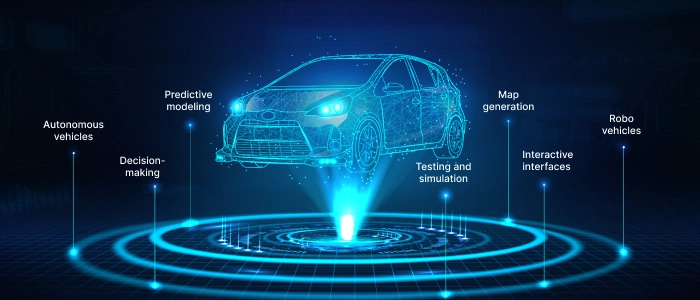
Gen AI is playing one of the important roles in transforming vehicle automation. It enables different aspects of autonomous driving such as:
1. Perception & Sensing: Gen AI helps vehicles understand their surroundings through LiDAR and computer vision. AI algorithms can easily generate transparent 3D maps that allow vehicles to detect obstacles, objects, and pedestrians with high accuracy.
2. Decision-making: Gen AI technology helps autonomous vehicles with real-time decision-making. These systems can effectively simulate different driving scenarios & create responses for ensuring safe navigation, acceleration, braking, etc.
Looking for Generative AI Development Solutions?
Streamline your complex business process with our generative AI development services.
3. Predictive Modeling: Generative AI models leverage advanced techniques to predict road conditions. This makes autonomous vehicles capable of anticipating and managing unpredictable situations seamlessly.
4. Testing and Simulation: Gen AI can create a large amount of data and real-time scenarios for autonomous vehicle testing. This speeds up the process of development and validation and makes vehicles more reliable and safer.
5. Map Generation: Gen AI technology is extensively used to generate high-end maps for autonomous navigation. These maps mostly include information regarding lane markings, traffic signs, road conditions, and more.
6. Interactive Interfaces: Many autonomous vehicles are designed with conversational AI interfaces that promote direct interaction with vehicles using natural languages. This makes the overall driving experience more convenient and easy.
7. Robo Vehicles: Gen AI technology is extensively used in robotic vehicles across different industry domains. This improves their ability to efficiently perform complex tasks and navigate complex industrial environments.
Understanding Gen AI
Generative AI, or GenAI, generates new content such as text, images, and audio in response to a prompt or query by employing advanced algorithms to arrange massive, complicated data sets into valuable clusters of information.
Usually, GenAI handles two tasks:
- To map data points according to the degree of their correlations (dependencies), it first encodes a collection of existing information into a form (vector space).
- Second, identifying the appropriate context inside the vector space’s preexisting dependencies creates (decodes) new material as prompted.
As it’s broadly accessible through OpenAI’s ChatGPT or Google’s Gemini, generative AI answers difficult questions, summarizes vast information, and automates numerous tasks that were previously human activities.
For example, businesses use Gen AI to help them create their business reports, personalize marketing campaigns, create commercial films, and improve their code.
Software vendors include Gen AI into existing applications, such as CRM and ERP, for a more sophisticated approach to business application productivity.
GenAI is being added to existing automation solutions, such as RPA and customer service chatbots, to make them even more proactive and context-aware.
Finally, underneath it all, generative AI is being used to produce synthetic data to train other AI and ML models.
Perks of Using Generative AI in Automotive Sector
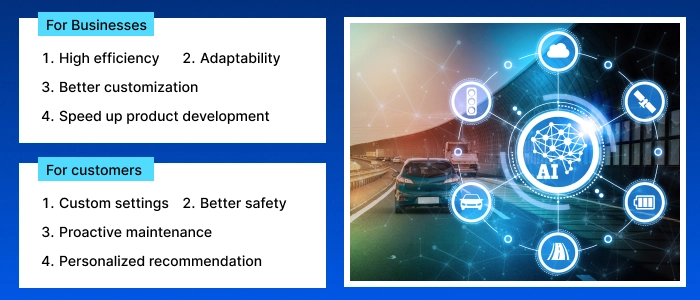
Generative AI is revolutionizing the automobile industry in several aspects. This technology is fundamental to facilitating reliable, efficient, and safe autonomous driving experiences. Let’s have a look at the key benefits of implementing generative AI in automotive.
For Businesses:
1. High Efficiency: Gen AI brings efficiency to automobile cost management and production by managing operational expenses, mitigating wastes, and streamlining manufacturing processes. This helps auto parts manufacturers enhance productivity and increase profitability effectively.
2. Adaptability: In the automobile industry, AI manages stock and helps in adaptive inventory dynamically. This level of adaptability ensures hassle-free operations and prevents stockouts. Real-time monitoring also keeps the supply chain operations more efficient and resilient.
3. Better Customization: Generative AI helps automobile sectors gain a competitive edge through customization. It allows automotive manufacturers to provide fully customized solutions and products. Moreover, AI-based customization also helps to enhance customer satisfaction and maintain market relevance.
4. Speed up Product Development: Gen AI helps to accelerate product development and manage deals. From design planning to delivery, it supports automotive manufacturers in all aspects of the manufacturing cycle. Gen AI also refines sales and marketing tactics. This leads to more effective and seamless client targeting.
Read More Related Blogs
For Customers:
1. Custom Settings: AI-driven solutions can adjust several in-vehicle parameters like climate control. This customization effectively improves customer convenience and personal driving experience.
2. Better Safety: Generative AI effectively helps in optimized navigation and automobile safety. It helps to analyze real-time traffic information & road conditions. This intelligent assistance boosts vehicle safety and eliminates travel time by avoiding hazardous roads.
3. Proactive Maintenance: Gen AI technology helps in proactive vehicle care by anticipating maintenance needs. This predictive maintenance service prevents breakdowns, expands the vehicle’s performance, and saves car owners from expensive repairs.
4. Personalized Recommendation: Based on customer preferences, AI helps with personalized recommendations. It suggests you choose the right auto accessories and features depending on your personal choice and budget. AI makes vehicle buying more customized and enjoyable.
Gen AI Trends In Automotive
As the most emerging technology, generative AI has unlocked diverse automotive trends nowadays. These trends not only showcase current automobile innovations but also hold a very promising future for automobile manufacturers, dealers, and customers. Let’s have a look at the popular gen AI trends in 2024.
1. Customized Infotainment: Gen AI allows vehicle owners to customize the navigation and entertainment system based on their preferences. It can employ voice recognition to create commands and personalize interactions. The system can also learn from users and suggest the most relevant content. These features make the driving experience more enjoyable and intuitive.
Read More Related Blogs
2. Improved Urban Mobility: Generative AI can manage overall traffic flow by anticipating congestion patterns. It also helps in optimizing routes and public transport schedules. This level of advancement will effectively improve personalized routing in ride-sharing and make traveling more convenient.
3. Self-driving Technology: Generative AI technology can analyze information generated from the sensors and helps in autonomous driving. It can learn from diverse environments and adapt responses. It can also predict road hazards and give appropriate suggestions. This leads to improving driving automation.
4. Enhanced Fuel Efficiency: Gen AI applications can improve overall fuel efficiency and reduce carbon emissions by adjusting engine performance and functionalities. Gen AI algorithms effectively adapt to real-time driving conditions. This leads to improving fuel efficiency and reducing carbon emissions.
Types of AI in the Automotive Industry
Are you aware that the automotive industry’s AI market is predicted to rise from $44.5 billion in 2025 to $74.5 billion in 2030?
It says volumes about the speed at which artificial intelligence is being adopted and applied in the automotive sector. But, the main question, however, is why this extraordinary expansion is occurring.
The massive usage of AI in the automotive sector is the reason for its growth. Vehicles with linked cars and the Automotive IoT have also embraced AI for real-time data processing. Two benefits of such data are improved vehicle performance and valuable information for manufacturers and drivers.
AI’s potential to transform the current station-to-station transit procedure is its most exciting application in the transportation industry.
The automotive mobility sector would undergo a significant revolution. Following the use of AI in automotive would enhance vehicle safety and reimagine the driving experience.
Below are the types of AI used in the automotive industry:
AI (Artificial Intelligence):
AI is like a car’s thinking brain. It helps vehicles drive better, stay safe, and work more carefully.
ML (Machine Learning):
Machine Learning is when an automobile learns from past experiences to make better choices.
Computer Vision:
Just like our eyes help us see, computer vision allows vehicles to look at the road, people, and traffic signs. This helps to know when to stop, go, or turn.
NLP (Natural Language Processing):
Using voice commands like “Turn on the music” or “Find the nearest gas station”? NLP helps vehicles understand human language and respond.
Deep Learning:
Deep Learning helps automobiles make decisions by learning from lots of information.
Generative AI:
Generative AI can design new routes, improve traffic flow, and even create smart driving suggestions.
How to Implement Generative AI in Automotive Industry?
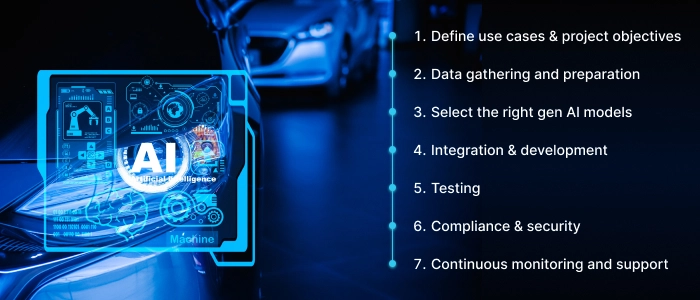
Integrating gen AI in automotive involves a highly strategic and thoughtful approach. Let’s have a look at the key steps of implementing this technology for your business.
Step 1: Define Use Cases & Project Objectives:
Define the project goals that you would like to achieve with the gen AI technology. This involves improving customer experiences, optimizing manufacturing, enhancing design processes, streamlining the supply chain, etc. Apart from that, you can also address different use cases where gen AI adds values like predictive maintenance, customer interactions, supply chain optimization, etc.
Step 2: Data Gathering and Preparation:
Data quality plays a key role in implementing gen AI in automotive successfully. Now, you need to collect diverse and high-quality datasets based on your use cases. This may include data related to manufacturing processes, customer feedback, vehicle performance, supply chain logistics, etc. You need to pre-process and clean the data to ensure that it’s ideal for gen AI model training.
Step 3: Select The Right Gen AI Models:
Choose the right-gen AI model to perfectly align with your automotive businesses. Well-known AI models like Generative Pre-trained Transformers (GPT) are widely used in different industry domains and automotive is no exception. You can also explore pre-trained models on your datasets for industry-specific use cases.
Step 4: Integration & Development:
Hire AI developers or collaborate with a reliable firm to successfully implement gen AI solutions. You must ensure that the company has extensive industry experience and proper portfolios. Moreover, incorporate gen AI models into existing systems based on your project objectives. This involves integration with manufacturing processes, design tools, customer service platforms, supply chain management, etc.
Step 5: Testing
You need to conduct testing for gen AI models and ensure that these models can accurately perform to meet the project objectives. Evaluate the overall performance of gen AI models and make adjustments if required. After that, you should validate the outcomes and confirm the applicability of your gen AI models.
Step 6: Compliance & Security:
Focus on security measures to safeguard sensitive automotive information and implement access controls, data transmissions, and encryptions to manage data privacy and integrity. Moreover, you have to ensure compliance with the latest industry standards and regulations.
Step 7: Continuous Monitoring and Support:
You can implement a proper monitoring system to track the overall performance of your gen AI model effectively. You need to update models regularly based on the availability of new data and industry requirements. You can also foster a continuous improvement culture, where performance insights and user feedback are used to improve gen AI applications.
Use Cases of Generative AI in the Automotive Industry
Generative AI is transforming how cars are designed. The buildup and usage have also transformed the old school methods of automobile designing. It helps the next-gen engineers, drivers, and automakers work with, sparking new ideas. It is utilised in the automobile sector in the following significant ways:
Vehicle Design and Prototyping
By evaluating large volumes of design data, generative AI assists automotive designers in producing cutting-edge vehicle models. The design process can be accelerated by using it to create innovative car body shapes, aerodynamics, and interior layouts. The benefits of Gen AI in prototyping and designing are:
- Lessening of workload on manual prototyping.
- Create vehicles that are more energy-efficient and aerodynamically optimised.
- Optimise the structural design to lessen material waste.
Autonomous Driving and Simulation
In actuality, testing autonomous vehicles requires a variety of traffic, weather, and road conditions. In addition to real-world testing, generative AI can assist in creating a virtual environment and simulating every driving situation for autonomous vehicle system training. The benefits of testing autonomous vehicles reflect in a way as:
- It decreases real-world testing costs and increases safety before its deployment.
- It helps test autonomous cars’ ability to maneuver through complex traffic situations without real on-road training.
- It improves decision-making algorithms for self-driving systems.
Predictive Maintenance & Fault Detection
Generative AI helps predict when a car part might fail before it happens. It analyses sensor data from the vehicle’s engine, brakes, and transmission. Instead of waiting for a car to break down, AI can alert drivers when a part needs servicing. The predictive maintenance and fault detection can be beneficial as they:
- Prevent the occurrence and increase vehicle reliability.
- Saves money by repairing minor issues before they become big ones.
- Ensures their lifespan by taking timely maintenance action.
AI-Generated Infotainment
Generative AI helps create personalised in-car experiences by understanding driver preferences. AI can recommend music, adjust climate control, suggest the best driving routes, and even talk to passengers through intelligent voice assistants. The Gen-AI’s role in entertainment has various benefits:
- Creates more pleasurable experiences while driving and uses user-friendliness in such driving.
- Minimise distractions with hands-free control through the help of voice commands.
- Learns the driver’s preference so that he would feel at ease driving.
Gen-AI for Safety Management
AI has the ability to analyze countless accident scenarios in helping automakers to create safer cars. Driver assistance systems are enhanced by AI with features such as emergency braking, blind-spot identification, and collision avoidance. Other benefits of safety management include:
- Enhancing road safety overall and mitigating accident risks.
- Assists engineers in developing vehicles that are stronger, safer, and resistant to various impacts.
- Enables safer driving through driver-assistance technologies.
Want to Hire Generative AI developers?
With gen AI development services, we create intelligent apps and ensure scalable deployment.
Final Words
Generative AI optimizes diverse aspects of vehicles including power efficiency, infotainment, driving capability, and so on. It paves a new way for eco-friendly engineering & promoting sustainable transportation. The rapid adoption of generative AI technology helps to optimize automotive operations and take the modern driving experience to the next level.
FAQ’s
1. What is generative AI in the automobile industry?
Generative AI in automotive is the application of machine learning methods and generative models used for operations, vehicle automation, automotive design, and manufacturing. It offers diverse opportunities for creating eco-conscious automobiles. From power efficiency to promoting sustainable transportation, generative AI optimizes different aspects of the automobile sector.
2. How is AI used in the automotive industry?
Artificial intelligence is utilized in the automotive sector in different ways to enhance safety, efficiency, and user experience. Some of the key applications of AI in automotive include:
- Autonomous vehicles
- Driver assistance systems
- Predictive maintenance
- Customer support and services
- Vehicle safety improvements
- Production & manufacturing



 Souradeep Kundu

 Shivraj Dhaygude