We are constantly seeing changes in curriculum due to continuous advancements in technology. The speed with which emerging innovations such as ‘machine learning’, ‘artificial intelligence’ and ‘big data’ are developing has a huge impact on how educational institutions with AI can help prepare children for life beyond school on the snow.
Companies, such as Sphinx Solutions, an AI Solution Provider, develop these new tools to allow teachers to customise learning and encourage knowledge, curiosity, and creativity. Teachers are getting a collection of new resources to support students by providing more purposeful learning opportunities.
Personalized educational programs, greater accessibility to remote regional educational institutions, and flexible information systems that provide insights into student strengths and weaknesses are obvious benefits of AI and machine learning in education.
Impact of AI in Education
1. From 2018 onwards, artificial intelligence’s (AI) marketplace has been escalating at a compound annual growth rate (CAGR) of 76.9%. Looking ahead, Global Market Insights forecasts an impressive CAGR of 20% from 2024 to 2032. They believe that by 2030, the AI field within education will surpass a whopping $80 billion in worth.
2.There are times when sorting through countless pages to locate a specific piece of text becomes tasking. Students can now efficiently apply tools like ChatGPT, Gemini, and additional generative AI systems to overcome this burden and enhance their learning experiences. Making use of such innovative AI tools allows educators to implement more practical, enjoyable, and focused research activities into their teaching processes. Many of these solutions are also recognized among the best ai tools for students, helping them learn faster and more effectively.
3. The excitement about Chat GPT in 2022 is just the beginning. The year 2023 has advanced the revolutionary journey of Generative AI in education. Generative AI has taken off this year and is now present in every aspect of the curriculum.
4. Designed as an intelligent and customizable assistant, like a digital friend that recognizes and caters to each student’s individual needs.
5. The goal of this comprehensive integration is to add fun and personal elements to the educational process, not just to facilitate learning.
Check Out Related Posts
Why and How to Implement AI in Education?
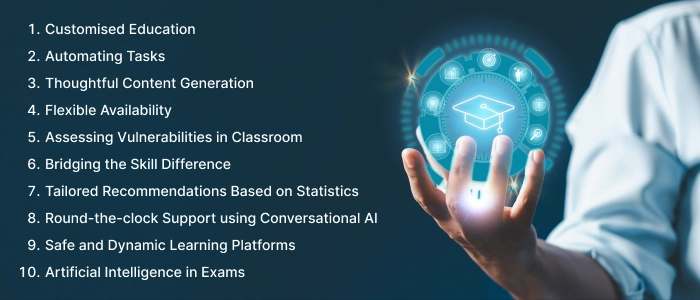
Customised Education
Every student responds differently to information. While some absorb things fast, others need time. The idea of personalized instruction for each individual student was absent from the traditional educational system. AI in online learning can help in this situation.
In the field of education, artificial intelligence guarantees that instructional software is customized for each user. Additionally, the system supports the way students understand different courses and adjusts to that process to reduce load by utilizing supporting technologies like machine learning in education.
This fusion of AI and education is tailored to each person’s needs via AI-infused games, personalized learning experiences, and other features.
Need a Detailed Estimation of Your AI App Development?
Try our app cost calculator to get in-depth and transparent budget estimates in just a few clicks.
Automating Tasks
AI fills the majority of value-added duties in online learning environments and educational instruction. Artificial intelligence (AI) solutions for education may also be used to create a customized educational system, grade evaluations, assess schoolwork, manage dissertations, keep track of reports, create briefings and notes, and handle other aspects of administration. For students balancing heavy academic loads, this often intersects with the need for paper writing services, where platforms like Paperwriter.com demonstrate how technology can assist in managing assignments responsibly while still keeping the focus on learning outcomes
For this reason, companies rely on incorporating AI technology into their operations to meet everyday objectives.
Artificial intelligence enhances the understanding and productivity of the learning environment by streamlining routine tasks.
Thoughtful Content Generation
Educators and researchers may also generate creative content for easy lecturing and comprehension with the use of AI and ML in education. This includes leveraging AI writing tools that help craft tailored lesson plans, generate quizzes, and even produce explanatory text that suits different learning levels. Here are some instances of intelligent content production using AI:
Information Visualization
AI in content creation increases the practical benefit of visualizing online educational settings when conventional educational approaches can only present lab tries as graphical components This technology facilitates 2D and 3D representations, where kids might receive data differently.
Digital Lesson Generation
AI in education can facilitate bit-size understanding by providing digital classes and educational resources with reduced storage requirements. In this manner, the complete study material may be utilized by specialists and learners without using much device storage.
You don’t need to bother with distant learning either, because these resources are available on any device.
Frequent Content Updates
With AI, users may easily produce and update content on a regular basis, keeping the lessons current over time. Additionally, the users receive notifications whenever new content is posted, which aids in work preparation.
Flexible Availability
Users may now take advantage of AI’s benefits in education since they have total access to information. More than 60% of education-related enterprises, according to a recent poll, depend on AI/ML-based education app development that is bolstered by contemporary tools and features. Features such as multilingual support facilitate the translation of content into several languages, hence making it easier for native speakers to teach and learn. For professionals seeking to extend these AI-driven access and adaptability benefits into community-oriented roles, UND’s online master’s degree in social work combines clinical training with data-informed methods to enhance service delivery in diverse populations
Additionally, AI is essential for instructing audiences that are blind or deaf. Artificial intelligence-driven translation solutions, such as Presentation Interpreter, offer simulated lectures with real-time captions.
Check Out Related Posts
Assessing Vulnerabilities in Classroom
Using online education to preserve a good environmental impact is one of the many educational benefits of AI technology. Nonetheless, a lot of experts think AI will eventually take on the role of human interaction in education. Now, this may not apply to the education industry, but it does to other businesses. AI and education work together to enhance both traditional classroom instruction and online learning.
Artificial intelligence only assists professionals by personalizing the learning process for each learner.
Bridging The Skill Difference
Developing students’ skills further is an important way for AI development companies to close the digital divide. Software and application development approaches driven by AI and ML provide broadly accessible and reasonably priced upskilling options for students.
This is not only for students: retraining and upskilling the current personnel in business may raise spirits and inspire a company-wide dedication to innovation and progress.
Furthermore, by examining how individuals learn new skills, the application of AI in the education industry has an influence on the learning and development field. The technology automatically adjusts the procedure for learning to individual study and learning styles as soon as it detects them.
Tailored Recommendations Based on Statistics
When it involves creating educational programs, either in a classroom or at work, feedback is an essential component. Effective teaching embraces constant evaluation. Since feedback must originate from a reliable source, artificial intelligence (AI) in education evaluates and assigns grades based on routine data.
A data-driven feedback system reduces bias in learning, increases student happiness, and makes it easier to identify areas in which a student’s abilities are deficient. This feedback is customized based on each staff member and the student’s accomplishments as documented in the computer system.
Round-the-clock Support using Conversational AI
An increasingly common example of AI being used in education to gather data and deliver relevant information and support are chatbots. Teachers and business executives alike gain from this when it comes to student participation in personalized learning.
By continuously monitoring the way that students consume knowledge and adapting to meet their requirements, conversational AI in education provides intelligent teaching. Globally, people are choosing corporate training programs and distance learning since they don’t need to take time off from their jobs, families, or studies. Here, AI chatbots may answer enrollment-related questions, offer prompt assistance, give users access to necessary study materials, and offer round-the-clock support.
Safe and Dynamic Learning Platforms
AI is enabling the education sector to innovate quickly, but it is frequently hampered by problems with data security, accessible data that may be altered, antiquated certification procedures, etc. Notwithstanding all of these difficulties, decentralized AI-based solutions have the potential to positively transform education technology.
This learning management system, supported by blockchain and artificial intelligence, has the ability to provide data and information security solutions to millions of educators and learners.
Searching for AI-driven ED-Tech Solutions?
WebMaxy ProMarketer.AI will help you customize your educational system as per your own specific requirements.
Artificial Intelligence in Exams
Artificial intelligence (AI) software solutions may be actively utilized to identify suspicious conduct during exams and interviews and notify the supervisor. Using webcams, microphones, and web browsers, the AI algorithms monitor each person and analyze their keystrokes, alerting the system to any movement.
There are more advantages to using AI-based software and applications than one may think. This explains why AI technology solutions that effectively address the diverse spectrum of user pain points are attractive to EdTech companies and corporations. It is thus officially time to include AI technologies into your educational enterprise if you work in the professional education sector.
The Role of AI in the Education Sector
Education has progressed from what it used to be. Gone are the days when learning meant sitting through the same old lectures and cramming from dusty textbooks.
AI is modern-day tech that’s smart and the main gig. It mimics human intelligence to get complex stuff done faster and more efficiently. It’s quietly becoming the MVP in classrooms, online platforms, and everything else.
Let’s explain how the role of artificial intelligence in education sector is turning the education world upside down in the best way possible.
Smart Learning Your Way
Traditional classrooms were a one-size-fits-all system. But not every student learns the same way, and that’s precisely where AI in the education sector shines. Through adaptive learning, AI tracks how you learn and figures out where you shine and where you need a little boost. In AI, the learning path is tailored according to your learning pace.
Recommending personal quizzes, smart feedback, curated content, and lessons that adapt as you go. It’s like having a tutor that knows what you need 24/7 in your studying journey.
Helping Special Needs Students to Grow
Education should be for everyone, but students with special needs often face extra hurdles to learning the same thing a normal child can learn quickly. AI is now helping them overcome those hurdles.
From speech recognition tools for students with communication challenges to text-to-speech software for those with visual impairments, AI empowers students to express themselves, connect with others, and learn on their terms.
They have customised lesson plans, real-time support, and interactive learning tools, creating opportunities like never before.
Smart Teaching for Teachers
Teachers, being superheroes, also need sidekicks. That’s exactly what AI is becoming for educators. It’s not replacing teachers or any of their jobs but making their lives a lot easier by enhancing their teaching strategies.
- Auto-generating innovative content that adapts to each student.
- Real-time grading and instant feedback.
- Answering basic student questions.
- Answering basic student questions so teachers can focus on deeper discussions
- Supporting inclusive teaching through adaptive tools.
In conclusion, teachers get to spend less time buried in administrative work and more time teaching.
Learning New Languages Like a Pro
Learning a new language meant waiting for a class or buying expensive courses. Now, AI-powered apps and platforms teach everything from French to Japanese, complete with real-time pronunciation feedback, grammar tips, and interactive practice. So whether you dream of ordering sushi in flawless Japanese, AI’s got your back.
Learning Vibes with AR and VR
Augmented and Virtual reality can be combined with AI to create an immersive education. These tools aren’t just flashy big names in the technology advancements; they help students see, feel, and experience what they’re learning engagingly.
Benefits of AI in Education
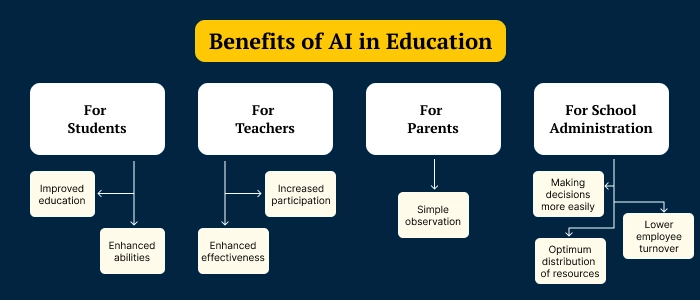
Visualize an educational institution of the future where learning is unrestricted and curiosity is encouraged. Every student has the opportunity to succeed and realize their full learning potential there! A classroom where each student receives individualized instruction based on their learning preferences and speed would provide them with a more dynamic and interesting educational experience. AI integration with EdTech makes this fictitious classroom conceivable.
Let’s examine the ways AI can be used in education to help different organizations within the education sector.
For Students
AI lifts the bar for students in terms of how they navigate the course material and does away with the constraints of traditional teaching techniques. Here are several ways that AI in education will help students, from individualized learning experiences to instantaneous query responses.
Improved Accessibility
AI can help students by providing improved accessibility to their learning materials. For example, with the help of AI, visually impaired or dyslexic students can listen to accurate audio feedbacks of their lecture notes and textbooks. In this type of process, an AI-enabled image to text converter would play the initial role (in converting pictures and images of notes to digital text). Then, a different online tool would change the written text into audio feedback to help the challenged students easily go through their study material.
Check Out Related Posts
Enhanced Abilities
Aside from academic achievement, it is competencies (resolving issues, innovation, analytical thinking, and versatile learning) that support students in succeeding in their jobs. Only when the students are in charge of their own quest to acquire the necessary information is it feasible. Students may successfully work on their deficiencies to upskill and promote personal growth with AI’s tailored approach.
For Teachers
AI has the potential to be a valuable ally for educators by giving them all the real-time insights they need to improve student engagement and by freeing them up from certain tedious, repetitive duties. This is how instructors might profit from AI in the classroom.
Increased Participation
When students are interested and captivated, they can absorb the material more effectively. In addition to encouraging participation, teachers may use AI’s statistical information on students’ needs, learning objectives, topics of interest, and more to offer lectures that pique students’ attention.
Enhanced Effectiveness
Teachers are relieved of tedious and time-consuming activities by automating common administrative responsibilities such as preparing lessons, evaluation, attendance, and more. Teachers may now concentrate on making wise decisions and mentoring or motivating learners.
For Parents
Parents frequently feel disconnected from their child’s academic achievement when it comes to providing for them, particularly during their formative years. This is how parents may benefit from AI in education in addition to their child’s learning experience.
Simple Observation
Parents were only informed about their child’s development at PTMs (parent-teacher meetings), provided they attended. AI would enable families to actively engage in their kid’s education process by providing them with an opportunity through which they can observe their child’s growth, abilities, deficiencies, efficiency, and more instantaneously.
Check Out Related Posts
For School Administration
AI has applications beyond improving learning in the classroom; it may also help with school administration. Let’s investigate how artificial intelligence (AI) may streamline and improve the efficiency of an educational institution’s back-end operations for both teachers and students.
Making Decisions More Easily
Complex choices, including budget use, class scheduling, student assistance techniques, and resource distribution, are made by the school administration. These choices can be more successful when supported by solid data that maximizes operational effectiveness while simultaneously improving educational results.
Lower Employee Turnover
Staff turnover is negatively impacted by the administrative duties that educators must do, which prevents them from excelling in their capacity as mentors or knowledge facilitators. Teachers may concentrate more on lecturing and student participation with automation enabled by AI.
Optimum Distribution of Resources
The administration of the school is responsible for overseeing matters such as finances, schedules, staff, time, curriculum, bus timetables, and even classroom scheduling. School administration may get better in these areas thanks to AI’s abilities in predictive analysis and recommendations.
Advantages of Artificial Intelligence in Education
- It makes teaching and learning easier and more effective.
- It helps teachers and students communicate better.
- Gives instant feedback to students.
- Creates a more flexible and personalised way to learn.
- Supports students with special needs through inclusive content.
- Saves time for both teachers and students.
- Builds learning materials that adjust to each student’s level.
- Offers round-the-clock help with chatbots.
- It helps students learn the skills they’re missing.
- It makes learning from home more manageable and more efficient.
AI Use Cases in Education: Real Examples
Artificial intelligence is revolutionizing traditional education by making it more dynamic, data-driven, and efficient.
Some practical uses of artificial intelligence (AI) in education, via the prism of a few well-known EdTech platforms:
Duolingo

Their educational infrastructure offers the most outstanding educational experience to its consumers through the innovative application of AI, whether it is through their spaced repetition system, bandit algorithm, logistic regression algorithm, or their new AI model, “BirdBrain.”
Paragraph Generator
This AI paragraph writer helps students and teachers create clear and well-organized paragraphs in seconds. Students can use it for essays, reports, or homework while teachers can quickly prepare examples and exercises. The tool improves grammar, clarity, and sentence structure so writing feels natural and confident. It is available online for free and ready to use anytime.
Coursera

This online educational system includes a Coursera instructor powered by generative artificial intelligence, which enables the creation of reading lists, assignments, course formats, suggestions for pertinent public information, and more automatically.
QuillBot
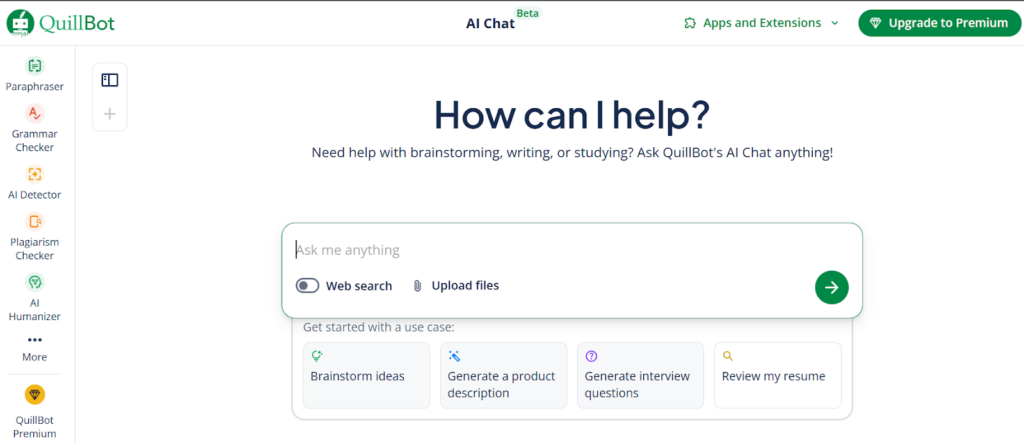
QuillBot’s AI Chat is an intelligent conversational assistant that helps users with writing, brainstorming, and content improvement quickly. It uses advanced language tools to deliver context-aware responses, personalized writing support, and quick problem-solving across a wide range of topics. The chat adapts to each user’s tone, style, and goals, making it an ideal companion for students, professionals, and creatives alike.
AI Chat continuously polishes its understanding of user prompts, offering tailored suggestions that enhance clarity, grammar, and coherence. It can also generate ideas, answer complex queries, and assist in drafting documents, essays, and reports.
Key features:
- Quick, conversational writing and brainstorming support.
- Context-aware suggestions for improved clarity and tone.
- Integration with QuillBot’s paraphrasing, summarizing, and grammar tools.
- Adaptive responses customized to user intent and writing style.
- Ideal for drafting essays, reports, marketing content, and creative writing.
Best for:
- Writers, students, and professionals seeking instant writing feedback and support.
- Teams that need a conversational AI tool for idea generation and collaboration.
- Users looking for an all-in-one AI assistant for drafting, editing, and polishing content.
Pricing:
QuillBot AI Chat is available as part of QuillBot’s premium subscription plans, with limited access in the free version. Premium users enjoy faster response times, deeper context handling, and access to advanced language tools for a seamless writing experience.
ProProfs Quiz Maker
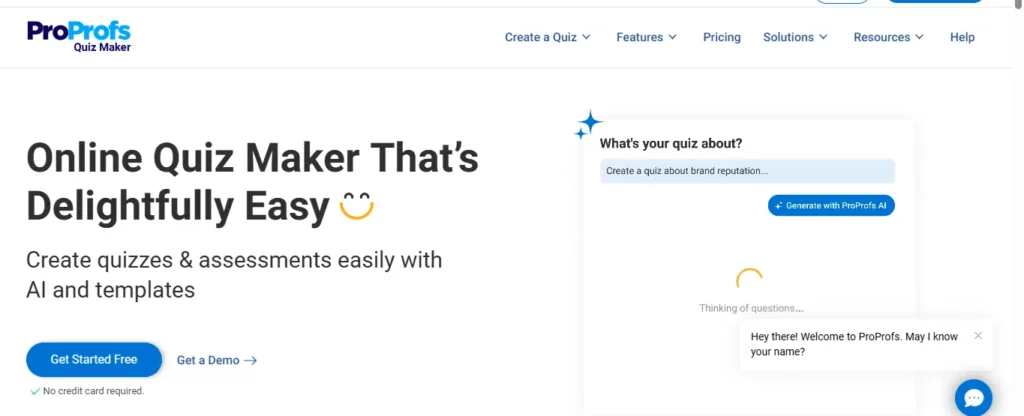
ProProfs Quiz Maker uses AI to help teachers turn learning materials into quizzes in just a few clicks. You can create questions from text, documents, videos, images, presentations, or even webpages. You can also simply type in a topic, and the AI will generate questions, answer choices, and explanations for you.
Teachers can choose how many questions they want, what types, difficulty level, and whether to include explanations after each question or at the end of the quiz to help students review and learn. The tool also takes care of grading, sending reminders to students, and giving out certificates when they complete or pass a quiz.
To manage students, teachers can create virtual classrooms where they assign quizzes and group learners, and track progress. Multiple teachers can have their own accounts, making it easier to share quizzes and collaborate. Reports show how each student—or the whole class—is doing.
For exams, there are features like time limits, question shuffling, browser lockdown, and proctoring tools to prevent cheating. ProProfs also connects easily with platforms like Google Classroom and Microsoft Teams, so it works well for both classroom and online teaching.
Google Classroom is another significant tool that incorporates advanced technologies to ease the practice of teaching. The Assistant allows instructors to build, attach, and assess tasks and control the flow of communication within a class. Within Google Classroom, AI grading systems are built as well as personalized content recommendations and student performance records analysis.
Students and also teaching personnel make use of other highly effective tools, such as Google Translate and Google Scholar, which elevate the quality of research and learning. Google Translate is important in eradicating the language barrier, for it provides instantaneous translation of all kinds of texts, websites, and even spoken language.
While more general-purpose search engines provide access to vast databases of information, Google Scholar focuses specifically on indexing, ordering, and organizing scholarly publications, including academic blogs, working papers, journals, etc. Thus, making it easy for students, researchers, and academicians to find dependable and pertinent sources for their works.
Squirrel AI
Squirrel AI is the first globally recognized educational technology firm that provides AI-enabled learning solutions that adapt in real-time to learner’s needs. It regularly assesses students’ knowledge and studying tendencies and modifies the lessons and exercises according to the speed and level of each student. The system identifies countries in which students are weak and forecasts their learning curve to assist them in performing well in different subjects. It also allows a constructive teaching approach by giving teachers insight into how each student is progressing within a specific timeframe.
Check Out Related Posts
What is the Cost of AI Education App Development
A platform based on AI for educational purposes can cost any amount from $30,000 – $300,000 or more, depending on the characteristics of the project.
However, this is merely an estimate, and the real price can be influenced by such aspects as the intricacy of the project, the services needed, UI/UX design, the geographical area of the app development company, the target device, and technologies used for the project.
Below is a chart presenting the roughly calculated price and duration of developing an AI education application broken down into three types of complexity and features of the project.
| App Complexity | Average Timeline | Average Cost |
| Simple solution with basic features | 4-6 months | $30,000 – $50,000 |
| Medium complex platform with moderate features | 4-9 months | $50,000 – $120,000 |
| A highly complex system with advanced features | 9 months to 1 year or more | $120,000 – $300,000 or more |
Future of AI in Education
Big changes are about to take center stage with AI in education. It threatens to change the entire teaching and education system by bringing in a new way of learning and teaching, one that cuts across all barriers and even age.
With more people embracing and making smartphones an everyday tool in education, AI uses complex sources and provides services that are measured against the entire scope of information. Therefore, students are able to access tailor-made lessons and immediate responses through aids such as augmented reality and virtual reality.
In addition, AI-based communication technologies used in education can offer help and manage students, promoting self-study through monitoring their learning activities and modifying the contents according to the learners. This technology is quite relevant for conducting online and corporate-based training since it enables learners to combine education and other activities, such as employment or personal engagement.
Also, AI helps learners by allowing the creation of personalized programs, delivery of dynamic lectures, and inclusion of game-based learning, all of which contribute to the expansion of the education technology industry. Thus, it is projected that the global market for AI in education will be $32.27 billion by the year 2030, indicating the increasing adoption of AI technologies in the field of education.
Want to Integrate Your Institution with AI?
Transform your educational infrastucture today with WebMaxy AI Implementation for a better learning experience.
Conclusion
Artificial intelligence’s transformational promise is changing the education sector. AI will be crucial, just as chatbots are becoming the new standard in every business due to the growing desire for customization, including EdTech.
With the automation of repetitive chores and the provision of ground-breaking real-time information to raise student engagement, it would be beneficial to both students and instructors.
AI is also expected to improve accessibility and engagement in education through the use of assistive devices, translations powered by AI, and round-the-clock assistance. Moreover, by giving students a viewpoint outside of traditional classrooms, the integration of AI with AR and VR will elevate the educational experience completely forever.
So, wait no further and contact Sphinx Solutions right away, if you are in search of a well established AI Development Company.
FAQ’s
How is AI being used in education?
AI in education is being used in many ways, such as:
Communication, Monitoring, Modeling, Assessment, Tutoring, Grading, Planning, Learning, Record systems, etc.
How AI will affect education?
Artificial intelligence (AI) can impact education in many ways, such as:
Personalized learning, Adaptive learning, Identifying knowledge gaps, Adaptable access, Easy access to materials, Real-time feedback, Relevant information, etc.
Why AI is the future of education?
AI in education has the potential to customise course material to meet each student’s unique needs.
Artificial Intelligence (AI) algorithms have the ability to analyse student performance and modify learning materials, pace, and difficulty levels to provide students with a personalised learning experience.
Massive amounts of educational data can be analysed by AI to find trends and patterns. Education decision-makers and school administrators will find this extremely helpful.


 Souradeep Kundu

 Shivraj Dhaygude