
The transportation industry is in the fastest gear of the growing sectors. Now and then, massive transformations in transportation are evidence of how technology is revolutionising how goods and people move. Introducing AI in transportation has become a driving force in how enterprises operate, manage logistics, and serve customers.
AI in transportation spending is expected to reach nearly $300 billion by 2026, witnessing profound changes. Optimising logistics, vehicle tracking, delivery routes, predictive maintenance, and autonomous vehicles, AI applications are growing the efficiencies of enterprises, setting new standards across the industry.
For example, algorithms for optimising selected routes can decrease fuel consumption by 10-15%, and AI-based preventive maintenance is helping companies save millions by avoiding expensive failures and cutting down service time-out by about 30%.
Due to the transformative shift in technology, the logistics industry is already current with autonomous vehicles, and studies suggest that the invention of self-driving trucks will save a huge amount of money on labour and fuel worth billions.
Organisations that effectively utilise AI in transportation can satisfy consumers who demand speed and efficiency, especially in intense competition. This blog will explore AI in transportation, highlighting its advantages and case studies.
Not sure about the cost of developing an AI-driven transportation app?
Get a clear estimate to plan your project budget effectively.
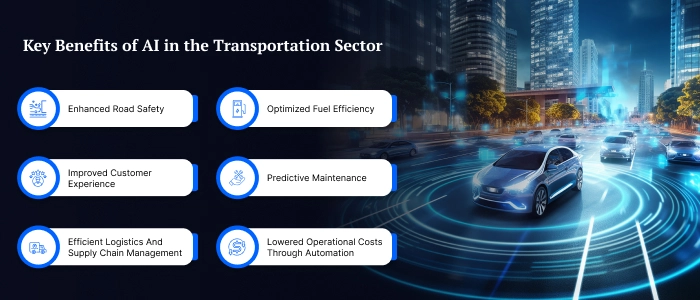
Key Benefits of AI in the Transportation Sector
Implementing new technologies like AI in transportation has been innovatively transformative. The projection for global AI in the transportation market is expected to reach $10.3 billion by 2030.
The advantages of AI reveal that autonomous vehicle technology has achieved a crash rate of over 90% during test runs, demonstrating the technology’s theorised ability to enhance road safety by limiting injuries caused by reckless driving.
Such predictive analytics already defines AI’s integration into logistics by cutting fuel costs and optimising transit routes. Studies attest to even saving up to 15% of fuel costs. However, AI tends to be more ambitious than this, especially concerning its introduction in this industry.
Let us look at some key benefits of AI in transportation.
Enhanced Road Safety
The World Health Organization reports that car accidents claim 1.3 million lives annually, with human error as the main factor.
AI in transportation is used by self-driving cars for all the features like applying brakes, acceleration, etc., without human intervention. For example, Advanced Driver Assistance Systems (ADAS) is an AI technology with sensors, cameras, and machine learning to detect risks and alerts before their occurrence.
Companies such as Tesla, Waymo, and Ford are already deploying self-driving car technologies, which might lower accident rates by up to 90% once fully implemented on roadways. These systems are invaluable in helping drivers avoid accidents, making AI an indispensable tool for road safety.
Check Out Related Posts
Optimized Fuel Efficiency
Fuel is a significant transportation concern, especially in logistics and freight. Route optimisation and predictive maintenance tools have been introduced to address the issue of fuel efficiency. In other words, the global logistics industry spends roughly $500 billion on fuel annually, tied to inefficient routing, traffic jams, and vehicle downtime.
AI-based systems examine historical data, traffic patterns, and weather forecasts to identify the most effective routes and departure times. Well-known companies like UPS use their AI-enabled routing software “ORION”, which reports fuel savings of over 10 million gallons per year by minimising turns and stoppages in their driving routes and reducing operational costs.
The impact is also vital for environmental concerns, as the transportation industry accounts for nearly 24% of global CO2 emissions.
Improved Customer Experience
The most messed up section of the transportation system is public transport. The integration of AI has enhanced the overall experience of millions of commuters throughout the country. From public transit systems to RV rental services, features like real-time tracking, predictive analysis, and smart booking systems have made travel more reliable, convenient, and accessible.
AI in transportation has made public transport more attractive with features like seat occupancy, on-time performance, and the ability to manage crowd control (during peak hours). The outcome resulted in a contribution to a shift towards sustainable urban mobility.
For example, Transport for London (TfL) uses AI algorithms to predict the commute’s arrival times, reducing commuter complaints by 60%. Similarly, the Smart Ticketing System provides features that help customers choose the best fares for travel times, improving affordability and accessibility.
Check Out Related Posts
Predictive Maintenance
The downtime in vehicles is a more minor but common problem that can cause unexpected delays, disrupting the vehicle’s health. AI in transportation helps in predictive maintenance and solves problems by monitoring the vehicle’s health regularly and predicting breakdowns before they occur.
The sensors in vehicles send data that AI-enabled systems analyse to indicate the signs of wear and tear in real-time situations. They also alert people to schedule maintenance beforehand so there aren’t any unnecessary delays while doing meaningful work.
For example, Deutsche Bahn, Germany’s largest rail operator, uses predictive AI, which has saved approximately $35 million annually in maintenance. There can be further improvements in uptime, reliability and customer satisfaction in the operated transportation industry.
Efficient Logistics and Supply Chain Management
For the transportation and logistics industry to guarantee on-time delivery and economical routing, efficient processes are essential. AI in transportation in logistics solutions helps enterprises manage large-scale inventory more accurately and precisely, optimising the scheduled delivery.
AI-powered supply chain management reduces logistics costs by approximately 15% annually, being cost-effective by saving millions. Retailers also take advantage of meeting delivery deadlines and reduce stockouts or overstocking. AI can evaluate customer demands, predict stock requirements and recommend routes predicting real-time data.
Big enterprises like Amazon and DHL manage their inventories using AI, which is instrumental in managing last-mile delivery logistics. Without human involvement, AI in transportation can schedule deliveries and inform customers about any delays, improving transparency in the delivery process.
Check Out Related Posts
Lowered Operational Costs Through Automation
Recurring tasks are time-consuming, engaging resources in not-so-productive work. Also, in transportation and logistics, repetitive tasks can affect costs. Automation through AI can eliminate this issue by upto 40%, minimising human errors. Many warehousing facilities employ automated drones and robots to sort and transport products, significantly reducing order processing costs and time.
Companies such as Embark and TuSimple are already testing autonomous trucks to move cargo over vast distances with little human involvement, increasing the efficiency of freight operations and cutting expenses.
The key advantages of AI in transportation vastly affect the industry, and several big enterprises are already in the race to benefit from the same. Some use cases of AI in the transportation industry will make it more understandable for the explorers.
Managing fleet efficiency, safety, and costs in transportation can be overwhelming.
Use AI to optimize routes, reduce fuel costs, and enhance safety.
Top 10 Use Cases of AI in Transportation
The transportation industry is experiencing a revolution with AI, thanks to improvements in efficiency, safety, and customer experience. AI has now percolated every layer of automotive software development, aviation, logistics, and urban mobility-giving way to maximizing operations through mobile app development frameworks and advanced analytics.
Leveraging AI technology from automotive design for generative use to AI for insurance fraud detection, companies are reaping the advantages of AI application development for keeping up in their competitive environments.
Ever-changing AI design firms spur the growth of car-automation, AI-chatbots, and predictive systems that reshape transportation.
Let’s go through the ten biggest AI applications in transportation and how they are shaping the industry:
Predictive Maintenance
Ensures that maintenance will be predictive by making use of artificial intelligences so that companies can save the millions they would have spent on mechanical failures.
How it Works:
In real-time engine health inspection, tire wear analysis, and vehicle performance studies, AI sensors collect performance data. The automotive software development incorporates these insights into mobile app development solutions to facilitate fleet operators in scheduling proactive maintenance.
Benefits:
- Reduced downtime and maintenance expenses
- Extended vehicle lifecycle and safety
- Streamlined operations for logistics and public transportation.
Heavy weights in AI development and Machine learning algorithm implementation for real-time diagnostics and better overall performance in fleet management systems.
AI Chatbots for Customer Service
The influence of AI chatbots is being felt in customer services in the transport industry.
How it Works:
Artificial Intelligence-Driven Chatbots handle customer queries such as flight delays, Uber rides, and package tracking.
Benefits:
- Available around the clock with instant reply capabilities.
- Increased customer engagement and satisfaction.
- Decreases operation costs by reducing involvement of humans.
AI chatbots are introduced into businesses in logistics, aviation, and car rental operations such that they now drive customer-centric innovation for businesses.
Generative AI in Automotive
Self-driving technology is really a one single, revolutionizing application of AI in transport. Similarly, generative AI proves to be revolutionizing automotive design because it can optimize the whole process of vehicle development which also includes aspects such as aerodynamics and energy efficiency optimization.
How it Works:
The AI system combines inputs in real time from the LiDAR (5), radar, and cameras to enable it to operate by itself without any human intervention in a safe manner.
Benefits:
- Traffic accidents will fall due to the human-factor error.
- It would have helped fuel efficiency and route optimization.
- This facilitates self-driving trucks and drones for delivery in logistics.
Companies like Tesla, Waymo, and Uber are AI-powdered in their operational automation while automotive software development continues to perfect self-driving algorithms.
AI in Insurance Fraud Detection
AI is helping insurance companies detect fraud in transportation-related claims. It’s paving the way for massive financial losses by promoting fairness in policy.Insured in turn are not impacted as they can learn on which basis their claims are not adjusted.
How it Works:
AI systems analyse vast amounts of data, including accident reports, driving behaviours, and past claims, to identify fraudulent patterns.
Benefits:
- Prevents false insurance claims
- Enhances claim processing speed.
- This reduces operational costs for insurers.
Using AI in insurance fraud detection, insurance providers and fleet operators can minimize risks and optimize policies based on real-time driving analytics.
Driver Behaviour Analysis
Telematics solutions powered by artificial intelligence are the best ways through which road safety is improved, mainly through an analysis of driver behavior and real-time feedback production.
How it Works:
Acceleration, braking patterns, lane discipline, fatigue level-AI keeps an eye on everything.
Benefits:
- Promotes safer driving practices
- Reduces accident risks and insurance premiums
- Helps fleet operators track driver performance
AI-based automotive software development integrates these insights into mobile apps, allowing businesses to monitor fleets efficiently.
AI for Flight Delay Predictions
The aviation industry is being completely transformed through artificial intelligence, which uses real-time data from a flight API for tracking flights and airport schedules to predict delays, optimize airline operations, and offer numerous benefits to passengers.
How it Works:
AI analyzes weather forecasts, traffic congestion, and real-time airport data.
Benefits:
- Minimizes disruptions in air travel
- Improves airline operational efficiency
- Enhances customer satisfaction with accurate delay forecast.
Leading AI development companies are working with airlines to implement predictive analytics for better decision-making.
AI-Powered Traffic Management
With the help of AI technology, these smart traffic management systems can ensure that urban mobility is made as efficient as possible in managing the population and their movement by reducing congested areas.
How it Works:
Since there is no change in the word count and HTML structure, Rewrite the text with lower perplexity and higher burstiness:
Benefits:
- Lessens urban traffic congestion.
- Minimizes fuel wastage and carbon emissions.
- Enhances emergency response efficiency.
Smart cities are implementing AI development companies‘ solutions to build next-gen urban transportation networks.
Real-Time Vehicle Tracking
AI aids in monitoring of the logistics fleet, with ready real-time information pertaining to vehicle location.
How it Works:
AI integrates with GPS, cloud platforms, and mobile app development solutions to provide precise tracking.
Benefits:
- Optimizes route planning for deliveries
- Enhances supply chain efficiency
- Enhances the prevention of theft and the management of assets.
From AI-powered tracking systems, big logistics players like Fedex, UPS and Amazon are starting to show accurate delivery forecasts.
AI for Inventory Management in Transportation
AI optimizes inventory management for transport and logistics companies by predicting demand and automating stock control.
How it Works:
AI-driven forecasting models analyze historical sales data, market trends, and supply chain performance.
Benefits:
- Reduces overstocking and stock shortages
- Enhances warehouse management efficiency
- Improves overall supply chain resilience.
AI development companies are creating AI-powered inventory management solutions to streamline operations for e-commerce and logistics businesses.
Intelligent Driver Assistance
AI powered Advanced Driver Assistance Systems (ADAS) have made driver safety and convenience only a click away.
How it Works:
The convergence of AI with automotive software development has delivered improved real-time hazard detection, lane departure detection, and adaptive cruise control.
Benefits:
- Uses autonomous braking technologies to lower the danger of collisions.
- Improves overall driving experience
- Lowers insurance costs for safe drivers
The integration of Generative AI in automotive is further refining driver-assist features, leading the way toward full automation.
Use Cases of AI in Transportation
As cities are getting more crowded and efficient, sustainable mobility becomes paramount. The advancement of AI in transportation is increasingly embedding how people and goods are moving from one point to another. Below are the use cases of how AI transforms transportation, leaving a big impact.
Traffic Management for Urban Mobility
With the rising urban population in cities, transport management needs to be much stronger to handle the rise in public transit. So, the cities are turning to AI to manage the congestion and avoid conflicts. AI in transportation systems use real-time data obtained from surveillance equipment such as CCTVs, sensors, and social networks to assess road traffic trends ahead of time.
Los Angeles has a technical advancement ACTS (Automated Traffic Control System) that uses real-time traffic data to adjust traffic light timings. This approach has cut travel time by 12% during peak hours.
Autonomous Vehicles for Safety
Autonomous Vehicles interpret their environment and make judgements using a combination of sensors, cameras, and machine learning algorithms. It reduces human error, which is the reason for 94% of traffic accidents, surveyed by the National Highway Traffic Safety Administration (NHTSA).
Driverless taxis in Waymo, Arizona, have many trips without a driver. Full Self-Driving (FSD) features of Tesla use AI in transportation for autonomous navigation of complex urban environments. Being still in the development stage, it drastically lowers accident rates in high-traffic urban areas.
Check Out Related Posts
Demand Forecasting for Public Transit Optimization
Public transport systems are the only ones that fail to predict how many people will use them and how often. With the help of AI, it is easier to analyse data like weather, upcoming events and past travel patterns. This data can help the authorities plan accurately to add more resources, buses or trains if required.
The Metropolitan Transportation Authority (MTA) in NYC plans bus or train transport routes more efficiently, reducing waiting times and costs. The attractive benefits of public transportation help more people choose public transport that benefits the rider and the city.
Smart Infrastructure for Improved Safety
AI in transportation is making vehicles smarter and the roads they drive on. Smart roads powered by AI are making the roads safer by reducing accidents. It uses real-time data that predicts future traffic patterns, and smart infrastructure can reduce traffic jams.
In Pittsburgh, for example, the intersection management system, founded on AI technologies, has reduced wasted time and resources while waiting for the green light. Emissions were cut by 21% and accidents by 40%.
In Tokyo, we find AI-enabled cameras mounted along the road that detect the movements of both vehicles and pedestrians and inform drivers of possible risks.
Several use cases of AI in transportation and their applications in several big names and enterprises prove to be powerful drivers of efficiency, safety, and innovation in the industry.
Not sure about the cost of developing an AI-driven transportation app?
Get a clear estimate to plan your project budget effectively.
Why Consider Sphinx Solution for AI in Transportation

Sphinx Solutions has emerged as one of the top IT service providers in Pune (M.H), India. Sphinx Solutions provides customised AI solutions that improve decision-making, operational efficiency, and customer satisfaction with a team of over 100+ skilled developers, UI/UX designers, project managers, consultants, and a portfolio of over 500+ successful projects.
Sphinx Solutions can be your AI technology solutions partner that can help the company level up with the technological advancements of AI in transportation. The technology consulting and development firm is well-equipped to help AI in transportation businesses meet modern challenges.
Here’s why Sphinx Solutions stands out in the AI in transportation:
Customised AI Solutions
Each transportation system has unique needs, and Sphinx Solutions focuses on developing tailored AI in transportation solutions to meet these needs. They ensure maximum operational efficiency, reduced costs and improved customer satisfaction.
Advanced Predictive Analysis
Predictive analysis can predict problems even before they arise. Sphinx Solutions uses predictive algorithms to improve fleet management, prevent unnecessary delays and reduce mechanical failures. This increases the lifespan of all critical factors for transportation providers for all vehicles.
Check Out Related Posts
Real-Time Data Integration and Decision Making
Real-time data integration with AI in transportation systems is the primary key to making certain decisions. This enables companies to adjust delivery schedules, re-route vehicles according to heavy traffic areas and monitor fleets as situations evolve, enhancing operational flexibility.
Experience in the Transport Industry
Sphinx Solutions has built a reputation with proven expertise in working with the transportation industry by integrating various data science and AI technologies. They stay at the forefront by staying updated with industry norms, emerging AI in transportation trends, and new transportation technologies in evolving models.
Cost Effective and ROI Focused
Incorporating AI would be a considerable expense, but Sphinx Solutions focuses on cost-effective development processes and profitable returns. Focusing on the important factors for AI in transportation, Sphinx’s solutions can enable enterprises to realise cost savings over a long period.
Choosing Sphinx Solutions for AI in transportation is like partnering with a team that understands the transport industry and AI technology. The guidance well-trained professionals provide throughout every step helps the company meet modern transportation demands.
Conclusion
The rapid automation of AI in the transportation industry is evolving every day and enhances everything from road safety to fuel efficiency, operational logistics, and customer experience. Partnering with a trusted AI solutions provider like Sphinx Solutions can be valuable for companies looking for these advancements. With years of expertise, it will position the companies to grow in the tech-driven landscape.
Transportation challenges are slowing down efficiency and increasing operational costs.
Harness AI to streamline operations and drive smarter, cost-effective solutions.
FAQ’s
How is AI used in transportation?
A wide range of options powered by AI within the transportation industry entails driverless cars, traffic management systems, determination of maintenance during the lifespan of machines, improving routing functions as well as many others. It also promotes safety through systems like driver assistance systems, and collision avoidance systems.
What is the future of AI in the transportation industry?
There is an optimistic outlook on AI where transportation is concerned. Traffic will be managed more efficiently, safety enhanced through advanced sensors and transformed the logistics sector with better routing. In general, artificial intelligence will change the face of transportation as we know it today making it better, greener and more oriented to the passengers’ needs.
How is AI used in vehicles?
Automated vehicles employ artificial intelligence to analyze their environment, determine appropriate actions, and follow the roads without incident. Safety measures such as adaptive control function to maintain a speed selected by the driver and automatic emergency braking systems are some of the exceptional innovations aimed at enhancing vehicle performance, fuel consumption, and maintenance calendar.


 Shaili Gupta


 Ajay Wadne
