
If you’re starting a new tech startup, this blog is definitely for you to succeed in your new venture. The crucial question now is: Should you use Python or Java as the programming language for your product?
If that made you pause and scratch your head, then read more. Particularly in 2026, when speed and size are both necessary for survival, this is one of the most prevalent technological conundrums that contemporary innovators encounter.
Time-to-market is the whole lot while you’re launching a startup. You want to get your MVP available as quickly as possible, take a look at your idea, provoke investors, and win those first loyal customers. That’s where Python, a programming language, often shines, getting things done quickly without making a big deal out of it.
But fast-forward six months, and now your product’s going viral, users. More data. More pressure. That’s when you might wish you had Java on your team, the solid, reliable programming language that’s built for the long run and handles heavy lifting like a pro.
So why this blog?
This blog is to help all tech enthusiasts, those just starting, and even young developers, pick well and know what they are doing. So, whether you’re into AI development, social apps, e-commerce solutions or a finance platform, this guide will help you figure out which language fits your team and your vision.
Let’s get into the Python vs Java face-off startup edition.
Facing uncertainty choosing startup language?
Choose Python or Java confidently.
Understanding the Core: Python & Java
Let’s take a moment to introduce the difference between Python and Java, the two code superheroes we are comparing, before we get into the major clash. They are well-liked, strong, and proven in combat. Their methods for resolving issues are the only distinction.
What is Python?

Python is a high-level programming language acknowledged for its clean syntax. Designed to emphasise code simplicity, Python allows developers to write very few lines of code to accomplish complex obligations. This makes it pretty green for rapid improvement cycles, specifically in early-stage startups in which time-to-market is a pinnacle priority.
Key Features:
- Dynamic typing: It expedites improvement by means of removing the need for developers to specify variable kinds; however, if not carefully controlled, it can additionally cause mistakes.
- Large preferred library: Python comes pre-installed with modules for data processing, record copying, net offerings, and more.
- Python may be used in AI, records, and the net way to programs along with Flask, Django, Pandas, TensorFlow, and FastAPI, among others.
- Python programs are cross-platform, that means they are able to function on plenty of structures without requiring any changes.
What is Java?
Java, an object-oriented, statically typed programming language, has long been a mainstay of enterprise company software development. It is compiled to bytecode that runs on the Java Virtual Machine to permit the “write once, run everywhere” functionality. Java locations a high price on average performance, reliability, and maintainability, all important traits for agencies hoping to grow over the long haul.
Key Features:
- Code is verbose but especially organised, lowering ambiguity and improving reliability in huge-scale systems.
- Java performs better in high-load situations because compiled bytecode is faster than interpreted code.
- Java is suitable for huge backend systems due to frameworks including Spring Boot and Hibernate, as well as tools that include Maven and Gradle.
- Ideal for packages that require exceptional performance and dependability under load.
Popular Use Cases:
- Enterprise software
- Scalable web backends
- Banking, fintech, and other regulated industries
Startups and Companies Using Java: LinkedIn, Spotify, Uber, Airbnb.
| Feature | Python | Java |
|---|---|---|
| Typing | Dynamically typed | Statically typed |
| Syntax | Concise and readable | Verbose but explicit |
| Compilation | Interpreted at runtime | Compiled to bytecode |
| Performance | Moderate | High |
Speed Matters: MVP Development With Python
One of the maximum critical levels for any startup is building and launching a Minimum Viable Product, the leanest version of your product that offers just enough capability to validate your idea with actual customers.
This stage is much less about scalability and more approximately pace, iteration, and gaining knowledge, and Python really plays a role in it. If you want a guided start, a practical python course can help you build faster with fewer missteps.
Why Python is Ideal for MVP Development?
- Fast and Readable Syntax:
Python’s syntax is simple, smooth, and closely resembles plain English words without any confusion. Developers can construct features the use of fewer lines of code, leading to quicker Python development cycles and reduced possibilities of errors for the duration of prototyping.
- Rapid Prototyping with Powerful Frameworks:
Python presents a variety of lightweight and powerful internet development frameworks, which include:
- Flask: Minimalist and flexible; tremendous for short APIs or microservices.
- Django: Full-stack and function-rich; perfect for MVPs that want admin panels, database support, authentication, and many others.
- FastAPI: Gaining a reputation for building speedy, asynchronous APIs with automated documentation.
These frameworks offer built-in solutions for routing, person authentication, database operations, and templating, allowing startups to recognition on commercial enterprise good judgment in place of reinventing foundational components.
- Vast Library Support:
Need to put into effect payment gateways, scrape net statistics, run analytics, or combine an AI model? Python has libraries for nearly everything, saving both time and effort.
- Requests for HTTP calls
- SQLAlchemy for database operations
- Matplotlib / Plotly for data visualisation
- OpenAI, HuggingFace, or TensorFlow for AI-powered features
With the help of this vast ecosystem, you may get from concept to implementation without having to start from scratch.
- Cost-Efficiency for Early-Stage Startups
Python is open-source and works well with many free or low-cost tools. Because the Python development time is shorter, startups can also reduce preliminary engineering costs. Additionally, Python’s popularity approach it’s easier to locate builders or freelancers for short-term MVP Development work.
Python developers are frequently hired at a much broader range of prices globally, which may advantage bootstrapped startups.
- Faster Iterations, Easier Debugging
Startups often pivot or tweak their MVPs based on user feedback. Python supports this agile approach beautifully:
- The interpreted nature of the language means changes are quick to test and deploy.
- Error messages are readable, and debugging tools are developer-friendly.
- Dynamic typing makes modifying data models and features less rigid during the early phase.
Real Startup Use Cases
- Dropbox famously built its prototype in Python and scaled the core of its platform with it.
- Instagram started with Django and was able to rapidly iterate and launch features before being acquired by Facebook.
- Zappier also built early infrastructure using Python, benefiting from rapid API integration and task automation.
These companies prove that Python can take you from MVP to market fast, and if the architecture is planned correctly, it can even sustain growth during early scaling.
When to Be Cautious?
- While Python is brilliant for early-stage pace, it may emerge as less green if:
- The application calls for excessive concurrency or low-latency performance (e.g., buying and selling platforms).
- Strong typing and inflexible architecture are important from day one (e.g., for compliance-heavy systems like banking or healthcare).
In such cases, startups may nonetheless prototype with Python; however, they plan a transition to a greater performant language like Java or Go when they validate their version.
Scalability & Structure: Java’s Long-Term Advantage
While Python is right for quick MVP rollouts, startups aiming to scale suddenly or characteristic in complicated, data-extensive environments often face barriers with dynamically typed, interpreted languages.
Java has been a top choice for businesses for many years, and for a precise purpose: it offers robust overall performance, strong kind safety, multithreading capabilities, and a mature environment that helps scalable, steady, and maintainable software development.
For startups transitioning from early product-market healthy to lengthy-time period increase, Java presents a sturdy technical basis to help scaling needs.
Why Java is Preferred for Scalable Architectures?
1. Statically Typed for Better Reliability
Java’s statically typed nature ensures that variable sorts and method signatures are explicitly declared, which:
- Reduces the probabilities of runtime mistakes
- Improves code clarity and maintainability
- Helps teams paintings more effectively on larger, collaborative codebases
In startup environments wherein the crew is expanding and a couple of builders are managing the same task, this shape reduces ambiguity and makes the codebase more stable and less difficult to scale.
2. Exceptional Performance at Scale
Java programs are run on the Java Virtual Machine after being compiled into bytecode, enabling:
- Faster execution times compared to interpreted languages
- Efficient memory management via garbage collection
- Optimisation techniques like Just-In-Time compilation
Because of these advantages, Java is especially suitable for:
- Applications with high user concurrency
- Real-time systems
- Backend services with intensive processing needs
3. Scalable Frameworks for Enterprise Growth
Java provides an advanced environment with scalable and production-grade frameworks, including:
- A lightweight, flexible framework called Spring Boot is perfect for creating RESTful APIs and microservices.
- Hibernate is a potent ORM tool that makes database interactions in large systems easier.
- Vert.X and Micronaut: Modern alternatives optimised for reactive, asynchronous packages.
These frameworks are notably configurable, nicely documented, and widely supported, making them best for developing businesses that require customisation, monitoring, and high availability.
4. Real-Time Concurrency and Multithreading
As startups scale, they regularly want to address lots of concurrent requests, heritage processing duties, or complicated event-driven workflows. Java is built with native support for:
- Multithreading
- Thread pooling
- Synchronised data structures
This makes it a solid choice for high-throughput applications like:
- Streaming platforms
- Fintech dashboards
- Logistics and supply chain systems
- B2B SaaS platforms
5. Built-in Security Features
Startups dealing with sensitive facts along with charge data, person authentication, or healthcare records want to undertake a language that helps sturdy protection practices. Java consists of:
- Built-in libraries for encryption, authentication, and access control
- Secure coding standards and runtime checks
- Community and employer-supported equipment for vulnerability detection and patching
For industries wherein compliance is non-negotiable (e.g., fintech, healthtech, edtech), Java’s surroundings align properly with regulatory expectations.
Examples of Startups Using Java
- Airbnb: Migrated parts of its infrastructure to Java to support growing backend needs.
- Uber: Uses Java for dispatch and matching systems due to its high-performance and concurrent processing requirements.
- Spotify: Runs much of its backend services in Java for scalability and microservice orchestration.
These companies scaled to support millions of users across global regions, powered in part by Java’s runtime performance and structural stability.
When to Be Cautious?
Despite all its strengths and benefits, Java may not be ideal for:
- Early-stage MVPs where speed and flexibility are more important than structure.
- Projects with limited resources or freelance developers (Java’s setup and configuration can be time-intensive).
- Lightweight applications with minimal user load or logic.
A lot of firms decide to begin small using Python and switch to Java after the business model is proven and scaling becomes a top concern.
Development Speed Vs. Runtime Performance
For startup teams, both how speedy you can construct and how well your app performs under real-world load are important metrics. Python and Java offer very exclusive strengths in these regions, and expertise in the trade-offs permits you to pick out the proper device for your product roadmap.
Let’s break it down into key areas: development pace and runtime performance.
1. Development Speed

Python: Fast to Write, Easy to Iterate
Python’s syntax is minimal and notably readable, which extensively reduces boilerplate code and simplifies good judgment. Developers can prototype functions quickly, onboard quicker, and adjust code conveniently throughout early product changes.
Key Advantages:
- Shorter code = faster build time.
- Minimal setup for web apps (especially with Flask or Django).
- Great for lean teams or solo developers.
- Lower learning curve for new hires or junior engineers.
Java: Slower to Set Up, Structured for Scale
Java requires more setup up front, defining types, classes, imports, and configuration,s which can slow down early Java development. But this structure helps maintain code quality as projects grow.
Key Advantages:
- Strong typing helps identify mistakes at compilation time.
- Intelligible code recommendations are provided by integrated Java development environments such as IntelliJ.
- More appropriate for longer-term team expansion and larger codebases.
2. Runtime Performance

Python: Slower Execution, Especially Under Load
Python is an interpreted language; therefore, it parses and executes code at runtime. This, blended with its dynamic typing, can also lead to higher latency and terrible overall performance, specifically in real-time, information-intensive programs.
However, performance bottlenecks can be partially mitigated by:
- Using C extensions or compiled modules (like NumPy).
- Offloading critical processes to background workers (via Celery or similar).
- Running Python behind a performant server (e.g., Gunicorn with async support).
Java: Significantly faster at runtime
Java is a compiled language. The Java Virtual Machine, which is overall performance-optimised with functions like rubbish series tuning and Just-In-Time compilation, compiles and executes code in bytecode.
Real-world impact:
- Better suited for high-traffic environments.
- More consistent response times.
- Efficient memory and CPU usage under load.
If you’re building a light-weight product, want to validate ideas speedily, or are managing a small dev team, Python’s development velocity gives a clear benefit. But in case you’re targeting an extreme-performance platform, assume big person volumes, or function in a latency-sensitive enterprise, Java’s runtime performance and architectural rigour provide you with a scalable edge.
Choosing between the two relies upon what you value maximum today, and where you see your startup headed tomorrow.
In the following phase, we’ll discover how team collaboration and hiring differ between Python and Java, especially from a startup skills perspective.
Team Collaboration & Hiring Ease
A startup’s achievement isn’t just defined by the code; it’s also approximately the humans at the back of it. As your product grows from MVP to a full-scale platform, the structure of your development team and how easily you can make it bigger becomes an important thing.
In this section, we’ll look at how Python and Java stack up when it comes to:
1. Python
Python’s minimal syntax, flexible structure, and lower learning curve make it ideal for early-stage or lean startup teams, especially when roles often overlap.
Why It Works for Startups:
- Easy onboarding: Junior builders, interns, or freelancers can make contributions quickly, even without deep experience.
- Readable codebase: Its simplicity promotes collaboration, mainly whilst working with go-useful groups (like product or design).
- Faster handovers: If a group member leaves or transitions, any other developer can pick up the undertaking with minimal ramp-up time.
Community and Talent Availability:
- Python has emerged as a popular language in universities, AI development, and online Python courses.
- It boasts a huge worldwide network, making it easy to get assist, appoint freelancers, or agreement specialists for short-time period projects.
Ideal for: Startups with short hiring needs, not unusual pivots, or disbursed teams with combined technical skill degrees.
2. Java
Java’s statically typed and object-oriented nature enforces stricter coding practices, which pay off as the product and the crew scale.
Why It Works for Growing Startups:
- Predictable code structure: Java packages are constructed with clean modularity and steady layout styles, making it less complicated for big teams to collaborate.
- Long-term maintainability: Well-acceptable for startups making plans to construct complex structures or scale to enterprise-level applications.
- Strong tool environment: Java IDEs like IntelliJ IDEA or Eclipse beautify team workflows with integrated version manipulate, refactoring, and testing tools.
Community and Talent Availability:
- Java remains one of the maximum widely used languages in the world, mainly in organisations, banking, and SaaS environments.
- It has a large and active worldwide network, making it easy to get assistance, lease freelancers, or agree on experts for quick-term assignments.
Ideal For: Startups with rapid hiring goals, not unusual pivots, or far-flung/allocated teams with combined technical expertise tiers.
Uncertainty about technology affects growth
Contact us for strategic language recommendations
Cost Implications: Development, Maintenance and Scaling
Every rupee is valuable to a startup. Choosing between Python and Java is about more than simply syntax or performance; it’s about how much it’ll cost you now and in the future.
1. Development Time and Productivity
Python: Speed Wins the MVP Race
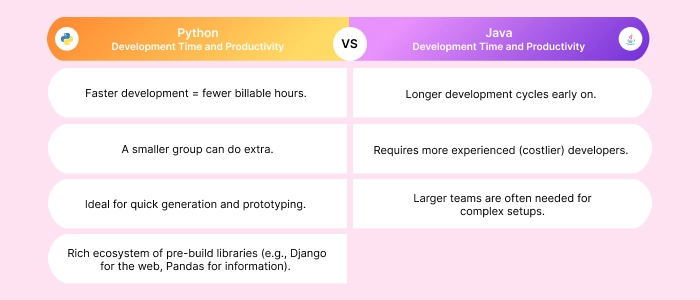
Python is cited for its developer-friendly syntax, fewer lines of code, and ease, making it a notable preference for growing an MVP.
Why is Python cost-effective initially?
- Faster development = fewer billable hours.
- A smaller group can do extra.
- Ideal for quick generation and prototyping.
- Rich ecosystem of pre-build libraries (e.g., Django for the web, Pandas for information).
For early-stage startups, this means you may launch faster, check sooner, and pivot inexpensively.
Java: Slower Start, but long-term Payoff
Java needs a more advanced setup and stricter structure, which could gradual down initial Java development. However, this area regularly outcomes in extra solid, maintainable codebases in the end.
What does this mean for cost?
- Longer development cycles early on.
- Requires more experienced (costlier) developers.
- Larger teams are often needed for complex setups.
Java’s structured nature adds cost early but reduces chaos and rewrites later.
2. Hiring and Talent Costs
Python:
- Plenty of developers, including freshers and freelancers.
- Affordable for early-stage startups.
- Popular amongst fact scientists, internet developers, and automation specialists.
- Great for building lean, multi-skilled teams.
Java:
- Highly skilled enterprise developers but usually at a premium.
- Larger talent pool for backend or Android app dev.
- Often more expensive due to specialisation.
- Common in fintech, banking, and large-scale SaaS structures.
Python developers are generally easier and cheaper to hire for generalist roles. Java developers are costlier but experienced in managing complexity.
3. Maintenance & Codebase Management
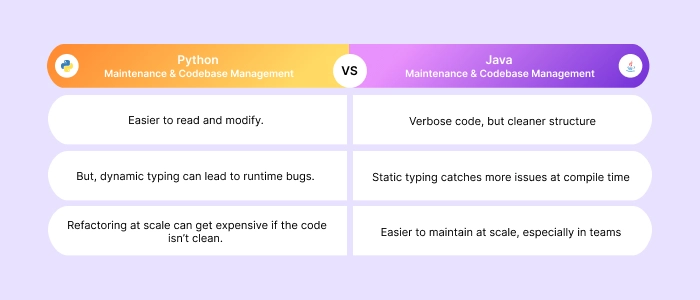
Python:
- Easier to read and modify.
- But, dynamic typing can lead to runtime bugs.
- Refactoring at scale can get expensive if the code isn’t clean.
Java:
- Verbose code, but cleaner structure
- Static typing catches more issues at compile time
- Easier to maintain at scale, especially in teams
Long-term maintenance costs are often lower in Java because of better code discipline and tooling.
4. Infrastructure, Performance & Scaling Costs
Python:
- Lightweight and cost-effective to deploy for small to mid-sized applications.
- But it requires more server resources under heavy load (due to slower runtime).
- May want more equipment (e.g., Redis, Celery) to address overall performance bottlenecks.
Java:
- More memory-heavy at the start.
- But optimised for high-performance applications.
- Excellent for multi-threaded environments, making scaling smoother.
- Often used with strong infrastructure (e.g., Kubernetes, Docker Swarm).
While Python can also save money early, Java’s overall performance can reduce infrastructure fees as your user base grows.
Real Startup Case Studies: Python or Java in Action
There’s no better way to understand the impact of a programming language choice than to look at how real startups have built and scaled their products. Let’s explore how some well-known companies used either Python, Java, or both and why.
Startups That Chose PYTHON
- Instagram:
When Instagram began, their crew desired to move speedy and iterate speedy. Python’s clean, readable syntax helped them construct a full-featured MVP with fewer lines of code and in much less time.
The Result: As they scaled, they continued to rely upon Python with the help of Django and different performance-boosting equipment. Even nowadays, Python powers a lot of Instagram’s backend offerings.
- AirBnB:
Airbnb originally used Python to quickly build and iterate on their booking platform. It allowed their small team to experiment with features while keeping Python development fast and flexible.
Later shift: As they grew, they adopted services written in Java and other languages for better performance and scalability in certain areas.
- Pinterest:
Pinterest used Python with Django to rapidly develop and test features during their growth phase. The flexibility allowed them to pivot speedy and construct a unique discovery experience.
The Result: Today, Pinterest makes use of a polyglot structure that includes Java and Go, relying on the project.
Startups That Chose JAVA
- Java:
Java offered the scalability and performance they needed to build a robust professional networking platform. Java’s sturdy multi-threading abilities and JVM performance are suitable for their organisation-grade dreams.
The Result: Java remains at the coronary heart of LinkedIn’s backend, assisting power its huge information processing and data systems.
- Spotify:
Spotify makes use of Java for most of its backend services, specially the ones requiring concurrency, real-time facts streaming, and overall performance optimisation.
Bonus Insight: They also use Python for statistics technological know-how and analytics, showcasing a multi-language surroundings that leverages the strengths of each.
- Twitter:
Twitter switched from Ruby on Rails to Java for its backend offerings to deal with important scalability and reliability demanding situations. Java helped them handle massive traffic loads and maintain system stability.
The Result: Java played a major role in helping Twitter scale into a global platform.
Which Language is Best for Your Startup?
Revealing the truth that both Python and Java can be the “right” choice. It simply depends on where your startup is in its development and what you’re creating.
Choose Python if:
- You’re building an MVP or prototype and need to move fast
- Your team is small or includes junior developers
- Your app involves AI, automation, or lots of data analysis
- You want quick iterations, early user testing, and market feedback
Examples: A Gen-Z-focused mobile app, a creator tool, a chatbot SaaS, a mental wellness tracker
Choose Java if:
- You’re targeting long-term scalability or enterprise clients
- Your product involves real-time processing or large user bases
- Security, reliability, and multi-threading are key
- You have access to skilled backend engineers
Examples: A FinTech platform, B2B SaaS for HR/payroll, EdTech LMS, healthcare app
Many startups now adopt polyglot programming they use Python for speed (like analytics, ML, or internal tools), and Java for core systems that need to scale securely. You do now not need to commit to one for the relaxation of your life. Choose what works for you proper now, after which evolve as your startup grows.
Choosing the right startup programming language can be overwhelming.
Contact us to get expert advice on the best language for your startup in 2026
Conclusion
There’s no absolute winner in the Python vs Java debate; all of it depends on your startup’s stage, group, desires, and vision.
If you’re in the early days of product discovery, Python permit you to circulate rapidly, check ideas, and pivot without friction. It’s novice-friendly, wealthy in libraries, and perfect for building MVPs that impress customers and investors alike.
But as you develop and your startup begins to deal with extra users, steady touchy records, or scale globally, Java shines with its robust structure, overall performance, and long-term reliability.
- Choose Python in case you value speed, simplicity, and agility.
- Choose Java if you want scalability, structure, and protection.
- Or use both, many startups integrate Python for the front-facing services and Java for core structures.
Startups succeed now not just due to the language they use, however because of the readability in their picks. So make yours wisely, knowing your tech stack has to assist your product, no longer the other way round.
Whether you’re constructing the next unicorn or your first side task, pick the equipment that passes you forward nowadays and grows with you the next day.
FAQ’s:
1. For what sort of web app development is Java best?
Java is best for large-scale, secure, and high-performance web apps like banking platforms, enterprise SaaS, and e-commerce systems that require scalability and stability.
2. Is .NET suitable for developing desktop applications?
Yes, .NET is great for building desktop applications, especially on Windows. It offers powerful tools like WPF and WinForms for rich UI and smooth performance.
3. Can Python be used for game development?
Yes, Python can be used for simple 2D games using libraries like Pygame, but it’s not ideal for high-end 3D or performance-heavy gaming compared to C++ or Unity.
4. Which language is better for artificial intelligence and machine learning?
Python is the top choice for AI and ML due to its simplicity and powerful libraries like TensorFlow, PyTorch, and scikit-learn.
5. Which is best, Python or Java?
It depends! Python is best for fast development and AI projects, while Java is better for performance-heavy, scalable apps. Choose based on your project needs.


 Shaili Gupta

 Ajay Wadne