Business automation is one of the “nice-to-have” features that modern organisations had a few years ago; nowadays, it has become the core business strategy of these companies. Essentially, companies are being forced to operate at a fast pace, minimise errors, reduce expenses and provide after that, seamless customer experiences. Technology is the solution here.
Automation, which is a very low and time-consuming task in general, is the one that is responsible for the abolition of these tasks so that the workforce may address the tasks that have high value, like innovating, decision-making, and business expansion. The transition from just simple task automation to the present AI-driven automation capable of thinking, learning, and adapting is the evolution of the case.
Automation in 2025 means far more than just copying human activities on a display. It calls for creating systems that are capable of comprehending data, adjusting to variations and, in fact, making choices with very little human intervention. As companies become increasingly digital, the old automation methods by themselves cannot suffice anymore. This has led to the rise of more advanced approaches such as Robotic Process Automation (RPA), Intelligent Process Automation (IPA), and the latest evolution, Agentic Process Automation (APA).
Whereas RPA is limited to the automation of rule-based and repetitive tasks, IPA extends the concept by integrating AI with automation. By utilising advanced technologies such as machine learning and natural language processing, intelligent process automation systems are capable of processing unstructured data, getting the gist, and enhancing themselves continuously.
APA goes a step beyond both by introducing autonomous, goal-driven systems. Often referred to as agentic AI process automation, APA enables software agents to plan actions, make decisions, and adapt dynamically, much like a digital team member working toward a business goal.
With so many automation models available, businesses often struggle to understand which approach fits their needs. Should they invest in traditional RPA tools, adopt intelligent process automation software, or explore advanced agentic process automation services offered by leading providers?
In this blog, we will break down APA, RPA, and IPA in simple terms, explain how they differ, and help you understand where each one fits in the modern automation landscape. Whether you are exploring agentic process automation tools, evaluating intelligent process automation services, or simply trying to future-proof your operations, this guide will give you a clear and practical starting point.
What is Robotic Process Automation (RPA)?

Robotic Process Automation is a technique that employs software bots to imitate human activities in digital systems. Those bots in effect use the same steps as a human would – they click buttons, enter data, copy information, and move from one system to another. The most significant aspect of RPA is that it strictly follows the rules set out. It doesn’t “think” or “learn” by itself.
RPA is being extensively employed to lift the heavy, monotonous, and repetitive tasks of large volumes that have a consistent logic from humans. For this reason, it is usually positioned as a stage preceding intelligent process automation or agentic process automation, which need deeper intelligence and decision-making abilities.
How RPA Works?
RPA works by observing and replicating human actions within software systems. A bot has a workflow that essentially serves as the instruction manual detailing the steps to be taken, the sequence of the steps, and the conditions. After deployment, the bot carries out these steps automatically without the need for a human.
For example, an RPA bot can:
- Log in to enterprise applications
- Extract data from emails or spreadsheets
- Validate information based on set rules
- Enter data into another system
- Generate reports and send notifications
Generally, RPA bots are considered to perform operations on systems through the user interface (UI); however, there are contemporary implementations that may utilise APIs if they are available. In this way, RPA is highly adaptable, as it can still function with old systems that have not been automated.
Core Characteristics of RPA
RPA has a few defining characteristics that set it apart from more advanced automation models:
- Rule-based execution: RPA follows strict “if-then” logic and cannot handle ambiguity on its own.
- Structured data dependency: RPA is most effective when working with structured data like spreadsheets, databases, and fixed-format forms.
- Non-invasive integration: Since RPA does not need system changes, it can be a quick solution in terms of deployment.
- Scalability: It is quite easy to increase or decrease the number of bots according to the volume of work.
- Quick ROI: Companies can experience the effects of their investments in a shorter period than with complicated automation solutions.
What is Intelligent Process Automation (IPA)?
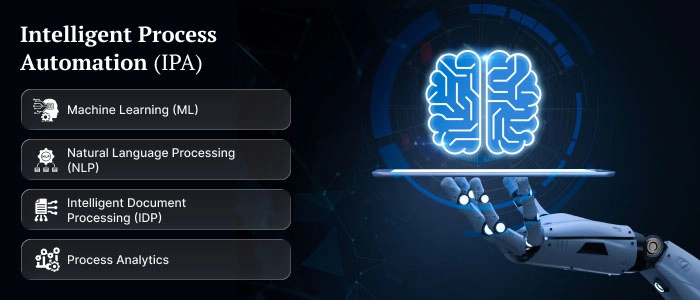
A next-level automation approach called IPA combines RPA with AI-based technologies. Where RPA is a mechanistic tool that only follows the rules set for it, IPA brings smartness to the processes. It equips machines to handle incomplete data, identify trends and provide logical answers to new situations.
Basically, IPA is an automated system that thinks. It is not a rivalry with RPA; rather, it is a progression. A majority of contemporary intelligent process automation platforms have RPA bots as the performance layer, while AI solutions takes care of the comprehending, learning, and deciding processes.
How IPA Extends RPA?
While RPA is great at completing repetitive chores, it has difficulties when data is inconsistent or when decisions are not clear. IPA extends RPA by adding intelligence to these automated workflows.
For example:
- RPA can extract data from a fixed-format form.
- IPA can read and understand the data present in emails, PDFs, scanned documents, or chat messages.
- With the help of AI models, IPA allows bots to manage exceptions, change according to variations, and increase their accuracy gradually. As a result, iPA, powered intelligent process automation solutions, become highly attractive to companies that have to manage complicated and data-intensive operations.
Core Technologies Behind IPA
Automation and AI technologies are driving IPA. Automation and AI drive many of the processes involved in IPA, including:
- Machine Learning (ML): Allows systems to get smarter from existing data, and therefore make better decisions.
- Natural Language Processing (NLP): Enables bots to understand human language in documents, emails, and in conversation.
- Intelligent Document Processing (IDP): That extracts and validates data from unstructured documents.
- Process Analytics: It scans for bottlenecks and optimisation potential in processes.
Collectively, these technologies change automation from script-based automation into practical process automation software capable of addressing real-life business complexity.
What is Agentic Process Automation (APA)?
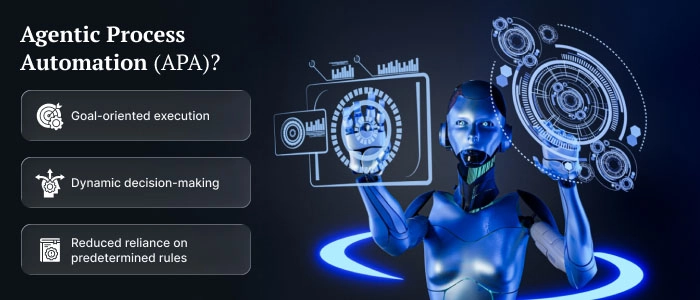
Agentic Process Automation (APA) is a sophisticated automation technique wherein autonomous software agents are created to accomplish particular business goals with little assistance from humans. APA systems are not restricted to carrying out predetermined workflows, in contrast to RPA or even intelligent process automation. They can assess circumstances, determine the best course of action, and continuously modify their behaviour in response to results.
To put it simply, APA is automation that determines what needs to be done and how to do it. This is why APA is often associated with agentic AI process automation, in which software functions more like a proactive problem-solver than a reactive tool.
How APA Differs From Traditional Automation?
RPA and other traditional automation approaches mostly rely on defined procedures and set rules. Even though IPA is intelligent, it nevertheless follows established workflows and restrictions. APA breaks away from this model.
Here’s how APA stands apart:
- Goal-oriented execution: Rather than following precise instructions, APA agents aim for business objectives.
- Dynamic decision-making: Without breaking the process, they may respond to unexpected events.
- Reduced reliance on predetermined rules: When circumstances change, the APA adjusts rather than fails.
This distinguishes APA from typical automation and positions it as a critical enabler in complicated, rapidly changing corporate situations.
Core Capabilities & Intelligence:
The power of APA lies in its advanced capabilities, which go beyond execution and intelligence:
- Autonomy: APA agents operate independently once goals are defined.
- Context awareness: They are aware of business context, data relationships, and constraints.
- Planning and reasoning: Agents can plan their actions in multiple steps to reach goals.
- Learn continuously: Performance increases as a result of feedback and from real-world outcomes. Such functions are often provided by a mixture of AI models, analytics and orchestrating layers.
Therefore, many organisations search for dedicated agentic process automation tools and dedicated agentic process automation services to govern their complex automation landscapes.
What are the Key Differences Between RPA Vs. IPA Vs. APA?
As automation progresses, companies often find it difficult to interpret how RPA, IPA and APA are different from each other. Although all 3 are trying to get more efficient with less manual work, they’re playing at very different spots on the intelligence /adaptability spectrum. The following table dissects this tangle in an easy-to-grasp, business-friendly manner that lets you quickly discern where each model belongs in today’s AI-led automation context.
| Parameter | RPA (Robotic Process Automation | IPA (Intelligent Process Automation) | APA (Agentic Process Automation) |
|---|---|---|---|
| Basic Definition | Automates repetitive, rule-based tasks by mimicking human actions | Combines RPA with AI to add intelligence and decision-making | Uses autonomous agents to achieve goals with minimal human input |
| Level of Intelligence | Low | Medium | High |
| Decision-Making Ability | No decision-making; follows predefined rules | Makes context-based decisions using AI models | Makes independent, goal-driven decisions dynamically |
| Automation Style | Task-oriented | Process-oriented | Goal-oriented |
| Data Handling | Works mainly with structured data | Handles structured and unstructured data | Works with real-time, dynamic, and contextual data |
| Adaptability | Low; breaks if rules or UI change | Moderate; can handle variations and exceptions | High; adapts automatically to changing conditions |
| Learning Capability | No learning ability | Learns from historical data using machine learning | Continuously learns and optimises based on outcomes |
| Human Intervention | Required for exceptions and changes | Reduced human involvement | Minimal human intervention once goals are defined |
| Use of AI | No AI involvement | Uses AI technologies like ML, NLP, and IDP | Uses advanced AI for planning, reasoning, and autonomy |
| Process Complexity Handling | Simple, repetitive processes | Moderately complex processes | Highly complex, unpredictable processes |
| Workflow Flexibility | Fixed workflows | Semi-flexible workflows | Fully dynamic workflows |
| Error Handling | Stops when exceptions occur | Can manage common exceptions | Self-corrects and re-plans actions |
| Scalability | Easy to scale bots | Scales with AI models and automation layers | Scales across systems, processes, and business units |
| Integration with Systems | Mostly UI-based; limited API usage | UI + API + AI models | Full ecosystem orchestration across systems |
| Speed of Implementation | Fast | Moderate | Longer due to complexity |
| Typical Business Value | Cost reduction and efficiency | Improved accuracy and smarter automation | Strategic agility and operational autonomy |
| Common Use Cases | Data entry, report generation, and invoice processing | Email processing, document analysis, fraud detection | Supply chain orchestration, autonomous operations, IT automation |
| Dependency on Rules | Completely rule-driven | Rule-driven with AI support | Minimal reliance on fixed rules |
| Maintenance Effort | High when systems change | Medium | Lower over time due to self-adjustment |
| Best Fit For | Organisations starting automation | Businesses scaling automation intelligently | Enterprises pursuing advanced automation maturity |
| Relation to Other Models | Foundation of automation | Extension of RPA | Evolution beyond RPA and IPA |
RPA, IPA & APA in the Automation Maturity Journey
Automation is not something businesses adopt overnight in its most advanced form. It changes gradually. The majority of businesses go through several phases of automation maturity, beginning with basic job automation and working their way up to intelligent and autonomous systems.
Businesses can make better technological judgments and steer clear of investing in solutions that are either overly simple or overly complicated by knowing where RPA, IPA, and APA fit into this process.
The automation maturity path can be conceptualised as a three-stage progressive slope:
Stage 1: Task Automation with RPA
This is where most businesses start. The goal of robotic process automation soluitons is to do away with repetitive human labour. Efficiency, quicker processing, fewer mistakes, and lower operating expenses are the current objectives. RPA boosts automation confidence and produces rapid results.
Where to Use this Approach:
When a process is stable, rule-based, and repetitive, use RPA. Data entry, report creation, and system changes are ideal examples of such tasks. RPA is ideal for organisations that are new to automation or looking for fast ROI.
Stage 2: Intelligent Automation with IPA
Once basic automation is in place, organisations start facing more complex challenges. Data may come from emails, documents, or customer messages, and processes may require judgment. This is where intelligent process automation becomes essential. IPA adds intelligence to automation using technologies like machine learning and natural language processing. The focus shifts from “just doing tasks” to “understanding and improving processes.”
Where to Use this Approach:
When procedures entail decision-making, numerous exceptions, or unstructured data, use IPA. Intelligent process automation solutions that can comprehend context and learn over time are generally advantageous to businesses that handle massive volumes of documents, emails, or customer contacts.
Stage 3: Autonomous Automation with APA
The final stage is Agentic Process Automation (APA). Here, automation systems operate as autonomous agents that work toward defined business goals. APA systems plan actions, adjust to change, and make decisions on their own rather than according to strict procedures. This phase exemplifies genuine AI-driven automation, in which computers do more than just carry out commands; they continuously optimise results.
Where to Use this Approach:
Use APA when processes are complex, dynamic, and outcome-driven. Supply chain orchestration, independent IT operations, and strategic decision support are examples of enterprise-level contexts where APA excels. In order to handle high-impact, mission-critical workflows, several businesses are currently investigating agentic process automation technologies.
How To Integrate AI With Intelligent Systems?
Adoption of AI is crucial when companies are moving beyond simple automation. Better operational intelligence can enhance reliability. The goal is not simply to mechanise but to create systems that can interpret information, make decisions, and adapt to new conditions. By integrating automation into the process, a full AI-powered automation will take place, allowing companies to increase productivity and creativity at the same time.
AI adoption is important for businesses seeking to go deeper than mere automation. More intelligence at the operational level can result in more reliable. Rather than just automating, the aim is to develop systems that can analyse data and make decisions based on that analysis, also by adapting their behaviour under changing circumstances. With an automated solution to bring them in, AI-powered automation will go end-to-end, and companies can drive productivity and innovation at the same time.
Hyperautomation is a growing trend that focuses on automating as many business processes as possible using a mix of technologies. IPA and APA play a critical role in this approach.
- IPA in Hyperautomation: IPA connects RPA with AI technologies such as natural language processing and intelligent document processing. This enables companies to automate complete processes rather than discrete operations. To give their automation projects structure, intelligence, and scalability, many organisations depend on intelligent process automation software.
- APA in Hyperautomation: By introducing autonomous agents, APA advances hyperautomation. To accomplish corporate objectives, these agents keep an eye on procedures, make choices, and modify workflows in real time. This is where agentic process automation becomes a strategic advantage, allowing automation systems to work automatically rather than respond.
IPA and APA enable a layered automation environment supporting flexibility, speed, and long-term expansion when combined.
What are the Benefits and Limitations of Each Automation?
Understanding the distinctions of RPA, IPA, and APA requires a thorough review of their commercial value, limitations, and future possibilities. It is simpler to choose which automation strategy best suits your company’s current needs and where you might want to go next, thanks to the table below, which compiles all of the information in one location.
| Aspect | RPA (Robotic Process Automation) | IPA (Intelligent Process Automation) | APA (Agentic Process Automation) |
|---|---|---|---|
| Primary Business Value | Automates repetitive, rule-based tasks to improve speed and efficiency | Adds intelligence to automation for better decision-making | Enables autonomous, goal-driven business operations |
| Key Benefits | • Faster task execution • Reduced operational costs • Quick return on investment | • Handles structured and unstructured data • Learns from patterns over time • Improves accuracy and process quality | • Autonomous decision-making • Highly adaptable to change • Drives strategic business outcomes |
| Type of Work Best Suited For | High-volume, predictable, and stable processes | Complex workflows involving data interpretation | Dynamic, unpredictable, and outcome-focused processes |
| Level of Intelligence | modest | average | top |
| Data Handling Capability | Structured data only | Structured and unstructured data | Real-time, contextual, and evolving data |
| Adaptability | Very limited | Moderate | Very high |
| Human Intervention Required | Frequent, especially during exceptions | Reduced but still required | Minimal once goals are defined |
| Common Challenges | • Cannot handle exceptions well • High maintenance when systems change • No learning capability | • Requires quality data • Higher implementation effort • Needs AI expertise | • Complex design and governance • Higher upfront investment • Requires strong oversight |
| Implementation Complexity | Low | Medium | High |
| Cost of Adoption | Low | Medium | High |
| Scalability | Easy to scale bots | Scales with AI and automation layers | Scales across enterprise systems and functions |
| Typical Use Cases | Data entry, invoice processing, report generation | Email processing, document analysis, fraud detectio | Supply chain orchestration, autonomous IT operations |
| Role in Automation Strategy | Entry point to automation | Expansion into smarter automation | Advanced stage of automation maturity |
| Future Outlook | Will remain a foundational execution layer | Rapid adoption through intelligent process automation software | Growth of autonomous enterprises using agentic process automation services |
| Strategic Impact | Operational efficiency | Process intelligence and optimisation | Business agility and competitive advantage |
How to Choose the Right Model in Automation?
Several pragmatic considerations influence the choice of automation strategy:
- Level of process complexity: If workflows are complex and unpredictable, IPA or APA is required, but the more repetitive the processes, the better RPA is.
- Type of data: Intelligent or agentic automation would be required for unstructured and real-time data, and RPA is a good fit for structured data.
- Business objectives: Cost savings point to RPA, productivity and accuracy towards IPA, agility and autonomy toward APA.
- Maturity in automation: RPA is the logical starting point, and this evolves to intelligent process automation software as they scale even more advanced agentic AI-based process automation.
Many businesses use a hybrid strategy, using APA for strategic operations, IPA for more intelligent workflows, and RPA for fundamental jobs. Businesses can increase automation capabilities without interfering with current systems thanks to this tiered approach.
Conclusion
Business automation has come a long way from simple rule-based bots to intelligent systems and now to autonomous, goal-driven agents. RPA, IPA, and APA are distinct phases of the same automation process rather than rival technologies, as this blog has demonstrated. At varying degrees of business maturity, each one provides value and addresses a particular issue.
RPA assists companies in getting rid of tedious manual labour, increasing productivity, and achieving immediate victories with little disturbance. IPA builds on that foundation by adding intelligence. With AI capabilities, it can understand data, manage exceptions, and support better decision-making through intelligent process automation solutions. Then comes APA, the most advanced stage where systems operate autonomously, adapt to change, and work toward business goals using agent-based logic.
What’s important to understand is that not every organisation needs to jump straight to autonomy. When their processes and data are ready, many prosperous businesses take a tiered strategy, beginning with RPA, growing into intelligent process automation services, and then progressively investigating agentic AI process automation. This well-balanced development maximises long-term value while lowering risk.
Businesses that make careful investments in selecting the appropriate tools, timing, and partners will be in the greatest position to grow as automation continues to advance. The secret is to match automation with actual business objectives, whether you are investigating agentic process automation services for enterprise-wide transformation or assessing intelligent process automation tools for improved processes.
FAQ’s:
1. What is the main difference between RPA, IPA, and APA?
RPA automates repetitive, rule-based tasks, IPA adds intelligence using AI to handle complex data, and APA enables autonomous, goal-driven automation with minimal human intervention.
2. Is RPA still relevant when IPA and APA exist?
Yes, RPA remains highly relevant as it forms the foundation of automation and is ideal for stable, high-volume tasks that do not require decision-making.
3. When should a business move from RPA to IPA?
Businesses should consider IPA when processes involve unstructured data, frequent exceptions, or require contextual understanding and smarter decision-making.
4. Is Agentic Process Automation suitable for all organisations?
No, APA is best suited for mature enterprises with complex, dynamic processes and strong governance in place, as it requires higher investment and planning.
5. Can RPA, IPA, and APA be used together?
Yes, many organisations use a hybrid approach where RPA handles execution, IPA adds intelligence, and APA manages autonomous decision-making across processes.


 Ajay Wadne