

Generative AI has become one of the most talked-about technologies, and all for good reasons. It is transforming how people work, learn and create, like generating images with generative fill AI to writing code, music, films, and marketing content in seconds.
First off, what really sets generative AI apart is the ability to create completely new content instead of just processing existing data. It’s a significant move forward to a whole class of AI systems that can merely categorise, predict, or suggest.
Over 45% of businesses worldwide began experimenting with generative AI technologies in 2024 alone, and industry analysts predict that the market will reach $1.3 trillion by 2032.
The technology is almost everywhere, as it is a perfect combination of creativity and automation, and its influence can be easily traced in any industry. The content creation is made fast by AI-powered tools, allowing businesses to save a significant amount of time and money. For example, creators can now quickly turn music into engaging visuals using tools like the Freebeat lyric video maker, which automatically generates lyric-based videos for marketing or social media.
Developers receive assistance from generative AI in writing code, and customer interactions become more pleasant due to the employment of efficient virtual assistants. Even end-users gain from AI-powered search, personalised buying journeys, and automatically generated summaries on their gadgets.
For companies, the next stage of digital innovation is built on generative AI, which is more than a fad. It allows organisations to operate faster, decrease costs, and unlock concepts that were difficult to attain before. And when more companies put money into the development of generative AI, it will be one of the most fascinating technological revolutions of the decade in the end.
Unlock creativity but face slow innovation?
Accelerate breakthroughs with generative AI
What is Generative AI?
Generative AI is no different from the word you know for artificial intelligence that generates materials. It is a set of technologies that focus on creating entirely new content, rather than just analysing or organising existing data.
Generative AI identifies the trends in the big data sets and then uses the learned concepts to make new things. It can be any of the following: text, images, sounds, videos, computer programs, product designs, or even artificially generated data. If you’ve used generative fill AI in design tools, or seen AI-written scripts, AI-generated images, or AI-assisted coding, you’ve already witnessed this technology at work.
Generative AI is based on deep learning models as LLMs, diffusion models, and generative adversarial networks (GANs). These algorithms are trained on billions of data points, allowing them to emulate human inventiveness with amazing accuracy. It’s more than just an improvement; it’s a new manner of producing.
Generative AI goes far beyond chatbots or simple text tools. Powered by open-source AI models, today it can produce. Today, it can produce:
- Text: articles, stories, reports, SEO content, scripts
- Images: product designs, concept art, branding visuals, design templates
- Code: debugging, code generation, automation for developers
- Audio & Music: voiceovers, podcasts, sound effects
- Videos: animations, marketing videos, 3D visuals
- Data: synthetic datasets for training machine learning models
- Design Solutions: UI mockups, shadcn templates, prototypes
How GenAI is Different From Traditional AI?
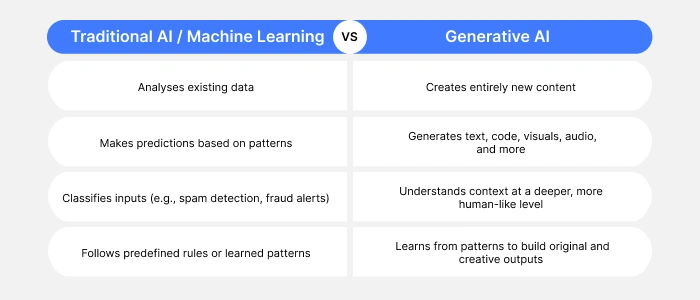
This shift from “understanding data” to “creating content” is exactly why businesses actively explore generative AI development and why every leading generative AI development company now offers specialised generative AI development services. Here’s a simple comparison to make it clear:
| Traditional AI / Machine Learning | Generative AI |
|---|---|
| Analyses existing data | Creates entirely new content |
| Makes predictions based on patterns | Generates text, code, visuals, audio, and more |
| Classifies inputs (e.g., spam detection, fraud alerts) | Understands context at a deeper, more human-like level |
How Does Generative AI Work?
Knowing how the Generative AI operates may seem to be a very complex matter initially, but after a little analysis, it turns out that it is based on a very simple principle: such systems accumulate knowledge by analysing huge volumes of data and then use this knowledge to generate something original.
Generative AI is powered by:
- Machine Learning: Allows the model to discover data patterns, such as the normal flow of phrases or the arrangement of photographs.
- Deep Learning: Uses multi-layer neural networks to simulate the human brain. These networks learn complex relationships, making generative models more accurate and creative.
Together, ML and DL allow Generative AI systems, whether built by a generative AI development company or integrated into everyday apps, to “understand” context rather than just memorise data.
Generative AI is able to learn from large data sets that can be diverse in nature, such as text, images, audio, video, or even code. The model sees millions of examples during its training, which enables it to figure out the patterns like syntax, tone, structure, visual styles, and logical linkages.
The richer and diverse the data, the better the model understands context, which is why every generative AI development business now prioritises high-quality datasets to ensure the output seems genuine and human-like.
What makes Generative AI truly special is that it doesn’t simply “remember” or copy what it has seen. Instead, it uses probabilities to predict what should come next. If it is completing a sentence, it chooses the most likely next word. it is generating an image, it decides how each pixel should appear based on the style it learned.
If it is writing code, it predicts the next logical function or line. This prediction-based mechanism is exactly why generative AI for software development can build clean, efficient, and original programs without being told every step.
These models appear human-like because they operate on millions of parameters that capture relationships between ideas. They understand context deeper than traditional AI, adjust tone and style, and replicate the natural flow of language, visuals, or logic.
Generative AI observes patterns → calculates the probabilities → produces something new that “fits” naturally.
What are the Key Generative AI Models and Techniques?
Generative AI refers to a set of leading-edge models and methods through which machines are enabled to produce content of any kind. In order to pick the finest generative AI tools or a development company, knowing the basic principles that propel the technology is indispensable.
1. GAN’s:
Generative Adversarial Networks, or GANs, were one of the first achievements that demonstrated how strong Generative AI might be. They work on the concept of two neural networks competing in a game.
- One is the Generator, which attempts to generate fresh content such as photographs, movies, and even artwork.
- The Discriminator, on the other hand, oversees inspecting the material and determining if it is genuine or fabricated.
You may see the Generator as a student trying to make a painting, and the Discriminator as an art critic looking for defects. After every iteration, they both get better. The Generator gets to produce more lifelike results, and the Discriminator gets better at finding errors. Over time, this rivalry pushes the system to produce incredibly lifelike content.
GANs are to blame for some of AI’s most memorable “wow moments”. They can make hyper-realistic human faces, restore old photographs, improve low-resolution images, generate new artwork, and even generate synthetic datasets to help train other AI systems. They are also the technology underpinning deepfakes, which, while controversial, demonstrate how well GANs resemble reality.
Where GANs are commonly used:
- Creating realistic human faces that don’t exist
- Image-to-image translation (e.g., turning sketches into colored images)
- Improving image resolution (super-resolution)
- Deepfake video creation
- Style transfer and creative design
- Generating training data for machine learning models
In essence, GANs are one of the most fascinating and influential generative AI techniques. Their ability to learn the nuances of real-world data and then recreate it with astonishing accuracy is one of the key reasons why generative AI development is increasing across industries.
2. VAEs:
Variational Autoencoders, commonly known as VAEs, are one of the most exciting generative AI techniques since they focus on developing variants of existing information rather than providing wholly random outputs. Unlike classic models that merely remember data, VAEs learn how to compress information into a simplified form, almost like packing an entire image into a tiny digital suitcase. The latent space, a compressed representation, aids the model in comprehending the underlying characteristics of the input.
What makes VAEs special is their ability to reconstruct the original content from this compressed version. In this reconstruction step, the model doesn’t just copy the input; it learns how to recreate the data using a blend of probability and learned patterns. As a result, the system becomes capable of developing unlimited versions of the same concept. A VAE trained on handwritten digits, for instance, can produce new handwritten styles that are authentic-looking but never appeared in the training set.
VAEs understand structure at a deep level; they are widely used in generative AI development and design-focused applications. Businesses use them for tasks such as:
- Image generation, where VAEs create new visuals with subtle variations
- Anomaly detection, by spotting when something doesn’t fit the usual pattern
- Product and UX design, generating quick prototypes or concept variations
VAEs act like creative digital artists; they learn the essence of something and then come up with new ideas that feel familiar yet original. This creative flexibility is what makes VAEs an important tool in many generative AI development services today.
3. Large Language Models (LLMs):
The biggest developments in generative AI today are powered by massive language models. These models, which are constructed on transformer-based architectures, are trained on enormous datasets that may include research papers, books, articles, websites, code repositories, and more.
They learn from trillions of words, and they develop a very profound understanding of language patterns, sentence structure, tone, and even the smallest characteristics of human communication.
What makes LLMs so effective is their capacity to not merely identify patterns but generate totally new ones. Once trained, they can write language that feels genuine and human-like, ranging from short replies to long-form explanations. This is why LLMs serve as the foundation of many modern generative AI development services.
They can write emails, draft articles, generate clean and functional code, summarise long documents, answer complex questions, and even maintain a conversation with proper context, something traditional machine learning models were never designed to do.
Another major strength of LLMs is their ability to understand context, tone, and intent. They don’t simply match keywords; they interpret meaning based on everything that came before. can answer with particular sector knowledge, change their manner, or explain concepts in simpler terms thanks to this contextual intelligence. That means a whole lot of new possibilities can open up for businesses – AI-powered assistants, automated workflows, smart chatbots, and productivity solutions, to name a few.
LLMs are the most widely used generative AI tools across industries. They power chatbots, coding assistants, customer support platforms, content creation systems, and countless enterprise applications. Their ability to integrate smoothly into software makes them the go-to choice for any generative AI development company working on AI-driven products.
4. Diffusion Models:
Diffusion models are arguably the biggest breakthrough in Generative AI to date, particularly in the domain of visual content creation. So, if you came across ultra-realistic AI-generated images on a platform like Midjourney, Adobe Photoshop’s Generative Fill, or any other tool that converts your rough sketches to photorealistic visuals, then most probably a diffusion model was there, working its magic.
They first take an image and gradually add random noise to it, imagine static slowly covering a photo. Then, during training, the model learns how to reverse that noise step by step. Over time, it becomes incredibly skilled at turning random noise back into meaningful visuals. This “reverse-engineering of noise” allows it to generate new images from scratch that are crisp, detailed, and highly realistic.
What makes diffusion models so powerful is their ability to capture very fine details like lighting, texture, shading, skin tones, reflections, and even artistic styles. This is why the latest generative AI tools using diffusion technology feel almost magical. They don’t just recreate images; they generate artwork that can rival human-created designs.
Compared to earlier models like GANs, diffusion models offer much more stability and control. GANs often battled with distortions or inconsistent outputs, while diffusion models are significantly more predictable and stable. This is a major factor in their current dominance in generative AI development and its widespread adoption in platforms that require photorealistic, high-quality output.
Key reasons diffusion models are trending:
- Produce stunning, photorealistic results.
- Offer better consistency than GANs.
- Used heavily in design, gaming, marketing, and creative industries.
- Power features like Generative Fill AI, sketch-to-image tools, and concept art generation.
5. Other Emerging Generative Architectures
New models continue to emerge as companies invest in advanced generative AI for software development. Some fast-growing techniques include:
- Transformers for multimodal AI (text + image + audio).
- Neural Radiance Fields (NeRFs) for 3D scene reconstruction.
- Reinforcement learning-driven generation for adaptive creativity.
- Hybrid models combining LLMs + diffusion for precision output.
What can Generative AI do?
AI might sound like a technology from the future, but it’s already changing the way that companies evolve, consider, and manufacture. The models in question are capable of automating a wide range of tasks, such as video production and content creation; however, they also have the potential to deliver unconventional business insights related to productivity and creativity.
Here are the present capabilities of generative AI and why industries throughout the world are rapidly adopting it.
Text Generation

Generative AI models like GPT can absorb instructions and produce meaningful, organised, and contextually appropriate information. This includes writing, summarising and ideation. Businesses increasingly rely on an AI content writer to create SEO-friendly articles, marketing copy, and other high-quality content at scale. This makes generative AI solutions crucial for enterprises, especially those working with massive amounts of text.
What it can do:
- Write blogs, emails, product descriptions, ad copy, and reports.
- Summarise long documents into clear bullet points.
- Translate content across languages while maintaining tone.
- Assist in brainstorming ideas and improving writing flow.
Why it’s trending: Over 56% of companies globally now use AI tools to support content creation and customer communication.
Image Creation and Editing

Diffusion models have changed the game for image generation. It includes generative fill AI for image creation and editing. These models start with noise and turn it into a sharp image, almost like magic, but grounded in math. If your organisation uses images, generative AI development services can substantially speed up design operations.
Capabilities:
- Create photorealistic images, graphics, and product visuals from text.
- Edit existing images using generative fill AI, as seen in Photoshop’s latest features.
- Produce brand concepts, packaging designs, and illustrations instantly.
Why it matters: Designers now generate dozens of variations in minutes. Over 60% growth in AI image-editing tools was recorded in the past year alone.
Code Generation

Generative AI is becoming an assistant for developers worldwide. It is very helpful for software developers. It’s one of the most practical uses of generative AI for software development today, and a structured Generative Ai For Developers approach helps teams apply it to real engineering workflows.
What it can generate:
- Code snippets in languages like Python, JavaScript, Java, and more.
- Debugging tips, documentation, and unit tests.
- Entire prototypes or backend logic with minimal input
Why developers love it: Several industry publications claim that AI coding assistance can cut development time by as much as 45%. It reduces human error, accelerates iteration, and provides real-time learning help for junior engineers.
Audio and Music Synthesis
Generative audio models can clone voices, create sound effects, transform text to speech, and even make unique music.
What it can do:
- Create studio-quality voiceovers for podcasts, videos, and ads.
- Generate music in various genres.
- Support accessibility tools like advanced speech assistance.
Why it’s exploding: Voice AI usage has increased more than three times (over 300%) in such sectors as entertainment and e-learning during the past two years.
Video Generation
Video is where generative AI is making some of the most jaw-dropping advancements. It is one of the fastest-growing capabilities.
Capabilities include:
- Creating short video clips from a simple text prompt.
- Replacing letters, objects, or backdrops with pixel-perfect precision.
- Generating product demos, animated explainers, and marketing videos.
Industry impact: AI-generated video is predicted to make up 10–20% of online content by 2026. Brands are already using AI videos to cut production costs by up to 70%.
Data Augmentation & Simulation
This is one of the most effective yet least discussed applications of generative AI.
What it can do:
- Artificially create datasets that reflect real-world data.
- Use to train machine learning models in cases of limited or sensitive real-world data.
- Use to simulate business scenarios (customer behaviour, demand, risk patterns, etc.).
Why it matters: It does not expose personal or confidential data while the model accuracy. An absolute must for inter alia the following industries: healthcare, finance, cybersecurity, and retail.
Multimodal Content Creation
They are multimodal, contemporary generative AI models that can process and integrate a wide range of inputs. It may comprise text, photos, audio, and video.
Use Cases:
- Create a full marketing campaign (text + images + video scripts) from one prompt.
- Understand images and describe them in natural language.
- Generate interactive product experiences.
Why it’s the future: Multimodal AI is very similar to a human as it processes visual, verbal, and emotional information. This is the basis of future generative AI tools and more intelligent assistants.
What are the Popular Applications of Generative AI?

Generative AI is not simply a buzzword anymore; it is an actual instrument that companies depend on daily. From customer service to healthcare innovation, the applications of AI are changing as companies roll out more efficient AI-powered solutions. These are some of the biggest and most talked-about generative AI applications that are being used in the real world today.
1. Customer Support & Conversational AI
Brands can use AI-driven chatbots along with virtual assistants to provide 24/7 support with fairly natural, human-like interactions. It also reduces operational costs, making it a top investment area for any generative AI development company.
2. Marketing & Content Creation
Marketers employ generative AI to come up with commercials, social media postings, scripts, and campaign concepts in a matter of minutes. Teams thus become capable of rapidly scaling their campaigns while at the same time being able to uphold consistency and quality. Marketers also combine AI-generated content with tools like QR code generator to bridge offline campaigns with instant digital engagement.
3. Software Development & Coding Assistants
With the help of generative AI, software developers can come up with cleaner code, pinpoint errors, and even generate test cases automatically. Such coding assistants are quickly turning into the standard toolkit of gen AI developers, thus facilitating teams to be able to release new products at a much faster pace.
4. Healthcare Diagnostics & Drug Discovery
AI models can comprehensively view scans, calculate the probability of various diseases, and thus supply a diagnosis that is more accurate of a human doctor. One such new technology in the pharmaceutical industry is generative AI devices that, by inventing molecular structures, shorten the period researchers have to spend on drug development, sometimes by a matter of days, months, or even years.
5. Finance & Risk Analysis
Banks and financial institutions employ generative AI in various ways, such as fraud pattern detection, credit risk assessment, and financial summary generation. AI-powered models can skim through massive datasets in a few seconds, which would take humans several weeks. Hence, the decision-making process gets better in quality, and the accuracy of compliance is increased.
6. Retail & Personalisation
Retailers invest AI when the addition of products is to be recommended, buying behaviour is predicted, and user experiences are personalised in real time. Besides, generative fill AI is capable of producing product images, lifestyle visuals, and store layouts in a very short time.
7. Education & E-Learning
Generative AI is capable of producing personalised study schedules, tests, providing the necessary help from a tutor and interactive lessons for students. The learning gets more attractive through the use of adaptive content that changes according to the learner’s speed. Colleges and research centres are installing AI-powered devices to make learning easier and to improve the students’ performance.
8. Manufacturing & Supply Chain Optimisation
AI models run supply chain scenarios, forecast disruptions, and plan inventory in a way that is most efficient. Manufacturers employ AI to recognise the onset of equipment issues, thus improving the time between production and lessening the costs of maintenance. Consequently, this paves the way for more intelligent automation and greater operational efficiency.
Why is Generative AI Redefining the Future?
New technologies like generative AI are profoundly changing the world by greatly accelerating our methods of building, designing, and innovating. The quick rate of innovation is, on the one hand, allowing businesses to stay competitive, and on the other hand, it is resulting in more occurrences of experiments across various sectors.
- Faster Innovation Cycles: With generative AI, different teams can simply think up, write code, create visuals, and test their ideas in a fraction of the time it would usually take. Such a pace adds to the businesses’ competitiveness and is, at the same time, the main reason for the rapid digital change.
- Democratisation of Creativity: Designers, writers, or developers have the privilege of creating professional-quality content just by giving a few instructions. Tools such as Midjourney and Adobe’s generative fill AI are democratising the design world by making it easy for beginners to create advanced designs. This transition attracts more people to the pool of creators as they now have the freedom to try, innovate, and realise their dreams.
- Hyper-Personalisation at Scale: With the help of generative AI, personal behaviours can be analysed, and interactions, product recommendations, and learning materials can be personalised. That’s the main reason why a lot of firms are spending on AI development services for the purpose of giving a unique experience to millions of users simultaneously.
- Automation of Complex Workflows: AI is now able to perform a wide range of tasks, such as generating reports, documenting automatically, creating visualisations, writing code, and even providing solutions for decision-making. Such abilities lessen the handwork required and get rid of those parts of the job which are repetitive and thus, are performed during operations on a daily basis.
- A Massive Boost in Productivity: Regardless of the case, i.e. marketing teams creating content or engineers employing generative AI for software development, productivity is increasing in all sectors. Consequently, employees are allowed to use the spare time for performing strategic tasks instead of being involved in the dull operation execution, which is done monotonously.
- Shaping the Future of Digital Experiences: One of the major factors that will bring about a radical change in applications, games, virtual assistants, and immersive environments is generative AI. Just to mention a few, AI-driven technologies are providing tailored customer experiences and a user-friendly educational platform. AI implementation is altering the communication process between humans and the digital world. Such enhancements are opening the doors to intelligent, user-friendly, and human-centric products.
Conclusion
Generative AI is changing the digital world at a pace that is incomparable to any technology previously. It is basically the backbone of modern innovation, as it does everything from producing texts and pictures to helping in coding and business automation.
The ability of the AI to recognise patterns, grasp context, and create completely new things is the very reason why industries such as healthcare and retail are more and more dependent on generative AI development services and advanced generative AI tools for increasing their productivity, accuracy, and creativity.
As corporations keep on installing smarter systems, the necessity of having a trustworthy generative AI development company as your partner will become higher and higher. No matter if it is through the creation of personalised customer experiences or speeding up software delivery, generative AI is the one that is driving these new levels of efficiency and innovation.
To put it simply, the future will be for the companies that get on board with this technology at an early stage and not only use it for task automation, but also for revealing completely new possibilities.
FAQ’s:
1. How does generative AI enhance creativity?
Generative AI boosts creativity by helping users brainstorm ideas, generate fresh content, and visualize concepts instantly. It acts like a creative partner that accelerates the process while offering new perspectives you may not have thought of.
2. Can AI completely replace human creativity?
No, AI can assist, inspire, and speed up creativity, but it cannot replicate human emotion, intuition, or lived experience. It enhances creativity, but the human touch remains irreplaceable.
3. What are some popular generative AI tools for creative professionals?
Designers and creators widely use tools like Adobe Firefly, Midjourney, DALL·E, RunwayML, and ChatGPT-like LLMs for idea generation, image creation, writing, and editing. These tools make creative work faster and more flexible.
4. What makes GenAI different from other AI?
Traditional AI analyses data and makes predictions, while generative AI produces entirely new content, text, images, code, audio, and more. It goes beyond detecting patterns to creating original outputs.
5. Can Generative AI be biased? How can we ensure fairness in its applications?
Yes, generative AI can inherit biases from the datasets it is trained on. Ensuring fairness requires diverse training data, ongoing model evaluations, ethical guidelines, and transparent governance practices.

