
AI in cybersecurity refers to the application of methods like machine learning, anomaly detection, behavioural analytics, and, in some situations, generative AI models to identify attacks early, automate tedious security tasks, and react almost instantly.
The complexity, automation, and frequency of cyberthreats are increasing daily. Because of AI-assisted tactics that make scam emails more convincing and harder to spot, phishing attacks have increased by more than 1,200% in 2025 alone compared to 2022.
More than 40% of cybersecurity experts are currently testing or evaluating AI tools, and nearly 30% of cybersecurity experts report that their teams currently use these AI tools for cybersecurity.
The rise of these tools is not just a trend; it’s a shift in how we defend data, networks, and users in a world where attacks evolve daily. Organisations that use these AI development services and AI tools for cybersecurity gain advantages: faster detection of zero-day exploits, better prioritisation of vulnerabilities, and more reliable defence across endpoints.
But it also raises big questions:
- “How to trust what the AI model suggests”
- “Hows to avoid wrong alerts or false negatives”
- “How to secure the AI systems themselves?”
At the same time, opponents are growing increasingly clever. To fool security systems, attackers deploy AI-powered malware, deepfakes for social engineering, and fast injection or model poisoning attacks. This means that defences, businesses, governments, and individuals must not only implement AI development but also consider resilience, transparency, ethics, and oversight.
This blog will examine how AI is transforming cybersecurity, including its potential, hazards, and the prudent and balanced use of AI development services and tools for cybersecurity by companies of all sizes. By the end, you will be able to ask appropriate questions and recognise the power of AI-powered defence.
What is AI in Cybersecurity?
“AI in cybersecurity” refers to the use of technologies such as machine learning, behavioural analytics, and anomaly detection to protect systems, networks, and data. Since AI models learn patterns from large volumes of data logs, network flows, and user behaviour rather than relying solely on predefined rules, they can detect previously unknown or suspicious activities.
As a result, security agents can identify threats earlier. Many organisations adopt AI tools for cybersecurity or engage AI development services to embed these intelligent capabilities into their security stack. Businesses also combine these tools with professional cyber security services to strengthen monitoring, incident response, and overall defence readiness.
According to a recent IBM report, companies that heavily use security AI and automation reduce breach costs by about $1.76 million on average compared to companies that don’t. The market forecast’s increasing figures demonstrate how the need for AI-driven security tools and software development is rising.
AI for cybersecurity is meant to complement human defenders, no longer to take their place. Apart from detecting unforeseen dangers including polymorphic or zero-day malware, filter noise, or false positives, the models also assist in prioritising the maximum important issues. But their strength depends on quality data, sound architecture, and constant oversight.
As we move beyond static security controls, organisations increasingly turn to AI development company offerings or internal AI development teams to build, integrate, and maintain these intelligent defences.
Why AI is Critical for Modern Cyber Defence?
Cyber threats are no longer just viruses or spam emails; they are sophisticated, adaptable, and frequently fuelled by artificial intelligence. Understanding the difference between virus and malware is fundamental to grasping the full scope of these threats. While all viruses are malware, not all malware are viruses—malware is an umbrella term that includes viruses, ransomware, trojans, spyware, and other malicious software variants. Traditional security systems struggle to keep pace. That’s where AI for cybersecurity comes in.
AI cybersecurity systems can filter millions of warnings, detect suspicious activities in real time, automate replies, and are now the foundation of modern digital protection.
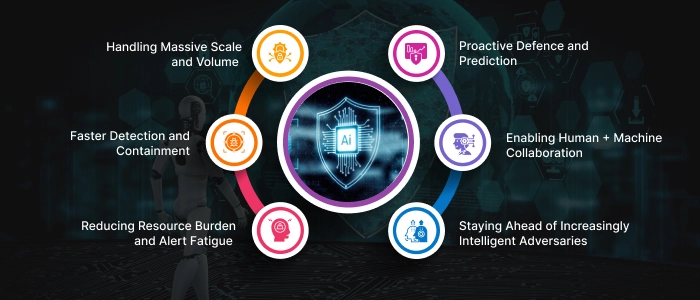
Handling Massive Scale and Volume
Every day, modern networks, cloud environments, and endpoints produce millions of events and logs. Traditional human review and static rule-based methods simply cannot keep up. AI solutions for cybersecurity assist defenders in parsing, filtering, and prioritising these signals, making sense of noise and helping them to discover what is genuinely important.
Faster Detection and Containment
Organisations using security AI and automation report significantly lower breach costs and faster response times. According to one recent data point, organisations with mature AI implementation identify and contain breaches 108 days earlier on average than those without.
Reducing Resource Burden and Alert Fatigue
Security groups are frequently overburdened with notifications, lots of which can be fake positives. AI can triage signals, doing away with low-threat ones even as highlighting excessive-priority threats. That frees human analysts to focus on deeper investigation, strategy, and improvements. In surveys, 69% of executives believe AI raises efficiency for cybersecurity analysts.
Proactive Defence and Prediction
AI can expect which vulnerabilities will be exploited, expect assault vectors, and assist in prioritising patching or defensive hardening. This forward-looking technique is closely related to exposure management, the practice of continuously scoping, discovering, and validating weaknesses across your environment before attackers can reach them. Together, these approaches form the basis of a proactive security posture that is critical in a global environment where attack methods change unexpectedly.
Enabling Human + Machine Collaboration
Rather than replacing humans, the best solution is a hybrid: AI augments human abilities by performing what machines excel at while humans provide judgment, context, and oversight. That’s why many organisations use AI development services or build internal AI development teams to integrate models into their security operations.
Staying Ahead of Increasingly Intelligent Adversaries
Attackers employ AI to automate reconnaissance, create convincing phishing, evolve malware, and deploy generative tactics. To address this, defenders should use AI as a force multiplier. In fact, more than 78% of CISOs say AI-powered threats are already impacting their organisation.
Companies that do not employ smart AI software development and security advances risk falling behind, both in terms of defence capability and regulatory or industry requirements.
What are the Core Uses of AI in Cybersecurity?
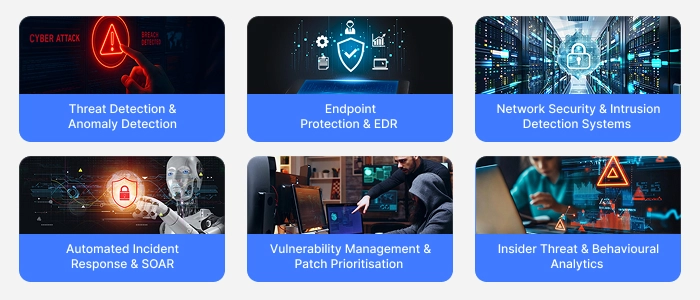
- Threat Detection & Anomaly Detection
AI models are distinguished in network traffic, system behaviour and user activity that identify unexpected patterns. Unlike traditional ruler-based systems, AI can detect zero-day attacks by deviating from already non-declared dangers from normal behaviour.
- Endpoint Protection & EDR
Attackers are focusing on modern endpoints, together with laptops, cellular devices, and servers. AI-powered EDR answers can automatically record activity, detect malware, and isolate the affected device. AI-enabled endpoint protection can drastically lessen malware harm and downtime, imparting companies with a faster and greater efficient defence mechanism.
- Network Security & Intrusion Detection Systems
AI systems examine site visitors’ metadata, patterns, and abnormalities throughout networks to detect intrusions and potential breaches. This proactive technique allows security teams to detect lateral movements, C2 communications, and anomalous scanning activities that traditional firewalls may miss. AI techniques for cybersecurity in network monitoring are becoming more important as network complexity increases in cloud and hybrid environments.
- Automated Incident Response & SOAR
AI is now powering automated response workflows, reducing the time it takes to react to security incidents. SOAR solutions can triage warnings, improve them with threat intelligence, and carry out specified response actions. This hybrid technique, which combines AI and human monitoring, ensures that accidents are resolved quickly and accurately.
- Vulnerability Management & Patch Prioritisation
Not all vulnerabilities carry equal risk, and AI algorithms help firms prioritize those most likely to be exploited. This intelligence is most powerful when paired with VAPT Tools the structured platforms that combine automated vulnerability scanning with manual exploitation testing, confirming which weaknesses are genuinely reachable and providing the evidence-based remediation priorities that security teams need to act with confidence.
- Insider Threat & Behavioural Analytics
Employees and contractors can pose considerable safety risks, both intentionally and accidentally. Artificial intelligence structures can detect insider threats via tracking behavioural style, including abnormal login times, sudden document get entry to, and unauthorised data transfers.
How Attackers Are Using AI?
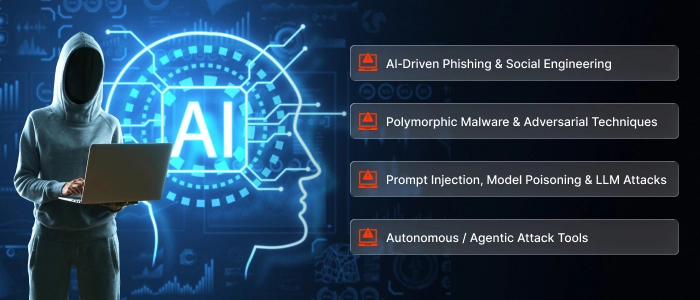
Cyber attackers are now using AI to make their attacks faster, smarter, and more deceptive. AI has grown to be a pressure multiplier in cybercrime, from growing hyper-realistic phishing emails to growing malware that could trade its behaviour on the fly.
Threat actors are even directly attacking AI systems, impacting defences with strategies like model poisoning and set off injection. To stay one step ahead of attackers in cutting-edge rapidly evolving danger landscape, corporations have to employ AI generation for cybersecurity and put money into AI development services.
- AI‑Driven Phishing & Social Engineering
Attackers use AI to generate extraordinarily convincing phishing emails and messages. By analysing publicly to be had facts and writing dispositions, AI may additionally generate emails that seem like from truthful colleagues or executives, increasing the chance of sufferers clicking on malicious links.
AI-assisted phishing attempts have surged by way of extra than 400% within the ultimate two years, highlighting the vital need for companies to use AI cybersecurity capabilities to detect and prevent complex threats. To reduce the risk, businesses should also strengthen email authentication so fake addresses are easier to detect and block. Email authentication controls like SPF, DKIM, and DMARC work together to reduce spoofing and make phishing harder to pull off. To confirm DKIM is in place you can check that your domain’s DKIM DNS TXT record is correctly formatted using the EasyDMARC dkim checker.
- Polymorphic Malware & Adversarial Techniques
Modern malware evolves fast, regularly relying on AI to dynamically trade its code, signatures, or behaviour to keep away from detection. Polymorphic malware can elude traditional antivirus systems, wanting more desirable AI-primarily based detection.
Adversarial techniques, such as feeding AI models deceptive inputs, can trick even intelligent defence systems. This creates a cat-and-mouse game where organisations rely on AI development services and AI software development to stay ahead of evolving threats.
- Prompt Injection, Model Poisoning & LLM Attacks
Attackers are targeting AI systems, specifically huge language models and automated decision-making tools. Prompt injection and model poisoning are two techniques that can have an impact on AI outputs, resulting in data breaches, false alerts, or unauthorised behaviour. Businesses are increasingly cooperating with AI development businesses to build robust AI systems that can withstand such threats.
- Autonomous / Agentic Attack Tools
AI-powered independent gear can now behavior reconnaissance, scan for vulnerabilities, and even perform assault sequences with minimal human intervention.
These agentic assault gear raise the tempo and volume of cyberattacks, leaving conventional safety features ineffectual. To successfully resist those developing threats, organisations that use AI answers for cybersecurity should combine automation and human monitoring.
What are the Challenges, Risks and Limitations of AI in Cybersecurity?
While AI for cybersecurity has huge capability for detecting and preventing cyber assaults, it isn’t always the surest. As with any mature era, it brings its own set of difficulties and dangers that businesses must identify and manage.
False Positives & False Negatives
One of the most commonplace issues with AI-driven systems is their tendency to generate false positives, flagging secure activities as malicious or false negatives, wherein proper threats slip via left out. According to IBM’s 2024 Cybersecurity Report, nearly 23% of all indicators precipitated by means of AI equipment for cybersecurity become false alarms, which can cause alert fatigue and slower incident responses. Striking the proper balance between accuracy and performance remains a central undertaking for security groups.
Explainability & “Black Box” Models
Many AI software improvement models behave like a “black box,” producing consequences without revealing how they were received. This lack of transparency may also make it hard for analysts to understand and believe AI consequences, mainly in high-hazard situations. Organisations that use AI development offerings are actually those that specialise in developing explainable AI systems, which could justify actions and enhance responsibility.
Adversarial Attacks on AI
Cybercriminals are studying a way to manipulate AI the usage of adversarial assaults, which involve quietly changing inputs or statistics to idiot device getting to know algorithms into producing wrong predictions. Attackers can create malware that evades AI-based detection by mimicking legal software behaviours. This has made AI development companies invest heavily in secure model training and threat resilience.
Data Privacy, Bias & Compliance
AI structures require large volumes of statistics to study and improve; however, that includes privacy issues. Improper fact handling can result in compliance violations under laws like GDPR or India’s DPDP Act. Moreover, biased training records can cause unfair or erroneous results, particularly in behaviour-based threat detection models. Maintaining ethical, obvious, and compliant AI practices is now a pinnacle precedence in AI development.
Resource, Talent & Cost Constraints
Implementing and retaining AI-driven cybersecurity systems needs skilled professionals, high-performance infrastructure, and non-stop monitoring, all of which may be luxurious. Smaller firms also struggle to finance such AI technology for cybersecurity; thus, it is vital to select scalable solutions and work with AI software development partners.
Looking for Healthcare Software Development Services?
We specialize in developing cutting-edge healthcare software systems for improved patient care.
What are the Best Practices and Strategic Recommendations?
To maximise the benefits of cybersecurity, companies must combine strategy, technology, and human knowledge. Using AI without structure can lead to safety holes, regulatory difficulties and even model operation. The following are some of the best exercises and strategic initiatives that companies can take companies promote their digital defence effectively.
Human + AI Collaboration
AI can system large volumes of records in seconds, but it still relies on human instinct to make the right conclusions. The most effective cybersecurity models employ the “human-in-loop” method, in which AI systems detect and automate, while human analysts assess and interpret the results. This teamwork causes rapid response time, fewer incorrect positives and more accurate risk assessment.
Frequent Retraining & Threat Intelligence Integration
Cyber threats evolve constantly. That’s why continuous retraining of AI models using fresh threat intelligence is essential. Integrating data from global threat feeds, cloud environments, and IoT devices allows AI systems to remain current and discover zero-day vulnerabilities. Regular retraining ensures that AI development services create models that are accurate and responsive to real-world occurrences.
Governance, Audit & Explainability
When using AI in important sectors like cybersecurity, openness is essential. Explainable AI, ordinary audits, and the usage of governance frameworks ensure that each AI-driven selection is tracked and supported. Companies that work with AI development companies ought to adhere to global requirements for moral AI practices that protect personal data and privacy.
Defence in Depth & Zero Trust Integration
Companies ought to adopt a Defence-in-Depth strategy that includes many layers of protection throughout endpoints, networks, and cloud environments. Integrating AI systems with Zero Trust Architecture improves resilience through constantly checking each request, tool, and consumer. Together, those concepts create a safety environment that is clever, proactive, and nearly impossible to assault.
What are the Emerging Trends & The Future of AI in Cybersecurity?
As cyber-attacks become surprising, the destiny of AI in cybersecurity seems extra dynamic than ever. Organisations are moving from using AI as a protective tool to incorporating it into proactive cyber resilience strategies. The following are the most interesting and rising tendencies influencing the subsequent phase of AI-powered safety.
Agentic & Autonomous AI Systems
The next generation of AI cybersecurity structures will function autonomously, detecting, assessing, and even neutralising threats without human participation. These agentic synthetic intelligence structures can continuously display networks for anomalies and respond quickly to intrusions.
Multi-Agent Attack & Defence Strategies
As attackers start experimenting with multi-agent AI equipment which can coordinate attacks, cybersecurity groups are also adopting multi-agent defence frameworks. These contain networks of AI models running collectively to locate, detect, and mitigate complicated threats throughout endpoints, clouds, and applications. Such systems are being developed through AI development services that combine behavioural analytics, anomaly detection, and predictive modelling to create self-learning defence ecosystems.
Generative AI in Security: Code, Patching & Deception
Generative AI is reworking how organisations approach hazard detection and response. Security groups are increasingly adopting it to automate code production, vulnerability patching, and even setting up decoy settings to tempt attackers. However, as AI fashions evolve, fraudsters are increasingly the usage of them to create polymorphic malware, making real-time risk intelligence even more crucial than ever before.
AI for Red Teaming & Adversarial Testing
Red teaming, the process of ethically mimicking assaults to test fortifications, is being transformed by AI. Machine learning models can now discover gaps in current systems, stress-test defences, and predict attack vectors. Leading AI development businesses are investing in this field to aid corporations in implementing AI-assisted adversarial testing and strengthening their systems against AI-driven attacks.
Conclusion
AI is transforming the manner we guard towards online assaults. AI for cybersecurity is being used by current security systems to detect and forestall attacks earlier than they cause harm, in preference to just reacting to them.
By automating danger responses and figuring out suspicious developments, artificial intelligence structures improve cybersecurity. AI software program improvement is likewise being used by corporations to create greater resilient safety structures which could react immediately to new threats.
Looking ahead, the destiny of AI in cybersecurity is brilliant. More autonomous structures can be developed that can make short defence decisions without requiring human intervention, as well as smarter AI that may generate steady code or stumble on network flaws in real time.
As technology evolves, AI development companies will play a key role in creating intelligent defence systems that not only protect but also predict and prevent cyber risks before they happen.
FAQ’s:
1. How is AI used in cybersecurity?
AI is used in cybersecurity to detect, forecast, and respond to threats in real time. It examines large amounts of data, detects abnormal behaviour, and assists security teams in stopping attacks before they spread.
2. Is AI a benefit or threat to cybersecurity?
AI provides both benefits and possible risks. While AI improves defence systems, hackers can also use it to launch sophisticated assaults, making ethical AI use and monitoring critical.
3. How can generative AI be used in cybersecurity?
Generative AI can mimic cyberattacks, build secure code, and create fictitious data to train security systems. It enables businesses to test and strengthen their defences before an actual hacker attacks.
4. What are the key use cases for AI in cybersecurity?
Typical applications include threat detection, fraud prevention, network monitoring, phishing detection, and automated incident response. AI tools for cybersecurity also help to reduce human error and improve response times.
5. What are some of the best practices for AI in cybersecurity?
Regularly retrain AI models, incorporate real-time threat intelligence, maintain human oversight, and provide openness in AI decision-making. Combining AI development services and expert governance promotes security and trust.
6. How can organizations ensure AI ethics in cybersecurity?
Organizations should deploy AI models that are explainable, adhere to data privacy regulations, and include human review of crucial choices. Ethical AI use promotes accountability and prevents prejudice in security systems.

 Shaili Gupta

 Ajay Wadne
