

Are you fed up with standing in the queue for long hours? Have you missed the last date for submitting your bank details? And many others have similar questions.
With the advent of digital transformation in the banking and financial sectors, it illuminates all the traditional banking problems and gives us the most unified banking software development solutions which are likely to boost the demand in the market.
For instance, as per a report published on Digital Banking Market size was valued at USD 10.9 trillion in 2023 and it is estimated to register a CAGR of over 3% between 2024 and 2032. Keep reading this blog to stay updated with the latest digital transformation trends in banking.
What Is Digital Banking?
Digital banking or online banking in simple words means accessing banking features and services with the help of your bank’s website or application from your computer or mobile — much like how courier websites allow customers to manage deliveries online. In layman’s terms, digital banking is a broad term that refers to providing services to customers that were previously available only at a bank branch.
Looking to Hire a Banking APP Developers?
We help companies to provide top-notch solutions to develop banking apps which integrate all your specific business needs.
What Are The Benefits of Digitization In Financial Services?

Nowadays many numerous industries such as healthcare, software, chemicals, and others are using digitized solutions that help to increase productivity and better customer experience. Like with most industries, digital transformation are delivering the large impact on financial services which are as follows:
1. Increasing Efficiency: The Digital tools are created to enhance the workflow more efficiently such as by saving manual-time work. Relying on such solutions helps financial institutions and employees to improve their productivity and improve focus on value added tasks.
2. Better Security: With the integration of finance automation tools, it helps to reduce the chances of malware and ransom attacks, while ensuring proper accounting for liabilities
and compliance with financial regulations. As in the financial industry, the protection of identity thefts and personal information are very common.
3. More Customer-Satisfaction: Digital tools are very convenient and friendly when it comes to usage for the consumers, many financial companies are investing in developing solutions oriented software tools to enhance customer experience and solving the queries in no-amount of time.
4. Deep Understanding and Analysis: Financial services providers especially large enterprises have access to handle large amounts of data. With the integration of this solution, it helps the organizations to unlock new business opportunities and make informed decisions. Staying updated with the latest market news is key to maximizing these opportunities
Read More Related Blogs
Key Factors Driving Digital Transformation in Banking
A central digital shift is being witnessed in the banking industry. Banks use technology enhancements in customer experience, security enhancements, and streamlining operations. Following are some of the major driving forces of digital transformation in banking:
1. Customer Expectations
Today, customers demand fast, seamless, and personalized banking experiences. They want to access banking services anytime, anywhere, with their phones or computers. In response to this expectation, banks invest in mobile apps, AI chatbots, and self-service.
2. Technological Advancements
Emerging technologies such as AI, blockchain, and cloud computing have significantly transformed the banking industry’s services. AI assists in fraud detection, personalised recommendations, and automated customer support. Blockchain technology strengthens transaction security and transparency, while cloud computing enhances efficiency and scalability of operations.
3. Security and Compliance
With the increase in the threat of cyber attacks, banks must ensure secure systems. Digital transformation has come with cybersecurity advancements, biometric authentication, and data encryption capable of protecting customer data. Regulatory compliance has also become a significant issue within banks to ensure adherence to government rules and industry standards.
4. Competition from Fintech Companies
The emergence of fintech start-ups has altered the face of financial services with novel solutions. Traditional banks have begun adopting digital solutions and engaging fintech firms in partnership while offering digital-only services to keep themselves afloat.
5. Cost Efficiency And Operational Improvement
Automation and digital banking cut operational costs by minimizing manual processes. AI-enabled chatbots, RPA, and digital document management improve efficiency for banks, saving time and money.
6. Data-Driven Decision Making
Banks gather vast amounts of data related to customers. By utilizing data analytics and AI, banks can gain valuable insights into customer behavior, enhance their service offerings, and design focused financial products.
7. Contactless and Cashless Payments
The rising preference for digital payments has only fast-tracked the push for cashless transactions. Banks have been introducing improved digital payment platforms, integrating with digital wallets, and supporting QR code payments that enable hassle-free and safe transactions.
What Are The Challenges Faced By Banking Services?
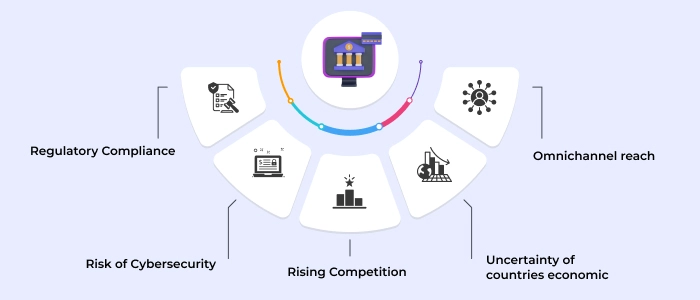
High installation cost and maintenance of digital software technology led to heavy investment for the large as well as small and medium enterprises. Many manufacturers are working towards reducing its costs and providing cutting-edge solutions. There are numerous challenges faced by banking services such as:
1. Regulatory Compliance: One of the biggest challenges, banks must comply with various regulations, from anti-money laundering (AML) to data protection laws. The organizations need to comply with the latest norms and policies which can be time consuming and can also affect profitability.
2. Risk of Cybersecurity: As financial services and banks become digital, they are a;so vulnerable to cyber attacks, many banks are partnering with cybersecurity firms to develop robust security systems.
3. Rising Competition : The banking industry and financial industry are facing growth in the competition from digital players such as digital banks and fintech startups. These digital banks provide better innovative products and services compared to the traditional banks.
4. Uncertainty of Countries Economic: Due to the political instability and trade tensions between the world countries could lead to create economic uncertainty. Such factors are the reason to create a negative impact on the banking industry as it may reduce the number of demands for financial loans and services.
5. Omnichannel Reach: By interacting online, you eliminate any unnecessary stages in the process such as the introductory small talk that is part and parcel of in-person interactions. In one survey, only as per the survey conducted, theri are 16% consumers are satisfied by the integration of digital experience in finance institutions.
Read More Related Blogs
Top 5 Impacts of AI in Banking to Redefine Customer Experience
How Digital Technology is Advancing Financial Service?
One of the two major solutions such as Blockchain and cloud technology are transforming finance by providing clarity and transparent transactions. The technology’s decentralized design promotes secure personal data and sensitive information.Here are some technology and the solutions which are stated below such as:
1. Growing Adoption of Online/Mobile Banking: there is the surge in adoption of Digital banking plays a vital role in making banking work more segregated efficiently. When visiting a local bank branch was no longer an option, more people turned towards digital banking. This has led to getting comfortable with digital transactions such as online payments and transfers.
2. Emergence of Challenger Banks: These are fully digital banks, with no physical branches. They challenge the traditional banks, by making the customer experience from the ease of opening an account to better functionality and more attractive fees and rates. Examples of such banks are Lunar, Monzo, and others.
3. Fintech Solutions: Their aim is to provide digital services ranging from budgeting to customer service chatbots. Nowadays, more finance companies are emerging with fintech startups which provide better solutions and save time compared to traditional banks.
4. Blockchain Technology: The digitalization in finance is boosting blockchain as it offers new opportunities to identify, record, and store assets digitally. Certain companies are working towards blockchain technology that is expected to make an impact for better undrestings of the clients requirement and make strategic decisions.
Digital Technologies Utilised By Banks
Digital technologies are changing banks to make financial services more efficient, secure, and user-friendly. Banks leverage some key digital technologies to improve their operations and customer experiences.
1. Artificial Intelligence (AI)-Machine Learning (ML)
Banks use AI and ML to automate operational processes, investigate fraud cases, and enhance customer service. Chatbots and virtual assistants can assist customers 24/7, while advanced AI analytics can analyse customer behaviors to predict needs and recommend financial products that suit their requirements.
2. Internet of Things (IoT)
Secure transactions are realised using IoT-enabled banking solutions such as connected ATMs and biometric authentication. Banks can also use IoT applications for asset tracking, risk management, and location-based services for customers.
3. Blockchain Technology
With blockchain, security and transparency in banking transactions have been assured. It helps reduce fraud, since transactions are verifiable on instant updating, quick cross-border payments are allowable, and processes such as loan approval and identity verification are simplified.
4. Cloud Computing
Cloud technology allows banks to store and securely access massive amounts of data. It enables efficient working, is cheap, and can provide real-time updates for any banking program, ensuring a smooth customer experience.
5. Big Data Analytics
Banks generate vast volumes of customer data. Big data analytics assists identity verification platforms and other tools to identify patterns, detect fraud, and personalise banking services. It also plays a key role in credit risk assessment and decision-making
Digital Transformation Solutions You Can Leverage
Innovative solutions help tackle this change. Mobile Applications and Data Analytics Solutions will be the two branches that drive digital transformation exceptionally. These will push your business closer to new frontiers of growth and success.
Mobile Applications
Mobile applications are no longer the privilege of big brands alone; businesses of all scales adopt them to engage customers, streamline operations, and improve efficiency. A well-designed mobile app will benefit you in these ways:
- A superior customer experience app: this is a direct, convenient invitation for customers to enter your business.
- Increased the simplest of these being automation, inventory management, and reservations.
- Brand visibility & loyalty: a mobile app keeps your brand right in the customers’ fingertips.
Data Analytics Solutions
Data forms one of the most prized possessions of any business. The right analytics solutions can bring that data to life. Here is the importance of that:
- Make informed decisions with the real-time understanding of customer behavior and trends in the market.
- Improved performance-gap identifications, success measurement, and strategy optimisation.
- Increased revenue through forecasting customer requirements and customising offers to enhance sales.
Want to Know Your Banking Software Development Cost?
Connect with us, to develop your banking App Software with a team of pioneer professionals.
Top Companies in The Field of Digital Banking Sector?
There are various companies which are utilizing the transformation of digital banking in their organization, to increase the profitability, productivity and efficiency. They have also integrated some technological innovations which are stated in the below points such as:
1. Sphinx Solution:
Sphinx Solution is a 12 years old custom software development company with a global presence in the U.S.A, UK, India, and growing. The company’s expanding market presence brings closer to local and regional customers and gives greater capability to serve customers. By leveraging extensive experience, the company crafts top-notch banking software development services that allow it to stand ahead with innovative, secure, and advanced banking services.
Founded on: 2010,
Specialization: IT Software and Services
2. Temenos:
The Temenos is a core banking software development company with insights from over 135 banks and optimize their technology investments and boost profitability. It provides C-level banking executives unique insights on how to optimize their investments to drive business value.
Founded on: 1993,
Specialization: SaaS Cloud Service
Read More Related Blogs
3. Backbase:
The company is integrated with a Dutch banking technology financial technology company that provides engagement banking for financial institutions globally from large banks to credit unions and community banks.
Founded on: 2002,
Specialization: Software and Services
4. Mambu:
It is a newcomer in core banking software development, rapidly gaining traction due to its simplified accessibility, adopted by 26 countries, it also serves fintech and telecom companies with over 14 million users worldwide.
Founded on: 2011,
Specialization: Cloud Banking
Latest Development by key company
On May 3, 2024, Sarantis Group was a multinational consumer products company with an ever-expanding geographical footprint of leading brands. The company aims to become the first customer in the world to choose the RISE with SAP S/4HANA Cloud, private edition, premium plus.
Looking to hire a Banking APP Developers?
We help companies to provide top-notch solutions to develop banking apps which integrate all your specific business needs.
Final Words
In today’s time cycle, consumers have become smarter, savvier, and more informed than ever before. They expect a high degree of personalization and convenience out of their banking experience in no loss of time. With the continuous changing of the rules and regulations by the governing authorities, it is very much important for the companies to keep up with the compliance that leads to increase in the profitability and smooth operations.
With the implementation of digital transformation in the banking and finance sector, the new generation of banking customers has a more essential understanding of technology, which is anticipated to increase the consumer base and turnover in the coming years.
FAQ’s
1. What are the four pillars of digital transformation in banking?
The transformation of digital banking have created a positive impact on the organizations with the help of tools such as AI, ML, and others to gain a competitive edge over the competitors, as per the company boston group recommends four pillars for any banks or financial institutions to make an profitable business are:
- Reinvent the consumer journey.
- Leverage the power of data.
- Redefine the operating model.
- Build a digital driven organization.
2. Why is digitization used in banking?
It provides the customer the ease of access from anywhere around the world. It saves time and energy, with just a click away everything you need to know about your bank details is efficient enough from your smart gadgets compared to the traditional banks where you are waiting in the queue.


 Anand Mahajan
 Shaili Gupta


 Shivraj Dhaygude