

Automating tasks and cost-cutting at the same time, is one of the main concerns for any enterprise. Besides this, freeing up staff for value-added activities must be considered while planning to implement any new technology on existing workflow.
RPA not just a buzz word anymore. It is beyond what you have read and known. Gartner estimated that by the end of 2022, “85% of large and huge enterprises will deploy some form of RPA in their work process.” Robotic Process automation software works best when an organization requires structured data to automate existing tasks.
What is RPA?
Robotic Process Automation (RPA) is a technology that helps businesses work faster and more efficiently. It automates repetitive tasks like entering data, processing documents, and managing workflows, reducing the need for manual work.
By handling these routine tasks, RPA allows employees to focus on more important work. It also ensures accuracy and consistency since tasks are completed based on set rules. This leads to lower costs, faster processes, and better customer service, helping businesses run smoothly and effectively.
How is RPA impacting business?
Every organizations seek ways to increase profit margins and productivity, here RPA can assist. Currently, the typical deployment of RPA would be for tasks that are consistent with the same steps done repeatedly. Also, when the process is rules-based and template-driven, with data repetitively recorded into a specific field; RPA can guide the workflow. This software can also be used to check human work (or vice versa) to find an error and migrate data between systems.
RPA is increasingly becoming an enterprise-level opportunity. Many companies that started with function-specific RPA initiatives have grown to take advantage of the broader opportunities. On the other hand, companies must make the right strategic choices- selecting the right approach to enable the best digital workforce that supports their drive for competitive advantage.
Though RPA maturity stage varies by industry, yet the global RPA market size was valued at USD 597.5 million in 2018.
How has RPA transformed industries?
While RPA is adopted across industries, a few industries have taken the lead. Industries like Banking and Finance, Insurance, Healthcare and Retail are top on using RPA. Together these industries account for 66% of the RPA spend.
Banking and Finance– Banks need to deal with multiple queries every day. From application status to balance inquiry, it gets difficult for banks to respond with low turnaround time. RPA in support with NLP & AI can provide better customer service and respond like a human employee in lesser time. RPA improves the quality of the compliance process and increases productivity with 24/7 working.
RPA, along with optical character recognition, solves the account payable process. Also, RPA can manage multiple systems simultaneously required for credit card processing. Be it KYC process, fraud detection, or general ledger; robotic process automation reduces a huge amount of data handling and time.
Insurance– Insurance companies are immersed in back-office forms as most of the documentation process is still paper-based. RPA is analyzing these vast volumes of data and translate them into insights to work on it. Automation is increasing efficiency by adding significant value to enterprise processes. Numerous insurance agencies are focusing on automation to streamline their business procedures and attend new customers.
For 100 application processing, RPA cuts the time from 3hrs to 3 mins. Similarly, works like policy administration & servicing, underwriting & pricing and claims & fraud detection are all effortlessly handled by RPA. As chatbot provides better service 24/7 without any break, it increases the customer experience. From policy, the RPA can analyze claim history and furnish insights based on records. In the process of fraud detection, RPA can detect the correct data to avoid fraud or suspicious data.
Healthcare– Outdated systems that make healthcare workers do needlessly repetitive tasks are being advanced to help the process run faster. For example, many healthcare companies struggle to verify health insurance eligibility for potential customers due to highly manual processes. With RPA, the medical supply distributors can verify thousands of patients’ insurance eligibility daily while saving time and cost.
A report by the Institute of health technology transformation says that “Automation makes population health management feasible, scalable and sustainable.” It supports utilization management, case management, care coordination and remote monitoring of patients with the healthcare system.
Retail– RPA has become one of the best ways of improving service delivery in the retail sector. Operations like taxation, auditing, or HR are some of the areas where RPA is best suited. One of the challenges for retail stores is the back office file report. Reports from hundreds of stores, gathered together to validate the cash register. These reports are now recorded in individual file transfer protocol server with the help of RPA.
Possible impacts of RPA
The global spending and acceptance of RPA are increasing. A report by Gartner, Inc revealed that “RPA software spending is on pace to total $2.4 billion in 2022.” RPA has a direct impact on job satisfaction. It comes with all the potential to cut repetitive jobs and free employees for value-added work. Well, its impact stretches across the enterprise and industries.
Uipath revealed that “80% of accounts payable and accounts receivable processes are automated today with the help of RPA.” Benefits like increased efficiency, improved accuracy and dramatic cost savings are for all. A lot of departments and types of work have proved to be good fits for RPA.
According to a global RPA survey by Protiviti, most employees working with RPA are happy that mundane tasks have been automated.
Read: How big companies are utilizing RPA for data entry?
Benefits of Robotic Process Automation
Increased productivity, better quality work and stronger market position are some of the top benefits besides cost savings. Relatively inexpensive and disruption free-solution allows companies to take advantage of RPA solutions quickly. Also, companies are trying firsthand to ensure that their RPA investments offer benefits beyond cost savings.
Check other potential benefits here.
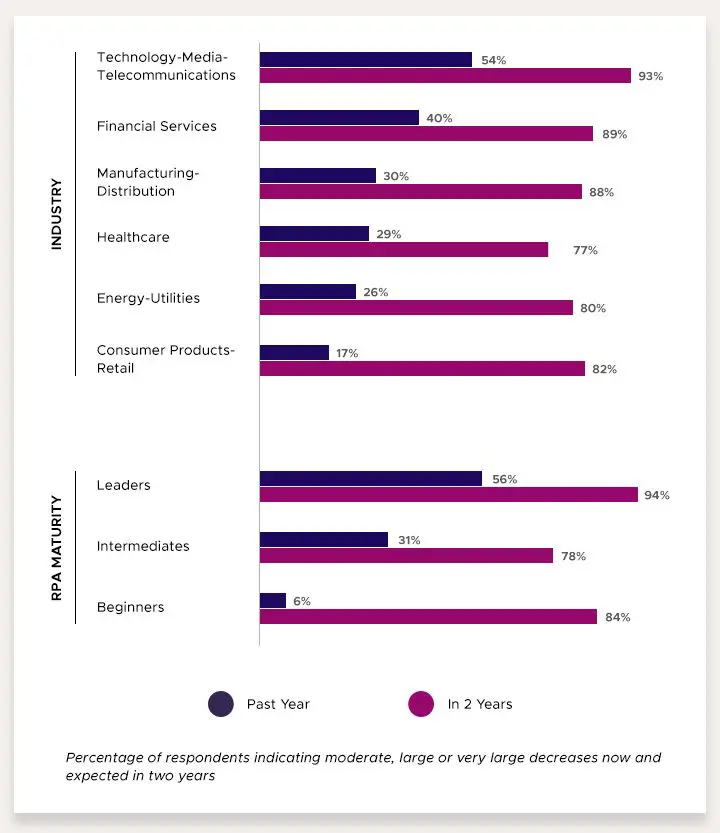
The above representation from Protiviti’s survey shows that prominent industries have cut costs with RPA usage over the past 2 years. Other mentioned benefits are all related to the and hence, increased productivity majorly helps in cost reduction resulting in a better return on investment.
How RPA Accelerates Industries
Robotic Process Automation (RPA) is changing the way industries operate by making work faster and easier. It automates repetitive tasks like data entry, document processing, and customer support, reducing the need for manual effort.
Boosting Efficiency with Automation
Many industries rely on manual processes that take up valuable time and resources. However, using RPA, tasks such as data entry, invoice processing, customer support, and report generation can be automated. This not only speeds up operations but also ensures accuracy, reducing the chances of human errors.
For example, in banking, RPA automates loan approvals, fraud detection, and account management, allowing financial institutions to serve customers faster. In healthcare, it helps process patient records, schedule appointments, and manage billing, improving patient care.
Reducing Costs and Increasing Accuracy
Human errors in business processes can lead to financial losses and inefficiencies. RPA eliminates these risks by following predefined rules, ensuring consistency in every task. Since automation requires less human intervention, companies can save on labor costs while improving service quality.
Retail companies use RPA to manage inventory, track shipments, and process returns efficiently. Manufacturing industries automate supply chain management, quality control, and compliance checks, reducing delays and improving production output.
Enhancing Customer Service
Fast and reliable customer service is essential for any business. RPA helps companies respond to customer inquiries quickly by automating responses and directing queries to the correct department. This ensures better service and enhances customer satisfaction.
For instance, in e-commerce, chatbots powered by RPA handle customer inquiries, process orders, and provide real-time updates, making shopping experiences smoother.
Enabling Businesses to Focus on Growth
By automating routine work, RPA allows employees to focus on innovation, strategy, and customer engagement. Instead of spending time on repetitive tasks, teams can work on business development, improving products, and creating better services.
Industries that embrace RPA become more competitive, adaptable, and ready for future advancements. As technology evolves, automation will continue to play a key role in driving business success.
In short, RPA is not just about working faster; it’s about working smarter. It helps industries save time, reduce costs, improve accuracy, and provide better services, making businesses more efficient and future-ready.
How to implement RPA on your existing work process?
A successful RPA initiative requires a sound business strategy, backed by sufficient finance and ongoing scaling of performance & results. It is enabling the companies to realign resources that require focus on high-value customers and strategic roles.
Before approaching any top RPA service providers, know that Ernst & Young has revealed that as many as 30%-50% of RPA projects fail in the initial stage.
To avoid that, you must create your checklist.
Read the top 10 tips for a successful RPA implementation here.

Overall glimpse
According to a 2018 report by KPMG in the US, 32% of industry leaders expect to increase RPA investment by 20% or more, and 32% said they would be upping investment in RPA by 20% or more.
- RPA is becoming increasingly an enterprise-level opportunity. RPA, along with other technology like Machine learning, Big Data, utilizing cloud and, etc. can do more.
- It has touched different industries and fits much for repetitive tasks.
- Companies consider a wide range of benefits. From improving productivity to accelerating time and generating venue, businesses are leveraging RPA’s benefits to the fullest.
- RPA programs often begin with a proof of concept (POC).
- When deployed rightly, RPA can provide both operational and strategic benefits.
However, RPA is not the only solution; there are cases where alternative automation solutions achieved better results than RPA.
It’s time to take the lower pricing and higher ROI trends, go to RPA service company to get started.
FAQ’s
- What is the difference between RPA and AI?
RPA automates repetitive processes using predetermined rules, but AI learns from data and makes conclusions. RPA is rule-based and does not adapt, whereas AI improves with time. When integrated, they result in more imaginative automation solutions.
- Can RPA work in all industries?
Yes, RPA is employed in various industries, including banking, healthcare, retail, manufacturing, and logistics. It automates operations such as data entry, fraud detection, patient records, inventory management, and supply chain procedures. Almost any industry that involves repetitive work can profit from RPA.
- How secure is RPA?
RPA is secure when used correctly. Businesses should implement role-based access control, encrypt critical data, monitor bot activity, and adhere to industry rules. RPA can improve security by minimizing human error and limiting data exposure.
- How can businesses prepare for the future of RPA?
Businesses should discover automation opportunities, incorporate AI for more intelligent operations, train staff to use automation, and regularly update their strategy. Staying ahead with RPA allows you to increase efficiency, reduce expenses, and remain competitive.



 Anand Mahajan


