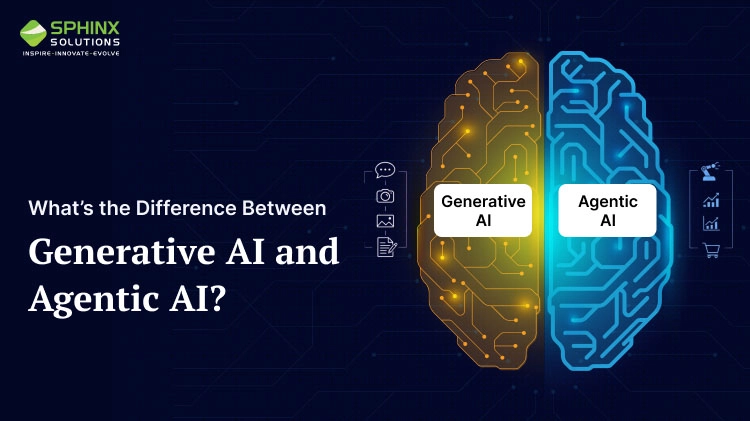
AI has transitioned to a different level where machines are no longer just creating different types of content but are also capable of thinking, planning, and acting independently. The most common question that executive leaders from different industries, such as marketing, finance, and software automation, are continuously asking is:
What is the difference between Generative AI and Agentic AI?
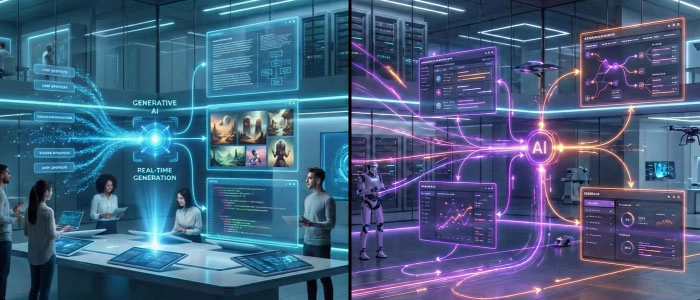
Both these technologies are getting a lot of hype, and it is becoming a necessity to understand how they work, identify their differences, and figure out the reasons for their importance.
In this blog, we’ll break down these two fast-growing fields in a simple, digestible format. We’ll also explore how companies today are adopting solutions from top Generative AI Development Companies and emerging Agentic AI Development Companies to build smarter applications.
If you are a business leader, a tech enthusiast, or just someone interested in development services, this guide will help you grasp the core concepts without any help from a specialist.
By seeing the comparison of technologies on how they perform tasks, learn from data, and communicate with their surroundings, you will understand the difference between content-generating models and goal-oriented intelligent agents. The two AI approaches that are changing how businesses build generative AI software development solutions and next-gen autonomous systems.
At the latest, when reading through this intro, you’ll understand that the distinction between generative AI and agentic AI is a matter of life and death. As the number of companies using automation, digital transformation, and advanced AI is growing, knowing the advantages of each method can give you a way out of the dilemma.
Which of the following would be the best strategy for your company to move forward: the creative AI tools industry, generative AI research, or the co-working of your company with autonomous, decision-making agents?
What is Artificial Intelligence (AI)?
AI is an extensive area, which aims at the creation of such machines that are able to accomplish the tasks which normally demand human intellect. Such jobs might be language comprehension, image recognition, problem-solving, or decision-making.
Contemporary AI becomes less dependent on fixed directives as it learns from the data, discovers regularities, and eventually gets better by itself. Without this, it would be difficult to fathom the next layer of concepts, such as what generative AI is, what agentic AI is, and how these two types of technologies vary.
Today, AI powers everything from sophisticated automation used in large enterprises to recommendations you see when shopping online. Research indicates that over 80% of businesses worldwide use AI in some capacity, primarily to increase productivity and decrease repetitive tasks.
This has led to a skyrocketing need for tools and technologies in the AI space, including generative AI software development, generative AI development services, and agentic AI development services. Enterprises are not interested in having systems that simply execute commands; instead, they desire systems capable of learning, evolving, and reasoning.
It often helps to compare two different approaches: traditional programming and machine learning, to understand how AI operates. Traditional programming is based on strict rules which are written by developers. The system behaves exactly as per these instructions, and any new scenario has to be handled by making changes to the code manually. Whereas machine learning is about enabling machines to learn by themselves based on the examples that are provided to them.
Instead of writing hundreds of rules, developers feed the system large datasets, and the algorithm figures out patterns on its own. This shift from rules to learning opened the doors to innovations like generative AI development and agentic AI development.
Both Generative AI and Agentic AI are built on machine learning. Many businesses now employ generative AI development firms to produce innovative apps because generative AI uses data to generate new material, such as text, graphics, or code. By fusing learning with thinking, planning, and autonomous action, agentic AI goes one step further.
This capability has pushed businesses to explore agentic AI development companies for solutions that can handle complex, multi-step tasks. Understanding this foundation makes it easier to grasp the difference between agentic AI vs generative AI, which we’ll explore next.
What Does “Generative” Mean in AI?
Generative AI refers to a branch of artificial intelligence that focuses on creating new content text, images, music, videos, code, or even designs, based on patterns it has learned from large datasets. The word “generative” simply means to produce or create. In contrast to conventional software, which retrieves pre-existing data, generative AI can produce novel results.
This is why tools built by a generative AI development company can write articles, generate artworks, draft emails, create product ideas, or even simulate human-like conversations. It’s a powerful shift from machines following instructions to machines contributing creatively.
Generative AI has been changing very rapidly in a span of two years, as compared to other digital technologies. Since different industries are busy putting money into the development of generative AI, the technology is gradually turning to be the core of the new ways of working.
This rapid adoption is also what sparked the growing comparison of agentic AI vs generative AI, as companies explore not only content generation but also autonomous decision-making systems.
In order to create material that is similar to but distinct from the original, generative AI first learns patterns from vast volumes of data. For instance, a model trained on thousands of photos can produce a new image that mimics the style of those images without replicating any particular one.
Opportunities in design, marketing, education, gaming, and software engineering have been made possible by this capability. This is also the reason why a lot of corporations look for generative AI development services or collaborate with generative AI development firms to create solutions that are specific to their requirements.
The area of AI known as “generative AI” is concerned with expression, creativity, and imagination qualities that were previously thought to be exclusive to humans. As we delve deeper into the distinction between generative and agentic AI, it becomes evident that although generative AI is excellent at producing material, it cannot plan actions or make independent decisions.
That role belongs to Agentic AI, which we’ll explore next as we continue shaping the bigger picture behind the growing Generative AI vs Agentic AI discussion.
What Does “Agentic” Mean in AI?
Agentic AI refers to AI systems that don’t just generate information; they actually take action, make decisions, and move toward a goal on their own. If generative AI creates content, agentic AI gets things done. It is the main reason why the discussion about agentic AI vs generative AI has exploded so fast. Agentic AI is more of a digital assistant with a drive, and it figures out, reasons and acts independently to do a job entirely.
Basically, agentic AI is an extremely independent problem solver, kind of a system. It does not simply sit there, awaiting detailed directions; rather, it comprehends the necessity, executes the most suitable method, and even changes the plan if the circumstances change.
Reports from leading tech companies show that organisations adopting agentic systems have seen productivity improvements of 30–40%, especially in operations and customer support. This rising demand has made agentic AI development services and agent-based automation a major trend across industries.
Another important part of understanding what agentic AI is is recognising how dynamic it is compared to traditional automation. Classic automation follows rigid rules, but agentic AI understands context, absorbs new information, and modifies its actions accordingly. It uses reasoning models, memory, and decision engines to operate with a human-like sense of judgment. This positions it as the next evolution of enterprise AI, far beyond simple workflow scripts or pre-programmed triggers.
Today, agentic AI is already being integrated into areas like software testing, supply chain operations, financial planning, and digital productivity tools. From AI agents that autonomously run test cycles to business bots that manage customer queries end-to-end, the applications are expanding rapidly.
As companies explore both generative AI vs agentic AI capabilities, many are now partnering with agentic AI development companies to build intelligent systems that can think, act, and deliver real outcomes with independence.
What is the Difference Between Generative AI Vs. Agentic AI?
| Comparison Area | Generative AI | Agentic AI |
|---|---|---|
| 5.1 Functional Focus (Actions vs Content) | Generative AI focuses on creating new content such as text, images, audio, or code. It responds to prompts and works mainly as a content generator. | Agentic AI focuses on taking action, completing tasks, and executing decisions. Instead of only producing content, it moves toward achieving a goal. |
| 5.2 Autonomy & Proactivity | Mostly reactive; it waits for user instructions. Even advanced models require prompts to deliver results. | Highly autonomous; agentic systems can plan steps, decide what to do next, and proactively execute tasks without constant supervision. |
| 5.3 Tool Integration & Environment Awareness | Limited interaction with external tools. Creates outputs within its model boundary. | Deeply integrated with APIs, applications, and external systems. Understands real-time environments and adapts actions dynamically. |
| 5.4 Workflow Complexity & Multi-Step Tasks | reat for single-step tasks like writing, summarising, generating designs, or drafting code. | Handles multi-step workflows, researching, planning, executing, verifying, and refining, making it ideal for operational automation. | 5.5 Memory, Context & Adaptability | Works with short-term context and depends on prompts for direction. Long-term memory is limited. | Learns from previous interactions, stores context, and adapts based on experience. Capable of long-term planning and improved decision-making. | Output Type | Produces creative outputs—documents, images, videos, test cases, emails, or prototypes. | Produces real-world impact by booking tickets, generating reports, testing applications, automating workflows, or managing processes. | Goal Orientation | Designed to assist users creatively. Great for ideation, brainstorming, and content creation. | Designed to achieve outcomes. Completes end-to-end tasks with measurable goals. | Integration in Businesses | Used for content automation, customer support drafts, product descriptions, chatbot responses, and marketing workflows through generative AI development services. | Used for autonomous operations, testing, supply chain optimisation, and digital workforce systems through agentic AI development services | Examples | ChatGPT content generation, Midjourney images, Gemini outputs, code suggestions, product descriptions. | AI agents that test apps automatically, manage CRM entries, run scripts, schedule tasks, or orchestrate entire workflows. | Best Use Cases | Writing content, generating ideas, designing creatives, producing synthetic data, and supporting teams with creative tasks. | Handling repetitive, complex, or multi-step tasks in software QA, operations management, finance reconciliation, and business automation |
How AI Agents Relate to Agentic AI?
AI agents are essentially the “building blocks” that make Agentic AI possible. If you think of Agentic AI as a fully operational digital employee, then AI agents would be the smaller components that handle specific tasks within that system. These agents can see their surroundings, draft their steps, make choices, and carry out operations. These are precisely the abilities which an agentic AI is to be understood.
Whereas generative AI models mostly create content, AI agents serve as functional modules that facilitate the conversion of this intelligence into viable real-world applications. This is why the debate around agentic AI vs generative AI is trending across the tech world.
Traditional AI perform single, isolated tasks such as forecasting, classification, or data filtering. In contrast, AI agents operate with a higher degree of independence. They don’t just compute they decide. They break big goals into smaller tasks, monitor the outcome, correct mistakes, and even restart processes if something goes wrong.
These features mirror the core strengths of agentic AI, which is designed to handle multi-step workflows that generative AI alone cannot manage. Companies now invest in agentic AI development because these agents reduce manual work and complete tasks end-to-end.
Many agentic systems continue to rely heavily on generative AI models. For example, an AI agent in charge of customer assistance may use generative models to create emails, summarise interactions, or generate reports. However, the agent is responsible for making decisions such as routing tickets, prioritising tasks, communicating with APIs, and updating CRM dashboards.
The blend of content generation and autonomous execution is why businesses are turning to both generative AI development services and agentic AI development companies to build powerful hybrid solutions. It’s not about choosing between generative AI vs agentic AI; it’s about combining them to get the best of both worlds.
In short, AI agents give agentic AI its “action capability.” They provide the structure and decision-making logic that allows a system to work independently inside a digital environment. Where generative AI provides the three core attributes of intelligence, creativity, and language fluency, AI agents supply the four additional attributes of direction, purpose, and execution.
As a result, they constitute a new era of hybrid AI systems that can plan, generate, automate, and improve, thus representing one of the most fascinating fields of contemporary AI technology advancements.
What are the Advantages & Limitations of Generative AI And Agentic AI?
Advantages:
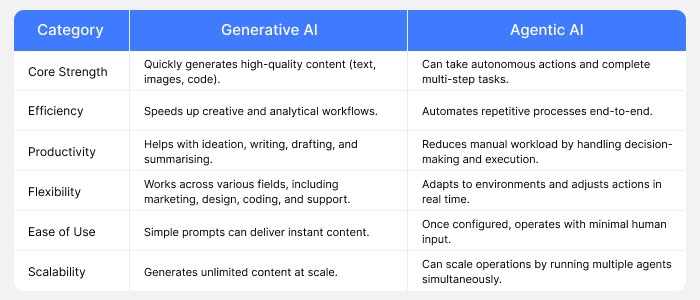
| Category | Generative AI | Agentic AI |
|---|---|---|
| Core Strength | Quickly generates high-quality content (text, images, code). | Can take autonomous actions and complete multi-step tasks. |
| Efficiency | Speeds up creative and analytical workflows | Automates repetitive processes end-to-end. |
| Productivity | Helps with ideation, writing, drafting, and summarising | Reduces manual workload by handling decision-making and execution. |
| Flexibility | Works across various fields, including marketing, design, coding, and support | Adapts to environments and adjusts actions in real time. | Ease of Use | Simple prompts can deliver instant content. | Once configured, operates with minimal human input. | Scalability | Generates unlimited content at scale. | Can scale operations by running multiple agents simultaneously |
Limitations:
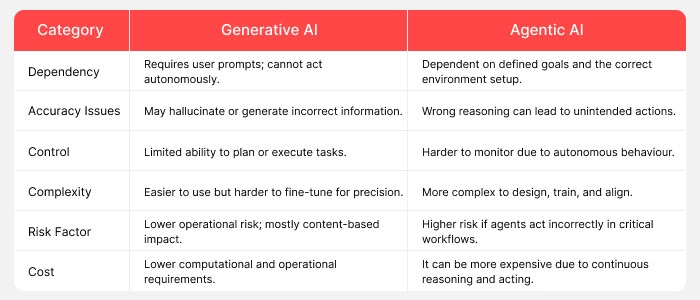
| Category | Generative AI | Agentic AI |
|---|---|---|
| Dependency | Requires user prompts; cannot act autonomously. | Dependent on defined goals and the correct environment setup |
| Accuracy Issues | May hallucinate or generate incorrect information. | Wrong reasoning can lead to unintended actions. |
| Control | Limited ability to plan or execute tasks | Harder to monitor due to autonomous behaviour. |
| Complexity | Easier to use but harder to fine-tune for precision | More complex to design, train, and align | Risk Factor | Lower operational risk; mostly content-based impact. | Higher risk if agents act incorrectly in critical workflows | Cost | Lower computational and operational requirements | It can be more expensive due to continuous reasoning and acting. |
How to Choose Between Generative AI and Agentic AI?
It is of utmost importance to understand the present needs and the future aspirations of your business before deciding on whether to go for a Generative AI or an Agentic AI. These two technologies might be strong, but they are differently equipped for different situations.
Generative AI can come in handy when the requirement is for new content, an idea, or a structured output, whereas Agentic AI is more appropriate for automated workflows where the system is to act, decide, and perform tasks with minimal intervention.
1. Determining Business Needs:
- Use Generative AI when your primary objective is to come up with content such as product descriptions, emails, reports, pictures, code snippets, or marketing assets. It is a great match for situations where companies require quickness, inventiveness, or a helper for the internal teams. This is why many companies invest in generative AI development services to boost content-heavy processes.
- Choose Agentic AI when your organisation requires autonomy. If you need a system that can analyse data, make decisions, trigger tools, and complete tasks (not just generate content), Agentic AI becomes the better option. For example, customer support automation, fraud checks, or multi-step operational workflows often rely on agentic AI development solutions.
- In case you require content generation as well as action-taking, a hybrid model might work perfectly for numerous businesses that are on the rise and want to merge the two paradigms for a systematic scaling of operations.
2. Technical Requirements:
- Generative AI, in most cases, calls for less complex hardware, an API, prompt setup, and coordination with your existing software. A company may collaborate with a generative AI development company to embed AI models into apps, websites, or internal tools.
- Agentic AI, conversely, requires more sophisticated parts: workflow orchestration, dependable tool integrations, environment awareness, and, in some cases, even real-time monitoring. Such systems necessitate a strongly built backend capable of handling planning, reasoning, and multi-step execution.
- It would be reasonable for your team to opt for generative AI if they are new to AI. If you have already been using automation or structured data pipelines, then you are good to go to work with agentic AI development services.
3. Future-Proofing Your AI Strategy:
- If that is the case, you might want to think about the next chapter of your business. In case your industry (like fintech, logistics, healthcare, or e-commerce) is moving towards automated operations, artificial intelligence-based decision-making, or self-governing workflows, Agentic AI will be the instrument with which you will be able to differentiate yourself from other competitors.
- On the other hand, if you restrain yourself mostly by the lack of creativity, content creation, writing documentation, programming support, or customer communication, then Generative AI is still the superior option regarding the strategy.
- Many organisations future-proof by choosing a modular approach; they start with generative capabilities and gradually expand into agentic functionality as their maturity grows.
- Trends clearly show that businesses combining both (Generative AI + Agentic AI) are achieving more efficient workflows and faster digital transformation, especially those supported by experienced generative AI development companies and agentic AI development companies.
Conclusion
As AI landscape changes, one of the most discussions technology and business leaders is the comparison between Generative AI vs Agentic AI. Basically, Generative AI is used in content production of many forms, such as texts, pictures, computer codes, data, and much more.
Agentic AI is capable of performing an action, making a decision, and accomplishing multi-step tasks without human help. It is a revolutionary change in a workflow which requires instantaneous reasoning and execution. The company can decide on the best technological solution for its needs instead of rushing into a trend blindly.
More than ever, it is becoming obvious that the decision of which intelligence model to adopt in the future is not between one and the other. Generative AI still could not have done without raising through agentic AI; the latter would have been able to complete the tasks faster and with more precision.
A lot of businesses are becoming a great success story of using these two together, pairing generative AI with agentic AI for implementation. It is such a holistic approach that both the services, i.e., generative and agentic AI development services, are equally in demand at the same time, namely among the companies that are into long-term automation and innovation.
For organisations that are looking to create compelling experiences through AI, the real reward is in the thoughtful integration of these technologies. Where Generative AI is limited only by the human imagination, Agentic AI is the implementation of these ideas.
The companies get the potential of Next-Gen Customer Services, Content that creates itself, Smarter Agents, and Automated Processes, which can evolve alongside their requirements, which are some of the examples of deeper value that can be achieved through their union.
Those firms teaming up with the best generative AI development agency or the top-notch agentic AI development company can keep their systems up-to-date and concurrently retain their position in the fast-paced markets.
The issue of agentic vs generative AI does not come down to just identifying and comparing one against the other, but rather insightfully asking how both could simultaneously work to strengthen your business.
By resorting to Generative AI in building things while employing Agentic AI for carrying out, businesses become not only the next generation but also flexible, scalable, and intelligent ecosystems are ready for the constant of change in digital transformation.
FAQ’s:
1. What is the main difference between Generative AI and Agentic AI?
Generative AI creates content such as text, images, and code, while Agentic AI performs actions, makes decisions, and completes tasks autonomously. One focuses on creation, the other on execution.
2. Which AI model is better for business, Generative or Agentic?
It depends on your goals. Generative AI is ideal for creativity and content workflows, while Agentic AI is best for automation, reasoning, and multi-step tasks.
3. Can Generative AI and Agentic AI work together?
Yes. Most advanced systems combine both Generative AI generates ideas or data, and Agentic AI uses them to plan, decide, and act. This hybrid approach boosts efficiency and innovation.
4. Is Agentic AI more advanced than Generative AI?
Agentic AI is more autonomous but not necessarily “better.” It requires generative models for creativity and context, making both equally important for modern AI ecosystems.
5. How do I know which AI solution my company needs?
Choose Generative AI if you need content generation, insights, or creative output. Choose Agentic AI if you want task automation or decision-making. Many businesses benefit from using both together.


 Souradeep Kundu

 Shivraj Dhaygude