

If your online store wants to succeed in today’s competitive market, It requires a robust online presence. It is true whether you are offering B2B or B2C services. You can’t afford to have a lousy and ineffective marketing plan. Suppose you are a new business, offering a product or service at a reasonable price online to a targeted market but are not seeing satisfactory results. In that case, there is a good chance that you are committing some serious mistakes that affect your sales. It’s in your best interest to understand the mistakes you, or your team, might be committing. Here are some common mistakes that I have encountered in my own experiences while marketing an eCommerce site. Fixing these issues has been very profitable for the eCommerce business.
1) Poor Site Navigation
If you want customers to interact with your website, you need to make it easy for them to search on your site. eCommerce websites that don’t have a precise navigation bar are confusing. Exceptional site functionality makes the difference between a satisfying and a disappointing user experience, so be sure your website is simple to navigate. For help, use a platform like Nextopia, which offers eCommerce site search and navigation services. Sometimes visitors don’t know where to click or how to find products. Even top-quality products won’t sell if people can’t find them. So customize your online store into logical sub-departments, such as Men’s Shoes, only show men’s shoes. Create a user-friendly menu with clickable internal links to each department. Give people options to search by size, colour, and style. Conversions are more likely when consumers can locate precisely what they desire.
2) Slow Loading Website
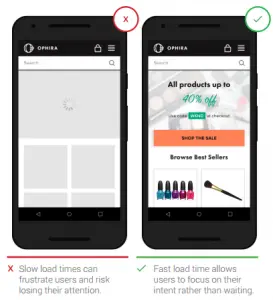
Living in a 5G age has created a dependency on fast and immediate satisfaction. Patience is a virtue we do not hold our internet usage to. Slow, unoptimized eCommerce websites won’t see good conversion numbers. Every second of increased loading time results in customers leaving the website quickly, resulting in higher bounce rates and lower eCommerce conversion rates.
A website that takes more than 2 seconds to load completely is considered too slow since Amazon has discovered that for every 100 milliseconds your website takes to load, you miss out on 1% in sales.
How can you get a faster website? Reduce your HTTP requests and redirects them. Eliminate unnecessary images, videos, and scripts. Monitor your image file sizes, keeping smaller images around 60-90 pixels and larger images to below 180 pixels in size. Use your favorite file conversion software to compress your essential files online, such as BeFunky.
3) Complicated Checkout Process
When customers browse your website, add the product(s) in a shopping cart, and start to check out, hold them back from hitting an additional ten unnecessary steps.
Facebook found that “87% of consumers experience complex checkout steps will stop them from shopping online” The longer the checkout process, the lower the conversions.
Multiple checkout pages and poor design will result in people leaving mid-transaction and loss of sales for you.
Offer a “Check Out as Guest” option if possible so that users that don’t want to create an account aren’t forced to.
4) Lack of Payment Options
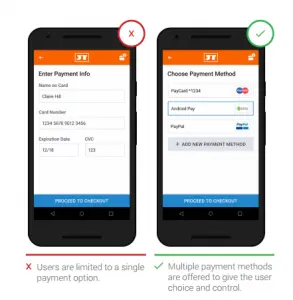
Imagine you’re shopping online, and find the perfect pair of shoes. You instantly add them to your cart and race toward completing checkout; the only thing between you and your shoes. The eCommerce website doesn’t accept your credit card or offer only limited payment options. If this happens on your site, your business conversions will suffer. Appeal to every consumer by taking a wide variety of payment options. Accept every major credit card, including Visa, MasterCard, Discover, and American Express. Let customers connect to UPI platforms like PayPal and Google Pay too. Make your payment process convenient and effortless, so you don’t miss that hard-earned sales lead.
5) Lack of Social Proof
Remember, images make the visitor stay engaged, but it’s the content that gets things done and appeals to the customers to hit on the add to cart button and eventually convert. Consumers like socializing, and research has shown that social proof like customer reviews and testimonials drives the purchase decision. Shoppers often want validation of their purchase decisions, and customer reviews help build trust in the product and the eCommerce website.
6) Not Implementing Trust Signs
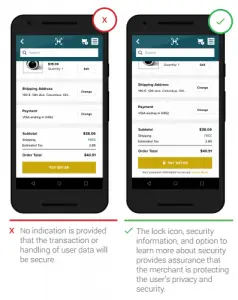
If you have not implemented an SSL certificate and a Verisign (or similar) trust seal on your website, you will not give new visitors to build trust in your business. 61% of online shoppers say that they expect to see the ‘padlock’ symbol on the address bar (SSL certificate) before they decide to purchase from your website. Trust signs are all the more critical to a new business.
7) Lack of Mobile Optimization
The digital transformation shows that the world is becoming more and more mobile-friendly. A study shows that smartphones account for a 62 percent share of total digital minutes, followed by desktops at 29 percent and tablets at 9 percent.
The customers reject Non-mobile-friendly designs. A responsive eCommerce website optimized for use across different screen sizes and resolution devices and providing a seamless user experience is necessary.
8) Lack of Customer Service
Suppose you ignore the quality of your customer service. In that case, the chances are that it is terrible and turns away prospects who were once interested in your product or service. This is because 76% of online shoppers view customer service as the true test of how a business values its customers. If you want to please your customer, provide several ways for your customers to get help. Use multiple communication channels such as phone, email, social media, and live chat to increase your brand’s accessibility and increase customer trust. Quick responses from customer support also boost the likelihood of a visitor completing a purchase.
9) Poor Quality Product Image
The best part about shopping online is that you got everything on your doorstep. But the worst thing about online shopping is that you can’t physically touch and check the product before buying. This is the reason online retailers need to add high-quality photos of the products.
Use product imagery as an advantage while developing eCommerce website. Offer a 360-degree angle of your products, color variations, and options. Don’t upload an undersized picture and expect people to click the “add to cart” button. Allow them to zoom in on the picture(s) and be able to get the sense of “holding and inspecting” before buying.
10) Sloppy Return Policy
Metapack’s Guide to Returns found that 50% of shoppers had abandoned a purchase due to a lack of choice of returns channels. Most online shops made a mistake by ignoring the return policy. Be sure that your website is not one of them.you should offer a great shopping experience with a clear and generous return policy.
Handling exchanges and refunds is smoother when customers receive a clear, printable invoice with return instructions and contact details. For small teams that don’t have a designer, free Microsoft Word invoice templates from InvoiceSimple make it easy to produce branded invoices in minutes—complete with itemized lines, taxes, and terms. Including these professional documents in every package or confirmation email reduces confusion, builds trust, and lowers support volume during the post‑purchase and returns process.
Conclusion:
We all make mistakes while running an online shop. But the most important thing is what we can learn from that mistake and avoid doing the same ones again and again. Digital transformation has changed the ways of engagement for brands with their customers. But you don’t need to be a digital-native brand to behave like one. To enjoy higher conversion rates and satisfied customers, you need to steer clear of these typical mistakes that cost your sales online.


 Anand Mahajan


 Shivraj Dhaygude