In the quick-moving virtual era, software is at the heart of the whole thing, from cellular apps that connect us to the world to complex structures running worldwide corporations. But even the most progressive software can fail if it’s riddled with bugs, security loopholes, or overall performance troubles. This is where software checks out steps as an important technique.
Have you ever wondered: “What is Software Testing?” It is a methodical strategy for analysing and validating whether a software application performs its intended functions efficiently, safely, and precisely.
Today, with Agile, DevOps, and AI-driven practices, software testing is not an afterthought; it’s an indispensable part of the software program development lifecycle, making sure pleasant at each stage.
Bugs and errors delay product launches
strengthen your QA process and deliver flawless software.
What is Software Testing?
Software testing is the methodical process of assessing a software program that satisfies the requirements, operates as commanded, and is error-free. Before handling to the end user, it needs to be checked out for its flaws, or missing features to ensure performance and quality.
It is crucial as it guarantees that applications meet both business requirements and user expectations earlier than they cross stay. It reduces the hazard of steeply priced failures, improves customer delight, and maintains a brand’s popularity in an increasingly more aggressive market.
Beyond simply “locating bugs,” modern testing goes beyond software testing basics to focus on overall performance, scalability, security, and usability, covering both functional and non-functional aspects of a product.
The records of software trying out is going lower back to the early days of computing in the 1950s and 60s, whilst debugging became the number one technique for exceptional quality. Over time, it evolved into an established subject within software engineering, introducing devoted methodologies, frameworks, and specialised equipment.
What are the Key Principles of Software Testing?
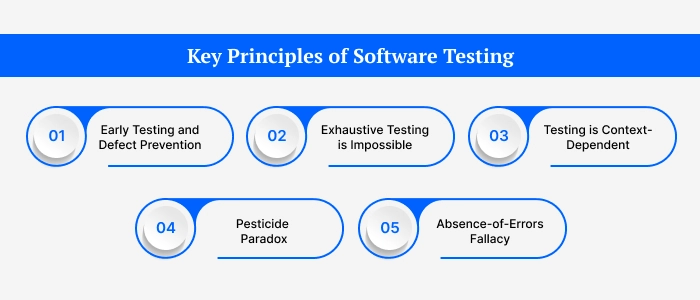
If you have ever laboured on a software program mission, you will recognise that checking out is greater than simply hitting a few buttons and exclaiming, “It works!”
It is an intentional, methodical method that clings to ideas to help testers in locating flaws quickly, saving time, and heading off costly mistakes later. These principles are important to software testing.
1. Early Testing and Defect Prevention
Consider noticing spelling blunders before clicking “print”; it’s simpler and much less pricey to correct early on. The same goes for software. The same goes for software. The sooner you begin testing, ideally within the requirements and design stages, the more problems you may avoid rather than simply resolving them later.
2. Exhaustive Testing is Impossible
You cannot look at each scenario, button click, or information combination for any quantity of time. As a result, testers’ attention at the most important factors: high-chance regions, important capabilities, and eventualities which can be maximum likely to cause the system to fail.
3. Testing is Context-Dependent
A banking app and a mobile game app can’t be tested the same way. One needs rigorous security and compliance checks; the other might put more weight on speed, performance, and smooth animations. The testing approach should always fit the project’s context.
4. Pesticide Paradox
Run the identical exams time and again, and they’ll in the end forestall detecting new insects. That is why good testers keep their test cases updated by adding new scenarios, adjusting old ones, and remaining one step ahead of faults.
5. Absence-of-Errors Fallacy
A computer virus-loose app can still fail if it doesn’t meet what users need. Passing all tests isn’t like handing over the proper product. True first-rate means building something that works and makes sense for its target market.
These concepts aren’t simply concepts; they’re sensible conduct that separates an average tester from an awesome one. They assist in ensuring the software program isn’t just useful, but also reliable, user-friendly, and equipped for the real world.
What is Software Testing Life Cycle (STLC)?
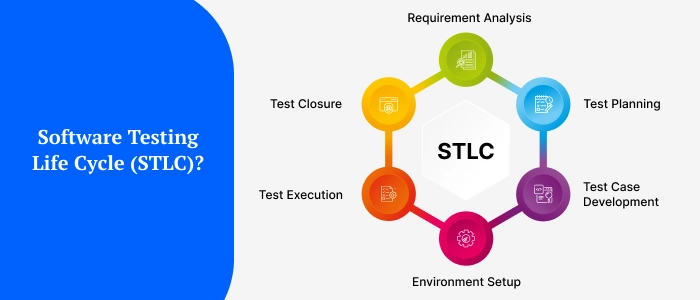
In any structured test process, things do not happen randomly; they follow a series of well-defined steps. This is known as the Software Testing Life Cycle (STLC). It gives a step-by-step structure for describing how check sports are executed, from comprehending the requirements to growing the very last check file. Mastering the STLC appeared as one of the maximum critical aspects of software trying out since it assures that testing is methodical, efficient, and dependable.
STLC acknowledges that software program trying out is a essential ability that every professional need to collect, because it guarantees that the take a look at technique is deliberate, controlled, and linked to mission desires.
1. Requirement Analysis
Before writing, an individual looks at the case, and testers review the venture’s purposeful and non-functional requirements. This facilitates determining what desires to be evaluated, potential dangers, and the general checking out scope.
2. Test Planning
This is the blueprint of the testing process. It covers strategies, required tools, resource allocation, schedules, risk analysis, and the estimated effort needed for testing.
3. Test Case Development
Testers here generate thorough test cases, scripts, and data. These are intended to cover as many positive and negative circumstances as possible to ensure that the program is thoroughly validated.
4. Environment Setup
This step consists of conducting test cases and comparing the actual output to the projected outcome. Any discrepancies are stated as flaws, which the improvement team need to solve.
5. Test Execution
This phase involves running test cases and comparing the actual output to the predicted outcome. Any differences are reported as faults, which the development team must fix.
6. Test Closure
After testing is completed, the team assesses the entire process, documents lessons learnt and creates a final test summary report. This helps to improve the approach for future projects.
The STLC guarantees that trying out isn’t just a one-off challenge, but a systematic, repeatable method that delivers dependable results. Whether your part of a small startup or a big company, following those ranges can extensively enhance the quality and success rate of any software challenge.
What are the Types of Software Testing?
Software checking out is not a one-size-fits-all method. Depending on the task’s goals, complexity, and constraints, numerous testing methods are employed to ensure that the product functions well.
Information on the various types of software programs to try out is essential for each tester or exceptional assurance expert, as every serves a selected purpose and is used at different stages of the software development lifecycle.
Based on Approach: (Manual & Automated Testing)
- Manual Testing:
Manual testing entails performing test cases without the use of automated technologies. It is amazing for exploratory trying out, usability exams, and tasks requiring human commentary. While time-consuming, it permits testers to assume imaginatively and locate flaws that computerised scripts may additionally forget.
- Automated Testing:
Automated testing executes take a look at cases using scripts and tools, resulting in faster, more repeatable testing. This is appropriate for regression. While the initial setup takes time and technical knowledge, automation is critical for large-scale initiatives with periodic upgrades.
Based on Objective: (Functional & Non-Functional Testing)
- Functional Testing:
Verifies that the application performs as per business requirements. This category includes:
- Unit Testing – It involves trying out individual modules or components in isolation.
- Integration Testing – It involves determining how modules interact with one another.
- System Testing – Evaluating the entire system’s capability gives an up-to-date evaluation.
- Acceptance Testing – Confirming the product meets the person’s and client’s expectations before release.
- Non-Functional Testing:
Focuses on how well the application works rather than what it does. This includes:
- Performance testing evaluates velocity, scalability, and responsiveness.
- Security testing incorporates detecting vulnerabilities and ensuring statistics security. Modern testing strategies now include tools like Pentest-Tools.com, which combine automated scanners and ethical hacking features to help teams catch vulnerabilities early.
- Usability testing assesses the navigation’s ease of navigation and usability.
- Compatibility testing is making certain the application works on a few hardware, operating systems, and browsers.
Based on Knowledge of Code: (White Box, Black Box & Grey Box Testing)
- White Box Testing:
Also called clear-box or structural testing, this method requires knowledge of the internal code and logic. It’s mainly performed by developers or technically skilled testers.
- Black Box Testing:
The tester has no access to internal code and focuses solely on input-output validation, checking if the application meets functional requirements.
- Grey Box Testing:
Combines aspects of both white box and black box testing, allowing testers partial knowledge of the system’s internals to design more effective test cases.
What are the Popular Software Testing Models & Strategies?
Over the years, several fashions and strategies have advanced to make trying out greater green, systematic, and aligned with the software development technique. Teams can choose the first-class approach for producing outstanding merchandise by way of information on those models and strategies.
In the sector of software program application checking out, no single method works for every mission. Understanding software testing basics enables groups align their method, but the making plans and execution of testing are still in large part depending on the development technique, task necessities, and timelines.
The Waterfall Model
One of the earliest approaches, the Waterfall Model, follows a linear and sequential process. Testing no longer starts till the development procedure is complete. Although this paradigm is easy to recognise, it works first-rate for projects with clear targets and few revisions, as subsequent changes may be luxurious and time-consuming.
V-Model
The V-Model carries trying out at each stage of development and is regularly regarded as an extension of the Waterfall Model. There is a testing activity that corresponds to each development activity. This lowers the possibility of significant problems during final testing by ensuring flaws are found early.
Agile Testing
Agile testing complements the Agile development technique. Testing is continuous, collaborative, and integrated into short development cycles known as sprints. This strategy promotes regular feedback, adaptation to changes, and faster releases, making it perfect for dynamic projects.
DevOps & Continuous Testing
In DevOps environments, development and operations work collectively, with checking out embedded into every stage of the development pipeline. Continuous Testing ensures code is demonstrated in actual time via computerised tests, allowing speedy, dependable deployments without compromising satisfactory.
Shift-Left and Shift-Right Testing Approaches
- Shift-Left Testing movements checking out activities in advance within the development cycle, specialising in illness prevention in place of detection.
- Shift-Right Testing entails checking out in the manufacturing environment to monitor performance, reliability, and personnel enjoyment in real-world situations.
What are the Software Testing Techniques?
Techniques in software engineering are ways for designing and executing checks in a way that maximises trouble discovery, ensures insurance, and validates each capability and exception.
Each approach serves a selected purpose, has strengths, and is first-rate for certain packages. Choosing the best aggregate can imply the difference between a product that just works and one that always, securely, and successfully.
1. Static Testing:
Static testing out specialises in figuring out troubles without executing the code. This includes sports like reviewing necessities, walkthroughs of system design, and formal inspections of code. It’s an early-stage quality gate that helps catch logical errors, missing requirements, and design flaws before development moves too far ahead.
2. Dynamic Testing:
Dynamic testing involves executing the software and observing its behaviour under specific conditions. It includes:
- Black Box Testing – Focuses on the input and output without thinking about the inner code shape.
- White Box Testing – Examines inner code, common sense, and structure to guarantee right implementation.
- Grey Box Testing – Combines both approaches, with partial knowledge of internal workings to design more informed test cases.
3. Risk-Based Testing:
Risk-based totally testing prioritises test efforts constant with the probability of failure and the capability impact of errors. High-hazard quantities of the application receive extra interest, making sure that key functionality is substantially examined before release.
4. Exploratory Testing:
Here, testers simultaneously design and execute tests while exploring the application. It’s particularly useful when requirements are incomplete or when creative, real-world usage needs to be simulated.
5. Regression Testing:
When a brand-new feature is delivered or a hassle is corrected, current functionality might also fail. Regression checking out guarantees that adjustments do not cause new issues in formerly useful quantities of the system. This is frequently automated for efficiency in continuous development cycles.
What are the Software Testing Tools?

In modern-day software development, tools are no longer elective; they are essential for performance, accuracy, and scalability. As programs turn out to be extra complicated, guide testing out by myself cannot keep up with tight release cycles and growing best needs.
Testing tools help automate repetitive duties, simulate actual international usage, identify bottlenecks, or even come across vulnerabilities before they could motive harm. Choosing the right device depends on the kind of checking out, assignment necessities, and the talent set of the testing team.
1. Automation Tools
Automation solutions free testers from time-consuming and repetitive look at instances, letting them paintings on extra complicated situations.
- Selenium is a popular open-source framework for trying out web applications on diverse platforms and browsers.
- Cypress is famous for its actual-time reloading abilities and simple, developer-pleasant end-to-end testing.
- Playwright is the latest product from Microsoft that supports more than one browser and permits scalable automation.
2. Performance Testing Tools
Performance testing tools evaluate how software behaves under stress, high traffic, or peak loads.
- JMeter – Open-source, ideal for load and stress testing of web applications and APIs.
- LoadRunner – A commercial solution with advanced analytics for enterprise-scale performance testing.
3. Security Testing Tools
Security equipment discovers vulnerabilities, misconfigurations, and ability exploits in programs. Examples consist of OWASP ZAP, Burp Suite, and Acunetix, which assist in ensuring programs meet security compliance requirements and face up to cyberattacks.
4. Mobile App Testing Tools
With mobile-first usage, testing on diverse gadgets, display sizes, and OS versions is essential. Tools like Appium, TestComplete, and Espresso allow functional, UI, and overall performance checking on Android and iOS platforms.
5. AI-Powered Testing Tools
AI-based equipment is reshaping the way trials are accomplished via predicting high-hazard regions, producing check scripts automatically, and speeding up illness detection. Platforms like Testim, Functionize, and Applitools carry out wise automation, visible checking out, and self-restoration talents into the process.
What are the Best Practices for Effective Software Testing?
Good software program does no longer simply appear; it comes from cautious, robust, and steady checks. If you use tried and true methods, software tests will give true results, cut down on errors, and line up with what the business wants. Here is how to test in a way that works:
1. Involving Testers Early in the Development Cycle
The faster testers get worried, the better. Integrating testing processes from the beginning of development, generally called Shift-Left Testing, facilitates to discovery of issues before they come to be complicated. This saves time and money at the same time as also making sure that the product is of excellent pleasant from the outset.
2. Creating Clear and Comprehensive Test Plans
Look at the plan acts as the blueprint for the testing procedure. It must outline objectives, scope, sources, timelines, and specific checking out strategies. Detailed check cases, recognition standards, and predicted outcomes provide testers a clean roadmap, reducing ambiguity at some stage in execution.
3. Prioritising Tests Based on Risk
Not all functions pose an equal level of threat. Risk-based testing prioritises the maximum essential and excessive-effect functionalities, ensuring that any capacity enterprise or safety risks are addressed without delay. This is mainly real in large-scale or enterprise structures, wherein time and resources are scarce.
4. Automating Where Appropriate
While guide trying out is essential for exploratory and value assessments, automation accelerates regression, general performance, and repetitive testing obligations. Using a suitable automation framework, which includes Selenium, Cypress, or Playwright, can extensively lessen testing instances while improving coverage.
5. Maintaining Clear Documentation
Documentation is more than simply record-retaining; it’s an asset for future improvement and protection. Well-organised test reports, illness logs, and personnel remarks assist groups to comprehend beyond issues, music development, and make knowledgeable selections in upcoming releases.
What are the Challenges in Software Testing?
No depend how advanced the tools or the team, software testing gives its own set of demanding situations. These troubles often influence how fast and efficiently a product may be brought to the marketplace. Understanding them is step one in growing ways to triumph over them.
1. Limited Time and Budget
Testing groups are frequently faced with brief timeframes and restrained resources in fast improvement cycles, especially in Agile and DevOps contexts. While deadlines are unavoidable, best cannot be sacrificed. Balancing velocity and thoroughness become an ongoing fight, necessitating smart prioritisation and useful resource performance.
2. Managing Frequent Requirement Changes
In today’s volatile economy, product requirements can shift overnight. This is especially genuine for organisations that adapt swiftly to customer comments or marketplace changes. It can be time-consuming and error-prone to regularly update check cases, adjust test methods, and verify that no functionality is left out.
3. Handling Complex Test Environments
Modern apps must work across many devices, gadgets, working structures, and network configurations. Creating and preserving such special settings, whether for mobile app development, cloud-primarily based solutions, or agency structures, may be technically hard and expensive. Mismatches between test and production settings can result in problems that are ignored.
4. Skill Gaps in Testing Teams
Software checking out is not just about clicking through interfaces; it calls for an understanding of automation equipment, scripting languages, performance testing, and safety analysis. Without ongoing schooling, groups risk falling in the back of in adopting contemporary testing procedures, which could negatively impact the product.
What are the Emerging Trends in Software Testing?
The global software checking out is undergoing speedy change, driven by advancements in era and the growing call for faster, greater reliable packages. Traditional testing approaches are no longer sufficient to achieve today’s development goals. Instead, innovative tactics influence how things are done today and will evolve in the coming years.
Let’s take a better study of the key tendencies redefining the checking out panorama.
1. AI and Machine Learning in Testing
AI and ML are revolutionising trying out via making it smarter and more predictive. From finding trends in defect-prone areas to creating optimised test cases, AI reduces manual effort while increasing accuracy. Machine learning-powered tools can even evaluate historical data to detect possible faults before they occur.
2. Test Automation at Scale
Automation is no longer limited to regression testing. Organisations are expanding automation into functional, performance, and even security testing. This lowers the need for recurrent manual efforts and speeds up delivery, particularly in large-scale projects.
3. Continuous Testing in DevOps Pipelines
In DevOps, trying out is not a separate phase; it’s continuous. Continuous Testing guarantees that every code commit is routinely demonstrated through pipelines, providing instant feedback. This fashion helps teams seize insects early and supply quicker without sacrificing high-quality.
4. Low-Code / No-Code Test Automation
Not every tester is a professional programmer. Low-code and no-code finding out structures are making it simpler for testers to layout, execute, and preserve look at instances through clean drag-and-drop abilities. This democratizes automation and lets in even non-technical testers to make a successful contribution.
5. IoT and Edge Testing
With billions of IoT devices connecting to networks worldwide, testing is not confined to software on my own. IoT trying out involves validating overall performance, protection, and compatibility across numerous gadgets and environments. Edge testing ensures that applications running close to the consumer, like autonomous cars or healthcare gadgets, perform without delays or screw ups.
6. Self-Healing Tests
One of the most difficult tasks in automation is test case maintenance. Self-healing tests allow automation scripts to automatically update themselves when the user interface changes, minimising maintenance effort and assuring test stability over time.
7. Blockchain Application Testing
As blockchain utilisation spreads to industries which include finance, supply chain, and healthcare, experimenting with distributed programming becomes increasingly more crucial. Blockchain checking out focuses on safety, standard performance, and scalability to ensure transaction integrity and reliability.
What are the Real-World Examples of Software Testing?
While frameworks assist us in apprehending the Software Testing Basics, the real impact of trying out will become clear best when we see it in action. Every region, whether it’s online buying, banking, healthcare, or mobile apps, is predicated closely on checking out to ensure structures run smoothly, securely, and without glitches. Let’s look at a few real-world eventualities wherein testing performs a critical function.
1. Testing in E-commerce Platforms
Consider purchasing at an e-commerce behemoth like Amazon or Flipkart during a massive deal. Millions of customers are investigating, adding items to carts, and paying all at once. Even tiny problems, if not thoroughly tested, could lead to failed transactions, inaccurate checkout pages, or inventory mismatch.
Functional testing certifies the purchasing process, performance testing ensures that websites can handle traffic surges, and security testing protects sensitive client data like credit card information. In a nutshell, software testing ensures that your shopping experience operates easily and consistently.
2. Testing in Banking and Financial Systems
The financial sector has zero tolerance for errors. A single issue in financial software might result in improper transactions, data breaches, or regulatory problems. This is why banks and fintech companies make significant investments in end-to-end testing.
From load testing to handle millions of transactions per second, to regression testing after every software update, testing in software engineering is mission critical. For example, UPI-based payment apps in India go through stress tests to ensure they can withstand peak festival-season transactions without crashing.
3. Testing in Healthcare Applications
Healthcare apps are closely related to patient safety, making testing even more important. Every characteristic of a health centre administration device, telemedicine platform, or IoT-enabled scientific gadget has to work effortlessly.
Testing ensures that statistics are captured appropriately, affected person records are safe, and documents and patients can communicate uninterrupted. A well-tested gadget can make the difference between life and death, including ensuring that a virtual prescription is well delivered to a pharmacy.
4. Testing for Mobile and Cross-Platform Apps
In today’s mobile-first world, customers count on apps to work seamlessly throughout Android, iOS, tablets, or even wearables. This is where pass-platform testing becomes crucial. It guarantees consistent overall performance and user enjoyment, irrespective of the tool or running system.
For example, social media apps like Instagram or WhatsApp run continuous testing cycles to ensure features like stories, reels, or messaging function equal manner everywhere, even when updates roll out at lightning pace.
Hidden defects compromise user experience
Achieve stability through essential testing
Conclusion
Software checking out is more than just a checkpoint; it’s miles the muse of dependable digital products. Testing ensures that e-commerce apps and financial systems function properly, are steady, and provide a regular person experience. As the era advances with AI, blockchain, and IoT, the role of trying out in software program engineering becomes increasingly crucial in influencing the future of innovation.
At Sphinx Solutions, we think quality is not negotiable. As a leading Software Development company, our testing services go beyond finding bugs; they help businesses build secure, scalable, and trustworthy applications. Whether it’s mobile, web, or next-gen platforms, we make sure your product is market-ready and future-proof.
FAQs:
1. Why is testing necessary in software development?
A. Testing ensures that software works as intended, is secure, reliable, and delivers a smooth user experience. It helps detect bugs early, saving time and costs in the long run.
2. What are the different types of testing?
A. Types of software testing include unit testing, integration testing, system testing, acceptance testing, regression testing, performance testing, and security testing.
3. What are the essentials of software testing?
A. The essentials include clear requirements, well-designed test cases, proper test data, efficient automation tools, and a skilled software tester team.
4. What are the 7 principles of software testing?
A. The seven principles are: testing shows the presence of defects, exhaustive testing is impossible, early testing saves time and cost, defect clustering, pesticide paradox, testing depends on context, and absence-of-errors fallacy.
5. What are the basics of software testing?
A. Software testing basics cover planning, designing test cases, executing tests, reporting defects, and validating fixes to ensure the software meets quality standards.
6. What are the 7 steps of the testing process?
A. The 7 steps are: requirement analysis, test planning, test case design, environment setup, test execution, defect reporting, and test closure.


 Shaili Gupta
 Ajay Wadne