Key Takeaways
- An AI agent is defined by its autonomy, the knowledge it uses, and its capacity for tool usage so that it can execute its aims.
- One little distinction between agents, chatbots, and copilots is that they’re able to execute tasks in multiple steps, as opposed to just receiving a response.
- Classical AI agents(reflex, goal-based, utility-based, learning). LLM-powered intelligent agents include: Tool-using, Workflow, Autonomous, Multi-agent.
- The riskiest part of an AI agent isn’t the model. It’s the permissions, tool access, and lack of oversight around it.
- Multi-agent systems aren’t always the best solution. Keep your multi-agent architecture as simple as possible while still consistently solving the business problem.
- In reality, agents can be deployed for an organisation’s benefit beyond what you’ve selected, through focusing on workflow configuration, data cleanliness and governance.
AI agents are computer programs capable of accepting an objective, reasoning through which action sequence to take to achieve the objective, accessing and operating on existing data or tools with which to take action, evaluating progress towards the objective, and persisting until the objective is met or human intervention is required.
That’s sort of the underlying premise that distinguishes an agent from a typical chatbot or script; a chatbot replies to your questions, while a robot (agency, system etc.) strives to achieve your stated goals.
In this guide, we go into detail about what AI agents are, how they work, the various types of agent within AI, real-life enterprise examples, and a simple framework for deciding whether and how to build one. This is meant for the decision-makers: CEOs figuring out where the value is, CTOs architecting the solution, and product folks trying to differentiate vendors’ marketing from their true capabilities.
What Are AI Agents?
Briefly put, an AI Agent is a program that is powered by AI such that LLM models drive it and it is capable of doing the following: reasoning toward an objective (i.e., forming a plan of action) for reaching the objective; performing a function/API/tool when its use is identified; recalling the data/information when it is needed; re-adjusting its plan each time; and there is no requirement to pass on a prompt to perform a function each time.
An AI agent combines a reasoning model with the ability to observe its environment, plan a sequence of actions, use tools, and act, then evaluate the outcome and decide what to do next. It’s not simply an LLM answering a prompt.
By default, LLM calls can be made, and they spit out a result, one and done. However, LLM agents iterate. They can search, use or perform a task based on search results, and determine whether or not a search attempt was successful. If the search fails, LLM agents iterate to use or take an alternate action or search.
In a nutshell, an AI agent is basically a combination of an inferencing algorithm, available tools and data and its short/long term memory, so that an agent can perform predefined tasks based on its observations, step by step till completion, or till requesting human intervention.
How do AI Agents Work?
Most agent architectures follow some version of this loop:
Goal → Understand → Plan → Retrieve/Observe → Choose Tool → Act → Evaluate → Repeat → Complete/Escalate.
Walk it through a support scenario. A customer reports a billing issue. The agent:
- Understands the request and extracts the relevant details.
- Identifies the customer and pulls their account.
- Checks the billing system for the disputed charge.
- Reviews account and payment history for context.
- Determines the appropriate resolution based on policy.
- Applies the correction if it’s within its permitted scope.
- Logs the action and reasoning for audit purposes.
- Informs the customer of the outcome.
- Escalates to a human agent if the case falls outside its authority.
The individual details are highly dependent on a particular architecture and application, but the concept is simple: an agent’s role is to solve a problem until one of the stopping criteria are met, like the problem is solved, the agent violates a policy restriction or needs to express that they don’t know the solution.
What are the Core Components of an AI Agent?
An enterprise-grade agent is a system, not a clever prompt. The components that make it work:
- Foundation model: the reasoning engine behind planning and decisions.
- Instructions and policies: the rules that define scope and behaviour.
- Tools and APIs: What the agent will be able to do in the wild (contact database, send emails, create records).
- Enterprise data and retrieval-augmented generation (RAG): Make it more real by abandoning canned responses and grounding answers in the real world and current knowledge, not just your data.
- Memory: Briefly remembering recent history as it relates to the current prompt, and perhaps longer-term memory across multiple sessions.
- Planning and orchestration: It’s the glue in any algorithm where you determine the order of operations in your own.
- Guardrails and permissions: limits on what the agent is allowed to touch.
- Observability and evaluation: Logging, monitoring and running tests to verify the agent’s actual runtime.
A simplified view of how these fit together:
User / Event
↓
Agent
↓
Model + Context
↓
Planning / Reasoning
↓
Tools + Enterprise Data
↓
Action
↓
Observation / Evaluation
↓
Next Step or Completion
What’s the Difference Between AI Agents Vs. Chatbots Vs. Copilots Vs. RPA?
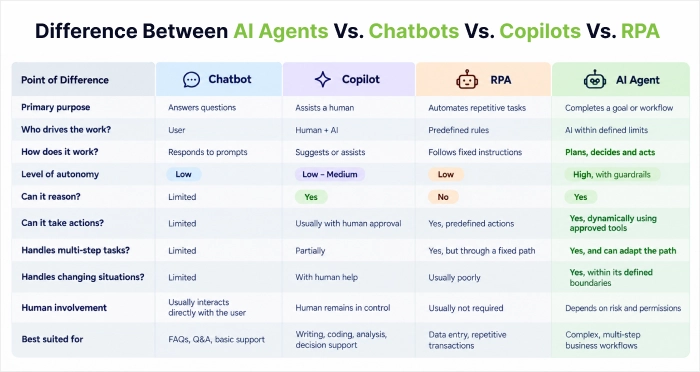
| Point of Difference | Chatbot | Copilot | RPA | AI Agent |
| Primary purpose | Answers questions | Assists a human | Automates repetitive tasks | Completes a goal or workflow |
| Who drives the work? | User | Human + AI | Predefined rules | AI within defined limits |
| How does it work? | Responds to prompts | Suggests or assists | Follows fixed instructions | Plans, decides and acts |
| Level of autonomy | Low | Low–Medium | Low | High, with guardrails |
| Can it reason? | Limited | Yes | No | Yes |
| Can it take actions? | Limited | Usually with human approval | Yes, predefined actions | Yes, dynamically using approved tools |
| Handles multi-step tasks? | Limited | Partially | Yes, but through a fixed path | Yes, and can adapt the path |
| Handles changing situations? | Limited | With human help | Usually poorly | Yes, within its defined boundaries |
| Human involvement | Usually interacts directly with the user | Human remains in control | Usually not required | Depends on risk and permissions |
| Best suited for | FAQs, Q&A, basic support | Writing, coding, analysis, decision support | Data entry, repetitive transactions | Complex, multi-step business workflows |
The core distinction: chatbots and copilots respond to what a person does. Agents can decide what to do next and act on it. That said, the lines blur in practice. Many “copilot” products are adding agentic capabilities, and many agents include a conversational interface. An agent was just something that acted on your behalf. Don’t judge an agent on what it might be able to do, judge it on what it can do now.
What are the Types of Agents in AI?
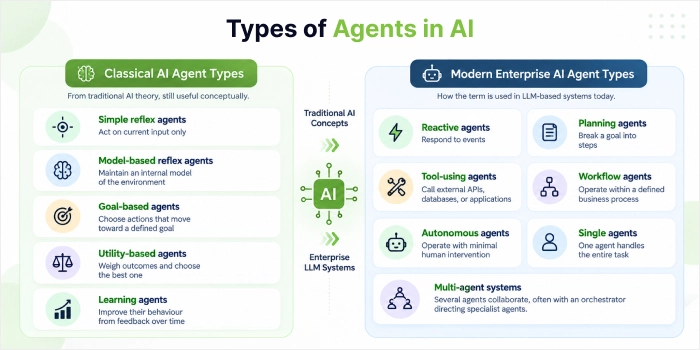
It helps to separate classical AI taxonomy from how the term is used in current enterprise LLM systems, since the two get conflated constantly.
Classical AI Agent Types
From traditional AI theory, still useful conceptually:
- Simple reflex agents act on current input only, no memory
- Model-based reflex agents maintain an internal model of the environment
- Goal-based agents choose actions that move toward a defined goal
- Utility-based agents weigh outcomes and choose the best one, not just any workable one.
- Learning agents improve their behaviour from feedback over time.
Modern Enterprise AI Agent Types
How the term is used in LLM-based systems today:
- Reactive agents respond to events as they occur
- Planning agents break a goal into a sequence of steps before acting
- Tool-using agents call external APIs, databases, or applications
- Workflow agents operate within a defined business process
- Autonomous agents operate with minimal human intervention within their scope
- Single agents have one agent that handles the entire task
- Multi-agent systems have several agents collaborate, often with an orchestrator directing specialist agents.
The classical categories describe general decision-making behaviour. The modern categories describe how today’s LLM-based systems are actually architected in production. Both are useful, but they answer different questions.
How to Build AI Agents?
Building AI agents is an implementation decision, not a coding exercise. The practical path enterprises follow:
- Identify the business problem the agent would actually solve.
- Set concrete, quantifiable goals.
- Find out if an agent is needed, or if automation will do.
- Determine the scope of the agent’s scope of: what it can and can’t do.
- Select your model on reasoning, cost and latency.
- Connect enterprise data so the agent works from accurate, current information.
- Add tools and APIs that give the agent something to act on.
- Design memory and context for the task at hand.
- Define orchestration logic for how steps are sequenced.
- Add guardrails and permissions to limit scope.
- Build in human approval checkpoints for high-risk actions.
- Create evaluation datasets to test accuracy before launch.
- Test in a sandbox against realistic scenarios.
- Deploy gradually to a limited group first.
- Deploy, measure, and iterate on an ongoing basis post-launch.
That’s how you get AI agents to production and not just a demo. Most failed agent projects skip straight from step 5 to step 14.
Single-Agent Vs. Multi-Agent Systems
A single-agent solution is applicable for workflows that are contained, require a minimal set of tools, and where it is possible to encapsulate reasoning and work within a specified bound without losing track of it. Such a solution is manageable in terms of debugging and control.
A multi-agent architecture is worth the added complexity when tasks require genuinely different specialisations, domains are distinct enough that one agent can’t reasonably handle all of them, or an orchestrator needs to break a complex goal into pieces and delegate them to specialist agents.
The principle worth repeating here is to use the simplest architecture that reliably solves the business problem. Multi-agent systems are not inherently more advanced or more valuable. They offer another point of coordination failure. They increase cost. They provide another layer to track. Opt for the complexity needed by the problem, not the one that you’re looking for simply for the cool factor.
When Should Business Use AI Agents?
AI agents are a good fit when the task involves multiple steps that can’t always be predetermined, decisions genuinely depend on context, several systems or tools need to be coordinated, the agent can meaningfully evaluate intermediate results, and there’s a clear, measurable business outcome at stake.
Here are common examples where your agents will fail to deliver optimal results, and you should instead look into using APIs or bots for your workflow; in fact, those solution types are the proper way to solve that. We are the agents, and in case your workflow is. If you feed bad data into it, agents become fast, certain know-it-alls who are constantly making mistakes.
Risks, Security and Governance
Autonomy can potentially add or subtract value to the system, depending on how well it has been implemented. This trade-off one might be better served knowing prior to implementing any system.
Common technical limitations: hallucinated outputs, incorrect tool selection, compounding errors across multi-step tasks, latency, and the infrastructure and model cost of running agents at scale.
Security risks specific to agents, several of which are covered in OWASP’s guidance on LLM and agentic application risks, include prompt injection (malicious instructions hidden in content the agent processes), excessive agency (an agent granted more permission than the task requires), privilege escalation, and unintended or unmonitored actions.
This actually works in practice, not in theory, for governance is a least-privilege access mechanism across all tools that an agent can make calls to, unambiguous identity and access controls, auditable logs of everything, defined decision checkpoints (approval gates for steps with high risk), secure sandboxing testing, throttling and a kill switch. Nothing about any of that is up to chance when dealing with a real customer or real money.
What is Human-in-the-Loop AI Agents?
The goal with enterprise agents isn’t maximum autonomy. It’s appropriate autonomy, matched to the risk of the task.
- Approval before action for high-risk or irreversible actions
- Intervention during execution when the agent hits ambiguity or a policy exception
- Review after execution: sampling completed work for quality control
- Full autonomy should be deployed only on low-risk tasks that have demonstrated their efficacy over time.
The majority of successful enterprise deployments begin with greater human oversight, which is scaled back when the agent demonstrates sufficient maturity.
The Sphinx Solutions Agent Readiness Framework
Before committing engineering time to an AI agent, we walk clients through six questions, in this order:
- Goal: What specific, measurable outcome is this agent responsible for?
- Data: Is the data this agent needs accessible, current, and reliable?
- Tools: What systems and APIs does it actually need to act on?
- Autonomy: Where does it leave up to us to do anything and where can it make an intelligent choice of its own?
- Controls: What permissions, guardrails, and audit trails need to exist before launch?
- Evaluation: How will we know, with data, whether this agent is actually working?
When teams don’t provide all six answers definitively, it is not a matter of readiness to move a project from the concept phase to the building phase. More important than just a tick in the box; it is a matter of building an agent that adds verifiable business value, or becomes an underfunded liability six months in.
Conclusion
The real question enterprises face isn’t “can we build an AI agent?” Most can, with enough engineering effort. The better question is: which business process should become agentic, how much autonomy should it have, and how will you control and measure it once it’s live? Which is really a business and architectural decision. Not necessarily a “use this technology because it’s cool” decision.
If you’re considering an AI-agent approach to any problem, Sphinx Solutions is already equipped to address that precise concern. Whether it’s helping you find your optimal initial workflow or helping design the appropriate governance around it. A conversation to have before writing code.
FAQs:
What’s the difference between AI agents and copilots?
Copilots assist a human who remains in control of the task. Agents can operate independently within a defined scope, though many products now blend both approaches.
What are some AI agent’s examples?
Common examples include customer support resolution agents, sales lead qualification agents, IT incident response agents, and finance agents that flag anomalous transactions.
Is it expensive to build an AI agent?
Cost varies widely based on model usage, integration complexity, and the level of governance required. Simple single-agent workflows cost far less than multi-agent systems with heavy compliance needs.
Are AI agents safe?
They can be, with the proper guardrails. Risks such as prompt injection and unchecked permissions are real, and security researchers have been documenting them for a long time, which is why access controls and human checkpoint are so important.
Can AI agents work with enterprise software?
Yes. Agents typically connect to enterprise systems through APIs and retrieval-augmented generation, allowing them to act on current CRM, ERP, or support data rather than static training data.
What is agentic AI?
Agentic AI is the broader design approach of building systems that plan, act, and adapt toward goals. An AI agent is a specific system built using that approach.
When should a business use AI agents?
When a task has multiple steps that can’t be fully predetermined, involves several systems, and has a clear, measurable business outcome worth the governance overhead.
What are the biggest risks of AI agents?
Excessive permissions, prompt injection, compounding errors across steps, and insufficient monitoring are the most common causes of agent failures in production.
How can enterprises measure AI agent ROI?
By comparing the value created (time saved, errors avoided, faster processing) against the full cost of ownership, including model, infrastructure, integration, and oversight costs, not just conversation volume.

 Shaili Gupta

 Ajay Wadne