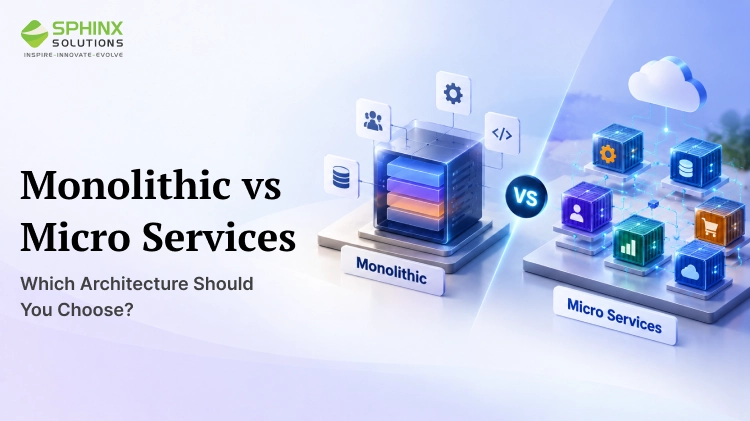
Key Takeaways
- Monolithic architecture keeps an application in one codebase and deployable unit, making it easier to build, test, and manage initially. However, a monolith can become difficult to scale and maintain as the application and development team grow.
- Microservices architecture separates an application into independent services that can be developed, deployed, and scaled individually. They provide greater team autonomy, independent scaling, and fault isolation, but they also bring higher infrastructure and operational complexity.
- Neither architecture is universally better. The right choice depends on product complexity, team size, scaling needs, and operational maturity, and should be based onreal business and engineering needs, not simply because microservices are a popular industry trend.
- A modular monolith can be a practical starting point for many new products because it keeps deployment simple while creating clear boundaries for future migration. When the time comes, moving to microservices works best as a gradual, planned migration, rather than splitting the application into services all at once.
- Netflix and Uber show that moving from a monolith to microservices can solve growth-related problems, but the transition also introduces new challenges. Teams should avoid creating a distributed monolith, where services remain tightly dependent on shared databases or coordinated releases.
A basic question always pop-ups for a software development company’s team i.e.to prefer the most conventional monolithic approach or to go for microservices. Many architecture debates begin the same way.
A product is developing, slowing down the releases, and someone on the team suggests for the breakdown of the application into smaller pieces. The monolithic vs microservices question normally arrives at that moment, and the answer shapes how quickly you deliver, how well you grow, and what you spend on operations for years.
The fact is no model is the only right approach, one can go for in the present time.
The monolith is the older model, and it only runs a many great successful products. Microservices approach is a lateral entry and suit system with teams that have outgrown a single codebase.
This blog article explains in detail about what each approach is, how they differ, how Netflix and Uber handled the change over, and how to decide which fits your team and your business growth plans.
The question: “what is monolithic and microservices architecture?” Needs a right answer before both are compared, because the terms are well versed now.
What Is Monolithic Architecture?
A monolithic application is an application that is constructed, tested, and deployed as an individual unit. The units that comprise the program’s user interface, business logic, and other functions are typically delivered within a common code base. In addition, such an application may have a shared database that is also hosted in the same code base.
Also, a minor code change must go via a full application test and deployment process.
Picture it as one big block where every part leans on the others. That’s why most products start this way. It’s quick to build, simple to deploy, and easy to debug since everything sits in one place. The cracks show as the app grows. The code gets heavier, releases slow down, and if one feature gets busy, you have to scale the whole thing just to keep up. As the team grows, more people end up working in the same code, and it’s easy to trip over each other’s changes. One small bug in one place can bring the whole app down. And switching to a new tool or framework isn’t easy either, since changing one part often means reworking everything connected to it.
What Is Microservices Architecture?
Microservices approach introduces the reverse strategy. The application is divided into distinct business capabilities. Each of them is implemented as an independent service. The services are co-located, but they have their own logic and usually own databases that are connected via API.
Running these independent modules in parallel enables for building, delivering, and upgrading services faster. It develops an opportunity to select a unique software technology tech stack for a specific service, which includes programming languages, frameworks, and tools. It is considered as the significant advantage, even though the wide use of diverse technologies increases the complexity of the system, leading to the necessity of supporting more technologies than expected.
Monolithic vs Microservices Architecture: Key Differences
The monolithic vs microservices difference lies in how an application is structured, deployed, and maintained. The table below puts the differences factor wise.
| Factor | Monolithic | Microservices |
| Structure | One codebase, one deployable unit | Many small services, deployed separately |
| Initial build | Quicker and simpler to plan | More design work up front |
| Scaling | The whole application scales together | Each service scales independently |
| Deployment | Any change redeploys everything | Services are released independently |
| Fault isolation | One faulty module can affect the full app | A failure usually stays within one service |
| Testing and debugging | Central logs, simpler end-to-end tests | Logs spread across services, harder to trace |
| Data consistency | Strong consistency across the system | Often eventual consistency between services |
| Technology choice | Tied to the existing stack | Each team can choose its tools |
| Operating cost | Lower infrastructure and tooling needs | More spend on hosting, monitoring, and automation |
| Team fit | Small teams | Larger teams organised around service ownership |
A monolith keeps things simple, while microservices give teams more flexibility, independence, and the ability to scale different services separately.
Monolithic Application vs Microservices: Pros and Cons
Any feature list can give some part of the entire story. An actual difference between monolithic application vs microservices shows what are the strengths and what are the weaknesses or limits, both approaches possess.
Pros of Monolithic Architecture
- Faster early development. With only codebase, there is not much to design and lesser coordination required, so a small team can work quickly.
- Simple deployment. There is one directory to deliver, and one release process to maintain.
- Easy testing and debugging. All the code, logs are in one place, therefore working on a request from start to end is with rapid speed.
- Good performance for simple flows. Calls happen within a process and skip the network jumps that distributed services depend on.
- Smaller attack surface. Fewer exposed interfaces give enough security.
Cons of Monolithic Architecture
- Scaling is all or nothing. If a feature is overburdened, the complete application must be scaled to relieve it.
- Releases slow down with time. A small change must be tested, redeployed alongside all.
- One fault can spread. A bug in one module can take down the whole product offline.
- New technology is harder to implement or use. Shifting of a framework or language touches each part of the application.
Pros of Microservices
- Independent scaling. Capacity arises for high demand, which keeps effective usage of infrastructure.
- Regular, low-risk releases. Every team delivers its separate service and can roll back without disturbing the other.
- Good fault isolation. When one service gets down, the other will keep running.
- Flexible technology. Teams can pick the tools that suit each service.
- Team autonomy. Ownership follows service boundaries, which works well for large and distributed teams.
Cons of Microservices
- Operational complexity. Service exploration, tracing, monitoring and orchestration all need specialist skills.
- High infrastructure cost. Each service brings independent hosting, pipelines, and test suites.
- Harder debugging. A business process can pass through various services and machines before it finishes.
- Latency, security exposure. More network calls and API gateways add delay and create more points to protect.
- Cluttered ownership. As services expand, it becomes complicated to know what is upcoming and who is answerable for it.
Monolithic vs Microservices Example: Netflix and Uber

Some real-world examples make these differences easier to understand. A monolithic vs microservices examples shows why a company must decide to change its architecture, what the transition is involved for it, and what challenges it may face through this journey.
Netflix and Uber show this better than most. Netflix decided to change after a big database failure in 2008 stopped its DVD shipments for three days. Uber began as one app, for one service, in one city, San Francisco. But as it grew into new cities and added more products, that single codebase became harder to handle.
Let us study below classic examples with their issues and resolutions implemented.
Netflix: Shifted from Monolith to Cloud Microservices
Netflix was struggling to make their infrastructure aligned to the increasing demand for streaming in 2009. The company decided to take their private data centres to the public cloud and decomposed its monolith into microservices, before the term got familiar.
Netflix is running with thousand microservices today and Netflix engineers are deploying code many times in a day. Monolith has delivered the required results in this case but did not long last.
Uber: Rising Beyond Two Monoliths
Uber had two monolithic services in 2012 and 2013. But as the product grew further and the team also expanded, the drawbacks of this approach became evident. Any code change could break the production system, deployments became slower and risky, and rollback processes were complicated. By shifting over to microservices it becomes possible to set up clear owner roles for some services, as well as deploy them independently and fast.
The bill arrived later. By 2020, Uber had about 2,200 critical microservices, and investigating one problem could mean working through around 50 services owned by 12 different teams. Uber’s answer was to group its services into roughly 70 domains, each behind a single gateway. That reduced the time required to onboard a new feature by 25 to 50 percent.
Key Lessons from These Real-World Migrations OR What These Success Stories Teach Us
Theory only gets you so far. Watching how real companies handled the switch tells you a lot more. Neither of these two moved to microservices to follow a trend. They did it because their old setup couldn’t keep up anymore, and they worked out the details on the way, slipping up a few times too. Look past their size and fame, and you’ll find lessons that fit almost any team, big or small. Here’s what they boil down to.
Both companies started with monolith and switched to the new design when their growth became impossible due to their current architecture. The second lesson that Uber taught us is not so obvious.
Although microservices help to resolve the issue of scalability and bring additional complexity into the system, it is necessary to plan the structure and responsible parties from the beginning of the development.
When to Use Monolithic Architecture vs MicroServices?
Taking decision on when to use monolithic architecture vs microservices has nothing to do with technology. But when should your team decide if they want a monolithic architecture or microservices? It has more to do with the makeup of your organization rather than the technology they are using. A rule, called Conway’s Law, states that systems built by organizations tend to have a similar structure to said organization. So, it is important to understand the organization and their maturity rather than just the current state of the industry.
Key Factors to Consider Before Choosing Monolithic and Microservices
There’s no one-size-fits-all answer here. Even Amazon’s Prime Video team moved one of its services from microservices back to a monolith and cut infrastructure costs by over 90%.
So, before you select anyone of them, consider below factors first.
- Stable boundaries: If your team still changes the application architecture every few months, hold off on moving toward microservices. The idea only makes sense when you see stable boundaries of the product elements.
- Operational readiness: Before you even think about decomposing your application, you must have fast and reliable delivery pipelines, quality monitoring and observability tools, and a mature dialogue between Dev and Ops teams. Otherwise, every microservice you create will only add to the complexity of your system.
- Your costs: Apart from the costs of hosting services, decomposing your application will require additional expenditures on tools, infrastructure, and personnel to maintain the system.
- Your data: Most of the time, it’s the relational database that becomes a single point of failure in the system. If your data is highly dependent on each other, you need to plan the schema’s decomposition carefully. If your data is highly dependent, you need to plan your schemas decomposition with awareness.
- Scaling needs: If your app grows at a steady pace, you can see coming, a monolith will cope just fine. But when a few parts keep asking for more power than everything else, it’s smarter to split them off into their own services.
- In the end, choosing the right application architecture is always a matter of business needs. It doesn’t matter what decision you make – either monolithic or microservices-based architecture. The most important thing is to select the most optimal solution for your organization considering existing constraints and be prepared to change your decision if the time comes.
When to Choose Monolithic Architecture?
A monolith is normally the correct choice when below mentioned conditions (factors) exists:
- Your team is small, with around 8 to 10 developers.
- You are still validating the product and speed is very important.
- Deployment is simple and one shared data model works well.
- You have limited DevOps and operations capacity.
When to Choose Microservices?
Microservices are worth only when below mentioned factors or conditions are existing:
- Your team has grown more than 10 to 15 developers and releases keep colliding.
- Different parts of the product have very different growing requirements.
- Teams must deliver on their own.
- You have CI/CD, monitoring, and container orchestration already in place.
- You need powerful fault isolation, or compliance rules need certain functions to be separated.
How to Move from a Monolith to Microservices?
The migration process from monolith to microservices is a gradual process with some steps to follow as per given below.
Here’s the thing about leaving a monolith behind. You can’t just tear it down and rebuild over a weekend. The app still has users, the business still needs it running, and one wrong move can break things nobody expected. Even experienced teams find this hard. In one O’Reilly survey, 37% of people said splitting up the monolith was among their biggest hurdles with microservices.
So, most teams go one piece at a time. They follow the strangler fig pattern, where you pull a single feature out, turn it into its own service, and keep the old system running next to it. Bit by bit, the monolith shrinks until there’s nothing left worth keeping. Netflix, Google, and Microsoft all took this route. Let’s walk through the steps of a monolith to microservices migration you can actually follow.
Migration Steps to Follow
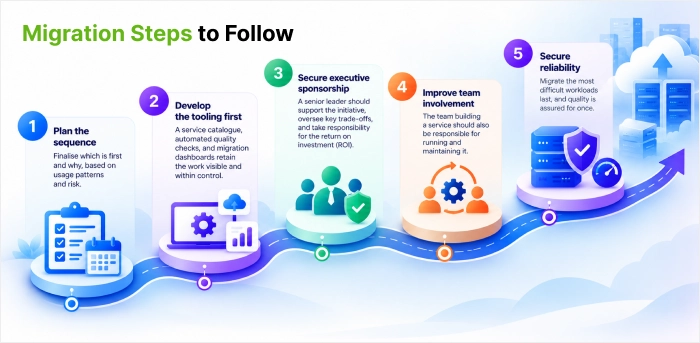
Most of the work happens in the planning that surrounds it. The teams that come out fine are the ones who pick their starting point carefully, get the right people and tools on board, and hold back the hardest parts until they’re truly ready.
- Plan the sequence – Finalise which is first and why, based on usage patterns and risk.
- Develop the tooling first – A service catalogue, automated quality checks, and migration dashboards retain the work visible and within control.
- Secure executive sponsorship – A senior leader should support the initiative, oversee key trade-offs, and take responsibility for the return on investment (ROI).
- Improve team involvement – The team building a service should also be responsible for running and maintaining it.
- Secure reliability – Migrate the most difficult workloads last, and quality is assured for once.
Common Mistakes to Avoid
Even well-planned migrations can slip, and usually it’s down to a few familiar mistakes. The CNCF 2025 survey found 42% of organisations are now merging microservices back into larger units, a sign that many teams split too much or too soon.
Here are two mistakes worth steering clear of.
- The first one is the distributed monolith, where services are deployed solely but still share a database and must be released together. It carries microservices complexity and delivers no independence.
- The second is splitting too early. A team that is not ready for the operational load yet will spend more time in infrastructure management over building the product.
Maintenance Planning and Support: Monolithic vs. Microservices
Life after launch should be considered as well. The distinction between software maintenance vs support emerges as especially relevant when it comes to microservices. The former involves the continuous development and improvement of each service and the latter deals with day-to-day operations-related issues and inquiries.
Both, in the case of dozens of services, require a dedicated owner. In the case when your team does not have the necessary skills and expertise in the field of distributed systems, a custom software development company can fill this gap.
An experienced partner will analyse your product, prefer the most suitable model, and develop or migrate your system with minimal disruption. With a monolith, maintenance is straightforward. There’s one codebase to update, one deployment to manage, and when something breaks, you usually know where to start looking. Microservices flip(turn) that around. Each service has its own code, its own set of dependencies, and its own release timing, so a small security fix you’d push once in a monolith might now need to go out ten separate times. Support gets trickier.
A single slow service can quietly drag down three others, and tracking the real cause means digging through logs, metrics, and traces spread across the whole system. That’s why maintenance and support can’t be an afterthought here. They need to be planned from day one, with clear monitoring in place and someone who knows each service well enough to step in the moment things go wrong.
Conclusion
There is no standard answer to the monolithic vs microservices question. The right architecture is the one which much more align with your team, your product stage, and where you anticipate it should be in a few years.
- A monolith is simple to develop and cost-effective, making it a best choice for smaller teams and emerging products of a business.
- Microservices allow for independent upgrades and faster releases, while isolating failures, but have high operational expenses.
- Team structure and operational maturity are vital than industry hype.
- Modular monoliths are a secured starting point leaving the option of evolving to microservices open.
- Migrations must be done in a stepwise fashion and are well supported by the right tooling, executive sponsorship, and an ownership culture.
If you are not so sure which path suits to your product, connect with our technical experts. As an AI-first software services and digital transformation company, Sphinx can evaluate your current system and develop the architecture your business requires. Book a free consultation today.
FAQs
What’s the difference between monolithic and microservices architecture?
The primary distinction is that in the first architecture design, all functions are combined and deployed together whereas, in the second, there are multiple services, each of which has its code and deployment.
Which is better, monolithic or microservices?
It is based on the context. Monolithic architectures are typically delivered by small teams in a simple product environment. Microservices architectures, on the other hand, are typically delivered by large teams in a complex environment where there is the need for autonomous release and scaling of different components.
When should you split a monolith into microservices?
We recommend that you split a monolith into microservices when the coordination overhead starts getting too high. When there is continuous friction in the coding practices between the different teams and when different parts of the product need to scale in an independent manner. Organizational concerns outweigh the technical concerns.
Should a startup begin with microservices?
Probably not. A modular monolith is usually much better for a startup. We suggest that you should only start considering a transition to a microservices architecture when there are certain business drivers such as the need for extreme scalability and fault isolation and the need for an API-first platform.
Can monolithic and microservices architectures be used together?
Yes, and in many ways, that’s what many companies do. We often see a monolith as the main system with a few microservices that perform payment processing, notifications, and analytics, among other functions.


 Shaili Gupta


 Ajay Wadne