If you step into any enterprise automation strategy meeting, at some point someone will be asking the same question: is RPA dead? It is certainly a valid point. Generative AI has fundamentally changed people’s perception of what software can achieve. Agentic AI now takes pride of place in all vendor keynotes, all analyst reports and all CIO planning slides. In that context, robotic process automation may seem quite old-fashioned. The truth is that 2018 RPA vanished. It has been replaced by a more powerful paradigm: bots that have a common platform with reasoning AI agents, hyperautomation and human-in-the-loop governance. Depending on which layer of the stack you are emphasising, industry analysts call this larger category intelligent automation, hyperautomation or agentic automation. This guide is the most comprehensive answer to “is RPA dead” you will find anywhere online. It features a comprehensive set of detailed comparisons, a practical market outlook, industry-specific use cases, a decision grid, pros and cons and top automation tools. Finally, it answers the most common enterprise questions, making it a complete resource for understanding the future of automation.
Key Takeaways
- Most of the “RPA is dead” message is driven by generative AI hype, fast-moving agentic AIs, and vendors actively dropping “RPA” from their marketing- not by enterprises ditching bot-enabled automation.
- The categories of RPA, intelligent automation, hyperautomation, and agentic AI are layered and additive, not sequential replacements.
- The winning architecture combines each AI agent with an RPA bot, monitored by a human – not one by itself replacing the others.
What is RPA?
RPA full form: Robotic process automation is software that utilises “bots” to imitate human behaviour on digital platforms such as clicking, typing, copying data, reading screens and transferring data from one application to another in order to automate monotonous business tasks that are based on rules without affecting the existing systems. Most RPA platforms share the same basic architecture:
- Recorder / Studio — A developer records or builds a sequence of steps a bot should follow.
- Bot runtime — The attended bots, which operate on the human’s desktop in real time; and the unattended bots, which run on servers constantly.
- Orchestrator — A central console takes care of scheduling, running, logging and managing several crowds of bots, managing exceptions, queue and credentials.
- Connectors and recognition layer — Increasingly AI-powered, this layer lets bots read documents, interpret unstructured data, and interact with modern APIs, not just legacy screens.
Here are some well-segmented Benefits and Limitations of RPA:
| Benefits of Traditional RPA | Limitations of Traditional RPA |
| Pilots can be deployed in weeks rather than months, enabling organizations to realize automation benefits quickly. | Even minor changes to an application’s interface, such as a moved button or redesigned screen, can cause bots to fail and require updates. |
| Integrates with existing legacy systems without requiring expensive infrastructure changes or application re-engineering. | Traditional RPA follows predefined rules and cannot adapt to exceptions or scenarios it wasn’t explicitly programmed to handle. |
| Eliminates fatigue-related errors in repetitive, rules-based processes such as data entry and validation. | Processing emails, scanned documents, handwritten forms, or ambiguous requests typically requires additional AI capabilities. |
| Organizations can easily track productivity gains, hours saved, reduced operational costs, and lower error rates. | Unlike AI-powered systems, traditional RPA cannot interpret context, weigh alternatives, or make intelligent decisions in dynamic situations. |
| Every automated action can be logged, creating detailed audit trails that support regulatory compliance and governance. | As business processes become more dynamic and decision-driven, maintaining and scaling traditional RPA workflows becomes increasingly difficult. |
RPA vs. AI: What’s the Difference?
RPA executes predefined, rule-based steps exactly as programmed; AI interprets data, recognizes patterns, and makes probabilistic judgments. RPA is deterministic (the same input always produces the same output); AI is probabilistic (outputs can vary based on context and learning). They are complementary, not competing, technologies.
| Dimension | RPA | AI |
| How it works | Follows explicit, pre-programmed rules and UI/API steps | Learns patterns from data to make predictions or generate output |
| Data it handles | Structured, predictable data | Structured, unstructured, and semi-structured data |
| Decision-making | None, executes fixed logic | Makes probabilistic judgments and predictions |
| Adaptability | Low, breaks when the environment changes | Higher, can generalize to new, similar situations |
| Transparency | Fully deterministic and auditable | Can be harder to fully explain (varies by model type) |
| Best suited for | High-volume, repetitive, rules-based tasks | Judgment-adjacent tasks: classification, prediction, language understanding |
| Implementation speed | Fast (weeks) | Moderate to slow, depending on model complexity and data readiness |
| Typical role in a workflow | Executes the action | Informs the decision |
Is RPA Really Dead? Why People Think RPA is Dead?
No. RPA is not dead or even dying; it’s just not being replaced by one; it’s being included in a larger automation stack. The “RPA is dead” narrative comes from five converging forces: generative AI’s cultural dominance, the rise of agentic AI, RPA’s own technical limitations, vendors rebranding themselves away from the RPA label, and a natural hype-cycle pattern where a newer technology’s marketing eclipses an older one’s continued, quieter growth.
1. Generative AI Changed What “Smart Software” Means
Before 2023, RPA bots were the easiest to see examples of enterprise automation. Then came large language models, and software could digest a contract, write an email, or interpret a complex question. Next to that, a bot that only follows a fixed sequence of clicks can look primitive even though the two technologies solve different problems.
2. Agentic AI Stole the Spotlight
Agentic AI became a top strategic technology trend, and enterprise interest followed: Gartner has reported more than a 1,400% surge in enterprise inquiries about multiagent systems between early 2024 and mid-2025. When analysts, media, and vendors spend that much airtime on a new category, older categories inevitably feel like they’re being left behind, whether or not that’s actually true.
3. RPA’s Real Limitations Became More Visible
Bots built to follow exact screen paths do break when an application updates. Bots lacking built-in AI-enabled document understanding really do have difficulty with unstructured inputs, and these are tangible, proven shortcomings that are the reason the RPA vendors have been adding AI to their offerings rather than doubling down on the legacy architecture for the past three years.
4. Vendors Are Deliberately Retiring the “RPA Services” Label
UiPath now describes itself as “a global leader in agentic automation” rather than an RPA company. Automation Anywhere calls its platform an “Agentic Process Automation (APA) System.” When the category leaders stopped talking about RPA, then the outsider started thinking the category is dead, but the vendors are still selling RPA services, packaged as powerful AI agents.
5. Changing Enterprise Needs
Enterprises do not only want single-process automation anymore. They want orchestration for end-to-end workflows including structured activities, judgmental decisions and human approvals. RPA was never meant to do all of that, which makes it ‘lacking’ when compared to it, but it is still the most robust tool for executing the structured activities of the broader workflow. The notion that RPA is dead is supported not by enterprises quitting bot automation but by real hype-cycle forces and vendor repositioning. The reality of the technology itself is outpacing the name that was attached to it.
Automations That Are Replacing RPA
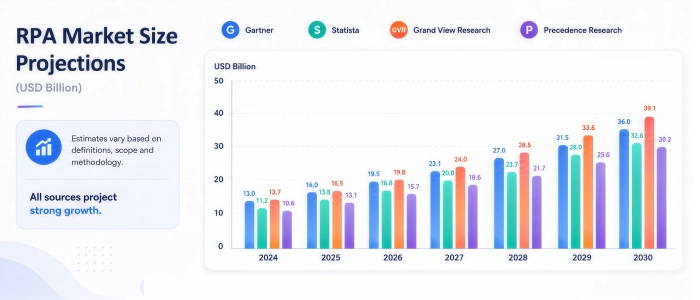
In the market, it is expected that by 2030 RPA will become largely invisible as a standalone product category while becoming more embedded and more essential as the execution layer inside agentic AI platforms, with AI-native, self-healing bots, tighter governance requirements, and consumption-based pricing replacing today’s per-bot licensing models.
Here are some new automations replacing RPA:
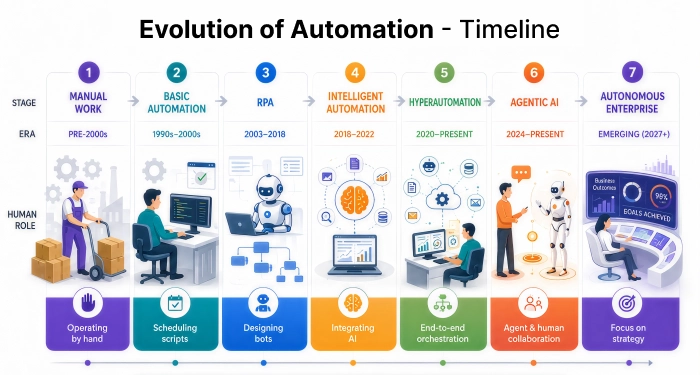
Intelligent Automation
Intelligent automation (IA) combines RPA with AI technologies like machine learning, natural language processing, computer vision, and document understanding so that bots can handle semi-structured and unstructured work and not just rule-based tasks.
Business Value of Intelligent Automation:
Where traditional RPA would handle “copy this field from system A into system B”, intelligent automation would pick up the customer email arriving in the inbox, classify the request, read out the order number, look it up online, and generate a draft reply for a human agent to review. That’s a different, much more valuable level of automation; not merely data movement, but work that is closer to decision-making
Key Difference Between IA & RPA:
| Aspect | RPA | Intelligent Automation (IA) |
| Definition | Automates rule-based tasks using bots | Combines RPA with AI, ML, OCR, and analytics |
| Capabilities | Executes predefined rules | Understands, learns, and makes decisions |
| Data Handling | Best for structured data | Handles both structured and unstructured data |
| Decision-Making | Rule-based | AI-assisted and context-aware |
| Role of RPA | Standalone technology | One component of a broader automation ecosystem |
Hyperautomation
Hyperautomation, a term coined and popularized by Gartner, is a business-driven, disciplined approach to rapidly identifying, vetting, and automating as many business and IT processes as possible using an orchestrated combination of technologies RPA, AI/ML, process mining, low-code platforms, and integration tools (iPaaS) rather than any single tool alone.
Enterprise Benefits of Hyperautomation
Its real value proposition is coverage, rather than automating once at a time on individual bots; hyperautomation creates a governed portfolio approach, identifying, prioritising, building, monitoring, and evolving automation at a corporate level as opposed to a basis.
Agentic Automation
Agentic automation is the practical fusion of agentic AI with enterprise automation infrastructure, AI agents that reason and plan, orchestrated alongside RPA bots and human workers, to execute complete, cross-functional business processes rather than isolated tasks.
Key difference between Agentic Automation and RPA:
| Aspect | RPA (Robotic Process Automation) | Agentic Automation |
| Approach | Automates predefined, rule-based tasks | Automates end-to-end workflows with autonomous AI agents |
| Decision-Making | Follows fixed rules | Makes context-aware decisions and adapts dynamically |
| Learning Ability | Does not learn from experience | Continuously learns and improves using AI models |
| Handling Exceptions | Requires human intervention | Resolves many exceptions autonomously |
| Best For | Repetitive, structured processes | Complex, multi-step, decision-driven workflows |
| Human Involvement | High for exceptions and changes | Minimal, with human oversight when needed |
| Future Readiness | Supports task automation | Enables autonomous enterprise operations |
RPA Trends To Watch Closely
The RPA trends are all pointing in the same direction from standalone bots toward governed, AI-agent-orchestrated automation. The ten RPA trends below matter most for enterprise planning this year.
1. AI copilots inside automation platforms:
All of the big vendors are now offering a natural-language assistant that will create, debug, or clarify a workflow-breaking down the barrier between “citizen developer” and “pro automation engineer.”
2. Multi-agent systems: Instead of one monolithic AI agent, enterprises deploy teams of narrowly specialised agents that hand off work to each other, coordinated by an orchestrator mirroring how human teams divide labour.
3. Workflow and business orchestration:
Platforms like UiPath Maestro and Automation Anywhere’s Mozart Orchestrator are built specifically to coordinate agents, bots, APIs, and people across a single end-to-end case (a claim, a loan, a dispute) rather than a single task.
4. Autonomous operations:
IT operations, network operations, and increasingly finance operations are piloting “detect, diagnose, remediate” loops with limited human checkpoints.
5. Decision intelligence: Structured frameworks for how AI-assisted decisions get made, logged, and reviewed separate from the automation that executes them are emerging as their own discipline.
6. Document AI matures further: Intelligent document processing accuracy on complex, messy real-world documents has improved enough that document-heavy industries (insurance, healthcare, legal, mortgage) are automating higher-stakes document workflows than they would have trusted to software even two years ago.
7. LLMs as the reasoning layer:
Rather than building custom ML models for every decision point, more automation platforms now call general-purpose or fine-tuned LLMs to interpret context and reason through exceptions.
8. Vertical AI agents:
Custom solutions tailored to industry and function—such as healthcare pre-authorisation, insurance claims denials mitigation, and sourcing for procurement—are beating generic, horizontal automation consulting for both accuracy and speed to value.
9. Human-in-the-loop automation, formalised:
Instead of an afterthought, a designed, documented part of the architecture—with structured human checkpoints, approval gates, confidence thresholds that trigger escalation, and audit sampling—these controls are being built in from the beginning.
10. Consolidation among vendors:
Expect continued M&A activity as platform vendors race to own the full stack from process discovery through agentic execution, rather than competing on any single layer alone.
The Enterprise Decision Framework: RPA vs. IA vs. Agentic AI vs. Hyperautomation
Choose traditional RPA for stable, high-volume, rules-based tasks; intelligent automation when you need to process unstructured or semi-structured data; agentic AI when the process requires genuine judgment, planning, or handling novel exceptions; and hyperautomation when you’re ready to manage automation as a governed, enterprise-wide portfolio rather than a collection of individual projects.
| If your process is… | And your priority is… | Choose |
| Stable, repetitive, rule-based, high-volume | Fast ROI, low risk, easy audit trail | Traditional RPA |
| Involves unstructured documents or free-text data, but decisions are still fairly rule-based | Automating perception (reading, extracting) alongside execution | Intelligent Automation |
| Requires judgment, planning, or handling many novel exception types | Flexibility and autonomy, with strong governance in place | Agentic AI / Agentic Automation |
| Spans many processes across departments, with varying levels of structure | Enterprise-wide, governed automation strategy rather than isolated projects | Hyperautomation |
Step-by-Step Decision Process:
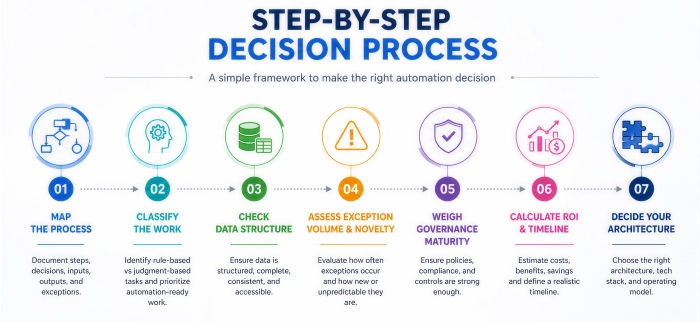
1. Map the process
Document every step, every decision point, and every exception type the process currently handles.
2. Classify the work
Is each step rule-based (if X, then Y) or judgment-based (it depends on context)?
3. Check data structure
Structured data (fields in a database) favors RPA; unstructured data (emails, PDFs, chat) requires an AI/document-understanding layer.
4. Assess exception volume and novelty
High, predictable exception volume can often still be rule-based. Low-volume but highly novel exceptions are where agentic AI adds the most value.
5. Weigh governance maturity
Agentic AI’s autonomy is only safe with strong guardrails, access controls, approval thresholds, monitoring, and rollback capability. If that governance doesn’t exist yet, start with RPA or intelligent automation while building it.
6. Calculate realistic ROI and timeline
RPA and intelligent automation typically deliver measurable ROI within months. Agentic AI can deliver larger returns, but with longer, less certain timelines. Factor this into portfolio planning rather than promising agentic-level ROI on an RPA timeline.
7. Decide your architecture, not just your tool
In most cases, the right answer isn’t “RPA or agentic AI”; it’s designing which layer each technology occupies within a single, orchestrated process.
Benefits of Modern RPA and Intelligent Automation
RPA development benefits compound over time, an enterprise with disciplined RPA practices isn’t just saving hours today, it’s building the process clarity and governance foundation that determines whether its next agentic AI development succeeds or becomes one of Gartner’s cancellation statistics.
Business Benefits
- Reallocates employee time from repetitive tasks to higher-value, judgment-driven work.
- Improves customer experience through faster processing and fewer manual errors.
- Supports scalability without proportional headcount growth.
Technical Benefits
- Non-invasive integration with legacy systems.
- Detailed, automatic audit logging of every action taken.
- Increasingly resilient, self-healing execution as AI-assisted bots mature.
Financial Benefits
- Reduced cost-per-transaction on high-volume processes.
- Faster close cycles and reconciliation, improving cash-flow visibility.
- Lower error-related rework and compliance-penalty exposure.
Operational Benefits
- 24/7 unattended execution without shift constraints.
- Consistent output quality regardless of volume spikes.
- Faster onboarding of new process variations once a governed automation framework exists.
Strategic Benefits
- A foundation for hyperautomation and agentic AI organizations with mature RPA practices have cleaner processes and better data discipline, both prerequisites for successful agentic deployment.
- A documented, auditable process baseline that makes AI governance easier to implement later.
- Deloitte’s research into Global Business Services organizations found that a strong majority consider RPA a key transformation technology, underscoring how embedded it has become in modern operating models.
How Enterprises Should Prepare for Future Automations?
The next few years will separate enterprises that treat automation as a series of disconnected tool purchases from those that treat it as a coherent, governed operating model and the second group will pull decisively ahead.
- Stop asking “RPA or AI?” and start asking “which layer of our automation stack does each technology belong in?”
- Build (or strengthen) a governed automation center of excellence before scaling agentic pilots.
- Prioritize process documentation and data readiness both RPA and agentic AI perform only as well as the process clarity and data quality underneath them.
- Set realistic timelines: RPA-style fast ROI and agentic-AI-style transformational value follow different curves that don’t measure one against the other’s timeline.
- Treat vendor “agentic” claims with healthy scrutiny, and evaluate actual autonomy and reasoning capability rather than marketing language.
If your organization is trying to figure out where it sits on the automation maturity curve and what the next 12 to 18 months should actually look like, that’s a conversation worth having with Sphinx Solutions before committing budget to any specific tool.
Not sure whether your next automation investment should be RPA, AI, or both?
Talk to Sphinx Solutions about a free automation portfolio assessment
Final Verdict: Is RPA Dead?
No. RPA is not dead. From being a stand-alone automation category it’s evolved to be the reliable execution engine for the vast AI development and automation stack.
What replaces the old, standalone “RPA-only” category? Agentic automation platforms where AI agents provide reasoning and planning, RPA bots provide reliable, auditable execution, and humans provide oversight, judgment, and accountability.
What coexists? All of this, at the same time, within the majority of businesses: Manual effort for outliers and exceptions, conventional RPA for predictable, rule-based tasks, intelligent automation for document-heavy processes, agentic AI for “next to judgment” tasks, and hyperautomation managing it all.
Instead of asking “Is RPA dead?”, companies ought to design their right automation architecture by blending RPA with AI wherever possible, and the opportunities are strongest.
A focus should be maintained on robust governance, documented processes, and gradual automation rollout, where we could accept some AI pilot tests that don’t become useful as technologies mature over time. That said, all the facts lead to a simple conclusion: RPA is not dead; RPA grew into a foundational component of intelligent and agentic automation.
FAQ’s:
What is RPA (robotic process automation)?
RPA is software that uses bots to mimic human actions inside digital systems clicking, typing, reading screens, and moving data between applications to automate repetitive, rule-based business tasks without requiring changes to the underlying systems. It’s non-invasive, fast to deploy, and best suited to structured, high-volume, predictable work like data entry and reconciliation.
What is agentic AI?
Agentic AI refers to AI systems, built on large language models, that can autonomously plan, decide, and take multi-step action toward a goal with minimal human supervision. Unlike a chatbot that only responds to prompts, agentic AI actively pursues objectives looking up data, calling tools, and adapting its plan when conditions change closer to how a human employee would work through a task.
Is agentic AI going to replace RPA?
No. Agentic AI needs a reliable way to actually execute the decisions it makes inside enterprise systems, and RPA is that execution mechanism. Analysts, including Gartner, frame RPA as a critical enabler of agentic automation rather than a technology being phased out the two are increasingly deployed together, not as substitutes for each other.
What are the best RPA tools?
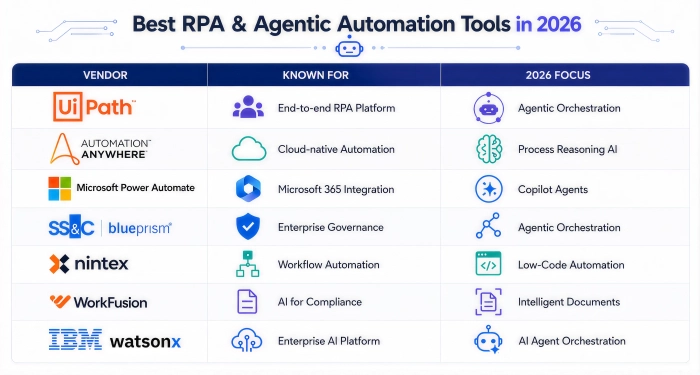
Gartner’s RPA Magic Quadrant currently ranks UiPath, Automation Anywhere, and Microsoft as leaders, alongside SS&C Blue Prism, the category’s original pioneer. Nintex, WorkFusion, and IBM’s watsonx Orchestrate are also widely used, particularly for workflow-centric, compliance-focused, or hybrid-cloud enterprise environments respectively. The right tool depends on your existing stack, budget, and governance requirements rather than any universal “best” answer.
What industries use RPA the most?
Banking, financial services, and insurance (BFSI) represent the largest share of RPA revenue across most market research, reflecting the volume of structured, compliance-heavy back-office work in that sector. Healthcare, retail, manufacturing, and logistics are also major adopters, with healthcare frequently cited as one of the fastest-growing verticals for RPA and intelligent automation investment.
How much does RPA cost to implement?
Costs vary widely based on scope, vendor, and deployment model from free community editions for small pilots to substantial enterprise licensing for large, governed rollouts. Sphinx Solutions has its own RPA ROI Cost Calculator that can give you an estimate for your RPA projects. Calculate Now.
What is the ROI of RPA?
RPA ROI is typically measured in hours saved, error-rate reduction, and cost-per-transaction improvement, and well-scoped projects often show measurable returns within months. ROI varies significantly by process complexity and implementation quality.
Can small and mid-market companies use RPA?
Yes. Low-code interfaces, cloud delivery, and free or low-cost community editions from major vendors have made RPA accessible well beyond the large enterprises that adopted it first. Mid-market companies commonly start with a single high-volume, well-documented process of invoice processing or data entry, for example before expanding their automation portfolio.
How is RPA different from BPM (business process management)?
BPM is a discipline for modeling, analyzing, and improving entire business processes, often spanning multiple systems, teams, and approval steps. RPA is a specific technology for automating individual task-level actions within a process. In practice, they’re complementary: BPM defines and orchestrates the process, while RPA (and increasingly AI agents) execute the steps within it.
What are the main risks of RPA and agentic AI?
Key risks include automation sprawl from uncoordinated bot-building, security exposure from bots and agents holding sensitive system credentials, AI-specific risks like hallucination or model drift, and compliance gaps in regulated industries that require explainability. Gartner attributes most agentic AI project failures to governance and scoping problems rather than weak underlying technology.
What is the future of RPA?
RPA’s future is embedment rather than extinction: expect fewer standalone “RPA platforms” as vendors rebrand around agentic automation, alongside deeper integration of RPA as the trusted execution layer inside AI-driven systems. Self-healing, AI-assisted bots, consumption-based pricing, and formalized governance disciplines are all expected to become standard by 2030.
How does Sphinx Solutions help with RPA and automation strategy?
Sphinx Solutions helps enterprises audit existing automation investments, design the right mix of RPA, intelligent automation, and agentic AI for specific workflows, and build the governance frameworks needed to scale automation safely. The focus is on realistic, phased roadmaps rather than hype-driven, all-at-once transformations that are more likely to stall or be scrapped.


 Shaili Gupta

 Ajay Wadne