Key Takeaways
- AI development is moving beyond the research phase. Businesses now want practical AI solutions that integrate with current systems, with demonstrable business value.
- When you are evaluating potential partners for the development of your AI, it’s important to assess factors beyond just their AI development skills. Strong expertise in software engineering, system integration, system security, or deployment could prove vital to a project’s successful outcome.
- Custom AI can empower businesses with unique processes or data needs, as “black-and-white” solutions or ready-to-use AI tools won’t suit specialised corporate needs.
- For effective AI execution, ensure a seamless road from conception to production, and partner with team members who can assist with discovery, developing, integrating, testing and ongoing refinement, for sustained value.
- Leading AI development agencies bridge both. They understand business and integrate their solutions seamlessly into existing structures that can evolve with the organisation as it expands.
The AI market is full of options like AI development companies, boutique consultants, generalist software agencies, generative AI specialists, and machine learning vendors all pitching some version of “we can build your AI solution.” Few of them are actually the right strategic partner for your specific problem.
Choosing the wrong one becomes a proof-of-concept that never goes to production, a data issue no one highlighted in the early days, a security hole, or a system nobody inside the business can own post-contract. Deciding who is the right AI development partner isn’t about selecting the largest AI team. It’s about working with the one who knows your business problem so well they can say ‘no’ to a bad idea.
What is an AI Development Partner?
An AI development partner is a technology company or specialist team that helps organisations design, build, integrate, deploy, and optimize AI-powered solutions, ideally across the full journey from strategy through use-case identification, data assessment, development, integration, deployment, and ongoing monitoring, not just the build phase in the middle.
This should be differentiated from a ‘deployment-focused AI implementation partner’, ‘strategy-focused, without any delivery component, enterprise AI consulting partner’, ‘plain ‘technology’ provider selling already built product’ or ‘staff-augmentation agency’. The strongest partners blend strategic and technical roles; many providers of artificial intelligence development services only offer one or the other.
Why Do You Need an AI Development Partner?
External AI teams fit most logical business situations when you don’t have one on the inside, you need speed for an initiative, you’re looking into any of the generative AI, legacy, or just validating an idea, to build at first. It’s less necessary when you have a strong internal AI team already, the requirement is simple automation, or an existing SaaS tool already solves the problem, in which case the decision is really about build vs. buy AI, before it’s about partner selection at all.
Why the Wrong Choice Gets Expensive?
Red Flags associated with AI solution provider selection:
- Delivering a technologically rich solution in search of a business problem,
- Underestimated data needs until 6 months into a project,
- Difficulty with integration into existing tech stack, late identified security & compliance deficits,
- Supplier lock-in and a lack of available “off-ramps”,
- Lack of an apparent long-term ability to grow the PoC into scaled AI capabilities,
- AI projects stuck in the PoC phase at 8 different points because there never was consensus on what “production-ready” means.
What is the Difference Between an AI Development Partner and AI Vendor?
| Aspect | AI Vendor | AI Development Partner |
| Focus | Sells a defined product or service. | Solves a broader business problem. |
| Approach | Works with predefined requirements. | Helps define and validate requirements. |
| Customization | Limited to the available product or service. | Builds solutions around specific business needs. |
| Involvement | Mainly focused on project delivery. | Supports strategy, development, deployment, and beyond. |
| Best for | Businesses that know exactly what they need. | Businesses are still exploring or validating an AI solution. |
How to Choose an AI Development Partner?
Choosing an AI development partner is not as simple as comparing company portfolios or checking how many technologies appear on a website. AI projects may have poorly defined business requirements, data that becomes problematic and untidy mid-stream, models that evolve during development and complex integration problems that will not become clear until development has begun.
A good partner should therefore bring more than technical skills to the table. Here are 12 factors worth considering before making a decision.
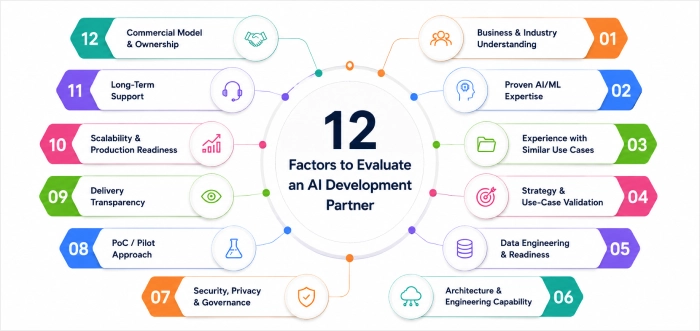
1. Business and Industry Understanding
The discussion should start with the business problem in your organisation, not the list of technologies the firm wishes to sell to your business. A good AI partner will listen to understand what it is that you are looking to improve, automate, predict or solve, before helping decide whether or not an LLM, machine learning model, or something else should be used.
Industry knowledge can certainly help, but the ability to understand a business problem and ask the right questions is often just as important
2. Proven AI and Machine Learning Expertise
The term AI is very broad; not all companies are proficient across all the fields. If your project involves document intelligence, for example, experience in large language models and retrieval systems may matter more than computer vision expertise.
Forget a lengthy technical checklist. Find out whether the team has hands-on experience of the problem you’re trying to solve and be able to justify their methods.
3. Experience With Similar Use Cases
Previous knowledge will shed a little bit of light on how to tackle a challenge a business faces in the real world. You do not necessarily need a partner that has worked in your exact industry, but it helps if they have solved problems with similar levels of complexity.
Find out what their pain points were in earlier projects, specifically how there were concerns with data quality, model performance, or integration and user adoption. Often, the answers they provide here offer more of a view of how they operate.
4. Strategy and Use-Case Validation
Not all business problems should be solved with AI. Not all AI ideas make good sense in business and investment terms either. Before any development even kicks off, your development partner should be supporting you to understand:
This one could include a chat about what we can expect, data, obstacles to setting it all up, and of course, how it will all pay off. It is generally better to identify a weak use case early than to discover the problem after months of development.
5. Data Engineering and Data Readiness
No matter how smart your AI solution might be, it all comes down to data: access to it and the quality of that data are paramount for success. Algorithms may struggle or fail altogether in the face of messy, noisy, empty, and elusive data.
A reliable development partner should be honest about these limitations. They should be able to identify data gaps, recommend improvements, and explain what needs to happen before a solution can perform reliably.
6. Architecture and Engineering Capability
AI solutions typically require more than a simple model to come into existence. After developing our AI model, we may also need to integrate with our database, third-party API, internal database, and other workflows as well.
Consider whether the company has the broader engineering expertise needed to make the solution work within your technology environment. This may include cloud development, system integration, vector databases, APIs, and MLOps.
7. Security, Privacy, and Governance
There will be several risks we have to be aware of on day one that come along with AI. Depending on the use case, this could include sensitive data exposure, access control, regulatory requirements, unreliable outputs, or vulnerabilities such as prompt injection.
Neither security and governance can be just the problem at the bottom of your to-do list until after go-live!. You may be wondering how they plan to implement data access, human monitoring, model behaviour, and compliance in the project.
8. Approach to Proof of Concept and Pilots
The goal of a proof of concept is to find out if an idea is technically viable. However, a proof of concept in and of itself doesn’t qualify an idea as being ready for commercial application. A pilot offers more than this by simulating your real-world working environment.
You want to ensure what success is or looks like for the deliverable and for the product so there should be absolutely no room for assumption before you write a line of code. Having defined metrics you can quickly ascertain if the product should proceed, change or be abandoned.
9. Delivery Transparency
AI projects rarely follow a perfectly predictable path. New issues may appear as the team works with real data or tests the system with users. What matters is how openly the development partner communicates those challenges.
Choose your AI software development partners who involve you with discovery sessions, ongoing demos and feedback sessions with updates on project progress, so there should be no need for you to wait until the product has been shipped in order to know what is being developed and the associated risks.
10. Scalability and Production Readiness
A system that appears seamless with limited interaction might prove problematic or inefficient when scaled to accommodate thousands of requests and millions of users, or massive quantities of data, respectively.
Ask how the company will handle performance, reliability, monitoring, and scaling the solutions during shifting workloads. Ultimately, it’s about demonstrating value beyond a well-executed demo; is this solution viable for a part of your workflow?
11. Long-Term Support and Optimisation
Deploying an AI system doesn’t mean a project is finally over. You might have to continue monitoring the system as user behaviour changes, data shifts, or the model degrades.
Discover life after deployment. After the project hits the go-live date, a reliable partner will be with you to provide maintenance, monitoring, optimisation, and beyond, it shouldn’t just walk away from the project at that point.
12. Commercial Model and Ownership
Finally, the commercial arrangement must be settled. You have to get a grasp on who owns the intellectual property in the source code, trained models, project-specific data, and anything else that’s generated.
Think also how reliant the AI software development partner will be. When transparent, easily navigable documentation is put into place, as well as terms of ownership, maintenance, extending, and even migrating the solution, it is simple in any such future case.
The Sphinx Solutions AI Partner Evaluation Framework
Score a candidate partner against seven questions:
- Strategy: do they understand our business goals?
- Problem Fit: can they identify the right AI use case, not just execute the one we brought them?
- Human Expertise: does the team have genuinely relevant experience?
- Integration: can they work inside our existing systems?
- Scalability: can the solution move beyond a prototype?
- Evidence: can they demonstrate real, verifiable results?
- Governance: can they build secure, responsible AI by design?
A partner who scores well on execution but poorly on Problem Fit and Governance is the most common expensive mistake, they’ll build exactly what you ask for, including the wrong thing.
How to Score in an AI Partner Scorecard?
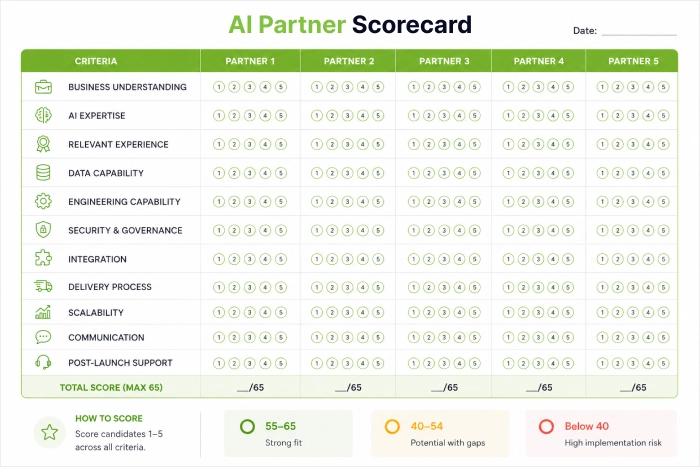
Score candidates 1–5 across business understanding, AI expertise, relevant experience, data capability, engineering capability, security, governance, integration, delivery process, scalability, communication, and post-launch support.
- 55–65 suggests a strong strategic and technical fit.
- 40–54 suggests real potential with gaps worth investigating directly.
- Below 40 signals meaningful implementation risk regardless of how confident the pitch sounds.
What are the Red Flags to Watch For?
- They recommend a solution before understanding the problem.
- They promise AI can solve everything, with no caveats.
- They can’t explain how success will be measured.
- Their case studies describe technology, never business outcomes.
- They wave off data readiness concerns.
- They have no clear security or governance process.
- They’re focused on a demo, not a production path.
- Their pricing is deliberately hard to pin down.
- You won’t own the code or documentation.
- They have no post-launch support plan at all.
How to Compare Multiple Enterprise AI Development Partners?
Determine your business needs and measure the indicators that mean you’ve won before you evaluate anyone else. The first thing you must do is ascertain if your own AI and technical capabilities even exist to implement a solution, much less scale one. Take a shortlisted list of viable providers for chats, technical & strategic ones to understand their capability to provide relevant use cases to your business.
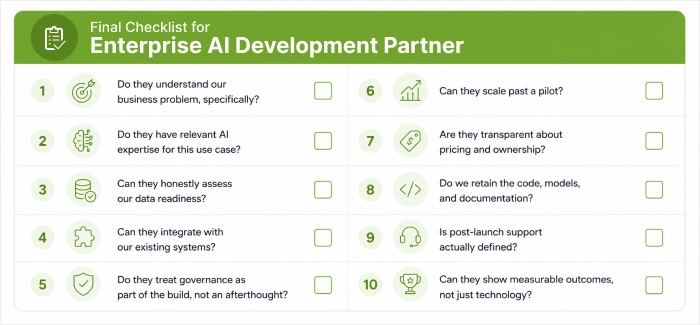
Score them using the framework you build. Pay extra attention to their security & governance stance and kick-start the engagement with a discovery or a pilot program instead of a full-blown development. You could skip evaluating your chosen AI vendor selection criteria against our checklist, including the discovery, provided you skip defining the problem clearly first.
Final Checklist for Enterprise AI Development Partner
Conclusion
A lot of times the best AI development partner for you might not be the company that’s advertising that they have the biggest AI team or they have a hundred technologies listed on their website. That might be them but if they can’t properly understand what the problem in your business is, can confirm or deny it’s actually solvable using AI, if they can actually build something and if they can support you even further down the line to be in production and make sure it keeps working.
If you’re weighing whether to build this capability internally, buy a platform, or bring in outside expertise, that decision connects directly to our Enterprise AI Adoption Framework and AI readiness assessment, worth working through before you start evaluating vendors.
Sphinx Solutions works with enterprises across exactly this journey, from validating the use case through building and supporting it in production, and a discovery conversation is a reasonable place to start if you’re not yet sure what you need.
FAQ’s:
What is an AI development partner?
A technology company or specialist team that helps organizations design, build, integrate, deploy, and optimize AI solutions ideally across the full journey from strategy through production, not just the build phase.
How do I choose the right AI development company?
Evaluate business understanding, relevant AI expertise, data readiness capability, security and governance practices, delivery transparency, and post-launch support together, not technical skill alone, and not price alone.
What should I look for in an AI development partner?
A partner who starts from your business problem rather than a preferred technology stack, can honestly assess your data readiness, builds governance in from the start, and has a clear plan for supporting the system after launch.
How much does it cost to hire an AI development partner?
Costs vary widely by scope, model (fixed-price, time-and-material, dedicated team, or managed service), and whether the engagement includes discovery and ongoing support get commercial terms and ownership clarified before comparing quotes.
Should I hire an AI development company or build an in-house team?
It depends on urgency, use-case complexity, and whether you have in-house AI talent already, this is effectively a build-vs-buy decision, and a strong partner should help you make it honestly rather than assuming the answer is “hire us.”
How long does an AI development project take?
Timelines vary by use-case complexity and data readiness; a discovery phase followed by a scoped pilot is usually faster and lower-risk than committing to a full production timeline upfront.
What questions should I ask an AI development company?
Ask how they identify the right use case, what similar systems they’ve built, how they handle incomplete data, how they secure sensitive information, and what support looks like after launch, not just what technologies they use.
What is the difference between an AI consultant and an AI development partner?
An AI consultant typically advises on strategy without building the solution; a development partner does both validating the opportunity and then designing, building, and supporting the system itself.
How do I know if an AI partner has real expertise?
Ask for case studies tied to measurable business outcomes in a comparable use case, not a list of technologies or a demo. Real expertise shows in how they talk about failure modes and data problems, not just successes.
Should I start with an AI proof of concept?
Often yes, but only with predefined success metrics and a clear criterion for what “ready to move to production” means a proof of concept without that boundary tends to stay a proof of concept indefinitely.


 Shaili Gupta

 Ajay Wadne