Key Takeaways
- AI ROI includes the direct and indirect costs associated with your AI initiatives, but more importantly, the growth in Revenue, productivity, efficiency, customer satisfaction and the strategic business value the technology brings.
- Begin by framing clear business goals and identify your success indicators for AI investments before breaking ground.
- Track AI ROI KPIs (cost savings, productivity, impact on revenue, adoption rates, and ROI or payback period) effectively using appropriate AI ROI metrics.
- Track value and ROI on two timescales: what immediate boosts can AI investments bring, and what’s the long-term ROI over months, years, etc.?
- View your AI ROI as never done. Never forget to keep tracking performance, comparing outputs and costs to adjust your AI efforts in the real world.
Most enterprises can report how many people use their AI tools. Far fewer can answer a harder question: what did we actually get back for the money? Between ‘we adopted AI’ and ‘AI is delivering value’ is a measurement space that consumes huge parts of tech budgets not for AI’s failing but because most organisations measure activity (users, prompts, automation percentage) not the business result.
AI ROI means the business value an AI investment delivers compared to the all-in cost, and to obtain that figure accurately goes beyond a spreadsheet formula. This article lays out a complete framework for measuring it: how to define the outcome, set a baseline, count the real cost, separate leading signals from financial proof, and decide whether to scale, optimise, pause, or stop.
It builds on our Enterprise AI Adoption Framework and connects directly to AI governance and why AI projects fail. ROI measurement is usually where those threads either come together or fall apart.
What is AI ROI?
AI ROI is the actual business return (benefit, value) achieved from an AI investment compared to the total cost of ownership of the AI capability. The conventional formula still applies as a starting point:
AI ROI = (AI-Generated Value − Total AI Investment) / Total AI Investment × 100
That formula alone is insufficient for enterprise AI, though, because it assumes value and cost are both fully known and easy to attribute and with AI, neither usually is.
Indirect benefits (better decisions, not just faster ones), delayed returns, productivity value that doesn’t show up as a line-item saving, and genuine attribution difficulty all mean the formula is a starting point, not the whole answer. Searches for roi ai and AI ROI are asking the same question; this article treats them as one.
ROI full form in AI: ROI stands for Return on Investment. The impact is not in what the term still means, but in how difficult its measurement is, as AI value can appear in operational, financial and strategic terms at the same time rather than in a single cost-saving line.
What is the Difference Between AI ROI Vs. Traditional Technology ROI?
| Traditional Technology ROI | AI ROI |
| Predictable outputs | Probabilistic outputs |
| Easier attribution | Attribution is genuinely complex |
| Benefits defined upfront | Benefits can evolve as the system is used |
| Fixed functionality | Models and behavior can change over time |
| Predictable cost structure | Usage-based costs can fluctuate |
| Conventional financial metrics | Financial, operational, and strategic metrics together |
Why is AI ROI Difficult to Measure?
AI generates a lot of indirect benefits that don’t fit nicely into a dollar amount; saved time doesn’t equate to saved dollars until you put it back to work, turn it into throughput, or use it to buy an employee that you otherwise would have hired.
It can take months to see benefits. Many different factors impact the same business metrics. AI aims to do exactly the opposite, making attribution really difficult. Costs are frequently underestimated; teams tend to consider only license costs, ignoring integration, data prep and personnel costs.
Strategic and risk-related value resists quantification and pilot economics rarely translate directly into production economics, since the pilot ran under conditions production won’t replicate.
What is an AI ROI Framework?
A framework for enterprise AI ROI is a structured methodology for identifying, measuring, attributing, and monitoring the financial and operational value an AI initiative generates against its full lifecycle cost and associated risk, not a single formula applied once at launch.
The Sphinx Solution’s AI ROI Framework
The Sphinx AI ROI Framework is a structured methodology connecting business objective, baseline, value driver, total investment, leading and lagging metrics, attribution, risk adjustment, time-to-value, and a scale/optimize/pause/stop decision. It’s designed to move enterprises from measuring AI activity to measuring AI’s actual financial and operational business impact.
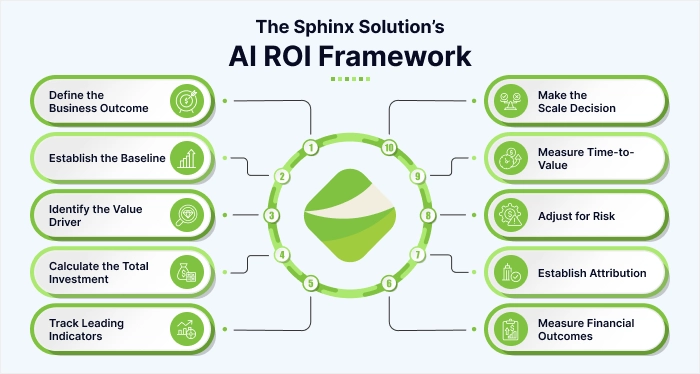
1. Define the Business Outcome:
Begin by selecting the one business measure that the AI project aims to impact. Examples might be to cut costs, raise revenues, improve conversions, or lower error or churn rates. The bottom line is: What number are we trying to change?
2. Establish the Baseline:
Prior to AI adoption, establish a measure of the current state of the process or metric. A dependable benchmark gives you the reference point to judge if the AI truly made a quantifiable difference. Simple question: “What does ‘before’ actually look like?”
3. Identify the Value Driver:
Describe the causal link between the AI capability and the forecasted business value. For example, AI-enabled automation will reduce manual processing hours and consequently reduce costs. The core question is: “How exactly will AI create value?”
4. Calculate the Total Investment:
AI investment extends beyond software licenses or implementation costs. Think development, integration, infrastructure, training, support, and ongoing operational costs. Ask yourself: “What is the real total cost of ownership?”
5. Track Leading Indicators:
It can be a while before you see financial results. It is important to track other leading indicators such as adoption levels, AI accuracy, timeliness, completion rates, and process flow.
6. Measure Financial Outcomes:
Use financial data to quantify the operational benefits. Savings in processing time should have a positive effect on labor costs. Increased personalization should increase the bottom line or conversion rate. So the question is: “Has the baseline business metric improved?”
7. Establish Attribution:
Not every change that happens after AI is implemented was directly caused by AI. Attribution allows us to see if the change was caused by the AI initiative or if it was due to other factors. Ask: “Would this have happened regardless?”
8. Adjust for Risk:
AI ROI should include those risks that could erode or eliminate the value. Examples are hallucinations, security, compliance, model drift, inaccuracy, and operational issues. The question is: “What risk could wipe out the value we anticipate?”
9. Measure Time-to-Value:
Time-to-value is also key. ROI is about how much value AI creates and how fast it does so, so time-to-value can be used as a way of evaluating whether an AI investment is becoming worth it quickly enough.
10. Make the Scale Decision:
Combine financial benefits, operational measures, attribution, risks, and time-to-value to decide on the next move. Using the findings, organizations can either scale up, optimize, put on hold, or discontinue the AI project.
Note: The Sphinx AI ROI Framework is a proprietary framework developed by Sphinx Solutions and is not an industry-certified standard. Its purpose is to provide a consistent approach for evaluating AI initiatives and prevent organizations from relying on ad hoc ROI justifications for different projects.
What Should Enterprises Include in AI Investment Costs?
AI ROI is only credible when the denominator includes the true cost of ownership, not just the software line.
| Cost Type | Includes |
| Direct | Software/API fees, cloud and compute, development, integration |
| Indirect | Data preparation, training, change management, governance, compliance, monitoring |
| Hidden | Failed pilots, rework, workflow redesign, opportunity cost of the team’s time |
Teams that only count direct costs routinely overstate ROI by a wide margin, because the indirect and hidden categories above are frequently larger than the software fee itself.
How to Measure the Impact of AI on Business?
AI’s influence in business is comprised in four broad areas, and mistaking them is a common measure.
- Cost reduction: automation, lower processing and support cost, fewer error-related losses.
- Revenue growth: higher conversion, personalization, retention, new AI-enabled products.
- Productivity and capacity: hours saved, faster cycle time, higher throughput; critically, hours saved only becomes financial value once it’s redeployed to revenue work, used to raise throughput, or used to avoid a hire otherwise it’s just capacity sitting unused.
- Risk reduction: fewer fraud incidents, better compliance, fewer operational errors, estimated as avoided cost without overstating certainty.
AI ROI Metrics: What to Actually Measure?
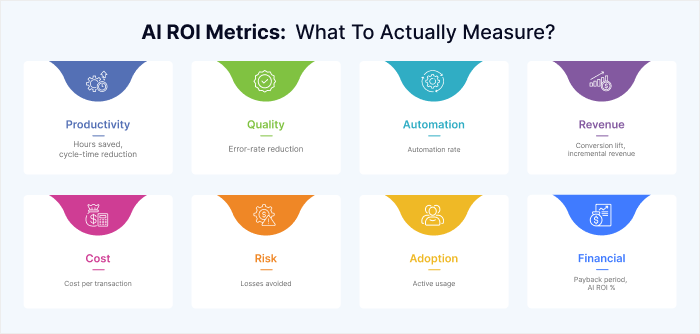
| Category | Metric | What It Shows |
| Productivity | Hours saved, cycle-time reduction | Efficiency and process improvement |
| Quality | Error-rate reduction | Accuracy |
| Automation | Automation rate | Workflow impact |
| Revenue | Conversion lift, incremental revenue | Financial impact |
| Cost | Cost per transaction | Unit economics |
| Risk | Losses avoided | Risk reduction |
| Adoption | Active usage | Whether people actually use it |
| Financial | Payback period, AI ROI % | Overall return |
- Leading indicators: adoption, accuracy, cycle time, automation rate, these metrics show whether value is developing.
- Lagging indicators: revenue, cost savings, margin, retention, these metrics confirm whether it actually did.
- Track both leading and lagging indicators: The problem is that the leading indicators alone can be deceptively positive for months before a financial outcome even manifests, and lagging indicators alone are too late to do any good when a failing project is underway.
Measuring ROI Across the AI Lifecycle
The ROI question changes as an initiative matures.
In AI experimentation, measure technical feasibility, accuracy, and cost per task.
In AI pilot, measure baseline improvement, adoption, and workflow performance.
In AI production, measure financial outcomes, reliability, and cost-to-serve.
At AI scaling, measure enterprise-wide value, portfolio ROI, marginal cost of extending the capability, and reuse across teams.
Applying production-stage rigor to a pilot or pilot-stage looseness to a production system, is a common source of misleading ROI claims in both directions.
How to Calculate AI ROI?
Let’s understand how to calculate AI ROI with an illustrative example:
A company invests ₹50 lakh in an AI-powered customer support system.
Implementation cost = ₹35 lakh;
Annual operating cost (compute, monitoring, maintenance) = ₹15 lakh.
After six months, the team measures:
- 20% of support hours recovered, valued at ₹18 lakh annually in redeployed capacity
- a 4% improvement in customer retention, valued at ₹12 lakh in retained annual revenue;
- reduced escalation-related costs worth ₹5 lakh.
Total measurable annual value = ₹35 lakh.
Net benefit in year one: ₹35 lakh – ₹50 lakh investment – ₹15 lakh operating cost = a first-year shortfall.
But from year two onward, ₹35 lakh in value against ₹15 lakh in ongoing cost yields a 133% annual ROI with payback completing partway through year two.
Note: This is an illustrative calculation, not a real client result, the structure, not the specific numbers, is what transfers to your own initiative.
The Enterprise AI ROI Scorecard
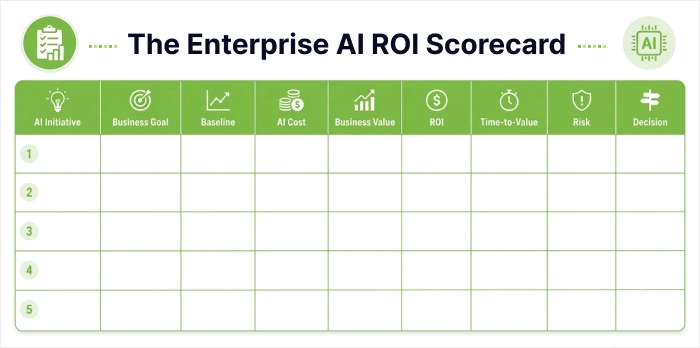
Fill one row per initiative and review it monthly or quarterly with finance in the room. The value of this scorecard isn’t any single row, it’s seeing the whole portfolio side by side, which surfaces the initiatives quietly consuming the budget with no row worth filling in.
What are the Common AI ROI Measurement Mistakes to Avoid?
- Measuring activity like users and prompts instead of business outcomes.
- Skipping the baseline, so “improvement” has nothing real to compare against.
- Counting all time saved as cost saved, when unused capacity isn’t money.
- Underestimating implementation cost by ignoring the indirect and hidden categories above.
- Measuring pilot economics and assuming they hold at production scale.
- Ignoring adoption; a system with strong theoretical AI ROI and low usage delivers neither.
- Claiming causation as no evidence for attribution attempts be it through a control group, a phased rollout, or a before & after approach.
- Trying to track every possible metric instead of anchoring to the one business outcome from Stage 1.
What Is an AI ROI Consultant, and When Do You Need One?
An AI ROI consultant plays an important role in use-case prioritization, ROI modeling, baseline creation, KPI selection, cost modeling, attribution design, and portfolio-level reporting to the board.
Internal AI teams are often sufficient when the organization already has clean baseline data and finance is comfortable validating AI-attributed value.
External expertise tends to help most when multiple business units are running AI adoption independently with no comparable measurement approach, or when the board is asking for portfolio-level ROI reporting that no one internally has built before.
This isn’t a decision to make defensively, it’s a capacity question, not a competence one.
Conclusion
The aim is not to demonstrate AI’s worth in theory because that’s rarely in question anymore. The purpose is to demonstrate where, how, how much and with how high a degree of certainty an investment in AI generates business value, so the next investment will be made based on solid argumentation and not on momentum.
It simply means running every initiative through the same cycle: measure the baseline, attribute the change, validate it against finance, optimize what’s underperforming, and scale only what the evidence actually supports. Enterprises that build this discipline once tend to reuse it across every future AI investment which is the real payoff of building an AI ROI framework instead of a one-time calculation.
FAQ’s:
What is AI ROI?
AI ROI is the measurable business return an AI investment generates relative to its total implementation and operating cost, spanning financial, operational, and strategic value rather than a single cost-savings figure.
How do you calculate AI ROI?
Define the business baseline, total the full investment cost, measure the resulting financial and operational change, attribute that change to AI specifically, and divide net value by
Total cost = (Value − Investment) / Investment × 100.
What is the ROI full form in AI?
ROI stands for Return on Investment. AI doesn’t change the definition, it changes the difficulty of measurement, since AI value often spans multiple business dimensions rather than one clean line item.
Why is AI ROI difficult to measure?
AI ROI is a bit difficult to be measured and calculated because AI creates indirect and delayed benefits, costs are frequently underestimated, attribution is genuinely complex, and pilot-stage results rarely translate directly into production-scale economics.
What is a framework for enterprise AI ROI?
An enterprise AI ROI framework is a structured methodology connecting business objective, baseline, cost, leading and lagging metrics, attribution, and risk into one repeatable process, rather than a single formula applied once.
What metrics should businesses use to measure AI ROI?
Track leading indicators (adoption, accuracy, cycle time) alongside lagging indicators (revenue, cost savings, retention) together: leading indicators alone can look promising for months before any financial result appears.
What costs should be included when calculating AI ROI?
Direct costs (software, compute, integration), indirect costs (data prep, training, governance, monitoring), and hidden costs (failed pilots, rework, opportunity cost); omitting the last two categories is the most common way ROI gets overstated.
What is an AI ROI consultant?
An AI ROI consultant helps enterprises build ROI models, select KPIs, design attribution methods, and report AI value at the portfolio level most useful when multiple business units need a consistent measurement approach.
How long does it take to see ROI from AI?
Timelines vary by use case, but time-to-value as the gap between investment and measurable benefit; should be tracked explicitly, since a faster, smaller return can be preferable to a theoretically larger one that takes years to materialize.
How can companies measure AI productivity gains?
Track hours saved and cycle-time reduction as leading indicators, but confirm the financial value only once that capacity is redeployed to revenue work, used to raise throughput, or used to avoid additional hiring.


 Shaili Gupta

 Ajay Wadne