Key Takeaways
- How do CEO’s demonstrate ROI on AI investments in the business rather than in the CIO’s department’s tech spend?
- Best AI investments are not those that use the most advanced technology or cost the most dollars. Go for high Business Value, ready for prime time, scalable, and strategic fit for your organisation.
- From data quality to infrastructure and talent, as well as governance, security, and workforces, it’s the factors that will enable you to ensure the success and unlock long-term value of the initial AI investment into your organisation.
- Every single AI solution should have a benchmark, return, investment, time frame, as well as the decision for the same to scale, stop, or continue.
- Balance Core, Growth, and Transform initiatives to improve today’s operations while building new sources of revenue and competitive advantage for the future.
AI investment is no longer a technology decision for the CIO and CTO. Rather, it’s a capital allocation choice for the CEO that impacts growth, productivity, customer service, operations and competitiveness. Simply buying more AI does not provide more value.
CEO’s today aren’t short on AI budget anymore; they’re short on a way to decide where that budget should go. The real challenge is knowing where to invest in AI, how much to invest, and which AI initiatives deserve to scale. From generative AI and intelligent automation to AI-powered products and enterprise data infrastructure, organisations have more investment opportunities than ever, but limited resources to pursue them all.
The smart investment in AI approach should therefore begin with the business outcome rather than the technology. CEOs require a clear assessment of whether to invest in an AI proposition based on return on investment, strategic worth, organisational readiness, risk, scalability, and time to value.
This guide will cover the ways business executives can approach enterprise AI investment as portfolio and improve their decisions with AI’s long-term measurable value.
How Should CEOs Think About Investing in AI?
CEOs must consider investments in AI in the same frame they consider any capital investment: based on expected value to the business, capacity to support business differentiation and competitive advantage, and an understanding of the risks. Not based on what their competitors are spending, or how flashy a demo can be.
That involves defining the business problem before defining the tech, prioritising a portfolio of use cases rather than throwing a Hail Mary behind every proposal simultaneously, clearly defining at the start the data that would lead to funding scale or stopping an initiative, and defining success in terms of business outcomes, not the number of pilots initiated. The point is to spend more on AI, not to spend the money wisely and in the right sequence, with a path to discovering what works.
McKinsey’s 2025 State of AI survey found 88% of organisations now use AI in at least one business function, yet only 39% can point to any enterprise-level EBIT impact, and just 6% qualify as high performers capturing real financial return. The bottleneck isn’t spending. It’s the absence of an investment discipline that treats AI the way a CEO would treat any other capital allocation decision.
What’s the Difference Between AI Spending and Strategic AI Investment?
| AI Spending | Strategic AI Investment |
| Licenses and tools | Business capability |
| Disconnected experiments | Measurable outcomes |
| Pilots that stay pilots | Scalable use cases |
| Technology-first decisions | Business-first decisions |
| Short-term activity | Portfolio value over time |
| Treated as a cost centre | Treated as value creation |
Buying AI tools doesn’t automatically create enterprise value. Gartner’s 2025 research found 72% of CIOs report their organisation’s AI investments are breaking even or losing money, and only 38% rate their progress toward AI value creation as good or excellent. The difference between the two columns above is usually the difference between those two groups.
Questions Every CEO Should Ask Before Investing in AI
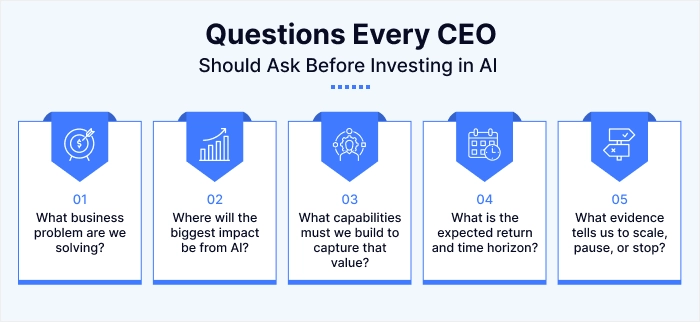
Q1. What business problem are we solving? Not “what can AI do,” but which specific outcome cost, revenue, risk, speed- this investment is meant to move.
Q2. Where will the biggest impact from AI? Several workflows pay for themselves many times over per dollar invested. Look for these places before you invest widely.
Q3. What capabilities must we build to capture that value? The model itself rarely matters as much as data, talent, and governance ability.
Q4. What is the expected return and time horizon? A defined number and date, not a vague expectation of “efficiency gains.”
Q5. What evidence tells us to scale, pause, or stop? Decide the criteria before the money is spent, not after results are disappointing.
A CEO who can’t answer all five for a proposed AI initiative isn’t ready to fund it yet, regardless of how compelling the technology pitch is.
Where AI Investments Actually Go?
A CEO’s investment in AI shouldn’t be limited to the purchase of AI tools, nor should it stop at deploying new AI models. When planning for AI, a CEO’s considerations should extend to the full suite of capabilities needed to build, deploy, govern and scale AI.
1. Use Cases & Workflow Transformation
Work on business problems for which AI provides a clear win for things that impact efficiency, cost, speed, or customer experience.
2. Data Foundations
Ensure that data quality, accessibility, integration, security and governance receive adequate investment. The foundation for reliable AI should always be reliable data.
3. Infrastructure & Technology
This encompasses all aspects ranging from cloud infrastructure and AI platforms to model APIs, integrations, and the associated monitoring tools that are ultimately used to deploy AI at scale.
4. Talent & Workforce Capability
Recruit, train, and upskill to have a healthy mix of AI expertise, industry experience, leadership, and full organisation AI knowledge.
5. Governance, Security & Risk
Design mechanisms that deal with data privacy, cybersecurity, compliance, risk modelling, intellectual property, and trustworthy AI.
6. Change Management & Adoption
Ensure training, communication and revised business processes enable and motivate employees to adopt AI. Provide sound change management.
7. AI-Enabled Products & Revenue
Don’t stop with cutting costs. AI can generate new products, services, customer experiences, and new sources of revenue, too.
Our AI Readiness Assessment and Enterprise AI Governance guides go deeper on the second, third, and fifth rows; this article focuses on how a CEO should allocate across all seven, not just the technology line.
The Sphinx AI Investment Priority Score
Most enterprises rank AI investments by executive enthusiasm rather than a comparable score. Use this simple model instead: score each candidate initiative 1–5 on business value, strategic differentiation, data readiness, and scalability, then subtract scores for implementation complexity and risk.
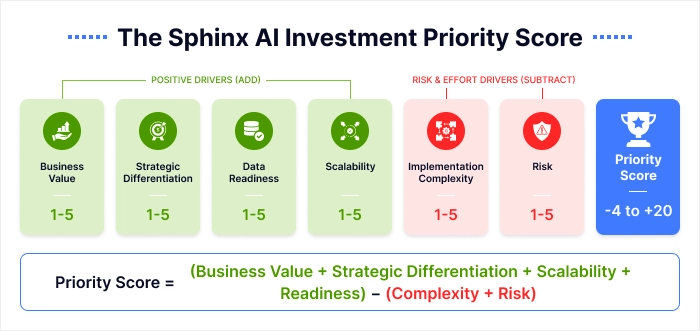
Priority Score = (Business Value + Strategic Differentiation + Scalability + Readiness) − (Complexity + Risk)
The loudest proposals don’t get funded first; the best ones do. A use case with strong business value but poor data readiness should be parked, not funded, until that specific gap closes; a lower-value initiative with near-zero complexity and risk may still be worth funding early because it builds organisational muscle for what comes next.
This is a practical Sphinx scoring model, not a certified financial methodology; its value is forcing a consistent comparison across a genuinely apples-to-oranges set of proposals.
How Much Should a Company Invest in AI?
There isn’t one right percentage across industry, and that is good – the ‘right’ budget depends on industry, AI maturity, data maturity, and competitive forces and not on some percentage from an unrelated company’s 10-K.
The three postures are three useful initial frames for thinking:
- Conservative: productivity and automation in low-risk areas.
- Growth-led: value workflows, customer experience, and products built with AI.
- Transformation-led: the business model and decision-making based on AI.
The right question isn’t “what percentage of revenue should we spend on AI”; it’s “what level of investment is justified by the value opportunity, and by our actual ability to capture it.” A company that hasn’t closed its data and governance gaps yet shouldn’t fund transformation-level investment no matter how large its budget is.
Build vs. Buy vs. Partner
| Approach | Best For | Main Risk |
| Build | Capabilities that differentiate you competitively | Cost, complexity, and time to value |
| Buy | Commodity capabilities available off the shelf | Vendor dependence, limited differentiation |
| Partner | Specialised transformation work outside core expertise | Integration complexity and external dependency |
The discipline that matters more than any single choice: build only where the capability is genuinely differentiating; buy or partner for everything else. Enterprises that default to building commodity capability burn scarce engineering capacity that should be funding the differentiating third of the portfolio.
How to Measure AI ROI?
AI ROI differs from conventional technology ROI because the value shows up across more categories than a typical software deployment and because some of the most important indicators lead the financial results rather than following them.
| Metric | What It Measures |
| Cost per transaction | Efficiency |
| Cycle time | Process improvement |
| Revenue per employee | Productivity |
| Conversion rate | Revenue impact |
| Customer retention | Customer value |
| AI adoption rate | Workforce uptake |
| Model accuracy | Technical performance |
| AI-generated revenue | New business value |
| ROI / ROIC | Overall financial return |
CEOs should track business outcomes, not the number of pilots launched or licenses purchased; activity metrics are the easiest to report and the least connected to whether the investment is actually working.
Why AI Investments Fail to Deliver ROI?
The pattern is consistent enough to predict: investing before the business problem is defined, funding fragmented pilots instead of a coordinated portfolio, weak data foundations, no accountable executive owner, governance added after deployment, and most expensively failing to fund the scaling stage once a pilot proves out. We cover this failure pattern and its fixes in full in Why Enterprise AI Projects Fail; the short version for a CEO is that most ROI failures trace back to a decision made at Question 1 or 2 above, not a flaw in the technology itself.
What is The AI Investment Portfolio?
Don’t use everything for experimental purposes. Divide your AI portfolio into three groups, so you can purposefully allocate funds for all three, rather than investing everything into a single project:
- Core: Low-risk initiatives that improve current operations (automation, productivity tools).
- Growth: Initiatives that create measurable new revenue or competitive advantage (customer experience, new AI-enabled workflows).
- Transform: Longer-horizon bets that could reshape products or the operating model itself.
A portfolio weighted entirely toward core plays it safe but rarely produces a competitive edge; one weighted entirely toward transform is high-risk with a long, uncertain payback. Most businesses require an intentionally crafted balance reviewed on a fixed schedule, not something that happens accidentally.
When to Scale, Pause, or Stop an AI Investment?
Scale when business value is proven, adoption is strong, unit economics improve with volume, and the capability can be reused elsewhere.
Pause when data or readiness gaps emerge, adoption is lower, or the ROI assumptions truly require re-evaluation before investing additional capital.
Stop when the business case no longer holds, risk outweighs value, the use case structurally can’t scale, or a better alternative has emerged.
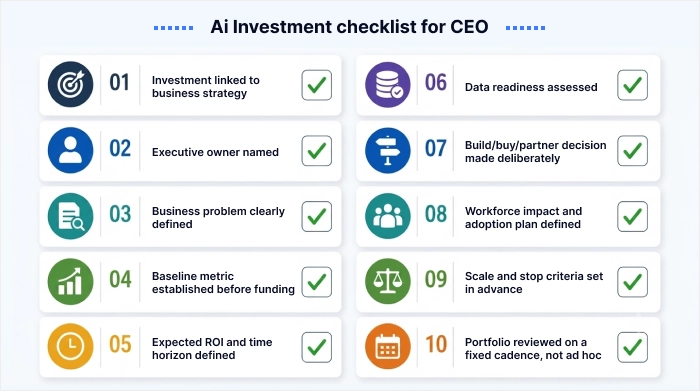
Deciding these criteria in advance, before the initiative is funded, is what separates a portfolio decision from a sunk-cost decision made under pressure six months later.
What is the Difference Between AI Investment vs. AI Stocks?
| Aspect | Investing in AI for Business | Investing in AI Stocks |
| Meaning | Allocating company resources to build AI capabilities | Buying shares of AI-related companies |
| Focus | Enterprise growth, efficiency, innovation, and transformation | Financial returns from equity investments |
| Examples | AI platforms, data infrastructure, talent, automation, governance | AI-related companies such as Microsoft, Nvidia, or Google |
| Decision-makers | CEOs, CFOs, CIOs, CTOs, and business leaders | Individual or institutional investors |
| Key criteria | Business value, ROI, readiness, risk, scalability, and time to value | Valuation, financial performance, market conditions, and growth potential |
| Search intent | “Investing in AI,” “AI investment strategy,” “enterprise AI investment” | “AI stocks,” “top AI companies to invest in,” “AI stocks list” |
| Goal | Build capabilities that create measurable business value | Generate financial returns |
What 12-Month AI Investment Plan
Successful AI investments should be developed in stages, not through enterprise-wide transformations. CEOs can follow a 12-month roadmap from discovery to proof and finally to scale.
Months 1–3: Diagnose
Initiate by outlining AI strategy and potential business value, carry out an AI readiness assessment, identify high-impact use cases and prioritise initiatives by business value, feasibility, risk and expected ROI.
Months 4–6: Prove
Move selected opportunities into pilot projects. Consider high-value use cases, measure baseline metrics, and define controls and risks. Ideally, test whether business value can be realised before scaling up efforts.
Months 7–9: Scale
Take successful pilots into production. This phase should comprise process redesign, technology implementation, employee adoption, as well as infrastructure upgrades to support an in-place deployment long-term.
Months 10–12: Optimize
Review portfolio performance and return on investment. Scale initiatives that provide value and put on hold initiatives that do not, or where should you look for your next best AI investment.
It’s not to get AI everywhere in 12 months. It is to be able to have a repeatable process of being able to identify, get and prove and scale and optimise AI investments.
Conclusion
The CEOs getting real return from AI aren’t the ones spending the most; BCG’s 2025 research found only 5% of companies have become genuinely “future-built” with AI in production at scale, while 60% report generating little material value despite real investment.
How is their approach different? Simply using AI capital allocation with the same rigour one would use for any large investment, involving: A distinct business problem; An equivalent way to score contenders; Funds wisely broken into a portfolio, rather than a single, large gamble; Stop-Loss rules determined before a nickel is spent. That discipline, not simply having a large budget, is the factor transforming AI expenditure into AI investment.
FAQ’s:
What does investing in AI mean for a company?
It means allocating capital toward AI capabilities, use cases, data, technology, talent, and governance that are expected to produce measurable business value, evaluated with the same rigour as any other capital investment decision.
How should CEOs evaluate AI investments?
By scoring proposals on business value, strategic differentiation, data readiness, and scalability against their complexity and risk, then funding the highest-scoring initiatives first rather than the loudest or most technically impressive ones.
What are the best AI investments for enterprises?
There’s no universal answer; the best investments are the specific use cases that score highest on your organisation’s own business value, feasibility, and data readiness, which is why a comparable scoring model matters more than a generic list.
How much should companies invest in AI?
There’s no correct percentage of revenue; the right budget depends on industry, AI and data maturity, and competitive pressure. The better question is what level of investment is justified by the value opportunity and your actual ability to capture it.
How do you calculate AI ROI?
Track financial metrics (cost savings, revenue impact) alongside operational, adoption, and AI performance metrics together, benchmarked against an internal baseline captured before launch, not against vendor benchmarks or pilot enthusiasm alone.
Should companies build or buy AI?
Build only where the capability is genuinely differentiating and proprietary; buy or partner for commodity capabilities. Defaulting to build for everything wastes engineering capacity that should fund the differentiating part of the portfolio.
What is the biggest mistake CEOs make when investing in AI?
Funding technology before defining the business problem it’s meant to solve, and funding many disconnected pilots in parallel instead of a prioritised, sequenced portfolio.
How long does it take to see ROI from AI investments?
It varies widely by use case and organisational readiness; what matters more than a fixed timeline is defining the expected return and time horizon before funding, so results can be evaluated against a real target rather than shifting expectations.
What’s the difference between investing in AI and investing in AI stocks?
Investing in AI as a business means allocating corporate capital to build AI capability; investing in AI stocks means buying equity in AI-related companies. They are different decisions, made by different people, evaluated with entirely different criteria.


 Shaili Gupta

 Ajay Wadne