
Key Takeaways
- AI projects fail more often from organisational and strategic weaknesses than from model capability. McKinsey and MIT’s research both point to the same conclusion using different methods.
- Every failure mode above has a specific, fundable fix, not just a diagnosis. Solutions belong in the original project plan, not a post-mortem.
- Executive ownership and workflow redesign are the two practices most strongly associated with AI value in McKinsey’s 2025 research.
- A successful demo is not evidence of successful enterprise adoption; only about a third of enterprises have reached the scaling stage at all.
- The objective is repeatable business value, not the number of AI experiments launched.
An organisation can have executive sponsorship, a large AI budget, access to the best available models, and several pilots already running, but still fail to produce measurable enterprise value. This is such a common result that is that it is no more consiidered as an exception but an expected outcome.
One reason we find it hard to understand why enterprise AI projects fail is that it’s not so much about over-diagnosing the one broken part as about seeing strategy, data, governance, integration, people, and economics as separate issues rather than parts of a managed whole.
This blog identifies patterns of AI adoption failure, proposes an original framework for how one weak decision triggers the next, and provides executives with a simple method to identify a failing project before it becomes costly. It builds directly on our enterprise AI adoption framework, which covers how to structure adoption from pilot to production; this piece focuses specifically on where that structure breaks down.
Why do Enterprise AI Projects Fail?
Enterprise AI projects fail most of the time because organisations begin with the technology rather than a business need, pick the visible over the feasible use case, underestimate all that’s required for production-ready data and integration, and add in governance and change management as afterthoughts rather than requirements. What’s left is the standard mold of technically valid Pilots without replicable business value.
Enterprise AI failure usually isn’t a story about a model that didn’t work. It’s a story about a model that worked fine in a demo and never became a business outcome. Progress through an AI adoption typically looks like this:
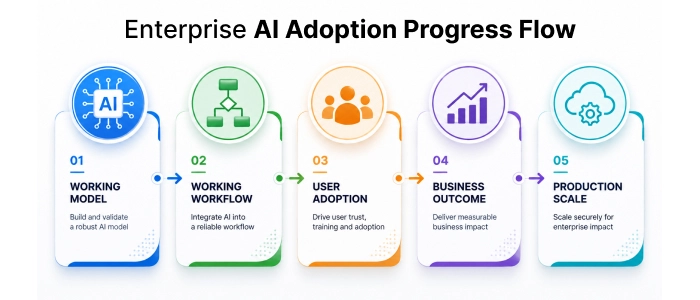
Most failed projects never get past the first stage, because the organisation stops measuring success there.
Almost every enterprise now uses AI somewhere. McKinsey’s 2025 Global Survey on AI puts regular use in at least one business function at 88% of organizations. Almost none of them are turning that use into enterprise-level financial results. Only 6% qualify as “AI high performers” with 5% or more EBIT impact and arrive at the conclusion that AI adoption is nearly universal, and value is rare.
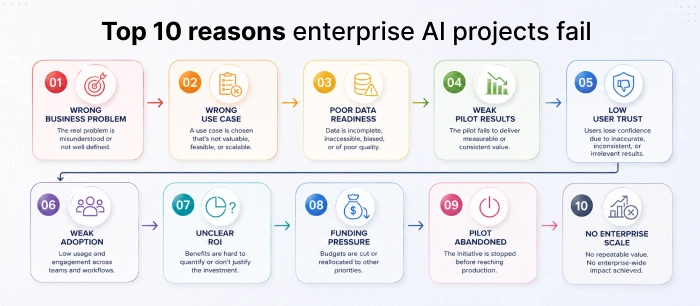
10 Reasons Enterprise AI Projects Fail
Enterprise AI failure is rarely caused by one isolated mistake. It’s usually a chain reaction, where one weak decision quietly produces the conditions for the next.
A successful AI demo is not evidence of successful enterprise AI adoption. An AI chatbot that answers questions correctly in a controlled test says nothing about whether it will be trusted by frontline staff, integrated into a live CRM, monitored for drift, or funded past its first budget cycle. Treating technical success as the finish line is the single most common reason “successful” pilots quietly disappear a few months later.
1. Starting with technology instead of the business problem.
Reason:
Many initiatives begin with a model, platform, or vendor rather than a measurable business outcome. Technology-first thinking produces an unclear outcome, weak ownership, and an ROI case built after the fact instead of before it.
Solution:
Put all of your proposed AI projects through a business-case gate. No technology is to be chosen unless a sponsor can identify which KPI they want to improve, what that KPI looks like today, and how much it is planned to improve in writing before meeting a vendor. If the team proposing a project can’t answer “which number are we trying to affect, and by how much,” then the project is not mature enough to fund. It doesn’t matter how slick a demo of the technology they have to offer.
2. Choosing the wrong AI use case.
Reason:
Organisations often prioritise novelty or executive excitement over business value, feasibility, data readiness, and adoption potential. An AI use-case prioritisation matrix scoring candidates on value against feasibility and data readiness consistently surfaces different winners than intuition does, and is covered in depth in our use-case prioritisation guide.
Solution:
Score every candidate use case on the same four criteria: business value, technical feasibility, data readiness, and adoption risk. Run this as a cross-functional scoring workshop, not a single executive’s judgment call, and fund only the use cases that clear a minimum bar on all four dimensions. A high-value idea with poor data readiness should be parked, not funded, until the data gap closes. We cover this scoring methodology in depth in our use-case prioritisation guide.
3. Poor data readiness.
Reason:
The problem is that the information we need to make a certain app work is incomplete data that has been poorly managed or governed. Without data readiness, it becomes difficult to access, stale, and sometimes “belongs” to different teams. This causes a well-known cascading effect; bad data goes in, bad data comes out, loss of user confidence, and the app doesn’t take off/scalability hits a wall. Data readiness for enterprise AI deserves its own diagnosis.
Solution:
Before any pilot is built, run a data audit scoped specifically to that use case’s requirements, not a generic enterprise data-quality review. Assign a named data owner, document lineage well enough to explain a wrong output, and treat closing any access or quality gap as a funded pre-project task, not something the pilot team absorbs mid-build.
4. No clear executive ownership
Reason:
“AI is everyone’s responsibility” functions, in practice, as no one’s responsibility. This is one of the clearest, most statistically supported failure patterns available. If there isn’t an executive owner with the decision rights, funding controls, and escalation mechanisms to make choices on behalf of the initiative, priority becomes lost to the next project that seeks more budget/resources.
Solution:
Name one accountable executive per AI adoption, someone with budget authority and the standing to resolve cross-functional conflicts, not a shared committee. Give that person a recurring seat on a governance or steering body with real decision rights, and tie at least part of their performance evaluation to the initiative’s outcome, not just its launch.
5. Running disconnected AI pilots.
Reason:
This is pilot sprawl. The accumulation of unrelated AI experiments across business units without shared governance, infrastructure, or evaluation methods. You don’t get 4x learning from 4 disconnected pilots; you get 4x vendor relationships, 4x vendor reviews, and no enterprise-wide pattern anyone can copy and paste.
Solution:
Process all new AI initiatives through a central, governing body; call it an AI Centre of Excellence or some other similar interdisciplinary group before these initiatives get funded. Instead of acting as the gatekeeper that approves or rejects initiatives on a whim, their function is to verify that another pilot isn’t already addressing the same problem, and to mandate that new initiatives tap existing data pipelines, contracts with third parties or governance signoffs whenever possible and not always begin from scratch.
6. Weak AI governance.
Reason:
Unclear risk ownership, undefined escalation paths, and no consistent model evaluation process leave initiatives exposed on privacy, security, and regulatory grounds. Governance has to be designed into an initiative from the beginning; recognised bodies that give organisations a defensible structure to build forward, though adopting a framework’s principles is not the same as being certified against it.
Solution:
Consider mapping internal AI governance requirements against a pre-established framework like the NIST AI Risk Management Framework or the AI system management ISO/IEC 42001. Define your AI risks so that those AI projects classified as low risk can iterate at pace while those classified as high risk can receive genuine attention. A generic risk management and review policy will typically bottleneck the process or blindly rubber-stamp, and there are two common ways this fails.
7. Poor enterprise integration.
Reason:
What worked brilliantly in the sandbox might fall over in production because of legacy infrastructure constraints, identity and access issues, fragility in data pipelines or latency that throws a workflow completely off the rails. In the enterprise world, AI is only going to provide real business value when it integrates seamlessly into the workflow in which the business result is actually generated, not simply bolted on beside the workflow.
Solution:
Bring enterprise architecture and IT operations into the pilot from day one, not after the pilot has “proven” the concept. Test integration against real production systems and realistic data volume during the pilot phase, and define latency, uptime, and cost-per-transaction requirements before build starts, not as a surprise discovered during the production readiness review.
8. Underestimating change management.
Reason:
Deployment is not adoption. Trust, training, workflow changes, and incentives will have a large part in whether a technically viable solution is adopted, and to what extent.
Solution:
Create a job role-specific change management plan. This involves the technical approach to managing your change, who specifically is impacted, how their new process looks and how they are onboarded into that. Name internal champions who model effective use, and track adoption metrics (active usage, workflow completion rates) separately from technical metrics, because a technically accurate system with low usage is still a failed project.
9. Unrealistic ROI expectations.
Reason:
Business cases frequently rely on vendor benchmarks, demo results, or assumed automation percentages instead of internal baselines, real usage data, and actual enterprise AI implementation challenges and maintenance costs. A project judged against a target it was never realistically going to hit gets labelled a failure even when it delivered genuine, smaller value.
Solution:
Build the ROI model from internal baseline data captured before launch, not a vendor’s published benchmark from a different company’s environment. Separate “hard” savings (headcount, direct cost) from “soft” productivity claims in the business case, use conservative multi-scenario projections rather than a single optimistic number, and revisit the model once real pilot data comes in rather than treating the original projection as fixed.
10. Failing to scale successful pilots.
Reason:
This is arguably the most expensive failure mode, because it happens after the hard work of proving value is already done. Without a scaling budget, permanent ownership, and production-grade architecture, a proven pilot stays trapped with the team that built it. The real test of an enterprise AI project is not whether it can be piloted; it’s whether the organisation can repeatedly scale what works.
Solution:
Fund the scaling stage as part of the original project approval. Define scale readiness criteria in advance (integration tested, security reviewed, ownership transferred, cost modelled at production volume), assign a permanent operating team before the pilot team disbands, and build the pilot’s architecture to be reusable across business units from the start rather than retrofitting it later.
How to Diagnose an AI Project Before it Fails?
The value of seeing failure this way is diagnostic. When a project is struggling, the visible symptom, usually “low adoption” or “unclear ROI”, is rarely the actual root cause. It’s a downstream effect of a decision made several steps earlier, often at use-case selection or data readiness. Fixing the symptom without tracing it back to its origin in the chain is why so many “relaunched” pilots fail the second time in the same way.
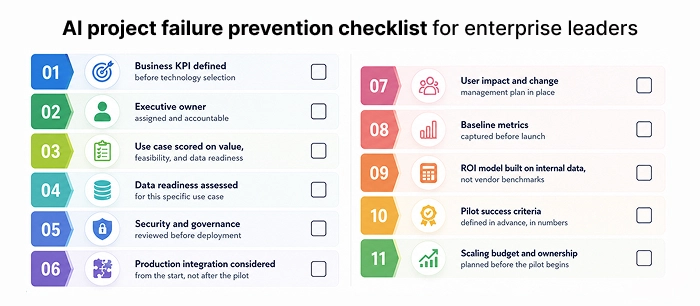
- Strategy: Is there a measurable business outcome this project is meant to move?
- Ownership: Is one accountable executive named?
- Use case: Is the problem both valuable and technically feasible?
- Data: Is the required data actually ready, accessible, governed, and current?
- Technology: Can this integrate with production systems, not just a sandbox?
- Governance: Are risk tiers and approval checkpoints defined?
- Security: Are AI-specific access and monitoring controls in place?
- People: Will the affected users actually adopt this workflow?
- Economics: Do your internal baselines, not the vendor’s benchmarks, establish your ROI?
- Scaling: Is there a funded path beyond the pilot if it succeeds?
Not every “no” will kill your idea. Not at all. But it is an explicit “risk” that should be addressed now, not after your company has burned a year’s budget.
How to Turn a Failing AI Project Around?
A struggling AI adoption is not automatically a dead one. The AI Project Recovery Loop gives leaders a structured way to intervene.
- Stop adding scope, as most failing projects respond to pressure by growing, which makes the underlying problem harder to isolate.
- Diagnose the actual constraint using the checklist above, rather than assuming it’s the most visible symptom.
- Reprioritise by returning to the original business outcome and confirming it’s still the right one.
- Fix the specific constraint, usually data, integration, governance, or adoption- rarely the model itself.
- Revalidate against the same measurable success criteria the project started with, not a redefined, softer target.
- Scale after proven underlying issue to have been solved. Not waiting until uncomfortable enough pressure to get the results comes on.
Why Enterprise AI Adoption Is Different From AI Project Success?
A single project succeeding and an organisation becoming good at AI are not the same achievement. AI project success means one initiative worked. Enterprise AI adoption means the organisation can repeatedly turn AI initiatives into measurable business value with shared infrastructure, reusable governance, and institutional learning that survives any one project.
An organisation that fixes today’s failing pilot but changes nothing structurally will very likely produce the same failure pattern on its next initiative. Sphinx Solutions enterprise AI adoption framework covers how to build that structural capability from the outset, rather than diagnosing it after something has already gone wrong.
Conclusion
None of the ten failure patterns above is unusual, and none of them is permanent. We find this failure pattern to be recurring. One common reason is that poor use case selection, poor data preparation, and poor governance are present in every project, as they aren’t usually fixed before the budget runs out. It’s not usually technology that causes enterprise AI project failures; it’s the inability to think about strategy, data, governance, integration, talent and value all together.
The fixes in this guide are meant to be used before a project starts struggling. A business-case gate, a named executive owner, a pre-build data audit, and a scaling budget approved alongside the pilot cost far less than rescuing a stalled initiative six months in.
If your enterprise finds itself banging into the same brick wall on pilot project after pilot project regarding all things AI, that generally means the issue isn’t a lack of success within specific pilots themselves; instead, it typically means that there is a gap within the foundational operating model which is why we developed the enterprise AI adoption framework in the first place.
FAQ’s:
Why do enterprise AI projects fail?
Enterprise AI projects most often fail because organizations start with technology instead of a defined business problem, select use cases based on visibility rather than feasibility and data readiness, and treat governance and change management as afterthoughts. The result is pilots that work technically but never produce measurable, repeatable business value.
What are the most common reasons AI projects fail?
The most common causes are: wrong starting point (technology-first thinking), poor use-case selection, inadequate data readiness, no accountable executive owner, disconnected pilots, weak governance, poor production integration, underestimated change management, unrealistic ROI targets, and no funded path to scale successful pilots.
Why do AI pilots fail to reach production?
Pilots are built and tested under controlled conditions that rarely match production requirements: legacy system integration, security review, real usage volume, and ongoing monitoring. A pilot proves a concept works technically; reaching production requires proving it works reliably at scale, which is a different and harder bar.
How can companies prevent enterprise AI project failure?
Start with a measurable business outcome, name a single accountable executive, score use cases on value and feasibility before funding them, assess data readiness up front, build governance and security into the design phase, and plan a scaling budget before the pilot even launches.
What are the biggest enterprise AI implementation challenges ?
Integration is frequently the biggest practical challenge: a model that performs well in isolation often struggles against legacy systems, identity and access requirements, and the latency and reliability demands of a live production workflow. Underlying that is usually a data readiness gap that surfaces only once the project moves past the pilot stage.
How does poor data cause AI projects to fail?
Poor data readiness produces unreliable AI outputs, which erodes user trust faster than almost any other failure mode. Once trust is lost, adoption drops, the business case weakens, and the project loses funding even if the underlying data problem would have been fixable with earlier investment.
Why is change management important for AI adoption?
Deploying a working AI system does not guarantee it gets used. Change management training, workflow redesign, incentive alignment, and clear communication about how roles change determines whether employees trust and actually adopt the new workflow, rather than quietly reverting to their old process.
How can enterprises measure AI project success?
Success should be measured across financial, operational, adoption, and AI performance metrics together, benchmarked against internal baseline data captured before launch not against vendor demo results or industry averages. A project can be technically accurate and still fail if adoption or financial impact were never tracked.
What is the difference between an AI pilot and production deployment?
A pilot validates whether an AI solution can work under controlled conditions with a limited user group. Production deployment means the system is integrated with live systems, monitored continuously, secured and governed at enterprise standard, and supported by a permanent team, a materially higher bar than pilot success.
How can organizations scale successful AI projects?
Scaling requires a dedicated budget, transferred ownership from the pilot team to a permanent operating team, standardized architecture that supports multiple business units, and continuous monitoring treated as its own funded stage of the project rather than an assumed next step.


 Shaili Gupta

 Ajay Wadne