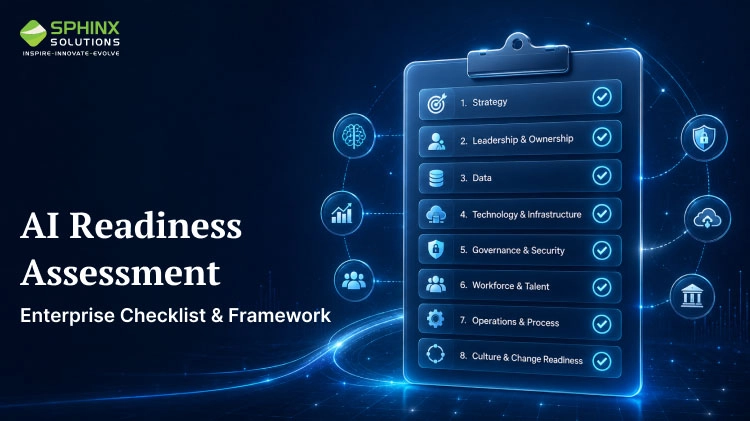
Key Takeaways
- AI readiness goes beyond technology; it requires alignment across strategy, data, people, processes, governance, and infrastructure.
- Assess readiness before scaling AI to identify gaps and avoid costly implementation failures.
- Evaluate key AI readiness assessment dimensions such as data, technology, security, governance, talent, and organisational culture.
- Use a structured scoring system to measure readiness, prioritise gaps, and determine the right next steps.
- A strong readiness assessment turns AI ambition into action, helping enterprises move confidently from experimentation to adoption and scale.
An organisation can have cloud infrastructure, a generative AI budget, and employees already using ChatGPT and still be unprepared for enterprise AI. Access to AI tools isn’t the same as AI readiness.
AI readiness can be assessed by an AI readiness assessment, which is a structured evaluation of whether an organisation’s strategy, data, technology, governance, talent, and operating processes can support AI safely and repeatedly at business scale. It’s not a technology audit; a company can have modern infrastructure and still fail the assessment on data governance, ownership, or change readiness.
This 8-point AI readiness checklist covers the eight dimensions that determine readiness, how to score them, and what to do with the results. For the structured process of turning readiness into a scaled AI program, see our Enterprise AI Adoption Framework. This guide focuses specifically on the step before that: knowing where you stand.
What is AI Readiness?
AI Readiness is simply the readiness of an enterprise to develop, control and expand the utilisation of AI. It looks at an organization’s readiness along critical pillars that ensure AI delivers measurable value and does not become a magnifier of operational weaknesses: strategy, data quality, infrastructure, skills, and ethics.
Gartner’s research cites that only 38% of CIOs and technology leaders rate their organisation’s progress toward AI value creation as excellent or good, and 72% report their AI investments are breaking even or losing money.
What does AI Readiness Measure?
AI Readiness looks at the extent to which an organisation’s strategy, data, technology, governance, security, talent, operations, and culture can sustain the scale-up of AI, not just the availability of AI technologies.
Why it matters: We see lots of organisations try AI, but it never really gets to production, and most of those successes (or failures) stem from weaknesses that readiness would have surfaced.
How it works: Score each dimension on a 0-4 scale by identifying quantifiable metrics, and not how confident we believe we are, then order them with the lowest score having the highest priority where it impacts our most important use cases.
What comes after: Low score indicates need to fix foundations, medium indicates pilot/gradual introduction with remediation, high indicators enterprise adoption.
Readiness vs. Maturity vs. Adoption
People use these words interchangeably and this creates real planning confusion.
- Readiness asks whether you can begin or scale AI safely.
- Maturity measures how advanced your existing AI capability already is.
- Adoption is the ongoing process of putting AI to use.
A company can be highly mature in one function (say, an advanced fraud-detection model in finance) while remaining unready in another (no governance structure for a customer-facing AI agent). Readiness is assessed per initiative and enterprise-wide; maturity is a trailing indicator of what you’ve already built
The Enterprise AI Readiness Assessment Checklist & Framework
A real enterprise AI readiness assessment must answer more than can we use the tool. It needs answers to the following: does the business have a business value-generation strategy, leadership ownership, necessary data, required technology, needed Governance and controls, capacity through people, defined and efficient processes, and Culture to achieve long-term capabilities?
Here are the eight dimensions enterprises should evaluate:
1. Strategy
An organisation is “AI-ready” if its top AI goals are clearly connected to business targets with quantifiable KPIs, rather than being based solely on widespread new-technology hype. Every proposed AI undertaking should have leadership able to answer the question: “What is this business problem we’re trying to fix?”, and which KPI should improve? Who owns the outcome?
What proves it must be a portfolio of deployed use cases with clear associations with identifiable business metrics and owners. Another red flag is an enterprise pursuing different AI endeavours and having difficulty describing the business value or positive impact that those initiatives create, be it in revenue, efficiency, client experience or other meaningful impact.
AI Readiness test: For those who can’t tie their AI project back to a business KPI as well as have a designated owner within your business, your company might not be positioned correctly to scale this AI implementation.
2. Leadership & Ownership
AI readiness requires more than executive interest. Each must have ownership, decision-making authority and accountability. A ready organisation has an executive who can make decisions about AI priorities, budgets, resources, and risk. That owner should also have a defined role within the organisation’s AI governance structure.
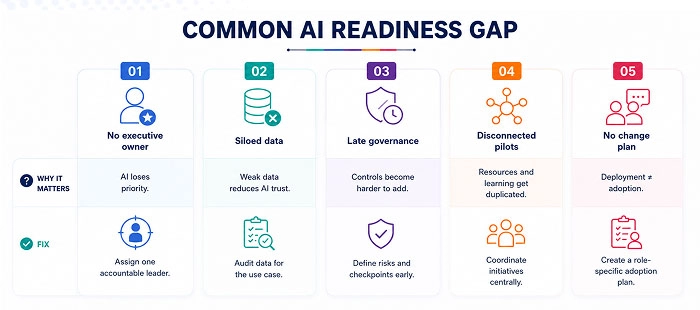
The evidence could include a named executive owner, defined responsibilities, an approved budget, and participation in relevant governance decisions. It’s also easy to wrongly assume that AI “is everyone’s responsibility” and consequently, when it comes down to the difficult choices like deciding between objectives, allocating funds, or mitigating AI risks, there is literally nobody who actually takes the lead.
AI Readiness test: If everyone owns AI but nobody has final decision-making authority, leadership readiness is incomplete.
3. Data
Data readiness is one of the most important foundations of enterprise AI readiness checklist. Having large amounts of data does not automatically mean an organisation is ready to use it for AI. The relevant data needs to be discoverable, managed, fit for purpose, accurate, and up to date.
Enterprises need to be able to explain where the data comes from, who owns the data, the lineage of the data, access permissions on the data, and whether the data can be used for the AI use case at hand. Another way to look at this is using the data lineage documentation, data quality reports, access controls for your use case, and access logs.
A typical shortfall is when the information needed is available in principle, but it is not in the right place, in the right format or held by the wrong group.
AI Readiness test: If it isn’t possible to locate, access, control and validate the data for the desired AI use case within the organisation, it is a sign a data-readiness gap exists.
4. Technology & Infrastructure
Having a viable proof of concept does not mean that the enterprise is ready to operate production. Technology readiness signifies that the company’s architecture can support AI insertion into actual business processes at the necessary volume, reliability, security, and quality.
Assess whether existing systems can support APIs, model integration, data pipelines, monitoring, security controls, application integration, and production workloads. The strongest evidence is not a successful demo. It is a tested integration with a live or production-like enterprise system.
It’s a common phenomenon to have an infrastructure that operates during a pilot, but not at production load, integrating, under monitoring, within the latency expectations and operational availability.
AI Readiness test: If an AI solution functions in a sandbox environment but can’t consistently integrate into the tools and processes staff use daily, the enterprise is not ready for production.
5. Governance & Security
AI governance should be established before bringing an AI system to production, not only after an incident occurs. A ready enterprise has categorised its risks, approval authorities, access rights, human-in-the-loop anticipation, monitoring procedures, and AI system responsibilities.
This proof can consist of an AI governance charter, risk assessments, sign-off workflows, access mechanisms and the formalisation of your overall governance. The level of certification you must take (e.g. NIST, ISO/IEC 42001, etc) will depend on the application and the sector.
Teams guess and hope for the best, and when something’s broken, they call in the security (or compliance, risk, legal) department.
AI Readiness test: If the organisation cannot explain who approves an AI system, what risks must be assessed, and how the system will be monitored after deployment, governance readiness is insufficient.
6. Workforce & Talent
AI readiness is a matter of far more than technology. People require the abilities, confidence and context-specific understanding to get the most from AI. An AI ready organisation understands which roles will interact with AI, what skills those employees need, and where specialist capabilities must be developed internally or sourced externally.
Evidence should go beyond generic “AI awareness” sessions. Investigate job-specific training logs, training on machine learning, and studies concerning technical competencies and strategic Roadmaps.
Another frequent hole is relying on outside vendors for everything AI-related work, meaning that your team won’t have the skills needed to manage, optimise, or troubleshoot the resulting AI models post-deployment.
AI Readiness test: Workforce readiness isn’t high when all your employees have the opportunity to use AI, but don’t have the skills and confidence to integrate it into their job functions.
7. Operation & Process
AI is not a sustainable value provider when it’s appended to an old way of doing things without re-inventing anything in the process itself. Being operationally ready means understanding how AI fits into your process, what decision it will inform or augment, which task(s) it can augment or automate, who is in charge of the process, and how to measure the result of said task.
Evidence should include a documented workflow showing where AI is introduced, which human roles remain involved, what happens when AI fails, and who is responsible for the process.
A common gap is “AI bolted onto an unchanged process.” An organisation, for example, could implement an AI assistant yet continue the same outdated approval workflows, data duplication, and systems that don’t talk to each other for employees.
AI Readiness test: Sometimes, technology has been used to embed processes or automate functions without improving efficiency or effectiveness. In this case, the organisation is unlikely to be “AI-ready” simply because AI has been employed, even if its effectiveness hasn’t been improved.
8. Culture & Change Readiness
AI projects are perfectly possible, technically executable, and technically flawless – and yet, fail miserably because no one in your organisation trusts it, uses it, or understands it. Culture and change readiness mean employees are ready to integrate AI into their day-to-day; leadership articulates why the change is happening; and every AI initiative has a discrete plan around adoption and change management.
What proves the power of your new AI feature most?
Regular usage, not initial enthusiasm. But it really says more when you see the same users continue to use that AI tool weeks and months down the line, as well as during the initial days.
A clear indication you’re going down the wrong road: Your users test out the new AI because it’s shiny and new, then promptly lose interest.
AI Readiness test: An organisation that is utilising AI mostly for experimental purposes and not as an integrating element in their daily job. It means an organisational gap in becoming ready for a change.
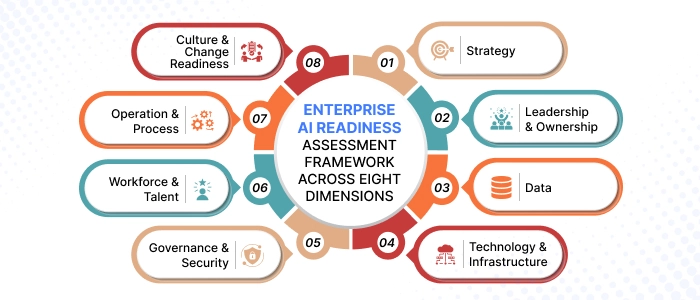
These eight dimensions of the AI readiness checklist should not be assessed independently.
An enterprise may have excellent technology but poor data governance. It may have strong leadership support but no workforce readiness. It may have high-quality data but no clear business strategy.
That is why an AI readiness assessment framework should look for dependencies between dimensions, rather than simply adding up isolated scores.
How to Score Your AI Readiness?
For a AI readiness framework, score each dimension from 0 (Absent) to 4 (Scalable):
0 — no capability exists
1 — early, fragmented experimentation
2 — inconsistent capability
3 — established and repeatable
4 — able to support enterprise-scale AI.
Total the eight scores and divide by the maximum possible (32) to get a percentage.
| Score Range | Readiness Band | What to Do |
| 0–25% | Foundation Required | Fix strategy, ownership, and data basics before piloting anything |
| 26–50% | Early Readiness | Address critical gaps in parallel with one small, low-risk pilot |
| 51–70% | Developing Readiness | Run controlled pilots while remediating remaining gaps |
| 71–85% | AI-Ready | Prioritize and launch production use cases |
| 86–100% | Scale-Ready | Build the operating model and scale across the enterprise |
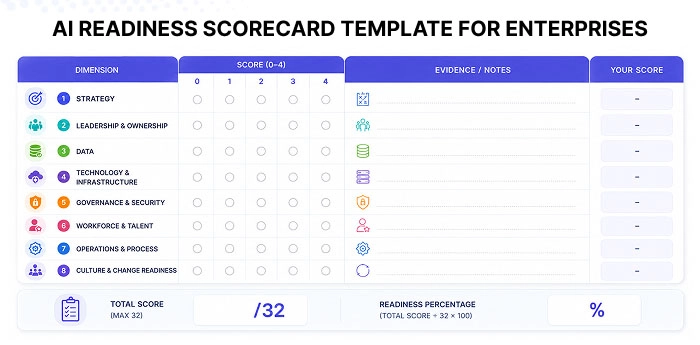
These bands are one illustrative planning model, not an industry-standard benchmark; consider them as a tool to frame internal discussions and not an external score to report on.
How to Conduct the AI Readiness Assessment?
- Define scope:
The whole enterprise or one business unit, and which use cases are in view. - Assign an owner:
Supported by a small cross-functional team of IT, data, security, and business units, led by a senior sponsor. - Collect evidence:
Documentation, access logs, and interviews not self-assessment surveys alone. - Score each dimension:
Using the 0–4 scale above, against the specific use case being evaluated. - Prioritize gaps:
Instead of fixing all gaps at once, tackle those that get in the way of the highest-value use case.
Even if none of these areas are handling the assessment day to day, make sure you check in with the legal, hr and finance departments if you have any governance, workforce or budget-related queries.
What to Do After Your Assessment?
- Low readiness → build foundational strategy, data, and governance capability before piloting.
- Moderate readiness → fix the specific gaps blocking your top use case, then run a controlled pilot.
- High readiness → prioritise and launch production use cases directly.
- Scale-ready → shift focus from individual projects to a repeatable operating model.
That last step is where our enterprise AI adoption framework picks up, and it covers use-case prioritisation, governance design, and scaling in full.
When Is an Enterprise Actually Ready to Start?
Enterprises don’t need perfect data, mature infrastructure, or a fully trained workforce before starting; that bar would delay AI indefinitely.
Each stage needs different things:
- Proof Of Concept needs a target problem, a user base, and anonymised or non-personal data.
- Production needs data governance, tested integration and clear responsibility.
- Enterprise size needs all 8 dimensions as “Operational” and higher, and shared infrastructure.
Meet your “readiness gate” against where you are in the execution process, not against some aspirational goal state.
How Can Sphinx Solutions Help?
Running an honest readiness assessment is harder without an outside view internal teams often rate their own data or governance more favourably than an objective audit would.
Sphinx Solutions works with enterprises to assess AI readiness across these eight dimensions, close the highest-priority gaps, and build toward production-grade AI through our generative AI, agentic AI, and enterprise integration capabilities. If you’re unsure whether your organisation is ready to pilot or ready to scale, that’s the right starting conversation.
Conclusion
AI Readiness is a per-initiative assessment that needs to be taken very seriously as use cases scale from “simple chatbot” to “system access self-service bot”. The organisations that Gartner sees as truly unlocking AI value today are not the organisations that have the “latest/greatest models” but rather the ones who have evaluated their specific weaknesses openly and honestly before they make budget, and addressed those weaknesses.
Use the 8-point AI readiness checklist to score yourself, be objective with the facts vs the aspiration, and let the score, not the calendar, be the guide for when you’re ready for structural adoption (i.e. moving beyond assessment).
Frequently Asked Questions:
What is an AI readiness assessment?
An AI readiness assessment is essentially a comprehensive and objective review of how well an organisation’s overall strategy, data, tech, governance, security, skills and processes can handle running AI on a wide scale continuously and securely. So instead it identifies issues and sets out an action plan, in order of priority. Rather than just a ‘green/yellow/red’ status.
What does an AI readiness checklist typically include?
A comprehensive checklist that includes strategic alignment, executive ownership, data quality and accessibility, technological and integration readiness, data governance and security practices, employee competency and readiness, workflow definition and organisational cultural maturity. Metrics should be evidence-based and objective, not survey-based opinions.
How do you calculate an AI readiness score?
Score each readiness dimension from 0 (no capability) to 4 (enterprise-scale capability), then divide the total by the maximum possible score to get a percentage. Bands from “Foundation Required” to “Scale-Ready” indicate whether to build basics, pilot, or scale next.
What’s the difference between AI readiness and AI maturity?
AI readiness measures whether an organisation can begin or scale a specific AI initiative safely. AI maturity measures how advanced its existing AI capabilities already are. An organisation can be mature in one area and unready in another.
How important is data readiness in this checklist?
Data readiness is usually the most common gap: even strong models fail if the required data is fragmented, poorly governed, or inaccessible. Unreliable inputs produce unreliable outputs, which is why data is assessed per use case, not as a general enterprise attribute.
Should an organisation wait until it’s fully AI-ready before piloting?
No. An enterprise-grade solution for full adoption is not needed to just experiment and to get started, but rather: one has to have a clear use case, and a willingness of the audience and non-critical and/or anonymised information is more than enough. The stricter requirements and conditions appear later when the solution is meant to go to enterprise-scale production.
What should an enterprise do after completing an AI readiness assessment?
Take action on your score. Low scores indicate a need to begin resolving foundational strategy, data, and governance gaps. Moderate scores indicate the need to address targeted blockers alongside experimentation. High scores indicate a point where production use cases can be initiated, and mature organisations need to evolve towards a repeatable enterprise AI operating model.
How to Choose an AI Readiness Assessment Provider?
Choose an AI readiness assessment provider based on its enterprise AI expertise, assessment methodology, technical capabilities, security knowledge, and ability to turn findings into an actionable roadmap. Look for a provider that evaluates strategy, data, infrastructure, governance, talent, security, and operations, not just technology and can support implementation after the assessment.
How Do You Do an AI Security Readiness Assessment?
An AI security readiness assessment evaluates whether an organisation can protect AI systems, models, data, users, and connected applications from security and privacy risks. It should assess access controls, sensitive-data handling, model and application security, third-party AI risks, monitoring, incident response, governance, and human oversight before AI systems are deployed or scaled.
How Do Consultants Assess AI Readiness in Businesses?
Consultants typically assess AI readiness by evaluating the organization’s strategy, leadership, data, technology, governance, security, workforce, operations, and culture. They gather evidence through stakeholder interviews, documentation reviews, technical assessments, data evaluations, and use-case analysis. The findings are then scored to identify capability gaps and prioritise an AI readiness roadmap.


 Shaili Gupta

 Ajay Wadne