

AI is making a massive difference in the real estate industry by embracing the landscape of buying, selling, and managing properties, which is being reshaped in ways previously thought were impossible.
AI in real estate algorithms can predict property values based on market trends, neighborhood data, and historical sales. Such overheads can be reduced using AI automation-facilitated activities of an estate agent, newsletter distributions, on-site scheduling, inquiries responding through a chatbot, or virtual property tours.
Real Estate giants like Zillow and Redfin have already integrated AI into their operations for their users. They utilize AI to recommend properties based on their preferences, browsing history, and even through their social media activity.
Unsure about the costs of AI development for your business?
Our AI development cost calculator gives you an instant estimate.
After numerous surveys and inferences, Deloitte declared that 68% of real estate corporations are now banking on AI for overall growth in their overall operation. This is no longer a hype period for the industry; innovation today is a prerequisite for recognition.
Going deep into the advancements of AI in real estate, analytics is expected to regularize property investments by identifying the next hot neighbourhood or predicting when a property’s value will rise.
Going further, AI’s advancements in real estate are promising. Analytics may identify the following projects in the neighbourhood and predict when property values will rise, regularizing property investments. Also, builders can integrate AI, including solutions like Freepik AI interior design tools, to design smarter and more sustainable buildings, analyze energy use, and optimize space efficiently. Tools such as Freepik AI interior design tools can help visualize interior layouts, select design themes, and create realistic mockups that align with modern sustainability goals
How does AI work in Real Estate?
The real estate market changed with the arrival of AI. It will make processes smarter, faster, and customised to the respective clients. Analysing market data, predicting property values, offering personalised recommendations, and enhancing decision support and operational efficiency are the premier times ever.
Data Collection and Analysis:
In order to produce insights that assist buyers, sellers, and real estate professionals in making better decisions, artificial intelligence (AI) systems collect and analyse vast volumes of data, such as market trends, property specifics, neighbourhood statistics, pricing history, and customer preferences.
Prediction and Valuation:
AI takes historical data and machine learning models to forecast property values, rental yields, market fluctuations, and investment opportunities. This leads to more precise data-driven property pricing and risk assessment in terms of investment.
Personalised Recommendations:
AI analyses user behaviour, preferences, and search history to provide tailored property suggestions, improving user experience for buyers and investors on real estate platforms.
Automation & Efficiency:
Depending on its real-time know-how, AI automates repetitive chores in real estate, such as listing operations, customer inquiries, document verification, and virtual tour creation.
Top Applications of AI in Real Estate
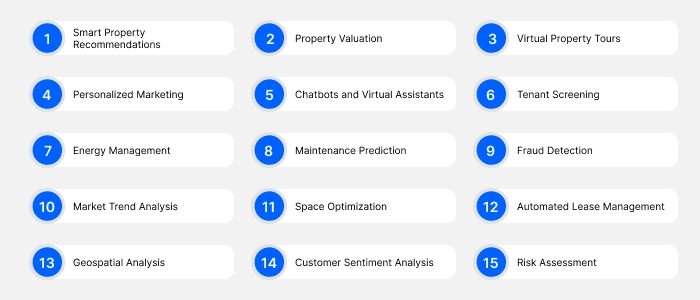
Gone are the days when finding a dream home had to be done just by visiting the site project. It was a massive problem for people willing to buy property in different cities. AI-driven tools are helping real estate investors identify these opportunities by analyzing market trends and risks faster than any human could.
AI in real estate has revolutionized property searches by analyzing preferences to predict the ideal home. Property managers also use AI to optimize energy usage and maintenance schedules easily, from automating all administrative tasks to providing hyper-personalized customer experiences.
The McKinsey report adds that AI adoption makes the entire real estate industry more intelligent and enhances productivity by 20% to 30%. For instance, Zillow predicts extremely accurate home prices using machine learning and adopts AI-enabled chatbots that respond to customer inquiries.
To learn more about AI in real estate, we have identified a few practical applications and innovations at the forefront. The potential to completely transform our perception of real estate is immense.
Smart Property Recommendations
Home hunting has always been hectic; an everyday realtor can’t evaluate the small details. The process of property analysis and its subsequent future validation can be intimidating, considering the number of factors determining determine proper pricing.
Thus, Artificial Intelligence in real estate aids a business in getting the right information concerning a property. AI can evaluate the season light disparities and verify realtor’s adverts for ‘sunny’ homes. It also assesses the property’s attributes, such as age, size, number of rooms, and interior design, to determine a reasonable price range. This evaluation can be paired with recommendations for reputable interior design services in Dubai to maximize a property’s market potential
Property Valuation
An accurate property valuation of a real estate determines its worth and influences its buying, selling, and investment decisions. Property valuations are often based on market trends, local considerations, and physical qualities.
However, with the help of predictive analysis that includes location, property size, condition, and even neighbourhood crime rates, AI can provide accurate and instant property valuations.
AI-powered valuation tools offer a significant advantage by providing rapid, accurate, transparent, and cost-effective property valuations. These tools can quickly analyze numerous factors, reducing human error and ensuring fair pricing for buyers and sellers. Beyond valuation, AI is also streamlining client communication AI receptionists for realtors now handle incoming property inquiries, qualify buyer interest based on budget and location criteria, and schedule viewings without agent involvement.
Virtual Property Tours
AI-powered virtual property tours provide a realistic, interactive depiction of properties by combining image technology, 3D modelling, and machine learning algorithms. The tours often integrate features like 360-degree views for every property corner, AI insights like natural lighting, space utilization, room dimensions, etc., and personalization like focusing on a modern kitchen or outdoor space.
Smart recommendations, voice assistance, and predictive analysis are features of virtual property tours that go beyond static visuals by introducing dynamic and interactive elements.
The buyers can explore the property anytime and anywhere by neglecting the travel expenses to the on-site and save time in the decision-making process. It offers practical solutions for individuals with mobility challenges.
Personalized Marketing
Creating surreal methodologies for delivering personalized marketing in real estate marketing campaigns, AI systems analyze data, apply machine learning algorithms, and scrutinize behavioral insights to help businesses deliver highly targeted experiences to buyers, sellers, and investors. These systems can get information from different sources, such as search history, social media behaviour, demographic and location data, and engagement patterns.
The benefits of personalized marketing in real estate include better audience targeting, increased conversion rates, and cost efficiency. Zillow uses search history, saved preferences, and interaction patterns to suggest properties that closely match user interests. It is one of the best applications of AI in business since that would increase its customer satisfaction, sales, and return on investment.
Chatbots and Virtual Assistants
Through text or voice interactions, question answering, user guidance, and help with property searches, virtual assistants for real estate and chatbots employ machine learning to mimic human discussions.
Such features include property inquiries, scheduling appointments, answering FAQs, and lead qualification. The benefits of 24/7 availability, personalized experience, time efficiency, lead generation, and qualifications have profoundly impacted customer satisfaction.
Future developments could include more sophisticated predictive capabilities examining market trends and advising customers on the ideal times to buy or sell or more profound integration with augmented reality (AR) for virtual property tours. Rex’s AI assistant uses a virtual assistant that guides through every stage of the home-buying process.
Tenant Screening
Tenant Screening is for property managers and landlords as it involves manually reviewing the applications, conducting background checks, and sometimes relying on gut instinct. The advanced algorithms analyze vast amounts of data from various sources, including credit scores, rental history, criminal background checks, and employment records.
According to a 2023 National Multifamily Housing Council (NMHC) survey, 65% of property management companies reported using AI-based tools to screen tenants. Predicting later rents payments, enhancing fairness in screening, and improving tenant retention are some of the figured-out scenarios that can improve.
The impact on tenant screening and property management will only grow, bringing even more value to the industry. With efficiency, accuracy, reduced bias, cost savings, and improved tenant quality, the benefits of AI in real estate is a game-changer for real estate professionals.
Check Out Related Posts
Energy Management
Energy management with rising demand for sustainable living and growing needs to reduce carbon footprints. Data from various sensors, IoT devices, weather forecasts, and occupancy patterns are used to predict and manage energy needs more efficiently.
AI can anticipate high energy consumption periods by examining past data and environmental factors (such as temperature and weather forecasts). This lessens the strain on energy grids and guarantees cost-effective operations by enabling property managers to modify systems before demand surges.
Furthermore, AI may aid in macro-level energy optimization, increasing the efficiency of large metropolitan areas as it advances its capacity to forecast energy consumption patterns. To reduce grid congestion and ensure that energy resources are distributed where they are most needed, cities could employ AI to balance energy demand across various regions.
Maintenance Prediction
The maintenance prediction technology is changing how property managers handle upkeep and repairs. It uses AI and machine learning to predict when a piece of equipment or a system in a building (such as HVAC, plumbing, or electrical systems) shows something unusual.
AI systems analyse and interpret multiple data sources, including sensor reading and past performance data, and can predict a successful path for property managers to undertake planned preventive maintenance for equipment by making predictive repairs before the equipment malfunction occurs to increase asset life.
These real-time data on everything from temperature and humidity to pressure and vibration levels are analyzed to identify patterns that might indicate a potential failure. Technology is set to become a standard practice in the real estate sector as it develops further and becomes more widely available, enabling the creation of more intelligent, effective, and economical properties.
Check Out Related Posts
Fraud Detection
Analyzing data from jumbo datasets and recognizing patterns of fraudulent activities can help safeguard transactions in real estate. Fraudsters exploit cutting-edge technologies to trick buyers, sellers, and financial institutions into more complex real estate scams.
AI-driven systems enhance fraud detection through pattern recognition, identity verification, and document authentication. These methods help prevent the fraudsters from committing crimes. The real-world examples of AI helpful in real estate fraud detection are Dwellsy’s enhanced fraud detection and Snappt’s document fraud detection.
But, as we know, with advanced technology, fraudsters are also learning new methods to break the code, and hence, they are quite learned and trained in AI technology as well. However, as fraudsters also use AI technology, ongoing development and ethical concerns are necessary to preserve the efficacy and integrity of the system.
Market Trend Analysis
Market movements go up and down based on the property value, so it is essential to understand the market trends. AI is applicable in analyzing historical data, economic indicators, and consumer behaviour patterns, which helps predict future real estate trends so that stakeholders know when to expect the market shift and strategise accordingly.
AI in the real estate market is said to be significantly valuable, with approximately USD 2.9 billion in 2024, and it is projected to grow to USD 41.5 billion by 2033. For example, Skyline AI, predictive analytics assesses commercial real estate opportunities with undervalued properties and forecasts future performance, enabling investors to make informed decisions.
By detecting emerging markets, improving property assessments, and making precise predictions, AI-driven market trend research is revolutionising the real estate sector. AI technology is expected to become more deeply integrated into real estate activities as it develops, providing more advanced decision-making and market research instruments.
Real estate decisions can be complex and time-consuming without the right insights.
Leverage AI to streamline your real estate decisions and boost efficiency
Space Optimization
Space optimization shows available spaces to maximize functionality, aesthetics and financial value. By improving the usability and liveability of even tiny spaces, efficient space utilisation can solve this problem and lessen the demand for new real estate projects.
The demand for optimized space is surging as 68% of the world’s population is projected to live in urban areas by 2050. AI in space optimization can help with layout design, predict space utilization, and make personalised recommendations.
Some well-versed examples of WeWork’s bright office spaces, smart apartments and retail space planning can be identified as AI integration in real estate. The benefits of AI-driven space optimization include cost savings, improved user experience and sustainability.
Automated Lease Management
Automated Lease Management can streamline the real estate works for extra critical data from complex lease agreements, reducing processing time by upto 80% and minimizing errors. This increases overall efficiency by guaranteeing property managers have rapid access to crucial information.
AI automates rent tracking, late fee calculations, and lease renewal reminders in financial management. Predictive maintenance capabilities further increase tenant satisfaction, which spots possible problems before they become serious. For example, Bear Property Management used an AI leasing assistant to streamline lease management.
As the adoption of AI grows, the market for such technologies is projected to reach $731.59 billion by 2028 with a 34% annual growth rate. Whether you’re enhancing an existing platform or just learning how to create a real estate website, integrating AI features like automated lease management can significantly optimize tenant relationships and property operations.
Geospatial Analysis
Geospatial Analysis uses AI to study data linked to specific locations from which one can evaluate factors like the distance to schools, parks or public transport and identify risks like flood zones or pollution levels. This gives buyers and investors a clearer understanding of property value and safety.
Real estate professionals use AI-powered geospatial tools to predict market trends and choose the best sites for development. For example, developers can find areas with growing populations or upcoming infrastructure projects to build homes or offices, saving time and planning the right move.
The best example is using satellite imagery with AI to quickly identify vacant land or evaluate building conditions. Such automated geospatial analysis tasks help investors and developers make faster and smarter investments, and its growing adoption can secure the real estate industry.
Check Out Related Posts
Customer Sentiment Analysis
AI-powered sentiment analysis includes customer reviews, social media comments and market feedback. The technology helps real estate agents understand buyer and seller emotions, uncovering preferences and concerns. By identifying trends in customer opinions, businesses can adjust their strategies to serve their clients better.
For example, sentiment analysis can reveal why a property is pinpointing dissatisfaction. So they can address issues like pricing, amenities or service gaps. Companies can customise their marketing campaigns and refine property recommendations by understanding the sentiments of potential buyers, sellers and renters.
For example, a property management company using customer sentiment analysis can learn about feedback on any new development and work on the mentioned problems to improve its design features or amenities in future projects. It’s helpful for real estate professionals to stay ahead of their competitors.
Risk Assessment
Risk Assessment in real estate can analyze large amounts of data to help investors make intelligent decisions. For example, it can evaluate a property’s location, market trends and potential risks like natural disorders or crime rates, offering accurate property valuations to help buyers and investors avoid costly mistakes. Tools like a property depreciation calculator also come into play by estimating how a property’s value might decline over time, further informing long-term investment strategies.
AI can be very helpful in fraud detection, protecting property owners and buyers by examining patterns in financial records and verifying identities; AI can flag suspicious activities such as fake documents or illegal property transfers.
Property managers also use AI for tenant screening and maintenance, reviewing applicants’ rental histories and credit scores to select reliable tenants, reducing the risk of defaults. It can also predict building maintenance issues, allowing repairs to be scheduled before problems escalate, saving time and money.
Real-world Examples of AI in Real Estate
AI in real estate is already in demand and is a use case for many property dealers. When we are reading about these examples, there is already somewhere around the world that some property management companies are using AI in real estate.
Zillow
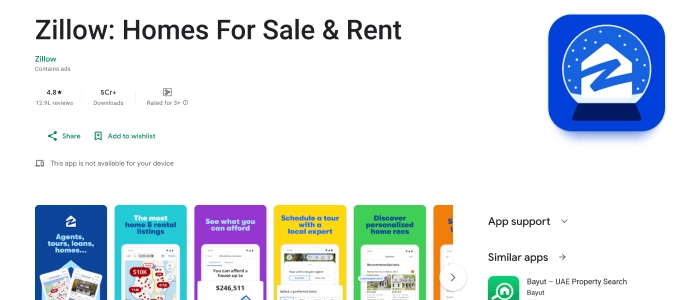
Zillow is a well-known brand in the United States and Canada in real estate that has used AI to improve its homa valuation tool called “Zestimate”. The AI looks at market trends, property details and other factors to estimate real-time home value. The buyers, sellers and investors can make informed decisions by analysing the property prices and investments.
Trulia

Trulia operates as a real estate company in the United States but is a part of Zillow. It helps its clients look for houses and neighbourhoods via various recommendations, local insights, and indeed maps showing commute times, the schools and churches, and the businesses in and around such areas.
Through the potential of artificial intelligence, Trulia recommends personal homes to users according to their wants, such as location, budget and amenities. Users are also introduced to the possibilities of AI virtual tours when looking at properties. Thus, homebuying becomes enjoyable as well as simple for a user.
Redfin

In Seattle, Redfin Corporation offers residential real estate services and mortgage origination. Redfin currently serves more than 100 markets spread throughout the United States and across the border in Canada. At present, in the year 2023, it is known that the company commands a national market share of 0.76% and an average of 1776 lead agents in relation to the number of units sold.
They use AI to make home valuations more accurate and recommend properties matching user preferences. Its AI-driven algorithms predict home price trends and help buyers find the right properties. Additionally, Redfin uses AI for marketing to ensure listings are shown to the right people at the right time.
Entera
Entera is an advanced platform that helps real estate investors find, buy and manage single-family homes on a large scale. Powered by artificial intelligence, Entera’s platform simplifies the entire process of investing in single-family homes.
Using AI, Entera automates property acquisitions by analyzing thousands of listings, market data and other important factors. This helps investors quickly spot profitable opportunities, speeding up the buying process and making it easier to grow their portfolios.
Real estate processes can be inefficient without advanced data-driven solutions?
Implement AI to optimize property analysis, pricing, and investment decisions.
Leveraging AI in Real Estate: Key Business Focus Areas
AI is slowly changing the way real estate companies function. From helping people discover the perfect property to maintaining facilities, Agentic AI is making everything easier.
Let’s look at the main AI applications that real estate companies are now using.
Smart Property Pricing:
To determine the optimum price for a home, AI systems may rapidly analyse market trends, geographic information, property prices, and previous sales. This eliminates the need for days of research and helps buyers, sellers, and agents receive fair agreements.
Predicting Market Trends:
Artificial intelligence can process large volumes of market data to predict whether prices will fall or rise in a given area. With that done, it becomes easier for agents, builders, and investors to decide when to invest and where to invest.
Helping with Real Estate Investments:
With AI’s data-driven insights, investors can easily find high-potential properties, avoid risky deals, and get suggestions on where their money might grow the most. It takes the guesswork out of property investment.
Making Property Search Easier:
AI helps people find the perfect property by showing them homes and offices based on their budget, location preferences, and other personal choices. It saves time and makes property hunting simple and personalised.
Virtual Property Tours:
Rather than conducting a property visit in person, the buyers and tenants use their mobiles or laptops via AI-powered virtual tours and augmented reality tools. So fast, so secure, so super convenient!
Smarter Building Management:
Modern buildings are managed and supervised by AI for energy use, security systems, and maintenance schedules. Hence, they become energy-efficient, safer, and cost-effective to run.
Paperwork Made Easy:
AI systems can automatically prepare contracts, inspect documents, and handle approvals. This reduces errors, saves time, and expedites real estate transactions without the burden of laborious documentation.
Finding and Managing New Customers:
Through emails, advertisements, and internet platforms, AI assists real estate companies in locating possible buyers and sellers. By providing offers, updates, and reminders, it also aids in managing client relationships.
Managing Customer Projects:
AI helps with material management, delay prediction, and construction progress tracking. It allows project managers to stay on schedule and keep costs under control.
Spotting Fraud and Reducing Risks:
AI can swiftly look for questionable activity in user behaviour, documents, and transactions. This shields companies from scams, fraudulent listings, and dangerous transactions.
Taking Care of Buildings & Facilities:
AI assists with routine facility maintenance by planning repairs, monitoring equipment performance, and notifying when something needs to be fixed. It keeps properties in good shape without constant manual checks.
Path to AI Success in Real Estate: Essential Implementation Steps
Your firm can become more effective by utilising AI in real estate, but you must take the proper precautions to get positive outcomes. You can start using AI in the real estate sector with the help of this brief article.
Know What You Want to Achieve
Selecting the issues you wish to employ AI to resolve is crucial before you begin. Do you want to anticipate real estate values, create new leads, or enhance building management? Make a list of your business goals and figure out where AI can help.
Collect and Organise the Right Data
When AI gets high-quality data to work with, it performs at its best. Thus, compile data such as real estate listings, consumer inclinations, industry trends, and previous transactions. Organise it well so your AI tools can easily use it to give you accurate results.
Make Sure AI fits into your Current Systems
It is crucial to design your AI solution to integrate easily with your current tools and applications. For AI to be effective, all of your technologies, such as your website, CRM, and property management system, must function well together.
Train AI Tools with Real Data
After your data is prepared, you must use actual examples to train your AI systems. This aids in the AI’s comprehension of how to identify trends, forecast outcomes, and provide suggestions based on real estate data.
Test Before You Go Live
Before using your AI solution for actual business, test it properly. Check how it performs with different types of data and see if the results as will help you to catch issues and fix.
Start Using AI in Your Business
Once you’re happy with the test results, you can officially start using AI in your daily operations. Use it for pricing, customer searches, lead management, or building maintenance, whatever your goals are.
Keep an Eye on Performance and Improve
Even after you launch your AI system, keep monitoring its performance. Regularly check its results and make improvements when needed. This will help your AI tools stay updated and continue delivering great results as your business grows.
If AI is properly conceived and executed, it has the potential to revolutionise the real estate industry. You may operate your real estate business more intelligently, quickly, and effectively by adhering to these easy guidelines.
How Generative AI will Revolutionise the Real Estate Market
One of the main causes of the rapid changes in the real estate industry is the emergence of generative AI. This AI system has real-time content creation, data analysis, and intelligent recommendation capabilities.
Real estate companies are using it to work more quickly, communicate with clients more effectively, and make better judgments. Let’s examine how it is expected to change the industry.
Better Ways to Connect with Customers
With the use of generative AI, real estate companies may interact with customers more personally and interactively. They might respond quickly to customer questions, suggest properties based on user preferences, and even create chatbots for 24/7 support.
Creative Ads, Listings, and Virtual Tours
Generative AI can perform routine operations such as organising property visits, sending emails, creating reports, and updating listings. Businesses with AI can concentrate more on strategy, sales, and customer service to handle these time-consuming repetitive chores.
Turning Data into Useful Insights
Real estate firms gather a lot of data, from property values to client searches. Generative AI may compile this data and use it to provide clear reports and forecasts. This aids companies in identifying patterns, comprehending client demands, and improving future planning.
Smart Business Decisions
AI in real estate can help make better decisions by providing access to data and future projections. The pricing, investments and marketing strategies with generative AI help businesses plan confidently and reduce risks by forecasting changes in the market.
As the latest innovation, generative AI is making its way into the real estate sector. By providing better client service, effortless content production, and swifter decision-making, real estate companies can now stay a step ahead in the competitive market.
Is Investing In AI Solutions Worth It?
Given the buzz around AI, many businesses question if it is worthwhile to invest in it. AI may help organisations improve their services and save time if done well.
Let’s examine the reasons your business thinks about acquiring AI technology.
Saving Time and Effort:
AI can free people from boring tasks that includes sorting data, report generation, or even simple customer care. The outing could redirect human effort to more important tasks while increasing their productivity, which is time-saving.
Helps You Make Smarter Decisions:
AI tools rapidly analyze large amounts of data and convert it into meaningful information. They tell you about market trends, consumers’ preferences, and risks, aiding in decision-making in a business without any trial and error.
Better Customer Support:
AI-powered chatbots may give your clients immediate answers and much-needed suggestions. Consequently, this enhances consumer satisfaction and your company’s response.
Keeping You Ahead of Your Competition:
As more companies begin to adopt AI, those who refute may lose the advantage. AI speeds up work and cuts costs, so it is your competitive edge against market competition.
Adapt and Grow with your Business:
The best thing about AI is that it is scalable. You can start small with a handful of tools and gradually build up as your business grows. This creates a flexible investment that can adapt to your needs over time.
The Future of Artificial Intelligence in Real Estate
This kind of AI has shown its effect in the real estate field and is bound to grow as time passes. AI helps bring different houses, based on budget estimation, location, and amenities, closer to the people. It will predict changes in preferences for houses in real estate sooner.
For example, AI could suggest new properties in similar areas if someone has previously searched for homes near parks. This will make finding the perfect house faster and easier. According to a report by PwC, almost 70% of real estate professionals believe AI will significantly change how property search and marketing are done in the next decade.
AI is also improving property valuation and maintenance as it estimates property values by analyzing location and market trends. In the future, AI will use even more data, such as environmental factors or future construction plans, to give more accurate property value predictions.
Why Choose Sphinx Solutions for Integrating AI in Real Estate
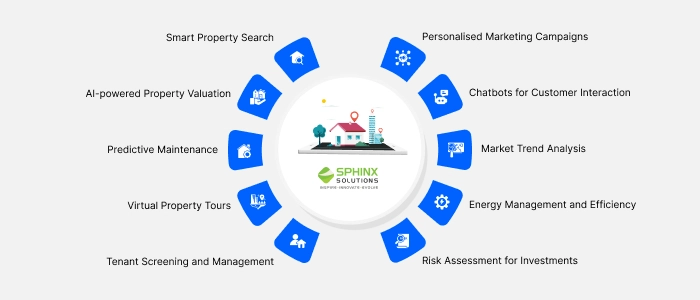
At Sphinx Solutions, we focus on AI, blockchain, and IoT technology as a top custom software development company. Our vast experience of 14+ years has put us at the forefront of offering innovative solutions to businesses from real estate and various industries. The company has 200+ skilled resources and developers that contribute to building better solutions for every project.
The company’s reputation in AI development has been emphasised by its more than 1000+ successful projects and its clientele of more than 500+ satisfied customers. The integration of AI applications in real estate is one such service provided by Sphinx Solutions that makes the process more efficient, leading to quicker anf better results for clients.
The services provided by Sphinx Solutions for top AI applications in real estate:
- Smart Property Search
- AI-powered Property Valuation
- Predictive Maintenance
- Virtual Property Tours
- Tenant Screening and Management
- Personalized Marketing Campaigns
- Chatbots for Customer Interaction
- Market Trend Analysis
- Energy Management and Efficiency
- Risk Assessment for Investments
Sphinx Solutions integrates AI in real estate to make the processes more intelligent and faster, which helps our clients be in a leading position. With AI, real estate businesses can improve everything from finding properties to managing repairs, improving the experience for buyers, sellers and tenants.
Real estate decisions can be complex and time-consuming without the right insights.
Leverage AI to streamline your real estate decisions and boost efficiency
Conclusion
AI is significantly altering the real estate market. These days, the goal is to make the entire process more cheerful and seamless, not simply to buy and sell real estate. AI is accelerating and reducing costs in various applications, including virtual tours, personalised property recommendations, and accurate property valuations. Regardless of the recent trend, real estate companies embrace it to keep pace with the times and satisfy the growing demand of their clients.
The future of AI in real estate is promising, with an innumerable number of probabilities for continuing the experience of enhancing that of the investor buyer and seller. The more AI develops, the better the industry approaches an intelligent, customized business mode.


 Shaili Gupta



 Ajay Wadne
