

A subset of AI, Machine Learning is the prime facilitator of custom healthcare software development, from improving patient care to resolving complex medical challenges. As one of the emerging technologies, Machine Learning allows healthcare service providers to customize healthcare solutions, maximize the accuracy of diagnosis, and simplify clinical operations.
According to a healthcare software development company, ML draws insights from several data sets to manage decision-making, automate daily workflows, speed up healthcare research, and enhance operational efficiency. In this blog, we will explore how Machine Learning is transforming healthcare software development in various ways. Let’s get started.
The Rise of Machine Learning
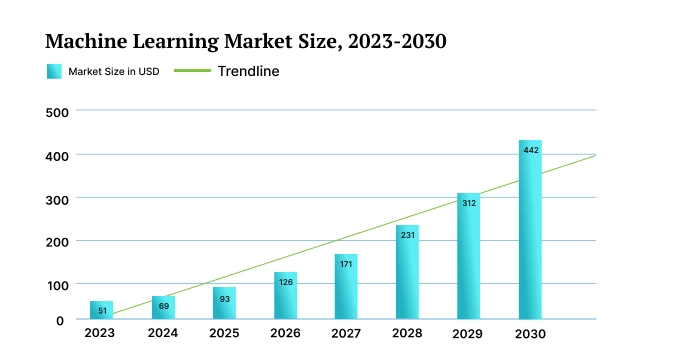
According to Precedence Research, the global Machine Learning market size was valued at $51 billion in 2023. This is also projected to expand to around $442 billion (CAGR of 35.09%) by 2030. Machine Learning technology has opened countless possibilities, allowing healthcare professionals and doctors to focus on customized treatment plans rather than addressing complex administrative challenges & managing data. The pandemic has pushed this sector further to adopt technologies like AI/ML.
Want to Hire Software Developers?
With our custom healthcare software development solutions, we help you empower your business innovations.
Role of ML in Healthcare Software Development
Machine Learning is thoroughly driving massive transformation in healthcare. ML involves the use of different algorithms and statistical models to streamline complex tasks. Its capability expedites advancements in major areas of healthcare including surgery, drug discovery, clinical operations, etc. Apart from that, Machine Learning in the healthcare sector effectively helps to enhance operational efficiency, medical research, and patient care.
The modern healthcare industry has been compiling massive data sets, often managing this information in EHRs as unstructured datasets. With natural language processing (NLP), AI/ML can rearrange this information into structured formats so that healthcare experts can easily get valuable insights from it. In addition, personalized medicine has reaped benefits from Machine Learning. By lifestyle, environmental factors, and genetic information analysis, ML models help professionals build personalized treatment plans for their patients.
Read More Related Blogs
How is Healthcare Software Development Improving Patient Care?
Use Cases of ML in Healthcare Software Development
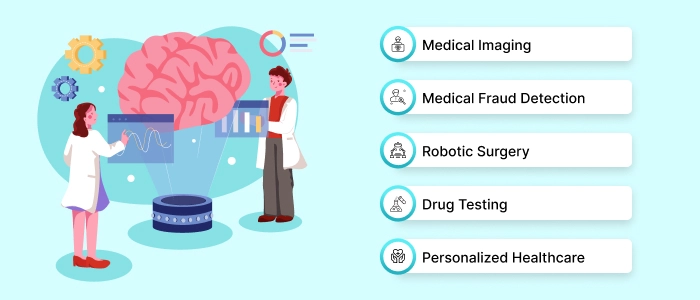
From making accurate medical diagnoses to improving operational efficiency, Machine Learning technology is transforming healthcare custom software development in all aspects. Here are some of the major use cases of Machine Learning healthcare software applications:
1. Medical Imaging: Though medical imaging is one of the biggest advancements in healthcare software development, it is prone to human errors as it requires high accuracy and attention to detail. Machine Learning can find the changes in X-ray, MRI, and CT scans to help radiologists in precisely addressing diseases. Early detections allow medical experts to prevent diseases from spreading and help them take necessary action for a cure.
2. Medical Fraud Detection: As per the report, medical frauds cause massive financial loss every year, almost 5 to 10% of annual expenditures. This is approx. $300 billion loss yearly. Machine Learning helps healthcare service providers address invalid insurance claims and accelerate the approval and payment process of valid ones. Moreover, AI/ML-integrated machine learning software also prevents the loss of sensitive patient information.
3. Robotic Surgery: ML-driven surgical robots have revolutionized the traditional surgical process with accuracy and speed. Robotic surgery performs complex surgical procedures and eliminates the risk of side effects, chronic pain, and blood loss. Apart from that, with the help of Machine Learning, surgical robots can also address state-of-the-art practices and valuable insights by browsing huge datasets.
Read More Related Blogs
4. Drug Testing: Drug discovery and testing through machine learning models provide excellent economic value for pharmaceuticals, hospitals, and healthcare service providers. Machine Learning goes through a range of complex data sets including proteomics, genomics, and transcriptomics that help to find new drugs for specific diseases and symptoms. Moreover, it can also predict toxicity and drug reactions based on complex chemical structures.
5. Personalized Healthcare: ML-driven personalized prediction and decision-making help healthcare institutions deliver personalized care by analyzing patients’ medical history, symptoms, and clinical profiles. Machine Learning software development in healthcare also helps doctors create customized treatment plans & prescribe medicines to address specific diseases.
Other Use-Cases to Consider
Apart from these top 5 use cases, Machine Learning is also used for several purposes in healthcare such as:
- Remote Patient Monitoring: IoT integrated Machine Learning models can measure & track patient’s health records in real-time
- Optimizing Healthcare Operations: Machine Learning helps in optimizing workforce allocation, resource management, and scheduling.
- Precision Oncology & Genomic Medicine: Based on genomic data, Machine Learning can address possible cancer threats & help in oncology for specialized study.
- Healthcare Supply Chain: apart from other medical support, Machine Learning helps to manage inventory and streamline supply chain operations in the healthcare sector.
Looking for Healthcare Software Development Solutions?
Build your custom software application with our complete range of software development services.
Five Real-Life Examples of Machine Learning In Healthcare
Hospitals are using machine learning these days to enhance the quality, accessibility, and even interoperability of their systems so as to improve the health of patients worldwide.
Viz.ai
Viz.ai uses machine learning to speed up communication between healthcare professionals, ensuring patients receive timely care. The tool connects frontline doctors with specialists in real time, helping them make quick decisions and improving patient outcomes. This technology is instrumental in stroke cases, where faster diagnosis and treatment can save lives.
Deep Genomics
Deep genomics uses artificial intelligence to accelerate drug research. The platform utilizes ML for analyzing genetic mutations that cause diseases and predicting their interaction with drugs. Thus, instead of testing for years, researchers can narrow possible drug candidates with this technology by screening millions of them in rest hours.
Da Vinci Surgical System
This Da Vinci Surgical system hybridizes the work of Intuitive Surgical, and hopefully, allows prospective surgeons to gain a foothold into artificial intelligence in robotic surgery. It is necessarily assigned the surgeon for performing minimally invasive surgeries at greater scale accuracy and precision. Machines learn such that, on a continuing basis, the system’s precision gets better, leading to superior surgical outcomes and faster patient recovery time.
Oncora Medical
A Philadelphia-based startup, Oncora Medical, is applying machine learning techniques to revolutionizing cancer care. The platform collects and analyzes extensive datasets, which include electronic health records and cancer registry data, to fine-tune treatment plans. Rigorous model development and validation procedures are established to ensure the reliability of recommendations for their cancer treatment, very similar to that followed in pharmaceutical research.
PathAI
Machine learning is employed by Path AI that allows pathologists in diagnosing diseases more accurately. Algorithms of the company analyze tissue samples and permit clinicians to detect conditions more precisely, including cancer. It is a company that is currently enlarging the role of AI in diagnostics through collaborations with eminent healthcare institutions as well as pharmaceutical companies, which would eventually help in early and more reliable disease detection.
How does Machine Learning Work?
Machine Learning is a branch of AI that allows a computer to learn, act, or decide from such learning from data without explicit programming. Instead of being told what to do, ML systems learn and create their functioning models by looking for patterns in the data and improving them with experience.
1. Collecting Data
Everything in an ML model begins with data. This data can come from various sources, including medical records, customer transactions, social media, sensor readings, etc. The better the data quality available to a model, the better it can learn and predict.
2. Preparing the Data
Raw data tends to be dirty, with errors, duplications, or missing values. Data was scientifically cleaned and arranged before model training for accuracy was performed on this data. This includes, among other things, formatting the data so that the machine learning algorithm may work with it.
3. The Choice of Model
Different types of machine learning models are available, and the choice of which type to use depends on the task at hand:
- Supervised Learning – The model is trained with input and corresponding correct output from the labeled dataset (a classic example is email spam detection).
- Unsupervised Learning – The model finds patterns in data without labeled outputs (an example is customer segmentation).
- Reinforcement Learning – The model learns through trial and error and is given rewards for good actions and penalties for bad ones (an example is self-driving cars).
4. Training the Model
Training data is fed to it, finding patterns and relationships while improving its accuracy with each iteration. Feedback thus helps it to refine its predictions.
5. Testing and Evaluation
The trained model is tested on new data and evaluated for its performance. If it makes many mistakes, it may undergo some tweaking, such as better data or parameter changes.
6. Deployment and Continuous Learning
With real-world applications, the model would predict diseases, recommend products, or detect fraud. The primary ML models learn, improve, and improve with time on data processing.
Why is Machine Learning Important for Healthcare?
By large-scale medical data analysis, ML assists in better decision-making for doctors and researchers, early-detecting diseases, and discovering new treatments for any disease. Here are some ways in which ML technology has become indispensable for the delivery of healthcare:
1. Early Disease Detection and Diagnosis
Artificial Intelligence systems can identify Cadillac diseases, especially cancer and diabetes, at an early stage using light illumination methods – radiological images, lab results, and the patient’s clinical history – compared to the traditional ways. Several AI tools succeeded in identifying the early signs of breast cancer with mammography, which has positively affected survival rates against the disease.
2. Personalized Treatment Plans
Every patient is unique; therefore, ML will help doctors to customize plans of treatment for the individual, based on their medical history, genetic dispositions, and lifestyles. It guarantees that the patient will receive the treatment that would work best with minimal side effects.
3. Fast and Accurate Medical Decisions
Every day, physicians come across tons of information. Processing such information within an acceptable timeframe has become possible through ML algorithms. These algorithms help produce probability insights by slicing through tons of data, such as patient records, research papers, or clinical guidelines. Reduced human errors can thus occur.
4. Drug Discovery and Development
The process of getting medicines to market is very long and very costly. ML crudely speeds this up by evaluating vast numbers of drug possibilities and predicting which ones are likely to help. That means faster and better new treatment development for pharmaceutical companies.
5. Predicting and Preventing Diseases
ML can analyze patient data to provide advanced risk predictions for heart attacks or strokes; “computerized hospitals” rely on AI systems to monitor real-time patient data and alert physicians should the patient’s condition deteriorate.
6. Improving Activities in Hospitals
ML optimizes hospital operations, such as appointment scheduling and medical supply management. Chatbots driven by AI help patients make appointments and obtain answers to their medical queries.
Machine Learning Challenges in Healthcare
The revolution in healthcare by machine learning (ML) does lie in making significant improvements in diagnosis, treatment, and patient care. However, successfully applying this comes as a challenge that requires proper consideration. Here are some crucial barriers and solutions:
Challenge: Lack of data
High-quality, well-structured data is essential for designing machine learning models; However, health organizations’ data sources are incompatible and incomplete. Much of the data is usually from one organization, so engineers typically rely on other sources without having a standardized data source across systems of different health organizations, making integration difficult.
Solution:
Imposing industry-wide data governance frameworks is then a major challenge. Standardizing medical data will require the contribution of healthcare providers, regulatory bodies, and technology companies. Establishing universal formats and interoperability standards will ensure that information is sharable and usable across organizations.
Challenge: Bias in Models of Machine Learning
Because machine learning models learn from human-generated material, they can inherit the same biases and even amplify them. In healthcare, it could result in inaccurate diagnosis and treatment recommendations that are biased against some minority groups or in favor of some based on race, gender, and/or socioeconomic status.
Solution:
A diverse and representative training data set reflecting all patient demographics will reduce bias. Human oversight must also be integrated. Healthcare professionals should validate or approve ML outputs to ensure equity, accuracy, and ethical decision-making. In this line, regular audits will highlight underlying biases in ML models and mitigate them before potential clinical impact on patient care.
Challenge: No Strategy of Operation for Adoption
Machine learning is an innovation that can comprehensively enhance healthcare workflow, but its implementation usually involves significant changes in processes and positions. This explains why many organizations see machine learning as more disruptive than helpful and fail to implement it for fear of resistance and lack of warranty about its future benefits.
Solution:
Introducing successful ML into effective organizations requires policy formulation with leadership support, workforce training, and planned change management. Accordingly, a recent Deloitte study has proven that redefining the team’s roles, investing in education in employees, and launching reskilling programs can improve productivity, innovativeness, and staff engagement. Organizations will have to prepare teams proactively for the shift to AI-powered healthcare.
Challenge: Limited In-House Expertise
ML in healthcare carries with it the necessity of combining AI and medical science. On the one hand, an AI startup does not have any clinical knowledge; on the other hand, many experienced doctors may not have gone through machine learning, which creates a barrier to achieving the practical realization of AI-driven solutions.
Solution:
Collaboration is key. Healthcare organizations must assemble techno-clinical-ethical interdisciplinary teams, including data scientists, ML engineers, life scientists, etc., to transform complex patient cases into big data algorithms.
Benefits of Integrating Machine Learning in Healthcare Software
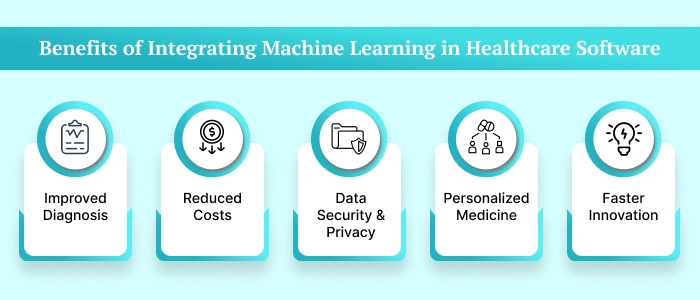
ML-integrated software systems have unlocked diverse benefits for healthcare institutions that allow them to deliver high-quality clinical services to their patients. Working with a healthcare marketing agency helps organizations effectively communicate these advantages to patients and referring physicians. Some of the popular Machine Learning benefits include:
1. Improved Diagnosis: Machine Learning healthcare software systems help to analyze medical information like genetic features, medical images, and patient records. This information helps doctors and medical professionals make quicker diagnosis. This leads to improved and accurate patient outcomes.
2. Reduced Costs: Machine Learning software plays a big role in minimizing operational expenses in healthcare institutions. For instance, ML algorithms simplify appointment scheduling and patient record management. This reduces the time and costs required for repeat tasks in healthcare.
3. Data Security & Privacy: With the rapid digitization of medical records, securing healthcare information is important. Machine Learning software systems can improve healthcare data security by addressing cybersecurity threats in real-time and ensuring that all data is secure and protected.
4. Personalized Medicine: ML algorithms analyze lifestyle changes, genetic variants, and medical history to personalize treatment plans for patients. This improves overall treatment processes and patient outcomes.
5. Faster Innovation: By improving drug discovery and testing, Machine Learning allows pharmaceutical service providers to reduce research costs and accelerate innovations. Moreover, it also helps to give insights into different diseases.
Want to Hire Software Developers?
With our custom healthcare software development solutions, we help you empower your business innovations.
Final Words
Machine Learning has massive potential to revolutionize the entire healthcare industry in all aspects. The advancement of healthcare software development solutions is continually expanding, and organizations are leveraging these solutions to improve patient care. While the perks of this technology are inevitable, the implementation of ML requires major operational changes and resources within healthcare organizations, and this is not quickly possible. Since the future of Machine Learning in healthcare is promising, it will resolve all potential medical challenges and drive more innovations soon.
FAQ’s
1: How to build software for healthcare?
Developing a custom healthcare software system involves several steps and adhering to industry regulations and standards to ensure privacy, safety, and effectiveness. Let’s have a look at the quick steps of the medical software development process:
Step 1: Understanding the project requirements
Step 2: Conducting deep market research
Step 3: Selecting the right tech stacks
Step 4: Focusing on the software design
Step 5: Start developing the software system
Step 6: Implementing regulatory compliance
Step 7: Testing and quality assurance
Step 8: Deploying the software system
2: How much does healthcare software development cost?
The average cost of healthcare software development ranges from $50,000 to $200,000. Technically, this cost mostly varies depending on diverse factors including project complexities, features and functionalities, choice of technology stacks, size of development team, hourly rates of custom software development company, geographical locations, etc.
3: What is custom healthcare software development?
The custom healthcare software development process involves developing tailored software systems for improving patient care and simplifying medical administrative tasks. Unlike traditional software systems, custom healthcare software is designed and developed to resolve specific challenges in healthcare sectors. Key benefits of custom healthcare software development include:
- Tailored solutions
- High scalability
- Existing system integration
- High security & compliance


 Shaili Gupta


 Ajay Wadne

