You already know AI chatbots save time. You already know they work around the clock, handle customer queries, and reduce operational costs. That part is everywhere, every blog, every LinkedIn post, every vendor pitch deck says the same thing. You’ve read the articles. 24/7 availability. Cost savings. Better customer experience. You get it.
But you’re still hesitating because no one’s telling you what happens after you deploy a chatbot. Or what separates a chatbot that converts from one that quietly frustrates every visitor and gets switched off in three months?
But here is what those resources quietly skip over.
They skip the part where a poorly designed chatbot frustrates your best customers into leaving. They skip the compliance risks that come with handling user data through a third-party AI. They skip the integration nightmares, the maintenance blind spots, and the very real difference between a chatbot that was deployed and a chatbot that actually performs.
This blog exists to fill that gap.
Whether you are evaluating your first chatbot or reconsidering a solution that never quite delivered, the next 10 insights are the ones that separate businesses that get genuine ROI from AI from those who simply check a box and wonder why nothing changed.
Let’s get into it.
The Difference Between a Chatbot That Converts and One That Just Exists
Here is a scenario most businesses recognise only in hindsight.
A company invests in a chatbot. It goes live on the website. It answers questions, handles frequently asked questions, and technically does all of the tasks for which it was designed. Six months later, conversion rates have barely changed. Support tickets are still piling up. And somewhere in the analytics, bounce rates on the chat widget tell a quieter story: most users are dropping off mid-conversation.
The chatbot works. It just does not work for the business. This is the conversation design issue, and it is far more prevalent than anyone in the business would care to accept.
One element of the equation is technology. The other half is how your chatbot engages a hesitant visitor, addresses an unanticipated inquiry, and most critically shifts someone from curious to dedicated, starting a conversation.
| Factors | Traditional Chatbots | AI Chatbots |
|---|---|---|
| Opening Message | Hi! How can I help you? | Personalised greeting based on the page the visitor is on |
| Handling Unexpected Inputs | Sorry, I didn’t understand that | Gracefully redirects with a relevant follow-up question |
| Conversation Goal | Answering queries | Advancing the user toward a decision |
| Tone & Language | Generic and robotic | Aligned with the brand’s voice and customer profile |
| Drop-off Response | None | Triggers a re-engagement prompt or human handoff |
| Post-Chat Action | Conversation ends | Lead captured, ticket raised, or follow-up scheduled |
| Outcome Tracked | Rarely | Measured against defined business KPIs |
A chatbot designed around your customer’s specific path, hesitations, language, and decision triggers performs quite differently from one developed around a generic template. It asks the appropriate questions at the correct time.
It does more than respond; it moves the conversation along to a meaningful consequence, such as a purchase, a booking, or a qualified lead for your sales staff.
The businesses seeing real returns from AI chatbots are not necessarily using more sophisticated technology. They are using more thoughtful conversation architecture, and that requires expertise, not just a platform subscription.
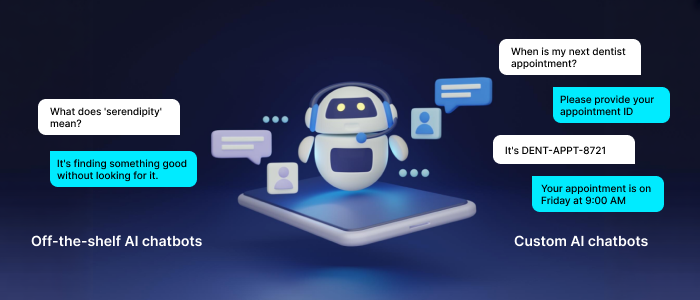
Custom-Built vs. Off-the-Shelf: Why the Choice Defines Your ROI?
The first question most firms ask when researching AI chatbots is practical:
“Can we just use an existing tool?”
And the truth is that you can. Platforms such as Intercom, Tidio, and ManyChat may create a rudimentary chatbot in hours. That may be sufficient for a solopreneur dealing with basic FAQs.
However, for a developing business with a real customer journey, a sales funnel, an existing tech stack, and a brand voice that must be safeguarded, off-the-shelf is where ROI dies quietly.
Here is why the distinction matters far more than most vendors will tell you:
| Factors | Off-the-Shelf Chatbot | Custom-Built Chatbot |
|---|---|---|
| Setup | Fast, template-driven | Architected around your specific workflow |
| Brand Voice | SGeneric, platform-defined tone | Fully aligned with your brand personality |
| Business Logic | Limited to the platform’s native tools | Built around your actual sales and support process |
| Integrations | Generic and robotic | Grows and evolves with your business |
| Scalability | Hits a ceiling quickly | Triggers a re-engagement prompt or human handoff |
| Training Data | Generic AI model | Trained on your products, FAQs, and customer interactions |
| OOwnership | The platform owns the infrastructure | You own the solution entirely |
| Long-Term Cost | A recurring subscription that compounds | One-time investment with measurable returns |
The ROI disparity between these two approaches expands dramatically over time.
A custom-built chatbot is capable of understanding your business context in addition to answering enquiries. It understands your product catalogue, price logic, escalation rules, and client segmentation. It expresses your brand’s voice. It connects with your existing systems rather than sitting awkwardly next to them.
More significantly, it is designed to tackle your individual problem, rather than a generic version of it. Off-the-shelf tools provide a chatbot. A skilled AI Chatbot development company hands you a business asset.
The Human Handoff Strategy, our Chatbot’s Most Underrated Feature
There is a moment in almost every customer conversation where automation reaches its limit.
A user has a billing dispute that requires context. Though about to finish a high-value deal, a prospect has a difficult query that your chatbot cannot completely address. One angry customer messages and gets a courteous, scripted response in turn. What follows in each of these cases will decide if your company gains trust or silently fails to.
This is the human handoff, and it is one of the most strategically important features of any well-built chatbot, yet it is rarely discussed in the content businesses read before making their deployment decision.
Most chatbot deployments treat handoffs like an afterthought. Reaching a dead end, the bot sends a generic please contact our support team message, and exits the user to restart the whole chat with a human agent who has no background of what was said before. That sensation feels like abandonment rather than like automated help.
A thoughtfully designed handoff does the complete opposite. It finds the appropriate trigger, whether it’s sentiment, query complexity, user irritation, or a specific keyword, and seamlessly switches the discussion. The human agent is given a complete transcript, the user’s information, and the context of the engagement thus far. The agent can solve the problem without the consumer having to repeat themselves; they feel heard.
Deliberate design decisions made at the architecture phase are necessary to get this right; therefore, it is a conversation worth having with your AI chatbot development company long before a single line of code is written.
A chatbot that hands off gracefully is one customers remember for the appropriate reasons. And a chatbot that does not is one they remember for all the wrong ones.
Data Privacy, Security and Compliance in AI Chatbots
Every conversation your chatbot has is a data transaction.
A user shares their name, their query, sometimes their phone number, their purchase history, or their medical concern. At that point, consumers are entrusting your company with information that has genuine weight. And, in 2026, the legal and ethical obligation that comes with that trust has never been clearer or more serious to neglect.
Here are the compliance realities every business deploying an AI chatbot must be aware of:
- India’s Digital Personal Data Protection Act (DPDP) is both active and enforceable. Any corporation that collects personal data from Indian users, whether via a chatbot or otherwise, must seek explicit consent, explain the purpose of data use, and give customers the right to access or delete their information. A chatbot built without these considerations is a liability, and a visible one.
- GDPR still applies if any of your users are based in Europe. Even if your business is headquartered in Mumbai, serving a European customer through your chatbot brings you under GDPR jurisdiction. The fines for non-compliance are substantial, and the reputational damage is worse.
- Sensitive industries have additional requirements. Healthcare, banking, edtech, and legal services all deal with data that falls into a different risk category. A chatbot that works in these businesses must be built with encryption, access controls, audit trails, and data minimisation principles in mind from the outset.
- Third-party AI systems pose data-sharing dangers that many organisations miss. When you employ an off-the-shelf chatbot driven by a third-party big language model, your users’ chats may be processed on other servers. Every business owner owes an honest answer to their customers about where their data goes, how long it is maintained, and who has access to it.
- User consent must be signed into the conversation flow. Compliance is more than just a backend concern; it’s mirrored in how your chatbot introduces itself, what it reveals up front, and how it handles a user’s request to opt out or remove their data.
- Businesses that see data privacy as a design philosophy rather than a statutory requirement are more likely to develop long-term consumer relationships. A development company that asks these questions before you do is one to trust with your project.
The KPIs That Actually Tell You If Your Chatbot Is Winning
Most businesses know their chatbot is live. Very few know whether it is actually working.
And that distinction between deployment and performance is where a significant amount of chatbot investment quietly goes to waste. Because without the right measurement framework in place from the start, you are essentially running a business-critical function on gut feel.
The good news is that a properly developed chatbot generates a wealth of performance data. The even better news is that you simply need to monitor the correct KPIs to get a clear, honest view of what your chatbot is providing. Here are the ones that truly matter:
- The Resolution Rate is the percentage of conversations that your chatbot resolves totally without human intervention. A high resolution rate indicates that your chatbot is well-trained, well-designed, and truly helpful to your clients. A low one signals the opposite and tells you exactly where to invest in improvement.
- Deflection Rate measures how many support queries your chatbot handles that would otherwise have reached a human agent. This is your clearest indicator of operational cost savings and directly translates into the ROI conversation your leadership team cares about.
- The Customer Satisfaction Score (CSAT), which is gathered at the conclusion of chatbot engagements, indicates whether or not consumers are leaving satisfied or dissatisfied. The wrong problem is being solved by a chatbot that has a high deflection rate but a low CSAT. It is keeping queries away from humans but delivering a poor experience in the process.
- Handoff Rate tells you how often your chatbot escalates to a human agent. Some handoffs are by design and entirely healthy. Conversely, a consistently high handoff percentage suggests that your use cases have exceeded the capabilities of the current build, that your chatbot is undertrained, or that your conversation flows need to be improved.
- Your chatbot’s average conversation length indicates if it is effectively directing people or circling them. Shorter, resolved conversations are a sign of strong conversation design. Long, unresolved ones are a sign of friction.
- Of all the metrics, goal completion rate is probably the most business-aligned. It tracks how frequently a user completes the desired action buying something, scheduling a demo, or filling out a lead form as a direct consequence of interacting with the chatbot. This figure establishes a clear link between your chatbot’s performance and income.
Multilingual & Regional Chatbot Challenges

Here is a number worth sitting with: only a fraction of India’s 1.4 billion population is truly comfortable communicating in English. Yet the overwhelming majority of business chatbots deployed in this country speak nothing else.
That is an enormous conversation gap. And for businesses willing to close it, it is also an enormous competitive opportunity.
The quickest way to gain or lose a customer’s trust is through language. In addition to having a better experience, a user who can communicate with your chatbot in many languages or even the informal ones they use daily feels appreciated by your company. Genuine loyalty, increased conversion, and recurrent engagement are all fuelled by that emotional connection.
But the multilingual advantage extends well beyond India’s borders, and here is why global businesses are paying close attention to it too:
- Together, Arabic, Spanish, Portuguese, and French represent billions of digital users whose first choice is invariably their mother tongue. By using English-only chatbot experiences, companies growing into the Middle East, Latin America, or West Africa are losing a lot of money.
- Script and character support matter as much as language understanding. For consumers who are much more at ease typing in their local script than in Roman letters, a chatbot that can read and reply in Devanagari, Arabic script, or Tamil characters eliminates a significant obstacle.
- The next frontier is multilingual support that is voice-enabled. With voice search growing rapidly across Tier 2 and Tier 3 cities in India, chatbots that can understand and respond in regional spoken languages are moving from a differentiator to an expectation and businesses building for that reality today will have a significant head start tomorrow.
Find your chatbot answers confusing, generic, or off‑brand?
Customize AI‑powered brand voice.
Chatbot Trained on Your Data Performs on a Different Level
Think about the best customer-facing employee your business has ever had. They knew your products inside out. They understood your brand’s tone. They remembered returning customers. They handled objections naturally because they had seen them a hundred times before.
That is exactly what a chatbot trained on your business data becomes, and it is a fundamentally different creature from a generic AI assistant pulled off a platform shelf.
Broad, publicly accessible data is used to build generic AI chatbots. When it comes to your particular business environment, they are astonishingly mediocre, despite their outstanding ability in general discourse. They are unaware of your pricing tiers, the subtleties of your return policy, your best-selling SKUs, or how your company handles unhappy customers.
A custom-trained chatbot does. Here is what that looks like in practice:
- Product and service knowledge is precise. Instead of giving a generalised answer about a category, your chatbot references your actual catalogue, your specific features, and your real pricing accurately, every single time.
- Your brand voice is preserved consistently. Whether your tone is warm and conversational or sharp and professional, a chatbot trained on your content reflects that identity across every single interaction, at scale.
- Returning customer context is recognised and used. A chatbot with access to your CRM data can turn a transaction into a relationship-building experience by greeting a repeat customer by name, emphasising their most recent behaviour, and making relevant recommendations.
- Common objections are handled with your actual responses. Instead of generic deflections, the chatbot draws from your real sales playbook the answers your best human agents give, making every conversation sharper and more persuasive.
- It becomes better with your business, not without it. A custom-trained chatbot can be retrained on fresh data to ensure that its performance grows with your business as your goods and client trends change.
Integration With Your Existing Tech Stack
Here is something most chatbot vendors will not tell you upfront: the chatbot itself is rarely the hard part. The hard part is everything it needs to connect with.
Your business does not function alone. You perhaps have a CRM for customer information, an ERP for inventory and orders, payment gateways processing transactions, a helpdesk tracking support requests, and a dozen or so internal tools often utilised by your teams. Rather than being an island, a chatbot unable to converse with these systems is not an advantage.
And islands do not convert.
Here is where the integration complexity actually lives, and why it matters:
- CRM integration determines personalisation depth. A chatbot connected to Salesforce, HubSpot, or Zoho can pull customer history, purchase behaviour, and past interactions in real time, delivering experiences that feel personal rather than transactional.
- ERP connectivity enables accurate, live responses. When a customer asks about order status, stock availability, or delivery timelines, your chatbot should pull live data, not recite a scripted approximation that may already be outdated.
- By integrating the payment gateway, friction is eliminated at the most crucial point. A chatbot capable of starting, executing, or verifying a purchase within the conversation window greatly speeds the purchasing process and lowers abandonment at checkout.
- Links with ticketing systems and helpdesk close the circle. Your support process becomes truly smooth rather than just partially automated when a chatbot raises a support ticket, sets a priority, and alerts the appropriate agent all inside the same chat.
- Custom API integrations enable opportunities no off-the-shelf system can provide. Bespoke API work needed only an experienced development team to architect reliably for proprietary internal tools, legacy systems, and industry-specific software.
- Every integration point is a possible failure point; each failure point exposes your client to your brand at its worst. Getting this right from the beginning requires a development partner who has already negotiated these obstacles and knows the pressure points before they become problems.
Maintenance, Updates, and Iteration
Launching your chatbot is the beginning of the journey, not the destination.
Maintenance is less exciting than a launch demo, so most vendors skip this aspect of the sales conversation. However, businesses that take post-deployment care as seriously as original creation will see their chatbots continue to improve, convert, and create value months and years later.
A chatbot left untouched after launch ages quickly. Here is what ongoing maintenance actually involves, and why each element matters:
- Regular training preserves your chatbot’s accuracy. Your products evolve, your pricing shifts, and your policies get reviewed. Most of your consumers would rather leave than inform you; a chatbot trained on last year’s information is already giving some of them incorrect replies.
- Conversation flow audits identify hidden friction areas. Regularly examining where users break off, pause, or repeat themselves reveals gaps in your conversation design that are silently losing you conversions.
- Security patches and compliance updates are non-negotiable. Your chatbot’s infrastructure needs to be updated appropriately as data privacy standards evolve and new hazards develop; hence, regular technical help is required.
- New use case expansion compounds your initial investment. A chatbot that is properly maintained develops along with your company. Over time, new product lines, new client segments, and new support situations can all be added to transform your initial design into a stronger and more strong business tool.
- Performance benchmarking against your KPIs drives continuous improvement. Monthly reviews of resolution rate, CSAT, and goal completion rate tell you exactly where your chatbot is winning and where it needs work, but only if someone is consistently doing the analysis.
Agentic AI Chatbots
Most chatbots nowadays are reactive. A user asks, and the chatbot responds. That approach is already becoming the standard expectation, and firms paying attention are actively planning for what comes next. Agentic AI chatbots do not simply reply to discussions. They act within them.
Compare a chatbot that alerts the consumer, offers a solution, and updates the logistical ticket without human assistance with one that informs a client their purchase has been delayed.
That is the agentic difference. Here is what it looks like across real business scenarios:
- Bookings, refund handling, account detail updates, and follow-up email sending are all entirely within the flow of the conversation.
- Reaching out to consumers proactively based on behavioural triggers, unclaimed carts, or approaching renewals without waiting to be triggered.
- Multi-step problem solving manages intricate questions needing information pulled from several systems, options deliberated on, and a full resolution delivered in one interaction.
- As one cohesive smart layer across your whole company, cross-platform activity running over your website, WhatsApp, app, and internal tools simultaneously.
- The one most significant jump in conversational AI right now is the change from reactive to agentic. Businesses constructing now with this evolutionary perspective will not have to start again tomorrow.
What to Look for in an AI Chatbot Development Company?
Selecting the right AI Chatbot development company is maybe more important than picking the best technology. The platform is a tool; the team behind it will decide if your chatbot is a valuable corporate asset or an expensive lesson.
Here is what a serious AI chatbot development company looks like in practice:
- They question your company first before they address technology. Rather than pitching characteristics, a trustworthy partner begins the first conversation by trying to learn your customer journey, your current systems, and your growth objectives.
- They have knowledge spanning many sectors. A team that has created chatbots for healthcare, financial technology, e-commerce, and education technology brings pattern recognition that a generalist agency just cannot copy.
- They create for discussion, not only for usefulness. Beyond simply getting the chatbot to work technically, they dwell on its tone, direction, and conversion rate.
- They raise compliance and security questions proactively. Data privacy, DPDP, GDPR, a responsible partner flags these before you think to ask.
- They define success metrics at the start. KPIs, resolution rates, and goal completion benchmarks are established before a single line of code is written.
- They offer post-launch support as a standard commitment. Maintenance, retraining, and iteration are part of the engagement, not an upsell conversation six months later.
- They have a portfolio that speaks for itself. Case studies, client results, and industry-specific builds are the clearest signal that a team can deliver what they promise.
- The right partner does not just build your chatbot. They take ownership of their performance, and that distinction is everything.
Watch your support team drown in repetitive queries?
Automate support with smarter AI.
Conclusion
Every insight in this blog points to the same underlying truth: a chatbot is only as smart as the thinking that goes into building it.
The technology is ready. The opportunity is real. However, the difference between a chatbot that truly advances your business and one that only lives on your website comes down to choices made long before implementation regarding language, data training, integrations, compliance, and long-term care. Those choices merit a major discussion with a crew that has previously handled them.
At Sphinx Solutions, we build AI chatbots the way we would want one built for our own business, with your customer journey at the centre, your systems in mind, and your growth as the measure of success.
If you have been thinking about building a chatbot, or rethinking one that never quite delivered, we would love to be part of that conversation.
FAQ’s:
- How much does a custom AI chatbot cost to develop?
The investment varies based on complexity, integrations, and features required. Sphinx Solutions offers a tailored pricing approach; the best starting point is a conversation about your specific requirements.
- How long does development typically take?
A well-built custom chatbot typically takes between 4 and 12 weeks, depending on scope, integrations, and the level of training data involved.
- Is a custom-built chatbotreally worth itover an off-the-shelf tool?
For growing businesses with real customer journeys and existing tech stacks, absolutely. The ROI gap between the two widens significantly over time.
- Can my existing systems, like CRM and ERP, be integrated?
Yes. Integrating with your existing tools is a core part of how Sphinx Solutions approaches every chatbot build, not an add-on.
- What is the first step to getting started?
Simply book a free consultation with the Sphinx Solutions team. We start by understanding your business; the technology conversation comes after.


 Souradeep Kundu

 Shivraj Dhaygude