Key Takeaways
- Context engineeringsupports AI models deliver suitable, reliable results by offering the right information, instructions, memory, and tools for every task.
- Context engineering vs. prompt engineering comes down to scope: prompt engineering focuses on instructions, while context engineering controls the broader information the model needs for effective working.
- RAG, fine-tuning, and context window management serve different purposes. RAG retrieves suitable information, fine-tuning catches model behaviour, and context management keeps required details accessible without unnecessary clutter.
- Context engineering best practicescover selecting suited information, compressing lengthy content, maintaining useful memory, and connecting AI models to appropriate tools via methods like the Model Context Protocol (MCP).
- Security and continuous evaluation are essential for dependable AI systems. Validating sources, controlling tool access, and testing accuracy, consistency, cost, and performance help in reducing risks and improve results over time.
For years, we focused heavily on how to think and word a single prompt to get the perfect reply from a Large Language Model (LLM). But as AI is evolving, from simple chatbots to tough, autonomous agents able to organise multiple-step workflows, just a single good prompt isn’t enough. One can say, if 2023 was the year for prompt engineering, 2026 is officially the year of Context Engineering.
Building an AI agent to track customer accounts, remember unresolved support tickets, and maintain a coherent conversation for weeks needs something much bigger. The world of Context Engineering is all about the art and science of dynamically managing an AI’s active memory workspace to keep it accurate, focused, and efficient.
What is Context Engineering?
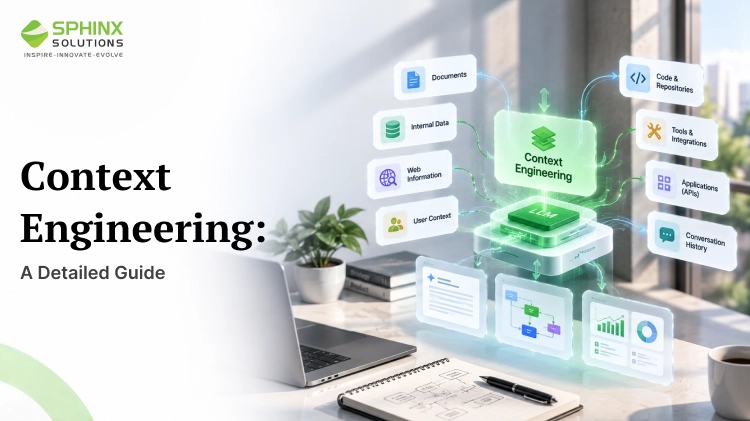
Context engineering is the practice of designing systems that select, organize, and provide the right information, tools, and relevant organizational knowledge to an AI agent. It helps ensure the agent has the context it needs to perform tasks effectively within its context window, which determines how much information the model can process at a time. This information is measured in tokens, the smaller units of text or data processed by the AI model.
RAG pulls in helpful info from outside sources and feeds it into the model so it can answer better. The Model Context Protocol allows AI apps link to outside tools, data, and services.
These techniques always keep the AI model clear on what to do, which data to use, and which tools to pull from. It’s not only about collecting more info, but also about shaping what’s there, so it’s clear, tidy, and helps with the task.
Now, let us understand the importance of evolution of Context Engineering here.
The Emergence of Context Engineering
Context engineering emerged as AI developed from simple, single-turn interactions to tedious workflows including agents, external tools, and multiple decisions. While prompt engineering works well for tasks like writing emails or summarising text, it becomes less sufficient when AI should retrieve information, remember past actions, and adapt to variable conditions.
Modern AI agents work via continuous cycles of reasoning, action, and feedback. They can query databases, call APIs, and execute code. Context engineering manages the resulting information, keeping suitable instructions, tool outputs, and task history available without burdening the model.
Context overload is other challenge. Too much irrelevant information can supress important details, increase costs, and affect the quality of response. Context engineering shows this through retrieval, filtering, summarisation, and careful context management.
Ultimately, context engineering supports build reliable AI applications by information management, connecting tools, and sustaining appropriate context across a task. This encourages businesses to build AI systems handling real-world workflows more efficiently with required consistency.
Why Context Engineering Matters?
Context engineering‘s like cleaning up your cluttered desk before you begin. Prompt engineering is about phrasing the question just right. Context engineering clears up the surrounding details so the AI can zero in on the answer.
That’s what lets an AI system stay perfectly accurate, keep results steady, cut costs hard, and never lose track of context.
Properly engineered context directly dictates an AI system’s viability across four critical pillars: accuracy, consistency, cost, and context rot.
The breakdown of these four pillars is as follows:
- Accuracy: Eliminates the “lost in the middle” condition. By refining noise and placing key data in preferred zones, it limits hallucinations and forces realistic grounding.
- Consistency: Set ups model behaviour. Using standard schemas and few-shot examples making it sure for identical formatting and tone across millions of different prompts.
- Cost: looking down API bills and latency. Techniques i.e. Semantic pruning and context caching minimise token payloads, making financially sound production systems.
- Context Rot: Context rot avoids conversational decay. Dynamic memory management purges stale history while saving core data, keeping the AI sharp during long sessions.
Context Engineering vs Prompt Engineering, RAG and Fine-Tuning
Selecting the perfect approach to boost AI responses depends on what the task expects. Context engineering vs. prompt engineering, RAG, and fine-tuning is not just a comparison of techniques, as each one of them addresses a different section of the problem. Understanding how they function or work, where they vary, and when to use each this helps to develop AI systems, those are delivering more suitable, accurate, and consistent results.
| Point of Comparison | Context Engineering | Prompt Engineering | RAG | Fine-Tuning |
| Primary Goal | Give the AI the right info, tools, and memory at the right moment | Get better answers by writing clearer instructions | Make answers more accurate by pulling in outside information | Teach the AI a specific skill or style |
| Scope | The whole setup around the AI | Just one question or instruction | Just the step where information is looked up | The AI model itself |
| Flexibility | Very flexible, adjusts to each task and user | Fairly flexible, easy to edit but limited to one prompt | Very flexible, you can swap documents anytime | Not very flexible, any change means retraining |
| Cost & Effort | Moderate, needs some planning and setup | Low, quick and easy to try | Moderate, needs a system to store and search documents | High, needs lots of data, computing power, and expertise |
| Best For | Complex AI tools that handle many steps | Simple tasks and quick tests | Answering questions from large or changing documents | Giving the AI a special tone, style, or expertise |
How Context Engineering Works?
The current scenario of AI applications is going beyond simple question-and-answer interactions. Core requirements of AI agents built on large language models (LLMs) comprises of user requests processing, retrieving enterprise knowledge, utilisation of external tools, managing context memory, and finishing up multi-turn tasks.
This is where context engineering is useful. Rather than iterating on the prompt, engineers build out a full information flow that describes what data, instructions, history, and tool outputs an AI model sees before it produces a response.
A good context system lets AI applications filter out irrelevant information, increase accuracy, manage token usage and produce more reliable results in production environments.
The Context Pipeline
The context pipeline elaborates how information shifts from a user’s request to the AI-generated response. It also supports developers to understand where information is accumulated, how it is filtered / refined, and how it is transferred to a large language model (LLM).
A context pipeline follows these stages:
Receive Request: Know the user first. The system identifies the question, the reason for it, and the style the answer has to be given.
Collect relevant information: The request is registered along with the system instructions. That is often sufficient, but when it is not, the system pulls up what else is needed, be it a document, a database record, a previous message, or something in memory.
Context setting: This is the cleanup stage. Irrelevant details are stripped away, redundancy is removed, and the data is checked for currency wherever possible. The rest is used for a reasonable order.
Manage the context window: It estimates the token usage and reserves space for instructions, retrieved information, conversation history, tool definitions, and the model’s expected response.
Generate or act: The model either generates an answer or asks for an appropriate tool to either fetch more data or perform an authorised action.
Match the response with the relevant requirements and apply the appropriate safeguards. Return the answer. If the task needs more information, the process repeats.
Context window limits and token budgeting
A model may handle a large amount of text at once. Whatever goes in, with whatever comes back out, should fit inside its context window, and that space is counted in tokens.
Token budgeting simply means planning how that space gets shared out. Some goes to instructions, some to the user’s question, some to retrieved documents, tool descriptions and past messages, and some has to be kept free for the reply.
Think of a support agent three weeks into a customer’s issue. Pasting the whole thread into every request is wasteful. It works better to keep a running summary and fetch an older message only when the customer refers to it. That cuts token use, and the model isn’t wading through details that no longer matter.
Effective context management prioritises accurate, useful information while saving essential instructions and security constraints.
Core Components of Context Engineering
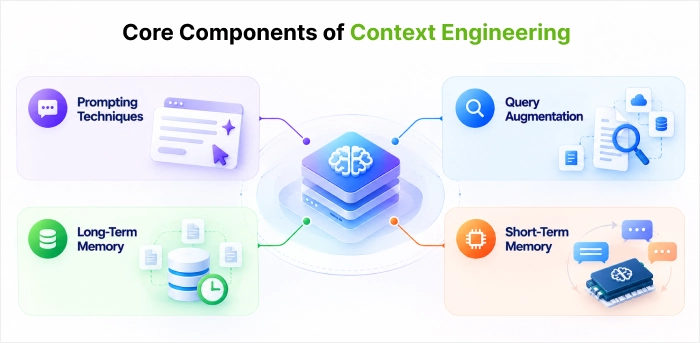
Core components of context engineering emphasis on optimizing how information is selected, streamlined, and delivered to large language models (LLMs) to maximize reply to accuracy. This discipline includes dynamic context retrieval to extract only the most suitable data, alongside prompt compression to minimize token usage and costs.
It also encompasses metadata enrichment to offer critical situational tracking and structural formatting to make sure that the model parses information efficiently.
These elements change raw data into a streamlined, high-utility input which directly improves an AI’s reasoning capabilities.
Let us roll them out here:
• Prompting Techniques
Classic prompting is related to pattern recognition. It involves providing examples, specifying the desired format, and defining clear guidelines for the model to follow. Few-shot prompting works particularly well for structured tasks.
Advanced prompting techniques are even more interesting. For example, Chain-of-Thought (CoT) prompting encourages a model to work through complex problems in a structured manner.
• Query Augmentation
Users are often reluctant to type long, detailed queries repeatedly. Query augmentation addresses this challenge by improving and expanding user queries through the following techniques:
- Query Rewriting: An LLM takes a vague or unclear question and reformulates it to make the user’s intent clearer.
- Query Expansion: Adds related terms, synonyms, and relevant keywords to broaden the search and retrieve more useful results.
- Query Decomposition: Breaks a complex question into smaller sub-queries that can be addressed independently.
- Query Agents: Use an agent to dynamically determine how to reformulate or refine a query based on initial results.
• Long-Term Memory
An AI agent may have in-depth conversations with users who share preferences, contextual information, and personal history. However, this information can be lost when a session ends.
Long-term memory addresses this limitation by storing relevant information in external systems, allowing agents to retrieve useful details across multiple sessions.
- Vector Databases: Store embeddings of past interactions and enable semantic searches to retrieve relevant information based on meaning.
- Graph Databases: Store entities and their relationships to represent connections between users, conversations, and contextual information.
Open-source tools make these capabilities more accessible, eliminating the need to build every component from scratch.
• Short-Term Memory
Short-term memory refers to the conversation history and contextual information an AI agent uses during an ongoing interaction. Although this capability is often available by default, it can be poorly managed.
Common challenges include:
- Context Overloading: Including too much information in the context window, potentially reducing the model’s effectiveness.
- Insufficient Context: Failing to provide enough relevant information for the model to generate accurate responses.
- Poor Context Ordering: Placing important information where the model may be less likely to use it effectively.
- Lack of Summarization: Failing to summarize long conversations, resulting in unnecessary context consumption and the loss of important details.
• Comparison: Short-Term Memory vs. Long-Term Memory
Memory enables AI agents to track conversations, retain useful information, and provide more relevant responses. Short-term memory focuses on the current interaction, while long-term memory preserves important information across sessions.
| Aspect | Short-term memory | Long-term memory |
| Purpose | Maintains context during the current conversation or task. | Retains useful information across conversations or sessions. |
| Stores | Recent messages, current goals, intermediate results, and decisions. | User preferences, important facts, and suitable past interactions. |
| Duration | Usually session-based; may be summarised or cleared. | Persists in external storage until updated or deleted. |
| How it works | Uses conversation history or active task state. | Retrieves stored information when it becomes relevant. |
| Example | Remembering the destination and budget while planning a trip. | Remembering the user’s general travel preferences for future trips. |
• Retrieval
Many teams consider this as RAG, but this is very stiff. RAG is just a pattern.
The real challenge lies in connecting AI technology with your business data.
Those sources are scattered in the form of docs, Wikipedia, databases, SaaS tools such as Notion and Google Drive, APIs, and code repositories.
The retrieval pipeline comes up across three layers:
- Pre-Retrieval
- Retrieval
- Augmentation
Open-source tools handle it all without needing custom connectors for every data source. Just sync your knowledge bases and access Notion, Google Drive, databases, and other tools from one place.
• Tools and Agents
A tool extends what the model can do because, without it, the model is hampered with just what’s in its weights and context window. Also, an agent decides when and how to use these tools.
Four Core Strategies for Context Engineering
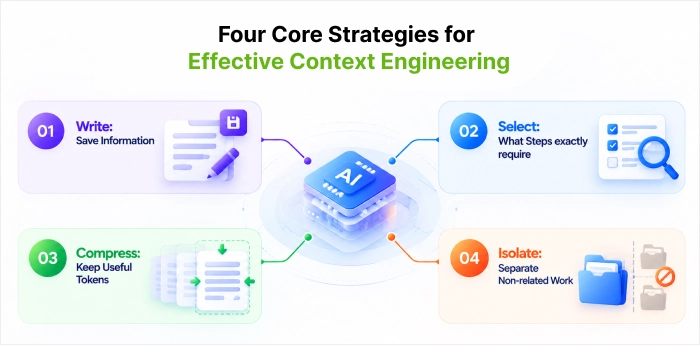
An AI model may lose track of important details when a task has much lengthier conversations, several documents, or many steps. Context engineering supports in managing this situation by deciding what information to save, retrieve, condense, and keep separate.
Four core strategies i.e. Write, Select, Compress, and Isolate. Together, they help AI agents to use their context windows more effectively without any loss of the information required to do a task.
• Write: Save Information
AI agent jots down thoughts, plans, and discoveries while working through problems. Keeps facts and preferences stored away to use later. The AI keeps facts and preferences around for later use. Storing information outside the context window also leaves more room for the details needed now.
• Select: What Exactly Require
Retrieves only the appropriate data, saved memories, and tool definitions needed for the existing task. It uses agentic Retrieval-Augmented Generation (RAG), semantic similarity search, and just-in-time tool to reduce unnecessary token usage and keep the AI focused on the current task.
• Compress: Keep Useful Tokens
Long interactions produce far more text than a model can use well. Summarisation condenses previous turns, and trimming trims out older or repeated messages. A weak summary is risky, because any detail it skips is missing from each further step.
• Isolate: Separate Non-related Work
Dividing a job among sub-agents gives each one a dedicated window and a narrow focus. Sandboxed environments do something similar for bulky outputs. The price is higher.
Tools and MCP in Context Engineering
AI models mainly need capabilities or informational details which are unavailable in the conversation itself. Tools enable an AI application to retrieve documents, querying databases, check records, conduct calculations, or execute other set operations. Context engineering detects which tools are ready for use, when they must be used, and how their results become integral part of the model’s working context.
Refer a table for better understanding here
| Category | MCP Tool / Integration | Description & Capabilities |
|
Development & Code Repositories |
GitHub |
Handles repository management actions and tracking (e.g., create_issue, get_issue). |
|
Filesystem |
Provides local directory sandboxing for secure file reading, writing, and editing. |
|
|
SQL Server / Databases |
Enables conversational database querying and schema inspection (e.g., list_databases, get_schema). |
|
|
Productivity & Communication |
Google Calendar |
Handles schedule management through functions like get_calendar, create_event, and update_event. |
|
Web Research & Automation |
Fetch |
Retrieves and converts external web content into token-efficient formats for LLMs. |
|
Firecrawl |
Executes deep web scraping and site-mapping tasks (e.g., start crawl, start_batch_scrape). |
|
|
Playwright |
Powers end-to-end browser automation and web application testing. |
|
|
Reasoning & Problem-Solving |
Sequential Thinking |
Guides the model through a dynamic, step-by-step reflection process for architectural debugging and complex problem-solving. |
Designing Clear Tool Descriptions
Building good tools means getting the basics right. Name it clearly. Know what it does. Define your inputs and outputs. Make them predictable. Leave balance checks need different tools than HR policy lookups. Employee support agents use both. When descriptions are solid, models pick the right tool. You waste fewer tokens. Functions don’t overlap or confuse things.
Security primarily depends on application-level input validation and access controls.
How the Model Context Protocol (MCP) Helps
MCP, the Model Context Protocol, standardizes how AI applications communicate with external tools and data sources. AI apps can discover what capabilities MCP servers expose. Fetch company documents. Access employee records you’re authorized to see. Invoke those capabilities when needed.
This supports context engineering by making suitable external information available to the model. Anyhow, MCP does not independently manage the entire context window or guarantee accurate responses.
Combining Tools, Retrieval, and Context Management
Effective context engineering aligns tools, retrieval-augmented generation (RAG), and memory to deliver relevant information when required. RAG retrieves external information, tools access data or perform defined actions, and memory retains useful details across conversations. Together, these components help AI systems handle multistep tasks while organising token usage and validating results.
Unlike context engineering vs prompt engineering, which compares two approaches to guide AI models, this section entrusts on how tools, retrieval, and memory work together. In a broader context model in software engineering, developers also define the entities, relationships, and environmental information- a system needs to operate correctly.
Real-World Examples of Context Engineering
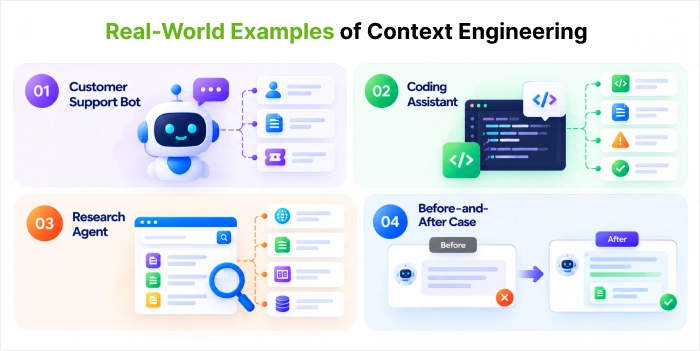
Context engineering helps AI deliver useful and accurate results by supplying the information, tools, and conversation history suitable to a particular task. This makes it easier for AI to work through complex, multi-step tasks in areas such as customer support, software development, and research, where a simple prompt may not provide enough information to produce the desired outcome.
• Customer Support Bot
Aligns customer history, authorised account details, and support documents to solve queries without repeating troubleshooting steps. RAG gathers suitable information, while tools check ticket status.
• Coding Assistant
Uses source code, project documentation, and error logs to suggest suitable solutions. Repository tools and test results support validating changes against the current codebase.
• Research Agent
Retrieves information from multiple sources, compares findings, and identifies conflicting claims. Context management saves suitable evidence while controlling token usage.
• Before-and-After Case
Before: An AI assistant gives a common answer about employee leave carry-forward without checking company policy.
After: It retrieves the applicable policy and authorised employee details to offer a suitable answer or request clarification.
This example shows how a well-designed context pipeline improves response quality via the most suitable retrieval, verified information, and appropriate access controls.
How to Implement Context Engineering in AI Products and Business Workflows
Applying or utilising context engineering starts with a basic understanding, what an AI application required to deliver reliable results. A structured approach supports teams to select certain information, connect with the right tools, manage token usage, and maintain security as the solution progresses from testing to production stage.
- Define your task at start: What’s the business problem? What output do you want? How do you know it worked out?
- Identify context: What instructions, documents, user data, and chat history does your model need to see?
- Build out your context pipeline: Wire up retrieval systems, memory, tools like APIs or MCP servers. Use what makes sense.
- Manage and secure the data: Strip out noise. Control who accesses what. Keep token usage inside your context window.
- Test and evaluate all: Test accuracy, retrieval quality, response consistency, latency, cost, security risks. Run through it all.
- Deploy in stages: See how it performs in the actual world. Align your context selection as business requirements shifts.
Context engineering isn’t a one-time setup. Treat it as continuous work. Regular review and improvement sustain usefulness, safety and matching perfectly with your dynamic business needs.
Best Practices, Common Mistakes and Security
AI models with powerful tools, extensive knowledge, and huge context windows still mess up if they get irrelevant information, outdated data, or contradictory inputs. Context engineering fixes this. Get the right information to the model at the right moment. Keep instructions, data sources, and available actions clearly defined.
Anyhow, making a reliable AI system needs more than selecting useful context. Developers must also manage token usage, validate retrieved information, protect sensitive data, and stop malicious instructions from affecting the model.
Following best practices helps in improvement of response quality, reduce common context failures, and make AI applications safer.
Context Engineering Best Practices Checklist
Effective context engineering depends on selecting relevant information, managing the context window, and maintaining control over data and tools.
Follow this checklist when designing / improving an AI application.
- Define clear objectives: Specify the task, desired output, and essential instructions.
- Retrieve relevant information: Use retrieval-augmented generation (RAG) to supply useful, up-to-date information.
- Manage the context window: Allocate tokens across instructions, retrieved data, conversation history, tool results, and the final response.
- Maintain data quality: Remove old, outdated information and verify source reliability.
- Design clear tools: Define each tool’s purpose, inputs, outputs, and permissions.
- Protect sensitive data: Retrieve only the information needed for the task and enforce access controls.
- Prevent prompt injection: Treat external content as untrusted and validate tool calls before execution.
- Test and monitor: Assess response accuracy, retrieval quality, token usage, and security risks.
Apply this checklist when designing / improving an AI application:
- Define clear objectives: What’s the task. What output do you want. What instructions matter most.
- Retrieve relevant information: Use retrieval-augmented generation to supply useful, current information.
- Manage the context window: Split your tokens across instructions, retrieved data, conversation history, tool results, and the final response.
- Maintain data quality: Remove outdated information. Verify sources work.
- Design clear tools: Each tool needs a purpose. Specify inputs, outputs, and permissions.
- Protect sensitive data: Only retrieve what you need. Enforce access controls.
- Prevent prompt injection: Treat external content as untrusted. Validate tool calls before running them.
- Test and monitor: Check response accuracy. Look at retrieval quality. Track token usage. Watch for security risks.
Good context engineering means picking relevant information, managing your context window, and controlling data and tools. Use this when building or improving an AI application.
Common Context Engineering Mistakes
Also, a well-designed AI workflow is possible for the failure, when its context has unreliable information or data, too many details, or conflicting instructions.
Four common failure modes help developers identify the cause and use the right correction.
- Context poisoning: Incorrect, old, malicious information goes into the context and effects replies. Validate sources, refresh stale records, and treat retrieved content as much untrusted.
- Context distraction: Extended conversation history / irrelevant documents distract from the current task. Summarise lengthy interactions and retrieve suitable information only.
- Context confusion: Overlapping tools / unnecessary details make it harder for the model to go for the right information or action. Streamline the context and clear out tool descriptions.
- Context clash: Conflicting facts or instructions take to inconsistent answers. Check source dates and versions, set up source-priority rules, and flag unresolved conflicts over just guessing.
Security, Privacy and Prompt Injection
Prompt injection happens when malicious instructions in user input or external content try to manipulate an AI model or carrying out unauthorised actions. Such instructions may be there in documents, emails, web pages, or tool outputs, making security a required part of context engineering.
Developers must apply or use layered safeguards to lower down these risks:
- Separate data instructions: Separate system instructions from user input and retrieved content. Delimiters can help. But they don’t guarantee safety.
- Implement access controls: Verify identity and permissions in the application or retrieval layer instead of relying on the model for the access.
- Validate tool calls: Check inputs, outputs, and permissions before running operations.
- Restrict sensitive actions: Require appropriate authorisation or human approval for high-impact operations, like deleting records or changing permissions.
- Restrict sensitive information: Retrieve necessary personal or confidential data only and protect stored memory, logs.
- Monitor and test: Test direct and indirect prompt-injection attempts, check again security events, and update safeguards with varying threats.
No single prompt or filter guarantees complete protection. Mix of access controls, input validation, monitoring, and human check offers a strong security approach.
Conclusion
Context engineering is becoming more important due to dynamical change in AI technologies from basic prompt and response approach to the automatic workflows and doing multiple tasks at a time with AI agents. A great, phrased prompt can change a model, but the output quality is entirely depending on the fed data, the tools it can use, and how you structure its context (with a task).
As explained in this guide, successful context engineering combines relevant data, retrieval, memory, token budgeting, and safe tool integration to achieve better accuracy, consistency, and efficiency.
Whether you’re building a bot to support customers, an assistant to help with coding, or an AI agent to run business workflows, the goal is the same: give the model the right context, at the right time, with the right safeguards. And that’s what makes the difference between promising AI capability and a reliable solution for the real world.
FAQs
Is context engineering replacing prompt engineering?
Context engineering is shifting from a trending word to a core discipline which is superseding and expanding upon standalone prompt engineering in production AI systems.
Is RAG part of context engineering?
Retrieval-Augmented Generation (RAG) is a certain technique, which is a definite part of context engineering.
How does MCP relate to context engineering?
The Model Context Protocol (MCP) works as the standard bridge and infrastructure layer for context engineering. MCP offers the universal connector and interface contract to make dynamic context retrieval scalable.
Do you need context engineering for simple chatbots?
No. Context engineering is not required for simple chatbots. Simple chatbots are based on question-and-answer format or query and response technique.
What is context poisoning, and how does it happen?
Context poisoning is when an AI system’s working context is compromised by incorrect, misleading or malicious information and influences its responses. Later decisions can be affected if information isn’t properly controlled. This requires verification of the source, reliable information retrieval, and prudent memory management.
What is the enterprise context gap in AI systems?
The enterprise context gap is the difference between an AI model’s general knowledge and the certain information needing for a business. Connecting it to certain company policies, documentation, and authorised data supports it produce more useful, business-driven responses.
How does context engineering support multimodal AI?
Context engineering assists multimodal AI systems in better understanding inputs across text, image, audio and video. It gives multimodal AI models the flexibility to pull context and make links between data in different formats to allow for more effective responses.


 Shaili Gupta

 Ajay Wadne