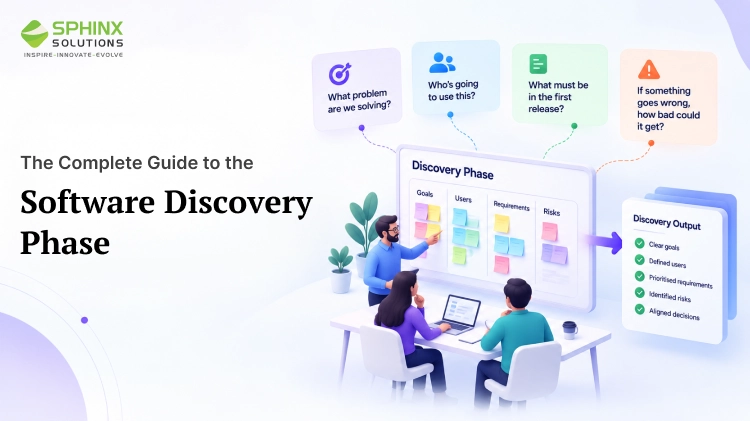
Key Takeaways
- The software discovery phase is the planning stage before any code is written, where business and technical teams agree on goals, users, scope, risks, and budget.
- It isn’t the same as the ongoing product discovery process. Discovery gives a project a solid start, while product discovery keeps it on course after launch.
- A proper project discovery phase brings risks out early, produces estimates you can defend, and gets stakeholders aligned before changes become expensive.
- The process moves from defining the real problem through interviews, research, a discovery workshop, workflow mapping, technical checks, prototyping, and planning.
- Most discoveries take one to six weeks and often cost between $5,000 and $15,000, usually less than 10% of the build budget.
- Faster, AI-assisted development makes discovery more important, because speed only helps when you’re heading in the right direction.
Ask any project lead why their last build went over budget, and you’ll rarely hear them blame the code. What you’ll usually hear is that nobody was entirely sure what they were building. The kick-off went well. Everyone nodded. Then each person quietly filled in the gaps in their own way. Sales pictured one product, operations pictured another, and the developers, working from a two-page brief, built something else again.
By the time anyone noticed, the scope had doubled and the budget was a rough guess. Follow that story back far enough, and you’ll often find a software discovery phase that was rushed or skipped. We’ve watched enough projects go that way to treat discovery as non-negotiable. At Sphinx, it’s the stage where an idea stops being a conversation and becomes a plan people can build.
This complete guide briefs about what the software discovery phase involves, why it pays for itself, how we run it, who should take part, what you should have in hand at the end, and what it usually costs.
What Is the Software Discovery Phase?
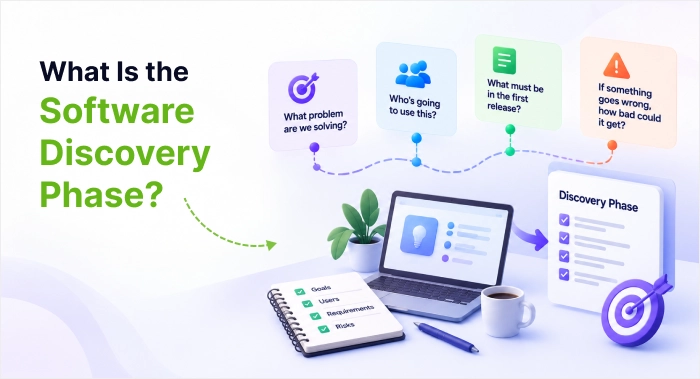
The software discovery phase is the planning work that happens before anyone writes code. It’s when the business side and the technical side sit down together and answer the questions that tend to get skipped in the rush to start. What problem are we solving? Who’s going to use this, and what does a normal day look like for them? What must be in the first release? And if something goes wrong, how bad could it get?
It does produce documents, but the documents aren’t the goal. The goal is to swap assumptions for decisions. A strong software discovery phase means everyone is on the same page about what is being built, what is being left out and why.
You will leave knowing your business goals and how to measure them. You’ll know who your users are, what goes into version one, whether the technology can do what you’re asking it to do, which risks need watching, and what a realistic timeline and budget look like.
Discovery Phase in Software Development vs. Product Discovery Process
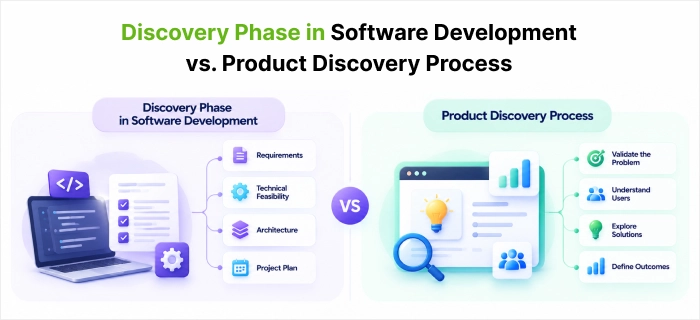
People use these two terms interchangeably, but they’re not quite the same thing.
The discovery phase in software development is a defined stage. It starts, it finishes, and its hands over the scope, requirements, and estimates the build relies on.
The product discovery process is closer to a habit. Good product teams keep talking to users, testing for ideas, and changing priorities long after the launch. You need both. The software discovery phase gives the project a solid start, and the product discovery process keeps it heading in the right direction over time.
Why Is the Project Discovery Phase Important?
On paper, skipping the project discovery phase looks like a shortcut. It just pushes the difficult conversations further down the road, where they cost much more.
The research backs this up. The Standish Group’s CHAOS studies have repeatedly tied project problems to incomplete requirements and limited user involvement. PMI has linked weak requirements management to bigger budget and schedule risks. McKinsey has noted that large IT programs often overrun because complexity was underestimated and people weren’t aligned at the start. A proper software discovery phase deals with those exact problems before serious money is spent.
• Fewer Surprises at the End
Discovery drags the awkward topics into the open early. Maybe it’s an API nobody has tested, customer data that’s messier than anyone admits, or a compliance rule only the legal team knows about. Raising it during the software discovery phase costs a meeting. Running into it in sprint six can cost weeks.
• Estimates You Can Justify
A quote built on a short brief is a hopeful guess. A quote built on agreed scope, mapped workflows, and an architecture engineer have reviewed is something you can take to your finance team without crossing your fingers. That’s one of the most practical things the software discovery phase gives you. As a bonus, you get a specification several vendors can price, so comparing proposals becomes much fairer.
• Shared Understanding Among Teams
Business leaders talk about outcomes. Engineers talk about systems. Left alone, the two groups can use the very same words and mean different things. Discovery gets them in the same room early, when a disagreement is still a quick chat rather than a change request with a price tag.
• A Sharp Product Idea
Plenty of strong ideas start out a bit vague, and that’s perfectly normal. When the software discovery phase includes real user and competitor research, the vague parts come into focus. You find out where competitors fall short and which needs nobody is meeting, and that shapes what goes into your first release.
Better Choices About What to Build First
Every product has more ideas than budget. Discovery allows you separate out the features people really need from the features with less weightage. The first release stays on track, your money stretches further, you get to market quicker.
During the software discovery phase, teams evaluate feature ideas against actual user needs, business goals, development costs, technical limitations, and potential risks. User interviews, current product data, and workflow analysis help to establish which problems need attention first.
Based on these findings, teams can prioritise required features for the minimum viable product (MVP) and defer less critical functionality to next releases. This approach helps teams focus their initial development efforts on the features expect to deliver value, avoid unnecessary work, and allocate their available budget more effectively.
Why It Matters Even More Today?
AI coding tools and low-code platforms have made development faster than it’s ever been. That’s great, but there’s a catch. A quick team working from fuzzy requirements just reaches the wrong product sooner. As building speeds up, the software discovery phase becomes more important, not less. Discovery helps teams to set up what actually needs to be built before committing remarkable time and resources to development.
This includes understanding users’ needs, assessing current workflows, validating initial assumptions, and finding business and technical constraints. Teams need to investigate dependencies on current applications, databases, APIs, and third-party services to understand how a planned solution will fit into the current technology ecosystem.
Without this groundwork, developers may deliver insufficient features not addressing the underlying problem, overlook integration bottlenecks, or create functionality duplicating a present solution.
A structured discovery process helping teams examine whether building new software is the right approach, define measurable results, and identify risks before going into development. The goal to make sure the team is solving the right problem with a viable solution rather than delaying the coding part.
When Do You Need a Software Discovery Phase?
Not every project needs a full software discovery phase. It’s worth it when there’s enough uncertainty that diving straight into development would be a gamble.
The biggest red flag is an idea nobody has tested. If three people describe the product three different ways, development will keep circling until someone settles the question. Risky features are another clue. Real-time processing, complex business rules, heavy integrations, and strict performance targets all deserve a careful look before anyone commits.
Requirements that keep changing point the same way. If priorities shift every couple of weeks, discovery brings those disagreements out before they turn into rework. A tight budget is another good reason, because guessing gets expensive when every dollar or rupee is already allocated. And if you’re replacing a legacy system, discovery is close to essential. Older systems tend to be full of rules nobody ever documented.
On the other hand, if you already have documented requirements, approved designs, and a settled strategy, you may not need the full process. A short scoping session to close the remaining gaps can be enough.
Types of Discovery
How deep your software discovery phase goes should depend on how much is still unknown.
Most new products need standard discovery, which covers goals, users, scope, prototypes, and estimates for the first release. Big platforms, or systems expected to run for years, benefit from extended discovery, which looks further ahead at scaling, data structure, and decisions that will be hard to reverse. When the business case is clear, but the technology isn’t, technical discovery fits better. Engineers test architecture, performance, and integrations with small proofs of concept before anyone commits to an approach.
How Does the Software Discovery Phase Work?
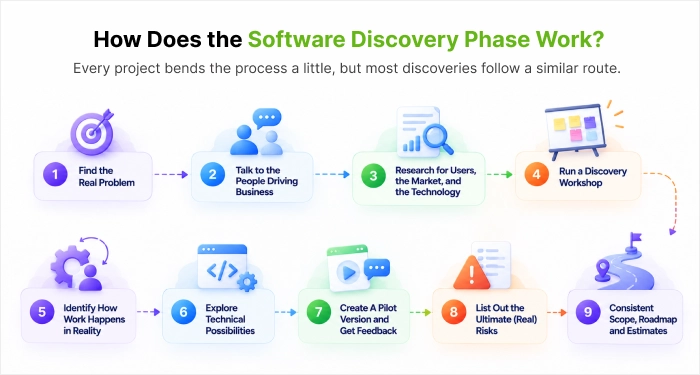
The software discovery phase starts with defining the business problem and understanding user needs. Teams research for user expectations, assess current available systems, collect requirements, and identify technical constraints, risks, and budget limits.
They then assess possible solutions, prioritise features, and define the initial project scope. When required, prototypes or proof-of-concept tests help to validate assumptions before development starts. The outcome is a clear understanding of what to build, why it is important, and how to proceed.
1. Find the Real Problem
Instead of starting with a list of features, we always begin with the problem. Before you ask a few follow-up questions, “We need a mobile app for our field team” seems like a simple brief. The real issue often turns out to be something like “our technicians lose two hours a day retyping job notes, and we want that time back.” Once the problem is that specific, every other decision in the software discovery phase gets easier.
2. Talk to the People Driving Business
Next, we sit down with executives, product owners, department heads, and the domain experts who know how things really work. We check out about goals, users, ongoing systems, competitors, and any research done already. These conversations always reveal something that never made it into the details, like a hidden dependency, an untold priority, or a team beyond imagination to add.
3. Research for Users, the Market, and the Technology
With that input, the team looks closely at the target audience, the competition, industry standards, and the platforms that might fit. The aim is to tell the users you actually have apart from the ones everyone imagines. A product designed for everyone tends to end up working for no one.
4. Run a Discovery Workshop
The discovery workshop is where alignment really happens. Stakeholders and the delivery team work through goals, user flows, priorities, and open questions together. Conflicting assumptions come out, key terms get defined, and the people who own the scope agree to it in the room.
Two sessions work well for most projects. An early discovery workshop sets goals and requirements, and a closing one reviews what we’ve learned, walks through the proposed solution, and confirms next steps.
5. Identify How Work Happens in Reality
Then we map current workflows, including the manual steps, approvals, exceptions, and points where systems exchange data. A booking tool sounds simple until you write the rules for cancellation, the differences in regions and the checks for compliance. Getting all of this down on paper early keeps the plan.
6. Explore Technical Possibilities
Architects and senior engineers evaluate existing systems and data quality, security and compliance needs, and product scalability needs. They create a small technical prototype to discover when there is uncertainty, rather than assume.
7. Create A Pilot Version and Get Feedback
Some ideas make sense once you can see them. Wireframes and clickable prototypes give stakeholders, and future users certainly concrete details to react to. A short feedback session can get a missing step or a confusing screen that might otherwise appear after launch.
8. List Out the Ultimate (Real) Risks
One of the most useful things that a software discovery phase produces is a frank list of risks. Tricky integrations, third-party dependencies, overstretched internal teams, resistance to change and tight deadlines, each one gets a plan.
9. Consistent Scope, Roadmap and Estimates
The team agrees on what is in the first release, what is pushed to later, and what is out. From there we build a phased roadmap of milestones, timeline ranges and budget estimates based on real decisions, not first impressions.
Who Will be inside the Team?
Keep the group small. The best software discovery teams are composed of people who can answer questions right away.
In terms of stakeholders, these are the people who understand the business processes, have the authority to make final decisions. As for the deliverables side, there are several common roles here. First, it is a business analyst who understands the needs and converts them into requirements, identifying contradictions.
Then, there is a project manager who facilitates meetings, tracks the decisions made. A UX/UI designer is also involved who develops mock-ups so that ideas are visualized. A solution architect or tech lead who challenges the idea and looks at its technical feasibility, and a QA specialist who starts looking at edge cases before any code is written are also involved in this stage.
Software Discovery Phase Deliverables
By the end of the project discovery phase, your team should know precisely what they have to build, why they must build it, and how they have to build the product. In this stage, you define the requirements that will guide the development teams during the building process. The actual outcome of the discovery phase is creating a solid foundation for the project based on the discussions, needs, and ideas of all stakeholders.
There are several deliverables that can be defined at the end of the project discovery phase:
- A business requirements document (BRD) that describes the nature of the proposed business, its initial business goals and objectives, expected results, and success criteria.
- Functional and non-functional requirements that specify the functions the application should perform and the quality standards that should be considered to achieve project goals.
- User personas and user journeys that help to visualize and understand the needs of the target audience, define their problems, and put them at the core of the development process.
- Market and competitor analysis that identifies what products are available on the market, what users are willing to pay, and how competitors’ offerings can be used to position the application.
- Wireframes or prototypes that allow the development team to see the software’s logic and interface and present their assumptions for the approval of the stakeholders.
- Technical feasibility document that focuses on the technical layers of the project, including technology stack, system architecture, integrations, processes, components, and other aspects.
- Risk register that compiles possible risks that might impact the project timeline, budget, and scope, along with mitigation measures that can be implemented to eliminate or minimize risk’s negative consequences.
- Prioritized product scope that includes what features should be developed at launch and what functionalities can be deferred to future releases.
- Roadmap, timeline, and budget estimate that set realistic expectations for all stakeholders and provide a general idea of the project’s scope.
The actual value of the project discovery phase lies in how well the project team can be set up for development. If the requirements can be presented clearly and simply explained to developers, the discovery phase has done its job.
Developers should not ask questions about the requirements because the document will contain all the information needed to proceed to the development stage.
How Long Does a Software Discovery Phase Take and How Much Does It Cost?
There are no precise numbers since everything depends on how many questions we have opened in the project. The complexity of the software product, its integrations, compliance requirements, and much more should also be considered.
Conventional Timelines
For small projects with a limited scope, it takes a discovery team about a week or two. A product of medium complexity and several user personas require about 2-4 weeks on average. More critical software with dozens of roles and multiple external APIs or services on board may take up to 6 weeks or more, depending on the technical depth of the audit and UX design deliverables.
Typical Costs
The cost estimates provided by software development companies vary significantly at the stage. On average, a discovery phase costs between $5,000 and $15,000 on a CDD basis. Technical audits, UX/UI design, and specification development fall under the highest layer, which determines the top range of the discovery budget.
In most cases, a software discovery phase takes up a small part of the overall build budget, often less than 10%. Compared with the rework it helps you avoid; that’s a sensible investment.
Mistakes We See Frequently
The most common mistake is treating the software discovery phase as a paperwork exercise. The value lies in the decisions, not the page count. A close second is leaving out the people who make decisions. If key stakeholders skip the workshops, whatever agreement you reach probably won’t last.
Teams also get caught out when they skip the technical review, because a plan engineer haven’t checked can fall apart as soon as it meets a real system. Some swing too far the other way and try to document every edge case. The discovery phase in software development should settle the big unknowns, not every small detail. And sometimes a team learns something important during discovery and then ignores it. If the research says a feature isn’t worth building, it’s okay to let it go.
Conclusion
A well-run software discovery phase is the difference between building on hope and building on decisions. If you remember a few things from this guide, software discovery changes a loose idea into an agreed scope, clear requirements, and a workable roadmap. It brings risks and disagreements to the ground while they are still relatively inexpensive to address.
It also helps teams develop planning estimates based on their understanding of the requirements and constraints. Discovery usually takes one to six weeks, depending on the project’s complexity and scope, and accounts for a small share of the overall development effort. With rapidly working development tools making it easy to build software quickly, discovery becomes more valued, not less, by helping teams focus on solving the right problem before development begins.
FAQs
What is the discovery phase?
The software discovery phase comes right at the beginning of the road to final delivery. Here, your product team gets to thoroughly evaluate the business goals and objectives of the intended product, its audience and user base, required features and functions, technical specifications, and any obstacles or complications that need special attention.
After collecting and structuring the information retrieved, it gets converted to the prioritization, requirements, cost estimation, and overall roadmap for the development team to follow.
What is the typical length of time for the discovery phase?
Speaking of time, there is no concrete or official estimate for how long this stage can take. It all depends on the size and complexity of the project, but roughly, one or two weeks for a small project with well-defined requirements, 2–4 weeks for medium-complexity apps, and 6+ weeks for large-scale systems with lots of integrated technologies are average per-project figures.
How much does discovery cost?
Discovery’s cost also depends on the specific discoveries made. As a reference point, many in the industry use the $5,000 to $15,000 rule of thumb. The actual cost, however, depends on hours devoted to research, UX/UI prototyping and walkthroughs, technical evaluations, integration assessments, documentation, and technical requirements specifications, as well as the depth of discovery necessary for a given project.
Any team of specialists who might be involved in research, design, or development will add to the final cost depending on the number of hours they put in.
What are the deliverables of the project discovery phase?
Any discovery phase involves a set of documents and supporting materials produced because of discussion and evaluation. This stage has various deliverables that may change depending on a project’s peculiarities: business and technical requirements, UX personas and journeys, product wireframes or mock-up’s, technical feasibility analysis, risk analysis and management plan, prioritization matrix, development roadmap, timelines and budget estimate, and others.
What problems can arise if I do not have a software discovery phase?
Your project will miss clarity before actual development without the discovery phase, inevitably creating setbacks, misunderstandings. Some features will receive undeserved emphasis while others will be completely overlooked. Project complexity and technical debt will grow out of control if unaccounted technical obstacles emerge, especially when it comes to third-party solutions and systems integration.
These issues and many others can be prevented by having a formal discovery session early in the process.
Do I always need a discovery before developing software?
No, not every software project requires the same amount of preparation. If there is very little ambiguity about a product’s requirements, design, technology, and general scope, there is little need for a lengthy discovery phase.
Software discovery is really required for complex developments, products with undefined audiences and objectives, large-scale legacy systems replacements, and overall rare opportunities when business needs are not fully aligned with technical possibilities.
What is a discovery workshop?
A discovery workshop is a brainstorming session where the development team, stakeholders, and often end-users meet to discuss the problems to be solved by the software, its users, business domain, functions, features, and technical requirements. It puts everyone on the same page regarding the scope and direction of the future product and allows finding out the problems to tackle during discovery.


 Shaili Gupta

 Ajay Wadne